




Quick Answer
The Taurus Brace-Ready TX22 is a new .22 LR pistol that expands the popular TX22 platform around an entirely new rear-accessory configuration. Announced on October 15, 2026, the pistol is available either with a factory-installed Strike Industries FSA Lite folding stabilizing brace or as a brace-ready model with the rear accessory interface left open for the owner's compatible setup.
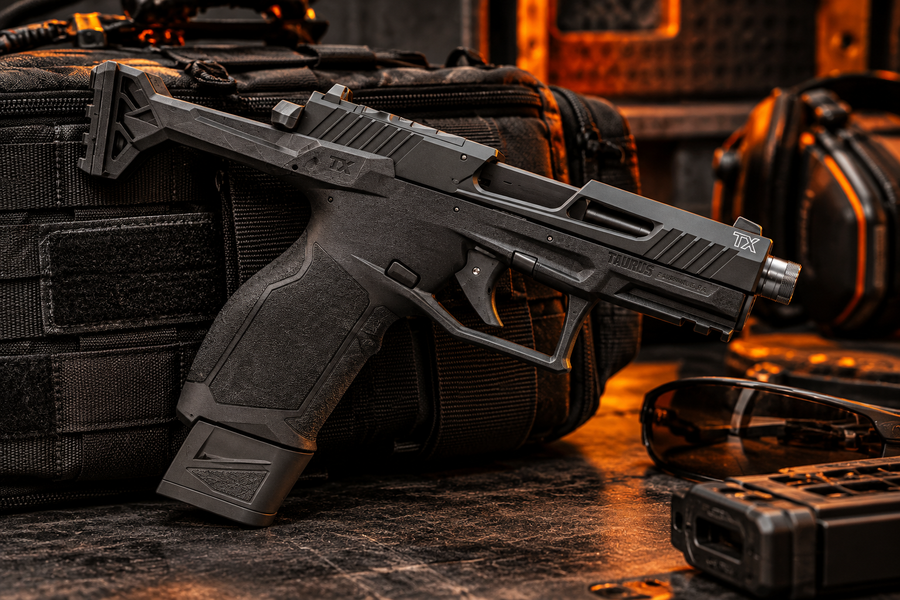
The defining feature is not simply the brace itself. Taurus redesigned the frame with an M1913 Picatinny interface integrated into the rear extension, creating a factory mounting point rather than relying on an aftermarket chassis wrapped around a conventional TX22. The new model also incorporates an ambidextrous rear charging handle that gives the shooter another way to manipulate the slide.
Forward of that new rear section, many familiar TX22 features remain. The pistol uses a 4.6-inch barrel, TORO optics-ready slide cut for RMSc-pattern sights, high-capacity TX22 magazines, adjustable rear sight, white-dot front sight, and a threaded muzzle on standard unrestricted configurations.
The standard package includes one 22-round magazine and one 16-round magazine. State-compliant versions are also part of the launch, including 10-round configurations and certain models without the threaded barrel.
Taurus currently lists the brace-ready configuration around $416.99 MSRP and the factory-braced version around $507.99. The unbraced model weighs approximately 17.3 ounces, while installing the FSA Lite increases published weight to approximately 24.9 ounces.
That makes the purchasing question fairly simple. A conventional TX22 remains the more straightforward choice for someone who primarily wants an affordable rimfire handgun. The Brace-Ready version makes considerably more sense for someone who specifically wants the integrated rear rail, folding-brace option, rear charging handle, optics capability, and threaded-barrel flexibility in one factory configuration.
It may be the most configurable TX22 Taurus has offered yet. Whether that makes it the best TX22 depends almost entirely on how much the owner values those additional configuration options.
Key Takeaways
- Taurus announced the Brace-Ready TX22 on October 15, 2026.
- The platform uses a newly configured frame with an integral rear M1913 Picatinny interface rather than simply adding a brace to a conventional TX22 frame.
- Buyers can choose a brace-ready configuration or a factory model equipped with the Strike Industries FSA Lite folding stabilizing brace.
- The pistol retains a 4.6-inch barrel, TORO RMSc-pattern optics cut, adjustable rear sight, and familiar TX22 magazine system.
- Standard unrestricted models ship with one 22-round and one 16-round magazine, while state-compliant 10-round configurations are available.
- The brace-ready model weighs approximately 17.3 ounces, while the factory-braced configuration is about 24.9 ounces.
- Current launch pricing is approximately $416.99 without the brace and $507.99 with the FSA Lite installed.
- The new model offers greater configuration flexibility, but conventional TX22 pistols remain simpler and less specialized for buyers who do not need a rear accessory interface.
What Is the Taurus Brace-Ready TX22?
The Brace-Ready TX22 is the newest branch of Taurus's expanding TX22 rimfire family. The original TX22 arrived in 2019 and quickly distinguished itself from many traditional .22 LR target pistols by using the ergonomics and controls of a contemporary polymer-framed defensive handgun.
Taurus has since expanded the family into compact, competition, optics-ready, threaded-barrel, and updated Gen 2 configurations. The Brace-Ready model takes another step by changing the rear of the firearm rather than focusing primarily on the slide, barrel, or magazine.
The new frame extends behind the slide and incorporates an M1913 Picatinny mounting surface. That gives the pistol a factory-designed interface for compatible rear accessories, including the Strike Industries FSA Lite used on Taurus's complete braced package.
This is a more significant change than attaching an aftermarket adapter to a conventional pistol. The frame itself was developed around the interface, giving Taurus a cleaner and more integrated solution.
The pistol also receives an ambidextrous charging handle at the rear of the slide. That feature makes slide manipulation possible from either side without relying exclusively on grasping the slide serrations.
The result is still recognizably a TX22, but it occupies a different role within the lineup.
Taurus Brace-Ready TX22 Specifications
| Specification | Brace-Ready TX22 | TX22 With FSA Lite |
|---|---|---|
| Caliber | .22 LR | .22 LR |
| Action | Semiautomatic, single-action striker-fired | Semiautomatic, single-action striker-fired |
| Operating System | Blowback | Blowback |
| Barrel Length | 4.6 inches | 4.6 inches |
| Barrel Thread | 1/2×28 on standard threaded SKU | 1/2×28 on standard threaded SKU |
| Slide | Hard-anodized aluminum TORO | Hard-anodized aluminum TORO |
| Optic Footprint | RMSc pattern | RMSc pattern |
| Rear Interface | Integral M1913 Picatinny | Integral M1913 Picatinny |
| Rear Charging Handle | Ambidextrous | Ambidextrous |
| Brace | Not included | Strike Industries FSA Lite |
| Standard Magazines | One 22-round, one 16-round | One 22-round, one 16-round |
| Approx. Weight | 17.3 oz. | 24.9 oz. |
| Length With Brace Folded | Not applicable | Approx. 10 inches |
| Length With Brace Extended | Not applicable | Approx. 19.5 inches |
| Published MSRP | Approx. $416.99 | Approx. $507.99 |
These specifications show how much the folding brace changes the physical character of the platform. The pistol itself remains extremely light, but adding the FSA Lite increases weight by roughly 7.6 ounces.
The extended overall length also reaches approximately 19.5 inches, which places the complete braced setup in a very different handling category from a conventional holster-oriented rimfire handgun.
Folded, however, the system contracts to approximately 10 inches, preserving much of the compact-storage appeal that motivates the configuration in the first place.
The New Frame Is the Most Important Change
The brace tends to dominate photographs of the new TX22, but the redesigned frame is arguably the more important development.
Earlier TX22 pistols were conventional handguns with no factory rear mounting interface. Owners interested in chassis systems, rear stabilizers, or similar accessories generally needed an aftermarket structure that attached around or replaced portions of the original configuration.
The Brace-Ready TX22 integrates the interface into the firearm itself. An M1913 Picatinny rail is molded into the rear frame extension, giving the owner a standardized mounting surface.
That approach is cleaner because it avoids requiring the rear accessory to depend on a separate external chassis merely to create an attachment point.
It also means the Brace-Ready TX22 should not be treated as mechanically identical to every previous TX22 frame. The barrel, slide system, controls, and magazines remain familiar, but the polymer structure itself has changed.
The Rear Picatinny Interface Creates More Than One Option
Taurus naturally highlights the Strike Industries FSA Lite because that is the accessory fitted to the factory-braced model. The underlying M1913 interface is broader than one proprietary mounting system, however.
The practical advantage of Picatinny is that it provides a known mechanical interface rather than limiting the firearm to an accessory molded permanently into the frame.
That does not mean every Picatinny-mounted rear accessory is automatically appropriate or legally suitable. Size, recoil rating, attachment requirements, and firearm classification all need to be considered.
The useful point is that Taurus has built flexibility into the frame rather than locking buyers into only one possible rear component.
The Ambidextrous Charging Handle Is Easy to Overlook
The new rear charging handle may end up being one of the more practical features of the platform. Located behind the slide and accessible from either side, it gives the shooter another way to retract the action.
That can be particularly useful once a rear accessory changes how naturally the hand reaches the slide. A folding brace or other structure behind the firearm may make some conventional manipulation techniques less convenient.
The charging handle also fits the broader design philosophy of the new TX22. Taurus is not merely attaching equipment to its existing pistol. It is adapting the user interface around the new configuration.
The Strike Industries FSA Lite

The factory-braced model uses the Strike Industries FSA Lite, a lightweight single-side-folding stabilizing system developed around low-recoil platforms. Its design makes particular sense on a .22 LR firearm because adding a heavy metallic rear assembly would dramatically change the balance of an otherwise lightweight pistol.
Strike Industries uses reinforced polymer construction and an M1913-compatible mounting system. The FSA Lite folds to one side, allowing the complete TX22 package to become substantially shorter for transport and storage.
Taurus positions the brace as providing another support point and improving stability and control. How valuable that is will depend heavily on the shooter and intended use.
A .22 LR pistol already produces relatively mild recoil. The larger advantage may therefore be increased stability during aiming rather than mitigation of strong rearward recoil.
Added Stability Comes With Added Weight
The brace changes the pistol from approximately 17.3 ounces to roughly 24.9 ounces, an increase of about 44 percent relative to the unbraced firearm.
In absolute terms, 24.9 ounces is still not especially heavy. Relative to the original pistol, however, the difference is substantial enough to affect balance and handling.
Some of that added mass is behind the shooter's hand, which can alter the way the firearm points compared with a conventional TX22.
Whether that feels better depends on the shooter. Someone seeking a highly stable rimfire setup may appreciate the changed balance, while someone attracted to the TX22 primarily because it feels light and pistol-like may prefer the unbraced version.
Folded vs. Extended Dimensions
The FSA Lite gives the new TX22 two dramatically different physical profiles. Folded, the complete firearm measures approximately 10 inches. Extended, overall length increases to approximately 19.5 inches.
That is one of the clearest examples of the tradeoff involved. The extended configuration creates a much larger shooting platform, while the folded position preserves a relatively compact package for storage and transport.
Buyers should not compare the brace-ready and braced versions solely according to the pistol's basic barrel length. The rear system changes the practical dimensions much more than the 4.6-inch barrel specification suggests.
The TORO Slide Carries Over a Good Existing TX22 Feature
The Brace-Ready TX22 uses Taurus's TORO optics-ready slide. TORO, or Taurus Optic Ready Option, is already familiar across the company's current handgun catalog and is not exclusive to this model.
The new TX22 uses an RMSc-pattern optic interface intended for compact reflex sights. That gives buyers access to a broad class of small red dots without needing an aftermarket slide or separate optics chassis.
This is useful, but it should not be mistaken for the reason the Brace-Ready model exists. Taurus already offers TX22 configurations capable of mounting an optic.
The new model's distinction is combining that established optics capability with the redesigned rear-interface frame.
RMSc Pattern Does Not Mean Every Small Red Dot Fits Automatically
Optic-footprint descriptions can become misleading when treated as universal guarantees. An RMSc-pattern slide provides a known basic mounting architecture, but individual sights may use different screw lengths, recoil features, body dimensions, or mounting instructions.
Buyers should verify their exact optic against Taurus and optic-manufacturer specifications rather than selecting solely because the product page includes the letters RMSc.
The same principle applies to sight height. The TX22 retains conventional iron sights, but co-witness relationships can vary according to the optic body and mounting height.
The 4.6-Inch Barrel Remains a Familiar TX22 Feature
The new model retains the 4.6-inch barrel associated with current full-size TX22 configurations. Standard unrestricted versions use 1/2×28 muzzle threading.
That is one of the most common thread standards in the rimfire suppressor market and makes the pistol compatible with a broad range of appropriately rated direct-thread devices.
Taurus specifically promotes the new TX22 alongside its recently introduced TTX22 titanium suppressor, which uses a 1/2×28 direct-thread mount.
The pairing is logical, but the Brace-Ready TX22 is not limited to that suppressor. Owners need to verify the exact suppressor's caliber rating, thread interface, barrel requirements, and manufacturer instructions before use.
The TTX22 Pairing Shows Where Taurus Is Taking the Platform

Taurus's launch material explicitly encourages buyers to consider combining the Brace-Ready TX22 with the company's TTX22 titanium suppressor. That recommendation provides a useful clue about the intended direction of the product.
The company is increasingly treating the TX22 not simply as an inexpensive rimfire handgun but as a modular rimfire host around which optics, higher-capacity magazines, rear accessories, and suppressors can be combined.
The Brace-Ready frame therefore makes more sense when viewed as part of that larger ecosystem.
A buyer who only wants a lightweight plinking pistol may not benefit from any of those additions. Someone who enjoys configuring rimfire platforms may see considerably more potential.
Suppression Does Not Depend on the Brace
It is important to separate the threaded-barrel feature from the brace-ready feature. Taurus already offers threaded TX22 configurations, and a stabilizing brace is not necessary to use a properly compatible rimfire suppressor.
The new model simply brings both capabilities together in one package.
That distinction matters when comparing prices. Someone whose only goal is to own a suppressor-ready TX22 does not automatically need the Brace-Ready version.
The rear rail should be part of the purchasing decision, otherwise the buyer may be paying more for a feature that remains unused.
The Magazine Package Remains Strong
Standard unrestricted versions ship with two different magazine capacities: one 22-round extended magazine and one 16-round magazine.
The 22-round magazine maximizes capacity, while the 16-rounder produces a shorter overall profile. This gives the buyer two ways to configure the pistol immediately without buying another magazine.
The capacity is also one of the areas where the TX22 family has historically distinguished itself from more traditional rimfire semiautomatic pistols.
Rather than treating ten rounds as the default simply because the firearm is chambered in .22 LR, Taurus has designed the platform around higher-capacity polymer magazines more comparable in handling to centerfire defensive pistols.
State-Compliant Models Are More Than Lower-Capacity Magazines
Taurus is also offering state-compliant configurations, and buyers should pay attention to the exact SKU rather than assuming the only change is magazine capacity.
Current launch information shows 10-round versions of both the brace-ready and factory-braced models. Certain restricted configurations also use non-threaded barrels.
That means two visually similar TX22s may differ in magazine capacity, muzzle threading, and included brace depending on SKU.
Prospective buyers in restrictive jurisdictions should therefore verify every important feature rather than relying on the general family description.
The Brace-Ready Version May Be the More Flexible Purchase
Taurus's decision to sell the firearm without the FSA Lite may ultimately be as important as offering the complete braced model.
The $416.99 brace-ready configuration gives buyers the redesigned frame, rear Picatinny interface, charging handle, TORO slide, threaded barrel, and magazine package without requiring them to pay for a brace they may not use.
That saves roughly $91 compared with the $507.99 factory-braced version based on launch MSRP.
For someone who specifically wants the Strike Industries FSA Lite, the factory package offers convenience. For someone who wants the rear rail for another compatible future configuration or simply wants the option available, the less expensive brace-ready model may be more logical.
Brace-Ready vs. Factory-Braced TX22
| Consideration | Brace-Ready | Factory-Braced |
|---|---|---|
| Rear M1913 Interface | Yes | Yes |
| FSA Lite Included | No | Yes |
| Approx. Weight | 17.3 oz. | 24.9 oz. |
| Folded Length | Not applicable | Approx. 10 inches |
| Extended Length | Not applicable | Approx. 19.5 inches |
| Standard Magazine Package | 22-round + 16-round | 22-round + 16-round |
| TORO / RMSc | Yes | Yes |
| Threaded Barrel | Yes on standard unrestricted SKU | Yes on standard unrestricted SKU |
| Launch MSRP | Approx. $416.99 | Approx. $507.99 |
The decision is therefore less about firearm performance and more about whether the buyer wants the FSA Lite specifically. The two models share the core Brace-Ready architecture.
Brace-Ready TX22 vs. TX22 Gen 2

The TX22 Gen 2 remains the more conventional choice for general-purpose rimfire shooting. It retains the familiar handgun format without the extended rear frame or additional accessory interface.
For someone using the pistol primarily for recreational shooting, inexpensive practice, basic optic training, or suppressor use, that simpler format may already provide everything necessary.
The Brace-Ready model adds the integrated rear rail, rear charging handle, and ability to support the folding accessory system. Those are meaningful additions only when the owner expects to use them.
This is why the new model does not make the TX22 Gen 2 obsolete. It extends the family into another category rather than replacing its core recreational pistol.
Brace-Ready TX22 vs. TX22 Compact

The TX22 Compact answers almost the opposite question. Instead of making the platform more configurable and physically larger when fully equipped, the Compact prioritizes reduced handgun dimensions.
That makes it better suited to buyers who specifically want a smaller rimfire pistol rather than a platform around which additional rear accessories are built.
The two models share a family name but pursue different goals. Choosing between them should begin with intended size and handling rather than assuming newer automatically means better.
Brace-Ready TX22 vs. TX22 Competition

The TX22 Competition emphasizes target and competition use through its distinctive barrel-and-optics architecture. Its purpose is not compact storage or rear accessory mounting.
The Brace-Ready TX22 instead concentrates on configuration flexibility. Its TORO slide keeps the optic attached to the reciprocating slide in a more conventional pistol arrangement while the rear rail expands what can be attached behind the frame.
A shooter interested primarily in structured competition may still prefer the specialized Competition model. Someone interested in a configurable rimfire host may find the new version more appealing.
Where the New Model Fits in the TX22 Family
| TX22 Model | Primary Strength | Best General Fit |
|---|---|---|
| TX22 Gen 2 | Straightforward general-purpose rimfire pistol | Recreational shooting and training |
| TX22 Compact | Reduced handgun dimensions | Buyers prioritizing smaller size |
| TX22 Competition | Target-oriented optics and barrel configuration | Competition and precision-oriented range use |
| TX22 Brace-Ready | Integral rear M1913 interface and configuration flexibility | Modular rimfire setups |
The Brace-Ready model's place in the lineup becomes much clearer when viewed this way. It does not win by being universally better. It wins when the owner wants something none of the conventional TX22 configurations provides from the factory.
What the Brace Changes in Practical Use
The most obvious change is stability. Adding another support interface can make it easier to keep the firearm steady while aiming, particularly when using an optic.
That can make small targets more comfortable to engage and may reduce how much the sight moves during longer shooting strings.
The TX22's mild recoil means the benefit is less about controlling violent rearward movement and more about creating a steadier overall shooting platform.
The tradeoff is that the firearm no longer behaves physically like a conventional handgun. It becomes longer, heavier, and less suitable for ordinary pistol storage or holster use.
The Brace Does Not Make the TX22 More Powerful
The added rear equipment does not change the cartridge, barrel length, or underlying blowback operating system. It remains a .22 LR firearm with the same broad ballistic limitations as other TX22 pistols using a comparable barrel.
The brace may change how steadily the shooter can hold and aim the firearm, but it does not increase muzzle velocity or transform .22 LR into a different cartridge class.
This distinction is useful because highly accessorized rimfire firearms can look dramatically different while remaining ballistically identical to much simpler configurations.
Brace-Ready TX22 and Current Federal SBR Policy
The new Taurus arrives during an unusually complicated period for short-barreled-rifle regulation. On October 9, 2026, ATF issued nationwide guidance substantially changing how it currently enforces several provisions of the National Firearms Act for short-barreled rifles, short-barreled shotguns, suppressors, and certain other covered items.
Under that policy, ATF says it will not currently enforce specified NFA prior-approval, registration, possession, transfer, and related requirements for the covered $0-tax categories.
This is a major change. It should not be interpreted to mean that every brace-equipped pistol automatically becomes or should be treated as an SBR, nor does it mean firearm classification has ceased to matter.
The Taurus is sold as a brace-ready or braced pistol. Its legal treatment depends on the actual configuration and applicable law.
The NFA Has Not Simply Disappeared
ATF's current position is an enforcement policy following litigation and Department of Justice action. The underlying statutory framework has not been erased from federal law.
ATF specifically warns that legal circumstances can change and that federal law does not generally provide automatic grandfathering for an unregistered NFA firearm if enforcement resumes later.
This distinction matters to anyone contemplating a configuration that would independently meet the statutory definition of a short-barreled rifle.
State and Local Law Still Matters
ATF's federal enforcement guidance does not supersede state or local restrictions. Some jurisdictions independently restrict short-barreled rifles, while others tie lawful possession to federal NFA registration.
That can create a particularly unusual situation under the current policy. An item may fall within ATF's federal nonenforcement framework while state law continues to demand federal registration as a condition of lawful possession.
ATF continues accepting voluntary NFA applications partly because of these state-law complications.
The practical lesson for a Brace-Ready TX22 owner is straightforward: the legality of a particular rear configuration needs to be evaluated where the firearm is actually possessed, used, or transported.
Gun Control Act Requirements Remain
ATF also emphasizes that covered firearms remain subject to applicable Gun Control Act requirements. Licensed dealer transfers still involve Form 4473, background checks, recordkeeping, prohibited-person rules, and other federal requirements.
The October guidance therefore should not be described as complete federal deregulation.
Interstate Transportation Still Has Separate Requirements
ATF continues to require prior approval before an SBR or SBS is transported interstate under the applicable Gun Control Act provision. Owners can request that approval using ATF Form 20.
This is another reason broad statements such as “SBR paperwork no longer exists” can be misleading. Certain NFA requirements are currently subject to nonenforcement, while separate federal requirements remain active.
The Brace Itself Does Not Settle Classification
The presence or absence of a stabilizing brace should not be treated as the only factor that determines how every firearm is legally classified. Classification depends on the actual firearm, configuration, statutory definitions, and current legal guidance.
For the Taurus, the cleanest approach is to evaluate the exact factory SKU being purchased and verify applicable law before making later configuration changes.
That is especially important because the new rear M1913 rail makes alternative accessories mechanically possible even when those alternatives may have different legal implications.
Is the Brace-Ready TX22 Worth $416.99?
The brace-ready configuration occupies an interesting price point because it adds the redesigned frame, integral rear rail, charging handle, TORO slide, threaded barrel, and familiar TX22 magazine package without automatically including the more expensive folding stabilizer.
That makes it arguably the more flexible of the two launch choices. The buyer gets the new architecture and can decide later whether any compatible rear accessory is worth adding.
Someone who has no interest in the rear rail is paying extra for functionality they may never use. In that case, a conventional TX22 remains the more rational purchase.
The value therefore depends almost entirely on whether the integral M1913 interface is a feature rather than dead weight for the individual owner.
Is the Factory-Braced TX22 Worth $507.99?
The factory package adds roughly $91 to the brace-ready launch MSRP and includes the Strike Industries FSA Lite already fitted.
For someone who has already decided that the FSA Lite is the rear accessory they want, the package offers straightforward convenience and avoids separately sourcing the component.
It also delivers the firearm in the configuration Taurus selected and promoted as a complete system.
The weaker case is someone uncertain whether the brace will receive much use. Paying the additional money only to keep it folded or remove it most of the time undermines the logic of the factory package.
The Most Versatile TX22 Yet?

From a configuration standpoint, there is a strong argument that it is. No previous factory TX22 combines a rear M1913 interface, ambidextrous charging handle, RMSc optics cut, threaded barrel, high-capacity magazines, and an optional folding rear support system in the same package.
Versatility, however, is not the same thing as universal usefulness.
Every additional configuration option adds something the owner needs to evaluate. The brace adds weight and length. The rear rail introduces compatibility and legal questions. The optics cut matters only if an optic is installed. The threaded barrel matters most when the owner actually uses compatible muzzle equipment.
A conventional TX22 does fewer things, but it does those things in a simpler and less expensive package.
The Brace-Ready TX22 is therefore the most versatile when versatility itself is part of the buying objective.
What the New TX22 Still Needs to Prove
The underlying TX22 platform has years of commercial history, but the Brace-Ready configuration has only just entered the market.
The first new component worth watching is the rear frame extension. Owners will establish how well the molded M1913 interface tolerates repeated installation and removal of accessories and how consistently it remains dimensionally stable.
The charging handle also introduces a new manipulation component whose durability will become clearer with extended use.
The FSA Lite's folding mechanism deserves similar long-term evaluation. Strike Industries itself notes that dirt and sand can interfere with the folding hinge and that long-term use will produce normal wear in the locking mechanism.
None of those considerations indicates a known defect. They simply identify the parts of the new configuration that do not have the same ownership history as the basic TX22 action.
Who Should Consider the Brace-Ready TX22?
The strongest candidate is someone who already enjoys the TX22 platform but wants a rimfire firearm that can be configured more extensively than a normal handgun. The integral rear rail is the feature that distinguishes this model from the rest of the family.
It may also appeal to shooters building a suppressor-and-optic-equipped rimfire setup and wanting a factory frame that accommodates an additional rear support option.
The brace-ready model makes particular sense for buyers who want flexibility but have not committed to the FSA Lite specifically.
Who Should Probably Buy a Conventional TX22?
Someone primarily interested in inexpensive recreational shooting has a weaker reason to select the Brace-Ready model. The standard TX22 family already provides high-capacity magazines, familiar controls, good ergonomics, optics-ready options, and threaded-barrel configurations.
If the rear accessory rail is unlikely to be used, it adds little practical value.
The same applies to someone who prioritizes the lightest possible TX22 configuration. Adding the brace increases published weight considerably relative to the unbraced pistol.
Final Thoughts
The Taurus Brace-Ready TX22 is more than a conventional TX22 with a folding accessory attached to it. Taurus redesigned the rear of the frame around an integrated M1913 interface and added an ambidextrous charging handle, creating a genuinely different factory configuration within the TX22 family.
That new architecture sits alongside several proven TX22 features rather than replacing them. The 4.6-inch barrel, TORO RMSc optics cut, familiar controls, 22- and 16-round magazines, and standard rimfire operating system remain recognizable.
The Strike Industries FSA Lite then gives Taurus a complete factory-braced option for buyers who want additional support. It also changes the nature of the pistol substantially, increasing weight from approximately 17.3 to 24.9 ounces and extending overall length to roughly 19.5 inches when deployed.
The ability to fold the system back to approximately 10 inches restores much of the storage advantage, but the complete firearm is still fundamentally different from a conventional TX22 handgun.
The $416.99 brace-ready version may ultimately be the most interesting configuration because it gives the buyer the redesigned frame without forcing them to purchase the factory brace. The $507.99 package makes more sense when the FSA Lite is already the intended setup.
The current federal regulatory environment also makes the timing noteworthy. ATF is no longer enforcing several NFA requirements for covered SBRs under its October 2026 policy, but that does not make firearm classification irrelevant or override state and local restrictions.
Gun Control Act requirements remain, voluntary NFA registration remains available, and interstate transport of an SBR or SBS continues to involve separate federal approval requirements.
For buyers, that means the new TX22 should be evaluated first as a product and second according to the laws that apply to the exact configuration being considered.
As a product, the Brace-Ready TX22 clearly expands what Taurus's rimfire platform can do. It combines a factory rear accessory interface, optics mounting, threaded-barrel capability, high-capacity magazines, and optional folding support in one lightweight package.
That probably does make it the most versatile factory TX22 yet.
It does not automatically make it the best TX22 for everyone. A shooter who simply wants a lightweight .22 LR handgun may still be better served by one of the simpler models in the family.
For someone who wants the TX22 to function as a configurable rimfire platform rather than only a pistol, however, Taurus has created something genuinely different.
The most interesting aspect of the Taurus Brace-Ready TX22 isn't simply the addition of another accessory option. It's how the new configuration reflects the changing role of rimfire firearms. Shooters are increasingly looking beyond basic plinking pistols toward platforms that offer modern optics compatibility, configurable ergonomics, and greater versatility at the range. The Brace-Ready TX22 fits that movement while retaining the economical characteristics of .22 LR. It's another example of why rimfire trainers are more popular than ever, as manufacturers respond to demand for rimfire firearms that serve recreational and training purposes without requiring centerfire ammunition costs.

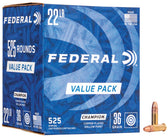
Federal .22 LR 36 Grain Copper Plated - Box of 525
$50.00
at Pro Armory
Prices accurate at time of writing
Frequently Asked Questions
When was the Taurus Brace-Ready TX22 announced?
Taurus announced the Brace-Ready TX22 on October 15, 2026. The company offers both a factory-braced model and a brace-ready version without the FSA Lite installed.
Is the Brace-Ready TX22 just a normal TX22 with an adapter?
No. Current launch information shows a newly configured polymer frame with an M1913 Picatinny mounting interface molded into the rear extension. The pistol also incorporates an ambidextrous charging handle at the rear of the slide.
What brace comes on the factory-braced TX22?
Taurus uses the Strike Industries FSA Lite folding stabilizing brace on the complete factory package.
How much does the Taurus Brace-Ready TX22 cost?
Current launch pricing places the brace-ready version at approximately $416.99 MSRP and the factory-braced model at approximately $507.99. Actual dealer pricing may vary.
How much does the new TX22 weigh?
The brace-ready model is approximately 17.3 ounces unloaded. The factory-braced configuration is approximately 24.9 ounces.
How long is the TX22 with the FSA Lite?
The complete braced pistol measures approximately 10 inches with the brace folded and 19.5 inches with it extended.
What barrel does the Brace-Ready TX22 use?
Standard unrestricted configurations use a 4.6-inch alloy-steel barrel threaded 1/2×28. Certain state-compliant versions use non-threaded barrels.
Is the Taurus Brace-Ready TX22 optics ready?
Yes. The pistol uses Taurus's TORO optics-ready slide with an RMSc-pattern mounting interface for compatible compact reflex sights.
What magazines come with it?
Standard configurations ship with one 22-round magazine and one 16-round magazine. State-compliant versions with 10-round magazines are also available.
Does the Brace-Ready TX22 work with a suppressor?
Standard threaded versions use a 1/2×28 barrel interface commonly used by rimfire suppressors. Taurus specifically promotes the pistol with its TTX22 titanium suppressor, but owners should verify compatibility with the exact suppressor and manufacturer requirements before use.
Do I need the factory-braced model to use a suppressor?
No. The suppressor attaches to the threaded muzzle, not the rear brace interface. A brace is not required simply because the owner wants to use a properly compatible rimfire suppressor.
Is the factory-braced TX22 considered an SBR?
Taurus markets the firearm as a pistol equipped with a stabilizing brace. Legal classification depends on the firearm's actual configuration and applicable federal, state, and local law. Buyers should verify current official guidance rather than assuming the presence of a brace alone resolves every classification question.
Did ATF remove all SBR requirements in October 2026?
No. ATF announced a nationwide nonenforcement policy covering several NFA making, transfer, registration, possession, and related provisions for covered $0-tax firearms. The underlying statutory framework remains relevant, state and local laws continue to apply, and Gun Control Act requirements remain in effect.
Can someone still voluntarily register an SBR?
Yes. ATF continues accepting voluntary NFA applications, which can be relevant in jurisdictions where state law requires federal registration.
Does Form 20 still apply to SBR interstate transportation?
Yes. ATF currently states that individuals must continue obtaining approval before transporting an SBR or SBS interstate under the applicable Gun Control Act requirement.
Which is better, the brace-ready or factory-braced TX22?
The brace-ready model makes more sense for buyers who want the rear M1913 interface but have not committed to the FSA Lite. The factory-braced version is the simpler choice for someone who already knows they want the Strike Industries brace.
Is this the most versatile TX22?
It has the strongest claim to that title from a configuration standpoint because it combines a rear M1913 interface, ambidextrous charging handle, TORO optics cut, threaded-barrel option, high-capacity magazines, and an optional folding rear support system. Whether those features make it the best TX22 depends on what the owner intends to use.
About the Author
The ProArmory editorial team includes experienced hunters, competitive shooters, military veterans, firearms instructors, and firearms industry professionals committed to producing accurate, practical, and research-based content. Our articles draw on manufacturer specifications, current industry information, regulatory guidance, and real-world shooting experience to help readers make informed decisions about firearms, ammunition, optics, suppressors, and related equipment.
Disclaimer
This article is intended for informational and educational purposes only and does not constitute legal advice. Product specifications, pricing, magazine configurations, classifications, and availability reflect information available as of October 2026 and may change.
ATF's October 2026 enforcement policy does not override state or local law and should not be interpreted as permanent elimination of all federal requirements applicable to short-barreled rifles or other firearms. Always verify current ATF guidance, applicable federal law, and the laws of the relevant state and locality before purchasing, possessing, modifying, transferring, or transporting a firearm.
Follow Taurus and accessory-manufacturer instructions, verify compatibility before installing optics, suppressors, braces, or other components, and use established firearm-safety practices at all times.


