




Quick Answer
The Springfield Armory Echelon Pro Comp is a factory-upgraded version of the company's modular, striker-fired 9mm platform. Officially announced on October 13, 2026, the new Pro family combines the Echelon's existing Central Operating Group and Variable Interface System with an integral compensator, LightForged Badlands grip texture, removable machined-steel magwell, stainless steel guide rod, upgraded iron sights, Springfield Grey Cerakote slide, and three extended magazines.
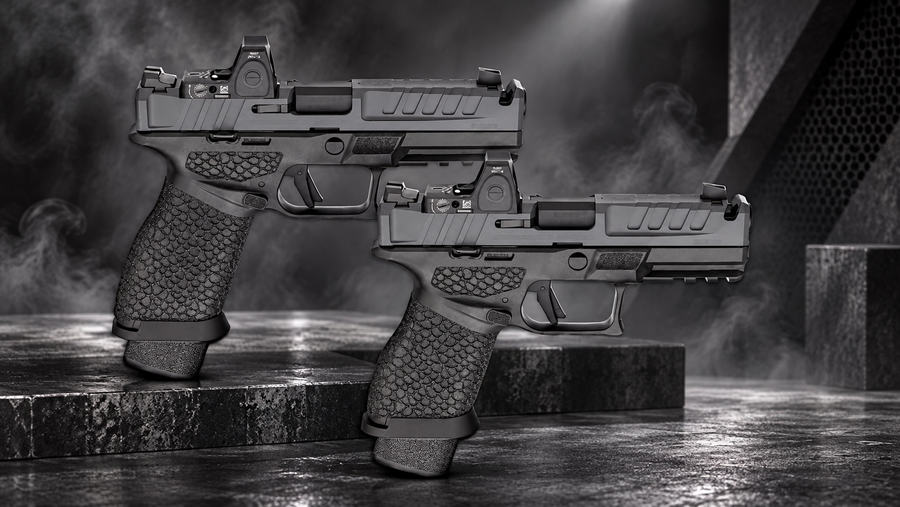
Springfield launched three Pro Comp configurations at the same $899 MSRP: the compact 4.0C, the hybrid 4.0FC, and the full-size 4.5F. The 4.0C uses a 4-inch barrel and smaller grip module with three 18-round magazines. The 4.0FC combines the same 4-inch slide length with a full-length grip and three 20-round magazines, while the 4.5F adds a 4.5-inch barrel and longer slide while retaining the full-size grip and 20-round capacity.
The important distinction is that the Pro Comp is not Springfield's first compensated Echelon. Integral compensation, the serialized Central Operating Group, and the Variable Interface System were already established within the Echelon family. The Pro designation instead represents a collection of factory enhancements built around that existing foundation.
That makes the $899 question fairly straightforward. For someone buying a first Echelon and already wanting a compensated model, more aggressive grip texture, steel magwell, upgraded sights, metal guide rod, and extra magazines, the Pro Comp creates a compelling all-in-one package.
For someone who already owns an Echelon Comp, the value proposition is less dramatic. The core pistol, compensator concept, modular chassis, and optics system are familiar, so the upgrade decision comes down primarily to whether the Badlands grip, magwell, guide rod, sight arrangement, additional magazine, and exterior treatment are worth changing pistols.
At $899, the Pro Comp is best understood as the most extensively equipped factory Echelon rather than an entirely new generation of the handgun.
Key Takeaways
- Springfield introduced the Echelon Pro Comp on October 13, 2026 in 4.0C, 4.0FC, and 4.5F configurations.
- All three models carry the same $899 MSRP and include an integral compensator, LightForged Badlands grip texture, Springfield Grey Cerakote slide, removable machined-steel magwell, stainless steel guide rod, and three extended magazines.
- The 4.0C ships with three 18-round magazines, while the 4.0FC and 4.5F include three 20-round magazines.
- The Pro uses the same serialized Central Operating Group and Variable Interface System found throughout the broader Echelon family.
- The Pro's iron-sight package uses a tritium/luminescent front sight with an orange ring and a black serrated rear rather than the Tactical Rack U-Dot arrangement found on several standard Echelon variants.
- The Pro makes the strongest value argument for new buyers who already want its complete equipment package. Existing compensated Echelon owners receive fewer fundamentally new capabilities.
What Is the Springfield Echelon Pro Comp?
The Echelon Pro Comp is the newest performance-oriented branch of Springfield Armory's Echelon pistol family. The original Echelon established the platform around a removable serialized internal chassis, fully ambidextrous controls, interchangeable grip modules, and an unusually flexible direct-mount optics system.
Springfield has expanded that architecture steadily rather than replacing it. Full-size, compact, compensated, hybrid, and lower-priced Alpha configurations now occupy different positions within the same broader ecosystem.
The Pro Comp is another step in that expansion. Springfield takes an already compensated Echelon and adds equipment that owners might otherwise consider purchasing separately or modifying after buying the pistol.
The slide receives a Springfield Grey Cerakote finish over its protective treatment. The grip module receives a more aggressive laser-created texture. A steel magwell, stainless guide rod, revised iron sights, and three extended magazines are added from the factory.
The result is not a fundamentally different handgun underneath. It is a more fully configured version of the Echelon platform.
Springfield Echelon Pro Comp Specifications
| Specification | 4.0C Pro Comp | 4.0FC Pro Comp | 4.5F Pro Comp |
|---|---|---|---|
| Caliber | 9mm | 9mm | 9mm |
| Action | Striker fired | Striker fired | Striker fired |
| Barrel | 4-inch ported hammer-forged steel | 4-inch ported hammer-forged steel | 4.5-inch ported hammer-forged steel |
| Barrel Finish | Melonite | Melonite | Melonite |
| Twist Rate | 1:10 | 1:10 | 1:10 |
| Overall Length | 7.4 inches | 7.4 inches | 8 inches |
| Published Weight | 23 oz. | 24 oz. | 25 oz. |
| Grip Module | Small / compact | Medium / full-length | Medium / full-length |
| Grip Width | 1.2 inches | 1.2 inches | 1.2 inches |
| Included Magazines | Three 18-round | Three 20-round | Three 20-round |
| Optics System | Variable Interface System | Variable Interface System | Variable Interface System |
| Compensator | Integral | Integral | Integral |
| Guide Rod | Captive stainless steel | Captive stainless steel | Captive stainless steel |
| Front Sight | Tritium / luminescent with orange ring | Tritium / luminescent with orange ring | Tritium / luminescent with orange ring |
| Rear Sight | Black serrated | Black serrated | Black serrated |
| Magwell | Removable machined steel | Removable machined steel | Removable machined steel |
| Slide Finish | Springfield Grey Cerakote over Melonite | Springfield Grey Cerakote over Melonite | Springfield Grey Cerakote over Melonite |
| MSRP | $899 | $899 | $899 |
The three-model strategy is more meaningful than it may appear because Springfield is not charging more for the larger pistol. Buyers can select the grip and slide combination that best suits them rather than treating the lineup as an ascending price ladder.
The 4.0C and 4.0FC share the same 4-inch barrel and 7.4-inch overall length, making grip size the major dimensional difference between them. The 4.5F adds half an inch of barrel and slide while retaining the taller grip configuration.
Three Sizes, One Price

Springfield's decision to price all three Pro Comp models at $899 makes the buyer's choice unusually clean. There is no financial incentive to choose the smaller gun and no surcharge for moving to the full-size version.
That shifts the decision toward fit and intended use. The buyer can ask whether they want the shorter grip, the full-length grip under a compact upper, or the complete full-size configuration without having price distort the answer.
It also reinforces the idea that Springfield views all three as equivalent members of one Pro family rather than positioning the 4.5F as a premium tier above the 4.0C.
Echelon Pro 4.0C: The Compact Model

The 4.0C Pro Comp is the smallest member of the lineup. It combines a 4-inch ported barrel with the smaller Echelon grip module, giving it the shortest grip architecture of the three Pro configurations.
Springfield lists the pistol at 23 ounces unloaded and 7.4 inches overall. It ships with three extended 18-round magazines.
Those extended magazines are worth keeping in context. The pistol itself uses the compact grip module, but an 18-round magazine extends beyond that grip and increases the effective height of the complete firearm.
Springfield makes the steel magwell removable, which also allows the owner to configure the pistol around compatible flush-fitting magazines. That gives the 4.0C more flexibility between its factory Pro configuration and a shorter-gripped setup.
For a buyer who wants the Pro features but still places the highest priority on grip concealability, the 4.0C is the logical starting point.
Echelon Pro 4.0FC: The Hybrid

The 4.0FC uses the same 4-inch barrel and 7.4-inch overall length as the compact model, but places that upper on a full-length grip module. Springfield had already introduced the basic 4.0FC architecture before the Pro series, so the crossover concept itself is not new.
What changes is the equipment surrounding it. The Pro version receives the compensated upper, Badlands texture, steel magwell, stainless guide rod, upgraded sights, Springfield Grey slide treatment, and three 20-round magazines.
At 24 ounces, the 4.0FC sits exactly between the smaller 4.0C and longer 4.5F in published weight.
The configuration will likely appeal to shooters who prefer a complete firing grip and 20-round capacity but do not see a reason to carry the longer 4.5-inch upper. It effectively gives them the full-size grip and compact-length slide in one package.
The tradeoff is straightforward: the full-length grip is less compact than the 4.0C. For concealed carry, grip height often matters at least as much as slide length.
Echelon Pro 4.5F: The Full-Size Configuration

The 4.5F Pro Comp is the largest of the three models. Its ported 4.5-inch barrel and corresponding slide bring overall length to eight inches, while published unloaded weight rises to 25 ounces.
The pistol uses the medium full-length grip module and ships with three 20-round extended magazines. Its grip width remains 1.2 inches, matching the other Pro models.
The longer upper gives the 4.5F the most traditional duty-pistol proportions of the family. It also provides the longest iron-sight radius when the optic is not being used.
That does not mean the extra half inch automatically creates better mechanical accuracy. Barrel fit, ammunition, trigger control, sights, and shooter consistency all play a role.
The strongest reason to choose the 4.5F is simply that some shooters prefer the balance and handling of a full-size pistol.
The Integral Compensator Is Important, but It Is Not New
The compensated slide receives much of the attention surrounding the Echelon Pro, but it is not a new Pro-exclusive technology. Springfield had already introduced integral-compensator versions of both its full-size and compact Echelon pistols.
The system uses a ported hammer-forged barrel and corresponding opening in the slide. Propellant gas is redirected upward as the pistol cycles, creating force intended to counter some muzzle rise.
The important phrase is some muzzle rise. Compensation does not remove recoil, and it does not transform a compact 9mm into a recoil-free platform.
It also does not inherently make the firearm more mechanically accurate. The principal benefit is control during firing, particularly how rapidly the muzzle returns toward the target during repeated shots.
Ported vs. Compensated: What Springfield Means
Springfield markets the system as an integral compensator because the gas-redirection feature is built into the barrel-and-slide assembly rather than attached to the muzzle as a separate threaded component.
Mechanically, the system relies on a barrel port and matching slide opening. That distinguishes it from an external compensator screwed or otherwise attached beyond the barrel muzzle.
The naming difference matters less than understanding what the system actually does. Gas exits upward through the integrated opening, producing a counteracting force intended to reduce muzzle rise.
The benefit should be evaluated according to shooting performance rather than terminology.
Compensation Comes With Tradeoffs
A ported system redirects hot propellant gases through an opening near the front of the slide. That can change blast and flash behavior compared with a similar nonported pistol.
Firing residue can also collect around the port and corresponding slide cut, creating another area that requires cleaning. Ammunition characteristics influence how pronounced those effects become.
None of this makes an integral compensator unsuitable for defensive or general-purpose use. It simply means compensation is not a free performance increase with no ownership consequences.
A buyer who does not value reduced muzzle rise may find a standard Echelon simpler. Someone who routinely shoots fast strings and clearly notices the benefit may see the system very differently.
Early Range Testing Suggests the Comp Works
Early independent testing of the 4.0FC Pro Comp supports the basic premise. One Guns.com evaluation put just over 500 rounds through a prelaunch loaner across four range sessions and described the pistol as flat shooting with rapid sight return.
The test included a mixture of 115-, 124-, and 147-grain factory ammunition, including both range and defensive loads. No firing malfunctions were reported, although the slide reportedly failed to lock open on an empty magazine a couple of times.
That is useful launch evidence because it goes beyond a few magazines fired at a media event. It is not a substitute for long-term testing across many production pistols.
Five hundred rounds can reveal immediate compatibility problems or obvious reliability issues. It cannot establish years of parts life, magazine durability, finish behavior, or production-wide consistency.
LightForged Badlands Texture Is One of the Truly New Pro Features

The LightForged grip treatment is one of the clearest features that actually distinguishes the Pro from previous Echelons. Springfield uses precision lasers to sculpt the polymer surface and create what it calls the Badlands pattern.
The resulting texture has a cracked-earth appearance and is substantially more aggressive than the standard Echelon grip treatment. Springfield's goal is to create traction closer to custom stippling while retaining repeatability from grip module to grip module.
That manufacturing approach has an obvious advantage over individually hand-stippled frames. The texture geometry and placement can be reproduced consistently during normal production.
Whether the shooter actually prefers it is another question.
Aggressive Grip Texture Is Not Universally Better
A more aggressive grip can improve traction when hands are wet, sweaty, gloved, or moving quickly during recoil. That can be valuable for training, competition, professional use, or anyone who finds the standard Echelon relatively mild.
The same texture may feel less comfortable against bare skin or clothing during concealed carry. It can also feel unnecessarily harsh to a shooter who already has no difficulty maintaining control of the standard grip.
This makes Badlands one of the Pro features most worth handling in person. Photographs show the pattern but cannot communicate its feel against the palm, fingers, or body during carry.
For some buyers, it may be the most meaningful upgrade on the pistol. For others, it may be the feature they care about least.
The Steel Magwell Adds a More Competition-Oriented Touch
Each Pro Comp comes with a flared magwell machined from steel. The wider opening is intended to guide magazines into the grip more easily during reloads.
That is a familiar idea from competition and performance-oriented pistols, where reducing the precision required to start a magazine into the grip can make reloads more forgiving.
The steel construction also places additional mass at the bottom of the pistol. Springfield does not need to exaggerate that effect for the magwell to be useful; its primary functional purpose remains providing a larger magazine funnel.
Importantly, the magwell is removable. That keeps the feature from permanently defining the pistol and allows compatible flush-fitting magazines to be used when a smaller external profile is preferred.
The Removable Magwell Matters Most on the 4.0C

The compact 4.0C is where removability becomes particularly useful. The pistol ships in its full Pro configuration with the steel magwell and extended 18-round magazines, which emphasizes capacity and reload speed.
An owner interested in reducing the grip footprint can remove the magwell and use compatible flush-fitting magazines. That does not turn the pistol into a different platform, but it gives the compact model more configuration flexibility than its factory photographs might suggest.
The 4.0FC and 4.5F already use the taller full-length grip, so the concealment benefit of removing the magwell is less dramatic.
The Stainless Steel Guide Rod Is a Genuine Upgrade, but Keep It in Perspective
The Pro Comp replaces the standard recoil-system configuration with a captive stainless steel guide rod. Springfield says the added forward mass and rigidity contribute to recoil management and reduced muzzle flip.
Those are manufacturer claims worth treating proportionally. The guide rod represents only a small portion of the total pistol mass, and the integral compensator, grip, ammunition, and shooter technique all play larger roles in the firing experience.
The presence of a metal guide rod also should not be interpreted as proof that a polymer or standard guide rod is inherently unreliable. Well-designed non-steel recoil components can provide excellent service life.
For buyers who already prefer metal recoil components, the Pro provides one from the factory. For everyone else, it is best viewed as one piece of the complete upgrade package rather than the reason to buy the pistol.
The Sight Package Is Different From the Standard Comp
The Pro uses a tritium front sight surrounded by an orange luminescent ring and pairs it with a plain black serrated rear sight. Springfield describes the combination as a front-focused arrangement.
This is a meaningful difference from several standard Echelon models, which use Springfield's Tactical Rack U-Dot rear. Buyers familiar with the existing Echelon should therefore not assume the Pro simply carries over the same irons.
The orange-ringed front provides a strong visual reference in daylight while the tritium insert retains a reference point in reduced light. The black rear keeps visual emphasis toward the front.
Whether that is preferable to the U-Dot system is subjective. Shooters who plan to use a red dot may care even less because the irons primarily become backup sights.
The Variable Interface System Remains One of the Echelon's Strongest Features
The Pro retains Springfield's Variable Interface System rather than replacing it with a new optics cut. That is a sensible decision because VIS is already one of the defining features of the Echelon platform.
The system uses movable self-locking pins to support direct mounting of numerous common optic footprints without inserting a conventional adapter plate between the optic and slide.
A direct mount can keep the optic lower and removes one additional plate-and-screw interface from the mounting stack. Springfield says the system supports a broad range of popular pistol optics.
Exact compatibility still needs to be confirmed for the specific optic. “Optics ready” should never be treated as universal compatibility with every sight on the market.
The Central Operating Group Is Still the Heart of the Pistol
The serialized Central Operating Group remains the legal and mechanical core of the Pro Comp. It is a removable stainless-steel chassis containing the central operating components.
Because the COG is serialized rather than the surrounding polymer grip module, owners can move it among compatible Echelon grip modules and slide assemblies.
That modularity is especially relevant to the Pro because the LightForged Badlands grip is only one possible external housing for the chassis. A buyer is not permanently locked into that exact grip geometry or texture simply because the pistol was purchased as a Pro.
This also reinforces why the Pro is better described as an Echelon configuration than an entirely separate pistol architecture.
The 4.0C and 4.0FC Are More Different Than Their Slides Suggest
Both 4-inch models are 7.4 inches long, use the same barrel length, and share the compensated architecture. Their practical difference is primarily below the slide.
The 4.0C uses the smaller grip module and ships with 18-round extended magazines. The 4.0FC uses a medium full-length grip and ships with 20-round magazines.
For shooters comparing them for carry, the full-size grip may matter more than the shared slide length. The portion of a pistol most likely to print through clothing is frequently the rear of the grip rather than the muzzle.
For shooters focused on range use or home defense, the 4.0FC's full firing grip and larger magazines may be preferable.
4.0FC vs. 4.5F Is Mostly About the Upper
The 4.0FC and 4.5F share the medium grip module and three 20-round magazines. The primary dimensional difference is the barrel and slide.
The 4.0FC remains 7.4 inches long with a 4-inch barrel, while the 4.5F reaches eight inches overall with a 4.5-inch barrel. Published weight increases by one ounce from 24 to 25 ounces.
That makes the 4.0FC attractive for someone who wants full-size grip capacity without the longest possible slide. The 4.5F makes the stronger case for the shooter who simply prefers a full-size pistol and has no reason to reduce front-end length.
Which Echelon Pro Comp Should You Choose?
| Priority | Best Starting Point | Reason |
|---|---|---|
| Shortest grip configuration | 4.0C | Small grip module with compact proportions |
| Compact slide with full grip | 4.0FC | 4-inch upper with 20-round full-length grip |
| Traditional full-size configuration | 4.5F | 4.5-inch barrel and longest slide |
| Lowest published weight | 4.0C | 23 ounces |
| Highest factory capacity | 4.0FC / 4.5F | Three 20-round magazines |
| Most adaptable between compact and high-capacity use | 4.0C | Compact grip with removable magwell and alternative magazine options |
Because every model costs the same, there is no reason to choose according to a perceived equipment hierarchy. The right answer comes down to grip fit, concealment priorities, preferred balance, and intended use.
Echelon Pro Comp vs. Standard Echelon Comp
This is the comparison that determines whether the Pro name actually means something to the buyer. The standard Echelon Comp already contains the core features that make the platform distinctive: integral compensation, COG modularity, VIS optics mounting, fully ambidextrous controls, and the Echelon operating system.
The Pro does not replace any of those systems with a fundamentally different design. Instead, it layers additional factory equipment on top.
| Feature | Standard Echelon Comp | Echelon Pro Comp |
|---|---|---|
| Integral compensation | Yes | Yes |
| Central Operating Group | Yes | Yes |
| Variable Interface System | Yes | Yes |
| Grip texture | Standard Echelon texture | LightForged Badlands |
| Magwell | Standard grip opening | Removable machined-steel flared magwell |
| Guide rod | Standard captive recoil system | Captive stainless steel guide rod |
| Rear sight | Commonly Tactical Rack U-Dot depending on model | Black serrated |
| Front sight | Tritium / luminescent on common Comp models | Tritium / luminescent with orange ring |
| Slide color | Black / standard finish | Springfield Grey Cerakote |
| Magazine package | Varies by configuration | Three extended magazines |
The comparison makes the Pro's role clear. It is an equipment package rather than a new performance category.
The Current Price Gap Is Smaller Than It First Appears
Springfield's current Echelon catalog lists the non-Pro family across a range reaching into the low $800s, while the Pro models carry a fixed $899 MSRP. That means the price jump from a highly equipped standard Echelon to a Pro is not enormous at current catalog pricing.
Actual dealer prices can narrow or widen that difference considerably. Older configurations may be discounted, while a just-released Pro may initially sell much closer to MSRP.
That is why the value comparison should use real purchase prices rather than MSRP alone. A $70 difference and a $200 difference can make the same collection of upgrades look very different.
Three Magazines Matter More Than They Sound
Every Pro ships with three extended magazines rather than treating the third magazine as a separate accessory purchase. The 4.0C receives three 18-rounders, while the 4.0FC and 4.5F receive three 20-rounders.
Magazine count is not a glamorous specification, but it affects real ownership cost immediately. Most owners who train regularly will eventually purchase additional magazines anyway.
Including three from the beginning improves the package more than another cosmetic change would, particularly when comparing the Pro against a lower-priced model that requires an immediate magazine purchase to reach the same training setup.
The Springfield Grey Slide Is Mostly About Presentation
The Pro's Springfield Grey Cerakote is one of the easiest ways to distinguish it visually from conventional black Echelons. Underneath the Cerakote, the slide also retains its underlying protective treatment.
Cerakote can provide useful additional surface protection, but the grey color itself does not alter the pistol's operating characteristics.
For some buyers, the two-tone black-and-grey appearance will be part of the appeal. Others may consider finish color irrelevant.
This is one area where buyers should avoid assigning performance value simply because the Pro looks more distinctive.
The Slide Has More Than a Different Finish
Springfield also emphasizes revised engagement surfaces on the Pro slide. Forward serrations, a flared rear profile, and a trench-like index cut forward of the action provide additional purchase points.
Those changes can make slide manipulation easier from different grip positions, particularly with wet hands or gloves. They also contribute to the Pro's more aggressive visual identity.
As with the grip texture, their actual usefulness depends on the shooter. Someone already comfortable manipulating a standard Echelon may notice only a modest difference.
The Trigger Is Familiar Echelon Territory
Springfield does not position the Pro as receiving a fundamentally new trigger architecture. The pistol remains a striker-fired Echelon built around the same central operating system.
Early independent testing of the 4.0FC Pro measured the trigger at just under five pounds on average, with short take-up to a defined wall and a concise tactile reset.
That puts the trigger firmly within familiar modern duty-pistol territory rather than turning the Pro into a light competition gun simply because the rest of the package looks performance oriented.
Buyers expecting the Pro designation to mean a dramatically lighter trigger should therefore keep expectations realistic.
The Echelon's Safety Architecture Carries Over
The Pro remains fully ambidextrous and uses the Echelon's internal safety architecture and trigger safety. Springfield also highlights a secondary sear within the Central Operating Group as an additional drop-safety measure.
The platform can be field stripped without requiring the trigger to be pulled during the normal disassembly procedure. That feature also carries over from the existing Echelon rather than being unique to the Pro.
These details reinforce the same theme that appears throughout the pistol. Springfield did not replace the Echelon's foundation to create the Pro; it retained the existing architecture and built a more extensively equipped package around it.
Early Reliability Results Are Encouraging
The Pro Comp has only been officially available for a matter of days, so long-term production data does not exist yet. Early testing does provide a few useful datapoints.
One 4.0FC Pro Comp loaned to Guns.com reportedly fired just over 500 rounds across four sessions using several 115-, 124-, and 147-grain factory loads without a firing malfunction. The only reported issues were a couple instances of the slide failing to lock back after the final round.
Another early test published through Safariland's contributor network produced encouraging accuracy results at 15 and 25 yards with several Hornady loads.
These results are worth noting because they demonstrate more than basic function during a short launch event. They remain limited to individual examples and should not be interpreted as proof of long-term production-wide durability.
The Pro Still Needs Time in the Market
The underlying Echelon architecture is no longer new, which gives the Pro an advantage over a completely fresh pistol platform. The COG, VIS system, magazines, controls, and basic operating design already have several years of commercial use behind them.
The new Pro-specific components do not have the same history. Badlands grip modules, the steel magwell package, revised sight arrangement, stainless recoil assembly, and Springfield Grey slide configuration are new in this combination.
Owners will eventually establish how the texture wears, how the magwell holds up to repeated magazine impacts, how the finish behaves under holster use, and whether the complete package remains consistent across larger production volumes.
None of those are current red flags. They are simply the questions time answers better than a launch specification sheet.
Is the Echelon Pro Comp a Competition Pistol?
The equipment certainly borrows from competition-oriented preferences. A flared magwell, aggressive grip texture, compensated barrel, extended magazines, and highly visible front sight all support fast handling.
That does not necessarily make the Pro a dedicated competition pistol. Its striker-fired trigger, modular duty-oriented architecture, accessory rail, and general dimensions remain equally relevant to defensive, professional, and recreational use.
The Pro is better understood as a performance-equipped general-purpose Echelon than a narrowly specialized match gun.
Is It Still a Duty-Style Pistol?
Yes, particularly in the 4.0FC and 4.5F configurations. The underlying Echelon was built as a modern duty-sized striker-fired platform, and Springfield has not abandoned that architecture.
Fully ambidextrous controls, high magazine capacity, optics compatibility, accessory rail, modular grip system, and internal chassis construction all remain intact.
The Pro simply moves that foundation toward a more aggressive factory configuration.
Who Should Buy the 4.0C Pro?
The 4.0C makes the strongest argument for buyers who want the Pro equipment while retaining the option of a shorter grip. It is the only member of the lineup built around the small grip module.
Its factory 18-round magazines and magwell make the pistol taller in its out-of-box configuration, but the removable magwell and ability to use compatible flush magazines provide another path.
That makes the 4.0C arguably the most adaptable Pro for someone balancing range use and concealment.
Who Should Buy the 4.0FC Pro?
The 4.0FC may be the most broadly appealing configuration because it combines the compact-length 4-inch upper with the larger grip and full 20-round capacity.
For buyers who do not need the shorter grip of the 4.0C, the full firing surface can be more comfortable while adding only one ounce of published weight.
It also gives up nothing in magazine capacity to the 4.5F, making the primary decision between those two pistols one of slide and barrel length rather than grip or ammunition capacity.
Who Should Buy the 4.5F Pro?
The 4.5F is the straightforward choice for buyers who want the complete full-size experience. Its extra half inch of barrel and slide moves overall length to eight inches and weight to 25 ounces.
For range use, home defense, duty-style applications, or shooters who simply prefer a longer pistol, the additional front-end length may be entirely desirable.
Because the price is identical to the smaller versions, there is no financial penalty for choosing the largest configuration.
Who Should Skip the Pro?
A buyer who primarily wants the Echelon's modular chassis and optics system but does not care about compensation, aggressive texture, a flared magwell, or upgraded sights may receive better value from another configuration in the family.
The same is true for someone who already owns a compensated Echelon and has no issue with its existing grip texture, sights, guide rod, or magazine package.
The Pro is not automatically the best Echelon because it has the highest standard equipment level. Features only create value when the buyer actually wants them.
Does It Make Sense for an Existing Echelon Owner?
For an owner of a basic noncompensated Echelon, the Pro creates a larger upgrade jump because it adds integral compensation along with all of the Pro-specific equipment.
An existing Echelon Comp owner already has the biggest mechanical difference. Moving to the Pro then becomes primarily about ergonomics, included equipment, sights, finish, and factory configuration.
Because the Echelon uses a removable COG and interchangeable grip modules, some owners may also be able to achieve part of the desired change without buying an entirely new serialized pistol.
That is one of the benefits of the architecture Springfield built in the first place.
Is the Springfield Echelon Pro Comp Worth $899?
For the right buyer, yes. The important part is defining the right buyer.
The Pro combines features that would require multiple purchases or modifications on a more basic handgun: integral compensation, aggressive factory grip texture, machined-steel magwell, metal guide rod, upgraded sights, distinctive finish, and three extended magazines.
Its $899 MSRP is also only modestly above the upper end of Springfield's current non-Pro Echelon catalog. That makes the package easier to justify than it would be if the Pro carried a several-hundred-dollar premium.
The buyer should still compare actual dealer pricing. A discounted standard Echelon Comp may create a much larger real-world price gap than MSRP suggests.
The Best Value May Be Avoiding Aftermarket Changes
One of the strongest arguments for the Pro is not that each individual upgrade is revolutionary. It is that the buyer does not have to chase those upgrades after purchasing the pistol.
Buying a magwell, additional magazines, a different grip module or custom stippling, sights, guide rod, and other parts separately can quickly erase the savings from starting with a cheaper configuration.
Factory integration also simplifies compatibility and preserves one clear manufacturer configuration.
If the Pro already looks like the Echelon a buyer would have built anyway, $899 becomes considerably easier to defend.
Final Thoughts
The Springfield Armory Echelon Pro Comp is a logical evolution of an already mature modular pistol rather than a completely new handgun. Springfield retained the Central Operating Group, Variable Interface System, ambidextrous controls, modular grip architecture, and compensated barrel-and-slide concept that already defined higher-end Echelons.
The Pro adds a concentrated set of upgrades around that foundation. LightForged Badlands texturing provides substantially more grip traction, the machined-steel magwell enlarges the reload funnel, the stainless guide rod changes the recoil assembly, the sights become front-focused with an orange-ringed tritium front and black serrated rear, and three extended magazines come standard.
The Springfield Grey Cerakote and revised slide surfaces give the pistol a distinctive appearance, but the features that matter most are the ones that influence interaction with the firearm rather than color alone.
Springfield also made a smart decision by launching all three configurations at the same $899 MSRP. Buyers can choose the 4.0C, 4.0FC, or 4.5F according to grip size and slide length rather than assuming the larger pistol represents a higher tier.
The 4.0C makes the strongest argument for buyers who value a shorter grip. The 4.0FC offers a particularly versatile combination of a 4-inch upper and full-size 20-round grip. The 4.5F remains the traditional full-size choice.
Early independent testing of the 4.0FC is encouraging, including more than 500 rounds without a firing malfunction in one review sample. That is useful evidence, but the Pro has been on the market for only days and does not yet have a long-term field record of its own.
The underlying Echelon architecture gives it a head start because many of its most important systems are already established. The new question is not whether Springfield reinvented the pistol. It did not.
The question is whether the factory upgrade package saves a buyer enough money, effort, and aftermarket experimentation to justify buying the Pro from the beginning.
For someone purchasing a first compensated Echelon and already wanting these features, the answer is compellingly close to yes.
For someone who already owns an Echelon Comp, the answer depends much more heavily on how badly they want the Badlands grip, steel magwell, revised sights, stainless guide rod, third magazine, and Pro-specific styling.
That makes the Echelon Pro Comp exactly what its name suggests: not an entirely different pistol, but a more complete version of the one Springfield already built.
The Echelon Pro Series raises an increasingly important question in the modern handgun market: when does a factory performance package offer enough practical improvement to justify its price? Springfield combines integrated compensation with upgraded grip texture, a flared steel magwell, enhanced sights, and other refinements across three configurations, but the value of those additions ultimately depends on how the pistol will be used. That makes the Echelon Pro a particularly relevant example in the debate over whether factory-compensated carry pistols are a useful upgrade or a marketing trend. Understanding the benefits and compromises of compensation helps separate meaningful performance improvements from features that may not matter equally to every shooter.
Magtech 9mm 115gr FMJ
$20.00
at Pro Armory
Prices accurate at time of writing
Frequently Asked Questions
When was the Springfield Echelon Pro Comp released?
Springfield Armory announced the Echelon Pro Comp family on October 13, 2026. The launch includes the 4.0C compact, 4.0FC hybrid, and 4.5F full-size configurations.
How much does the Springfield Echelon Pro Comp cost?
All three Echelon Pro Comp models carry an MSRP of $899. Actual dealer pricing may differ as retail availability expands.
What is the difference between the 4.0C, 4.0FC, and 4.5F?
The 4.0C uses a 4-inch barrel and small compact grip module with three 18-round magazines. The 4.0FC uses the same 4-inch upper with a medium full-length grip and three 20-round magazines. The 4.5F combines the medium full-length grip with a 4.5-inch barrel and longer slide.
How much do the Echelon Pro Comp models weigh?
Springfield lists the 4.0C at 23 ounces, the 4.0FC at 24 ounces, and the 4.5F at 25 ounces unloaded.
Does the Echelon Pro Comp use an integral compensator?
Yes. All three use ported hammer-forged barrels with corresponding compensated slide assemblies designed to redirect gas upward and reduce muzzle rise.
Is the compensator new to the Echelon Pro?
No. Springfield previously offered compensated Echelon models. The Pro combines that existing feature with a new grip treatment, steel magwell, stainless guide rod, revised sights, additional magazines, and Springfield Grey exterior treatment.
What is LightForged Badlands grip texture?
LightForged is Springfield's laser-based process for sculpting texture into the polymer grip module. The Pro debuts the aggressive Badlands pattern, which Springfield describes as resembling cracked earth and providing traction similar in concept to custom stippling.
Does the Echelon Pro Comp have a magwell?
Yes. Each model includes a removable flared magwell machined from steel. Removing it allows the pistol to be configured with compatible flush-fitting magazines.
What sights come on the Echelon Pro?
The Pro uses a tritium/luminescent front sight with an orange ring and a serrated black rear sight. This differs from the Tactical Rack U-Dot rear found on several standard Echelon configurations.
Is the Echelon Pro Comp optics ready?
Yes. All three models use Springfield's Variable Interface System, which allows numerous compatible pistol optics to mount directly to the slide using configurable self-locking pins rather than a conventional adapter plate.
Does the Echelon Pro Comp use the Central Operating Group?
Yes. The serialized Central Operating Group remains the core of the platform and can be moved among compatible Echelon grip modules and slide assemblies.
How many magazines come with the Echelon Pro Comp?
Every Pro ships with three extended magazines. The 4.0C receives three 18-round magazines, while the 4.0FC and 4.5F each include three 20-round magazines.
Is the 4.0C actually compact if it ships with 18-round magazines?
The pistol itself uses the shorter small grip module, but the included 18-round magazines extend beyond that grip. Springfield makes the steel magwell removable so compatible flush-fitting magazines can be used when a shorter overall grip profile is preferred.
Is the Echelon Pro Comp reliable?
The Pro series is too new for a broad long-term conclusion. One early independent 4.0FC evaluation reported just over 500 rounds without a firing malfunction, although the slide failed to lock open on an empty magazine a couple of times. More production examples and higher round counts are needed for a long-term verdict.
Is the Echelon Pro Comp worth upgrading to from an existing Echelon Comp?
That depends on which features matter to the owner. Existing Comp models already provide integral compensation, the COG chassis, and the VIS optics system. The Pro primarily adds the Badlands grip, steel magwell, stainless guide rod, revised sights, three-magazine package, and Springfield Grey finish.
Which Echelon Pro Comp is the best choice?
The 4.0C makes the most sense when shorter grip dimensions matter. The 4.0FC combines a compact-length upper with a full-size 20-round grip, while the 4.5F is the traditional full-size option. Since all three cost $899, fit and intended use should drive the decision.
About the Author
The ProArmory editorial team includes experienced hunters, competitive shooters, military veterans, firearms instructors, and firearms industry professionals committed to producing accurate, practical, and research-based content. Our articles draw on manufacturer specifications, current industry information, independent testing, and real-world shooting experience to help readers make informed decisions about firearms, ammunition, optics, and related equipment.
Disclaimer
This article is intended for informational and educational purposes only. Product specifications, pricing, magazine configurations, compatibility, and availability reflect information available as of October 2026 and may change as the Echelon Pro Comp enters wider distribution.
Manufacturer recoil, durability, and performance claims should not be interpreted as universal independent results. Always follow Springfield Armory's current manufacturer instructions, use established firearm-safety practices, and verify applicable federal, state, and local laws before purchasing, possessing, transporting, or carrying a handgun.


