




















Quick Answer
The 2026 Smith & Wesson Model 22 of 1917 Classic is a six-shot, double-action/single-action revolver chambered in .45 ACP. It features a 5.5-inch barrel, blued N-frame construction, smooth walnut grips, a traditional lanyard loop, and compatibility with half-moon and full-moon clips.
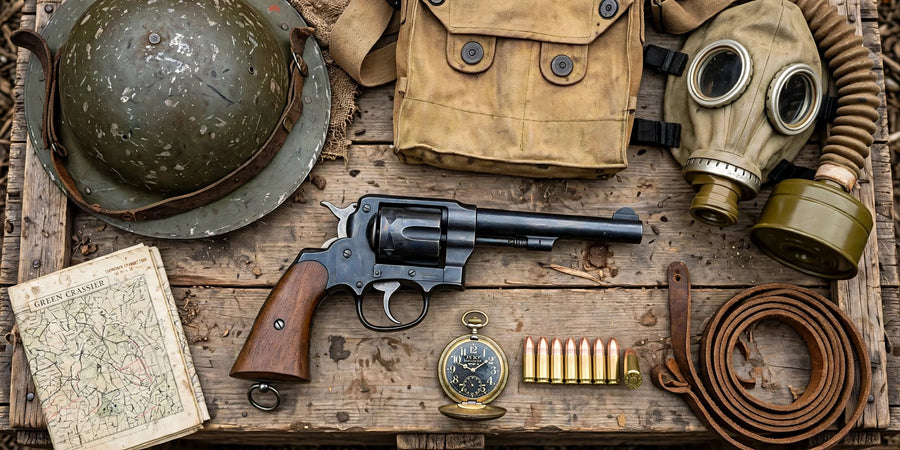
Its biggest appeal is historical authenticity combined with contemporary production. However, its fixed sights, substantial dimensions, and premium price make it a specialized choice rather than an all-purpose handgun.
This review is based on verified release information and published specifications. It does not represent independent hands-on testing.
Key Takeaways
- Smith & Wesson officially announced the Model 22 of 1917 Classic on October 27, 2026.
- The new revolver carries product number 14057 and has an MSRP of $1,299.
- It uses a six-shot N-frame cylinder chambered in .45 ACP.
- Its 5.5-inch barrel, half-moon front sight, walnut grips, and lanyard loop recreate important features of the original military revolver.
- The cylinder accepts traditional three-round half-moon clips and modern six-round full-moon clips.
- Five full-moon clips are included with the revolver.
- The 2026 model does not have Smith & Wesson's internal locking system.
- Its closest contemporary alternative is the separately released Model 22 Classic, which has a shorter barrel and additional .45 Colt compatibility.
More than a century after American soldiers carried the original Model 1917 into World War I, Smith & Wesson has returned to one of the most recognizable designs in its military revolver history. The newly announced Model 22 of 1917 Classic recreates the distinctive appearance of that service handgun, bringing its traditional proportions, blued-steel construction, and moon-clip arrangement into modern production.
Announced in October 2026, the revolver arrives at a time when many new handgun releases emphasize compact dimensions, optics compatibility, and modern materials. The Model 1917 Classic takes a different approach. Its appeal comes from preserving the character of a historical service revolver rather than competing with contemporary handguns on features or weight.
With a suggested retail price of $1,299, the new Model 1917 Classic represents a substantial investment. The question is whether its historical details, traditional construction, and distinctive .45 ACP chambering make it worthwhile for collectors and enthusiasts who want a modern-production example of this classic design.
Smith & Wesson Model 1917 Classic Specifications
The 2026 Model 1917 Classic follows the traditional proportions of Smith & Wesson's large-frame service revolvers. Its blued steel construction, long barrel, and fixed sights are central to the design, rather than features added simply for appearance.
| Specification | 2026 Model 22 of 1917 Classic |
|---|---|
| Manufacturer | Smith & Wesson |
| Official model name | Model 22 of 1917 Classic |
| Product number | 14057 |
| Release date | October 27, 2026 |
| Operating system | Double-action/single-action revolver |
| Caliber | .45 ACP |
| Capacity | 6 rounds |
| Barrel length | 5.5 inches |
| Overall length | 11 inches |
| Height | 5.38 inches |
| Width | 1.71 inches |
| Weight | 36.6 ounces |
| Frame | Blued carbon-steel N-frame |
| Cylinder | Fluted, moon-clip cut |
| Front sight | Fixed half-moon profile |
| Rear sight | Frame-integrated sighting groove |
| Grips | Smooth walnut |
| Internal lock | No |
| Included accessories | Five full-moon clips |
| MSRP | $1,299 |
Specifications are based on the October 2026 product announcement and published launch documentation. Verify current manufacturer information before purchasing.
At 36.6 ounces and 11 inches overall, the Model 1917 Classic is a substantial handgun. These dimensions are consistent with its historical inspiration and help explain why its appeal differs from modern compact revolvers. It is designed around the characteristics of a traditional service-size handgun rather than minimal weight or concealability.
The History Behind the Original Smith & Wesson Model 1917

To understand why Smith & Wesson brought this revolver back, it helps to understand the circumstances that created the original. When the United States entered World War I in 1917, the military needed more handguns than existing production of the M1911 semiautomatic pistol could provide. Smith & Wesson and Colt supplied large-frame revolvers chambered for the same .45 ACP ammunition used by the military's standard pistol.
That decision created a mechanical challenge. The .45 ACP cartridge was designed for semiautomatic pistols and does not have the prominent projecting rim normally associated with traditional revolver ammunition. The solution was a metal clip that held cartridges together and allowed the revolver's extractor to remove them.
The Model 1917 designation was shared by revolvers produced by both Smith & Wesson and Colt for U.S. military service. Although they served a similar purpose and used the same cartridge, the two manufacturers produced different revolver designs. The 2026 Model 22 of 1917 Classic specifically draws on Smith & Wesson's version of that military handgun.
The resulting M1917 revolvers became an important part of American military handgun history. Their distinctive appearance, large frames, and unusual ammunition arrangement made them recognizable long after the war ended.
The 2026 Model 22 of 1917 Classic is a modern tribute to that design, not an original military-issued revolver. Smith & Wesson has also revisited the Model 1917 concept in earlier Classic Series releases, so this is a new production introduction rather than the first reissue in the company's history.
What Makes the 2026 Model 1917 Classic Different?
Smith & Wesson could have created a modern revolver with a few vintage styling details and called it a tribute. Instead, the new Model 1917 Classic retains several defining characteristics of the original service revolver, including its barrel profile, traditional sights, and military-inspired furniture.
Traditional N-Frame Construction and Blued Finish
The new Model 1917 Classic is built on Smith & Wesson's N-frame, a large revolver frame associated with several of the company's best-known historical designs. Its carbon-steel construction and blued finish preserve the appearance expected from a traditional military-style revolver.
For collectors, the frame and finish are important because they contribute to the overall historical character. The revolver does not attempt to disguise itself as a modern lightweight handgun, and its 36.6-ounce listed weight reflects that approach.
The blued finish also introduces an ownership consideration. Traditional blued steel benefits from proper cleaning, corrosion prevention, and storage conditions. Buyers who prefer low-maintenance finishes should understand that preserving the appearance of a classic-style revolver requires attention.
A 5.5-Inch Barrel and Half-Moon Front Sight
One of the most recognizable elements of the original Model 1917 was its long barrel and rounded front sight. Smith & Wesson has retained the traditional 5.5-inch barrel length and half-moon front sight profile associated with the original military revolver. These features give the 2026 model a recognizable historical silhouette, even though it remains a newly manufactured interpretation rather than an exact reproduction of every original production detail.
The rear sight is a groove integrated into the frame's topstrap, another traditional feature. Unlike many modern revolvers with adjustable sights, this arrangement emphasizes historical styling and simplicity.
There is one notable modernization: the front sight is pinned rather than being permanently integral to the barrel. This preserves the classic appearance while allowing a different construction approach. Buyers should nevertheless confirm manufacturer guidance before considering any replacement parts.
Walnut Grips and Original-Style Lanyard Loop
The smooth walnut grips are another detail that separates the Model 1917 Classic from contemporary revolvers with rubber or aggressively textured synthetic grips. They complement the blued finish and maintain the understated appearance of the original military handgun.
A lanyard loop at the bottom of the grip frame further reinforces the historical design. On the original service revolver, this feature reflected military equipment practices. On the modern reproduction, its significance is largely historical and aesthetic.
These details may seem minor when viewed individually, but together they are central to the revolver's identity. A buyer interested primarily in modern ergonomics might prefer a different configuration, while someone who values historical presentation may see these features as essential.
No Internal Lock
Smith & Wesson specifically identifies the absence of an internal locking system as a feature of the 2026 Model 1917 Classic. This distinguishes it from certain other revolvers the company has produced with integrated key-operated locks.
For enthusiasts who prefer the traditional appearance of older Smith & Wesson revolvers, the absence of a visible internal lock is a meaningful design choice. It also supports the manufacturer's effort to recreate the historical profile without adding a conspicuous modern control.
This feature should not be confused with safe-storage equipment. Regardless of whether a firearm has an internal lock, owners remain responsible for preventing unauthorized access and following appropriate storage practices.
Why Does the Model 1917 Classic Use Moon Clips?

The Model 1917's relationship with .45 ACP ammunition is one of the most interesting parts of its history. Unlike traditional revolver cartridges such as .38 Special or .45 Colt, .45 ACP was developed primarily for use in semiautomatic pistols.
Moon clips provide a way to retain multiple cartridges together and assist with extraction in revolvers designed around this ammunition. The new Model 1917 Classic is compatible with both original-style half-moon clips, which hold three cartridges, and modern full-moon clips, which hold six. Smith & Wesson includes five full-moon clips with the revolver.
For buyers unfamiliar with this system, the important consideration is that moon clips are part of the firearm's intended ammunition arrangement. They can also be damaged or bent, making proper inspection and manufacturer-approved replacement accessories important.
The Model 1917 Classic is specifically listed for .45 ACP. Buyers should not assume that it accepts .45 Colt or other cartridges simply because those cartridges share a similar bullet diameter. Ammunition compatibility must always follow the exact manufacturer's specifications.
Model 1917 Classic vs. Model 22 Classic: What's the Difference?

Smith & Wesson introduced two closely related heritage revolvers in October 2026: the Model 22 of 1917 Classic and the Model 22 Classic. Their similar names and traditional N-frame construction make them easy to confuse, but they represent different configurations with distinct historical styling and ammunition requirements.
The Model 22 of 1917 Classic emphasizes the appearance of the original World War I-era service revolver, while the shorter Model 22 Classic offers a different barrel and sight arrangement along with additional manufacturer-specified cartridge compatibility. Understanding those distinctions is important because the two models should not be treated as interchangeable simply because they belong to the same Classic Series.
| Feature | Model 22 of 1917 Classic | Model 22 Classic |
|---|---|---|
| Product number | 14057 | 14058 |
| Operating system | Double-action/single-action | Double-action/single-action |
| Caliber | .45 ACP | .45 ACP / .45 Colt |
| Barrel length | 5.5 inches | 4 inches |
| Overall length | 11 inches | 9.38 inches |
| Weight | 36.6 oz. | 34.6 oz. |
| Capacity | 6 rounds | 6 rounds |
| Front sight | Half-moon | Serrated ramp |
| Frame | Blued N-frame | Blued N-frame |
| Grips | Smooth walnut | Smooth walnut |
| Internal lock | No | No |
| MSRP | $1,299 | $1,299 |
The most significant distinction is the Model 22 Classic's multi-caliber cylinder, which Smith & Wesson specifies for .45 Colt ammunition directly and .45 ACP ammunition with moon clips. The Model 1917 Classic, by comparison, is listed for .45 ACP.
The shorter Model 22 Classic may interest buyers who want a traditional N-frame with a more compact barrel configuration and additional ammunition flexibility. The Model 1917 Classic is the more obvious choice for someone specifically interested in recreating the World War I service revolver's appearance.
Neither is automatically a better purchase. The decision depends on whether historical resemblance or the Model 22 Classic's alternative configuration matters more to the buyer.
Is the 2026 Smith & Wesson Model 1917 Classic Worth $1,299?

At an MSRP of $1,299, the Model 1917 Classic is positioned as a premium heritage revolver. Its price reflects more than basic functionality; buyers are paying for a specific historical design, traditional materials, and a relatively specialized product within Smith & Wesson's lineup.
For a military history enthusiast, that combination may be the primary reason to consider the firearm. The 5.5-inch barrel, half-moon sight, lanyard loop, and moon-clip compatibility are not incidental details. They are the characteristics that connect the modern revolver to its historical predecessor.
For someone shopping strictly on practical specifications, the value proposition is different. Modern revolvers offer a wide range of sighting arrangements, finishes, grip designs, and price points. The Model 1917 Classic does not attempt to outperform all of them on contemporary features.
It is also important to distinguish a modern production heritage revolver from an original military collectible. An authentic World War I-era Model 1917 has a different historical provenance and may be evaluated according to originality, condition, markings, and collector demand. The 2026 model provides the classic design in a newly manufactured firearm, but it does not carry the same historical status as an original service example.
Who Should Consider the New Model 1917 Classic?
The strongest audience for the 2026 Model 1917 Classic is collectors and enthusiasts who appreciate American military handgun history. Its design is closely tied to a recognizable period, and Smith & Wesson has retained enough traditional details to make that connection meaningful.
It may also interest owners who enjoy large-frame double-action revolvers and prefer traditional blued steel and walnut over modern synthetic materials. For these buyers, the historical styling is part of the ownership experience rather than an unnecessary addition.
On the other hand, the Model 1917 Classic may not be ideal for someone seeking a lightweight handgun, adjustable sights, or the broadest range of contemporary features. Its size, fixed sights, moon-clip arrangement, and premium price all reflect a specialized design.
Final Thoughts
The 2026 Smith & Wesson Model 22 of 1917 Classic is a welcome return for enthusiasts who appreciate the company's military revolver heritage. With its 5.5-inch barrel, blued N-frame, traditional sights, walnut grips, and moon-clip compatibility, the new model captures many of the details that made the original Model 1917 distinctive.
Smith & Wesson has also made deliberate choices to preserve the classic appearance, including omitting an internal lock and retaining the original-style lanyard loop. These features help explain why the revolver is being marketed toward collectors and traditional revolver enthusiasts rather than buyers seeking the latest handgun technology.
The $1,299 MSRP is substantial, and the Model 1917 Classic will not appeal equally to every firearm owner. Those who want a shorter barrel or the flexibility of .45 Colt ammunition should also examine the separately released Model 22 Classic.
For buyers who specifically want the appearance and historical character of the World War I-era Smith & Wesson service revolver in a newly manufactured handgun, the Model 1917 Classic offers a distinctive option. Its long-term performance and ownership experience will become clearer as independent reviews and extended-use reports emerge.
The return of the Smith & Wesson Model 1917 Classic demonstrates that traditional revolver designs still have an audience, even as manufacturers continue developing lighter, more compact, and increasingly specialized handguns. Its historical significance and classic construction make it appealing to collectors and enthusiasts, but buyers focused primarily on everyday practicality may find other revolvers better suited to their needs. For a broader comparison of available options, our guide to today's top revolvers examines models intended for everything from recreational shooting to concealed carry and hunting.
Frequently Asked Questions
Is Smith & Wesson Releasing a New Model 1917 in 2026?
Yes. Smith & Wesson officially announced the Model 22 of 1917 Classic on October 27, 2026, alongside the Model 22 Classic. The new revolver recreates the appearance of the original military Model 1917 using modern production methods.
What Is the Official Name of the New Model 1917 Classic?
The manufacturer's full model designation is Model 22 of 1917 Classic. It is also commonly referred to as the Model 1917 Classic in industry coverage. Its product number is 14057.
How Much Does the Smith & Wesson Model 1917 Classic Cost?
Smith & Wesson announced an MSRP of $1,299 for the 2026 Model 22 of 1917 Classic. Actual dealer prices may differ depending on availability and market conditions.
Does the New Model 1917 Classic Have an Internal Lock?
No. Smith & Wesson specifically lists the 2026 Model 22 of 1917 Classic as having no internal lock system.
Does the Model 1917 Classic Come With Moon Clips?
Yes. The revolver includes five full-moon clips. Its cylinder is also designed to accept original-style half-moon clips.
Can the Model 1917 Classic Fire .45 Colt Ammunition?
No. The 2026 Model 22 of 1917 Classic is specified for .45 ACP. The separately released Model 22 Classic is the model Smith & Wesson identifies as compatible with both .45 ACP, using moon clips, and .45 Colt.
What's the Difference Between the Model 1917 Classic and Model 22 Classic?
The Model 1917 Classic has a 5.5-inch barrel, traditional half-moon front sight, and .45 ACP chambering. The Model 22 Classic has a 4-inch barrel, serrated ramp front sight, and a multi-caliber cylinder compatible with .45 ACP and .45 Colt as specified by the manufacturer.
Is the Smith & Wesson Model 1917 Classic Worth Buying?
It may be worth considering for collectors, military history enthusiasts, and buyers who appreciate traditional N-frame revolvers. Those primarily seeking modern features or a lower purchase price should compare other available revolvers before deciding.
About the Author
The ProArmory Editorial Team creates practical, research-informed content for firearm owners, ammunition shoppers, hunters, and shooting enthusiasts. Our articles focus on product education, firearm specifications, buying considerations, safety, and responsible ownership.
We aim to help readers understand their options and make informed purchasing decisions without exaggerated performance claims or unnecessary hype.
Disclaimer
This article is intended for general educational and informational purposes only. Firearm specifications, pricing, availability, and manufacturer configurations may change without notice. The information presented is based on manufacturer announcements and publicly available product documentation and does not represent independent hands-on testing conducted by ProArmory.
Always follow manufacturer instructions, practice established firearm safety procedures, use appropriate secure storage, and comply with applicable federal, state, and local laws. Verify firearm, ammunition, and accessory compatibility before use.
ProArmory does not guarantee the performance, reliability, or suitability of any firearm or accessory discussed in this article.


