


Quick Answer
Lever-action and bolt-action rifles are two of the most established rifle designs in American deer hunting, and both remain practical choices today. The better option depends much more on the complete rifle, chambering, ammunition, optics, hunting terrain, and individual hunter than on the operating system by itself.
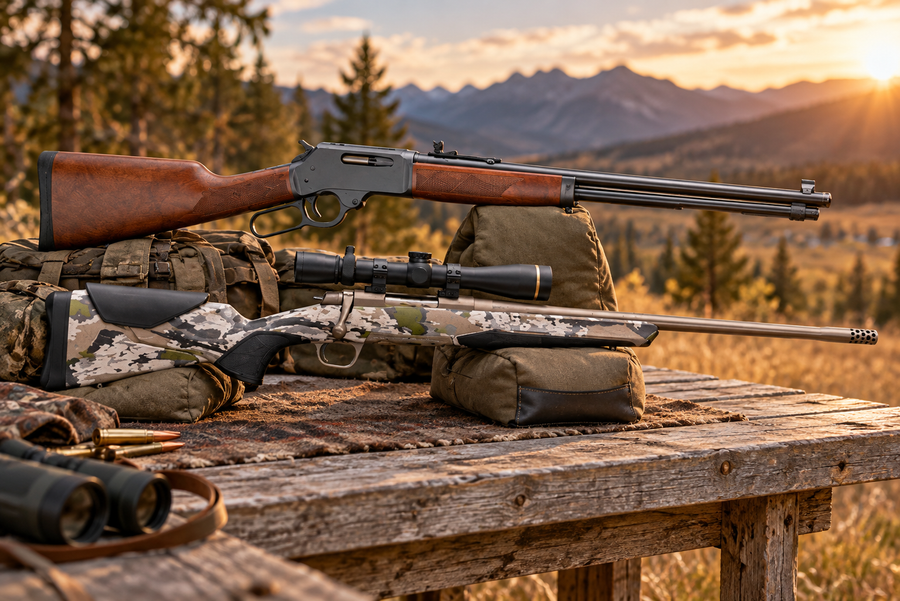
A lever-action rifle uses a manually operated lever beneath or around the receiver to cycle the action. These rifles remain closely associated with classic deer cartridges such as .30-30 Winchester and with compact sporting rifles that have spent generations in wooded hunting country. Modern lever guns have also evolved considerably, however, and buyers can now find models with synthetic stocks, threaded barrels, optics rails, M-LOK accessory interfaces, and chamberings that extend well beyond the traditional image of a walnut-stocked .30-30.
A bolt-action rifle uses a manually operated bolt and dominates much of the contemporary hunting-rifle market. Bolt guns are offered in an enormous range of chamberings, from compact deer cartridges and traditional .308- and .30-06-class rounds to newer high-BC hunting cartridges. They are also available across nearly every price range, stock style, rifle weight, barrel configuration, and optics setup.
For hunters who value a traditional sporting rifle, compact handling, and cartridges such as .30-30 Winchester, a lever-action remains extremely appealing. For hunters who prioritize the broadest cartridge selection, lightweight factory rifles, conventional scope mounting, and the largest overall selection of current hunting platforms, a bolt-action usually offers more flexibility.
Neither action type guarantees better accuracy, reliability, or hunting performance. The best deer rifle is ultimately the one that fits the hunter, carries comfortably, uses appropriate ammunition, and provides enough practical accuracy for the conditions in which it will actually be used.
Key Takeaways
- Lever-action and bolt-action rifles are both manually operated repeating firearms with long histories in deer hunting.
- Bolt-action rifles currently offer the broadest factory selection of chamberings, weights, stocks, barrel profiles, and optics-ready configurations.
- Traditional lever guns remain strongly associated with .30-30 Winchester, but modern lever-action offerings now include updated furniture, rails, threaded barrels, and additional hunting chamberings.
- Action type alone does not determine accuracy. Barrel quality, chamber dimensions, ammunition, optics, stock fit, and manufacturing consistency matter more.
- Tubular-magazine lever guns require ammunition appropriate to that magazine design. Conventional pointed bullets may be unsuitable, while specially engineered flexible-tip bullets can be approved for tubular use.
- A lever-action may feel especially handy in woods because many examples are compact, but lightweight bolt-action rifles can be equally portable or even lighter.
- For a first-time deer hunter, a bolt-action often provides the easiest path because of its enormous rifle, chambering, ammunition, and optics selection.
- A hunter who specifically wants a traditional .30-30, appreciates lever-gun handling, and accepts the platform’s more specialized cartridge ecosystem may have every reason to choose the lever instead.
Understanding Lever-Action and Bolt-Action Hunting Rifles
Lever-action and bolt-action rifles are both manually operated repeating firearms. In a conventional example of either design, the hunter operates the action after firing to extract and eject the spent cartridge case and prepare the rifle to chamber another round. Unlike a conventional semiautomatic rifle, neither action completes that entire cycle automatically using energy produced by the fired cartridge.
The difference is how the shooter operates the mechanism. A lever-action uses a pivoting lever connected to the rifle’s internal operating system, while a bolt-action relies on a bolt assembly that is lifted, drawn rearward, moved forward, and locked according to the design of the particular rifle.
Those mechanical differences affect receiver architecture, feeding systems, magazine design, chambering flexibility, stock geometry, optics mounting, and how manufacturers package the finished rifle. They do not, by themselves, determine whether one platform is appropriate for deer hunting.
Lever-Action vs. Bolt-Action Rifles: Comparison
| Feature | Lever-Action Rifle | Bolt-Action Rifle |
|---|---|---|
| Operating System | Manually operated lever | Manually operated bolt |
| Common Magazine Systems | Tubular or detachable, depending on design | Internal box or detachable box |
| Traditional Deer Chamberings | .30-30 Winchester, .35 Remington and others | .243 Winchester, .270 Winchester, .308 Winchester, .30-06 Springfield and many others |
| Current Chambering Selection | Growing, but more specialized | Extremely broad |
| Factory Optics Support | Excellent on some modern models, limited on others | Extremely common |
| Compact Hunting Configurations | Common | Common |
| Lightweight Factory Rifles | Available | Extensive selection |
| Precision-Oriented Factory Rifles | Comparatively uncommon | Extremely common |
| Traditional Sporting Appeal | Very strong | Strong but generally more utilitarian |
| Accuracy Advantage From Action Alone | None guaranteed | None guaranteed |
This table describes broad market tendencies rather than rules. Modern lever-actions increasingly blur several of these categories, while individual bolt-action rifles can be built around very traditional sporting designs.
What Is a Lever-Action Hunting Rifle?

A lever-action rifle is a repeating firearm that uses a manually operated lever to cycle the action. Lever guns became deeply connected to American sporting culture during the nineteenth and twentieth centuries, and several designs remain closely associated with deer hunting today.
The most familiar hunting lever-actions use tubular magazines positioned beneath the barrel. Cartridges are stored end-to-end inside the tube and move toward the action as the rifle cycles. Other lever-action designs use detachable or internal box magazines, which can expand the range of cartridge shapes that the rifle can accommodate.
The classic image is a wood-stocked .30-30 carried through eastern timber, but that image now represents only part of the category. Current manufacturers offer traditional rifles alongside synthetic-stocked, threaded, optics-ready, and accessory-compatible designs that look very different from their historical predecessors.
Why Lever-Actions Have Such a Strong Deer-Hunting Reputation
Lever-action rifles became popular with deer hunters because several successful designs combined useful hunting cartridges with relatively handy rifle dimensions. In thick woods, tree stands, brushy creek bottoms, and other environments where rifles are carried more than they are fired, a compact sporting rifle can be extremely convenient.
The .30-30 Winchester helped cement that reputation. It has been paired with lever guns for well over a century and remains one of the cartridges most closely identified with whitetail hunting in North America.
Tradition is only part of the appeal, however. A hunter who genuinely likes the way a lever gun balances, fits the shoulder, works from a particular hunting position, and handles in the woods has a practical reason to use one beyond nostalgia.
Modern Lever Guns Are No Longer Just Traditional Rifles
The current lever-action market looks very different from the market of several decades ago. Manufacturers continue producing walnut-stocked traditional rifles, but they also offer guns designed around contemporary optics, muzzle devices, synthetic furniture, and other modern equipment.
Henry’s X Model family, for example, has brought synthetic furniture, M-LOK slots, Picatinny interfaces, fiber-optic sights, and threaded barrels into the lever-gun market. Ruger’s revival of Marlin has similarly included traditional Model 336 and 1894 configurations alongside Dark Series and other modernized rifles.
This matters when comparing lever-actions with bolt guns because several advantages once associated almost exclusively with modern bolt-action rifles are no longer exclusive. A hunter can now build or buy a lever gun around a magnified optic, suppressor-compatible muzzle, synthetic stock, sling, and other contemporary equipment without abandoning the lever-action operating system.
What Is a Bolt-Action Hunting Rifle?

A bolt-action rifle uses a manually operated bolt assembly to chamber a cartridge, lock the action, extract the fired case, and prepare the rifle for another round. The concept appears across hunting rifles, military rifles, target rifles, precision competition platforms, and numerous other firearm categories.
Modern hunting bolt guns range from very inexpensive synthetic-stocked rifles to lightweight mountain rifles and premium wood-stocked sporting guns. The same basic operating system can support cartridges as different as .223 Remington, .350 Legend, 6.5 Creedmoor, .270 Winchester, .30-06 Springfield, 7mm PRC, and large magnum hunting cartridges.
That enormous flexibility is one of the bolt-action rifle’s greatest advantages. A hunter can often choose the cartridge first and then compare several rifles from several manufacturers rather than choosing one rifle family and accepting whatever chamberings happen to be offered.
Why Bolt-Actions Dominate the Modern Hunting-Rifle Market
The modern bolt-action market gives manufacturers enormous freedom to create rifles around different hunting needs. They can change barrel length, contour, receiver size, magazine design, stock material, stock geometry, trigger system, finish, and optics mounting while retaining a familiar operating system.
This creates a selection advantage that is difficult for lever actions to match. A hunter looking for a lightweight .308 may have dozens of choices, and the same is true for someone shopping for a .270 Winchester, 6.5 Creedmoor, .30-06 Springfield, or many newer cartridges.
Price is another factor. Because bolt-action rifles are produced across such a large portion of the hunting market, buyers can find entry-level rifles, mid-priced models, and premium platforms without changing action type.
Lever-Action vs. Bolt-Action Accuracy
Bolt-actions dominate precision-oriented rifle competition and long-range target shooting, which can create the impression that the operating system itself automatically produces superior accuracy. That conclusion oversimplifies what is happening inside the rifle.
Mechanical accuracy depends on the barrel, chamber, crown, ammunition, stock or chassis relationship, receiver construction, optic mounting, trigger, and the consistency with which the complete firearm returns to the same condition from shot to shot. Action design contributes to the complete engineering system, but it does not create a universal accuracy ranking by itself.
A high-quality modern lever-action can provide more than enough accuracy for ethical deer hunting within the limitations of its cartridge, sights, and ammunition. Conversely, a poorly assembled bolt-action rifle does not become accurate merely because the bolt locks manually into a conventional receiver.
Why Bolt-Actions Are So Common in Precision Rifles
The bolt-action architecture lends itself naturally to the heavy barrels, rigid stocks and chassis, specialized triggers, and broad cartridge selection used in precision-oriented shooting. The market also contains decades of competition development, aftermarket actions, barrels, triggers, chassis systems, and gunsmith knowledge centered on bolt guns.
That ecosystem creates a powerful advantage when someone is building specifically for small groups or long-range competition. It should not be confused with proving that an ordinary hunting bolt gun will automatically outshoot a quality lever-action rifle at normal deer-hunting distances.
For a hunter, the useful question is whether the rifle can place the selected hunting ammunition consistently enough for the conditions and distances in which the hunter is prepared to shoot.
Cartridge Selection Is One of the Biggest Differences
The bolt-action market offers a dramatically larger selection of hunting chamberings than the lever-action market. This can matter more than the action itself when the hunter has a specific ballistic requirement or wants access to a broad selection of factory ammunition.
Traditional lever guns remain closely associated with cartridges such as .30-30 Winchester and .35 Remington. Modern designs have expanded that list considerably, including cartridges such as .360 Buckhammer and selected configurations using .308 Winchester, .350 Legend, 10mm Auto, and other chamberings depending on the action design.
Bolt-action hunters have a much larger menu. Short-action cartridges such as .243 Winchester, .308 Winchester, 7mm-08 Remington, and 6.5 Creedmoor sit alongside long-action rounds such as .270 Winchester, .25-06 Remington, and .30-06 Springfield, plus newer PRC and other specialized families.
Common Deer-Hunting Chamberings
| Cartridge | Lever-Action Availability | Bolt-Action Availability |
|---|---|---|
| .30-30 Winchester | Extensive and historically important | Comparatively uncommon |
| .35 Remington | Historically established, current selection more limited | Limited |
| .360 Buckhammer | Available in current dedicated lever guns | Available in selected factory rifles |
| .350 Legend | Available in selected modern designs | Widely available |
| .243 Winchester | Specialized designs only | Very common |
| 6.5 Creedmoor | Specialized designs only | Very common |
| .270 Winchester | Specialized designs only | Very common |
| .308 Winchester | Available in selected box-magazine lever designs | Very common |
| .30-06 Springfield | Specialized box-magazine lever designs | Very common |
Exact chambering availability changes over time. Buyers should verify the current manufacturer catalog rather than assume that a cartridge historically offered in one platform is still being produced today.
Tubular Magazines Change Ammunition Selection
Traditional tubular-magazine lever actions place cartridges end-to-end inside the magazine tube. That arrangement means the nose of one bullet can sit close to the primer of the cartridge positioned ahead of it.
For this reason, firearm manufacturers commonly provide specific ammunition guidance for their tubular-magazine rifles. Winchester’s current Model 94 instructions, for example, direct owners toward ammunition suitable for tubular centerfire magazines and caution against ordinary pointed or conical bullets.
The broad lesson is not that every lever-action must use a flat-nose projectile. The correct lesson is that ammunition must be compatible with the specific magazine design and approved by the firearm and ammunition manufacturers.
Flexible-Tip Ammunition Changed the Lever-Gun Equation

Modern ammunition technology has expanded what can be used safely in certain tubular-magazine rifles. Hornady’s FTX and MonoFlex projectiles use flexible polymer tip technology developed specifically to provide a more aerodynamic nose while remaining suitable for tubular-magazine use.
This is an important distinction because it allows certain traditional lever cartridges to use bullets with higher ballistic coefficients than old-style flat-point designs while maintaining an ammunition configuration engineered for the magazine system.
Hunters should still verify the exact load and firearm. A polymer tip does not automatically mean a cartridge is approved for every tubular magazine, just as a conventional pointed bullet should not be assumed safe because it happens to chamber.
Box-Magazine Lever Guns Avoid Some Tubular-Magazine Limitations
Not every lever-action stores cartridges nose-to-primer in a tubular magazine. Box-magazine lever rifles can accommodate ammunition architecture more closely resembling what is used in bolt-action rifles.
This opens the door to cartridges and projectile shapes that would be problematic in a conventional tubular magazine. It is one reason a discussion of lever-action chamberings needs to distinguish between the classic tube-fed design and other lever-action architectures.
The tradeoff is that these rifles may lose some of the slim profile and traditional appearance that draw hunters to classic lever guns in the first place.
Are Lever-Action Rifles Only for Short-Range Deer Hunting?
No. The stereotype is understandable, but it is too broad.
The lever-action platform became associated with comparatively short-range woodland hunting because rifles such as the Winchester 94 and Marlin 336 were commonly paired with .30-30 Winchester and carried in environments where long shots were often unnecessary. That combination created a cultural identity around the lever gun that continues today.
The action itself does not impose a specific maximum hunting distance. Cartridge performance, ammunition, rifle accuracy, optic, environmental conditions, game presentation, and the hunter’s demonstrated ability are more meaningful factors.
A modern lever-action with appropriate ammunition and optics may offer considerably different capability than a century-old carbine with iron sights. The same is true in the opposite direction: owning a modern bolt-action chambered in a high-performance cartridge does not make a long shot automatically appropriate.
Hunting Distance Is an Ethical Limit, Not an Action-Type Contest
A useful deer rifle needs to place an appropriate hunting projectile accurately under real hunting conditions. The hunter also needs enough certainty in range, wind, position, and animal presentation to make the shot responsibly.
Those requirements should determine practical range. The operating system printed on the rifle’s product page should not.
This is why hunters should be cautious about treating lever guns as automatically close-range rifles or bolt guns as automatically long-range rifles. Either description can become misleading once the actual rifle, cartridge, and hunter are considered.
Which Rifle Is Easier to Carry?
Lever-actions have a strong reputation for portability because many classic models combine relatively short barrels, slim receivers, tubular magazines, and traditional stocks. That can produce a rifle that carries naturally in one hand and moves easily through dense woods.
Bolt-action rifles, however, now cover an enormous weight range. Lightweight hunting rifles can weigh considerably less than some traditional steel-and-walnut lever guns, particularly once large-caliber tubular magazines and heavy receivers are considered.
The best comparison is therefore not lever versus bolt in the abstract. Compare the published weights, overall lengths, barrel lengths, stock dimensions, and balance of the two actual rifles under consideration.
Balance Can Matter More Than Published Weight
Two rifles weighing the same amount can feel completely different in the field. A rifle with more weight between the hands may feel compact and lively, while one carrying more mass far forward can feel heavier than the scale suggests.
Optics change the equation as well. A lightweight lever gun topped with a large scope and steel rings can lose much of its original handling character, while a bolt rifle with a compact optic may remain relatively light.
Hunters who expect to carry the rifle for several hours should evaluate the complete hunting configuration rather than bare-rifle weight alone.
Lever-Action vs. Bolt-Action Optics Compatibility
Modern bolt-action hunting rifles are usually designed from the beginning around conventional magnified optics. Factory scope bases, drilled receivers, integrated rails, and widely supported ring patterns are common across the market.
Lever-action rifles are more varied. Some traditional receiver designs require more specialized mounting arrangements, while current rifles from Henry, Marlin, and other manufacturers may arrive drilled and tapped or equipped with rails.
This means the old statement that lever-actions are difficult to scope is no longer universally accurate. The more precise conclusion is that optics support varies much more by lever-gun model than it does across the modern bolt-action market.
A Modern Lever Gun Can Be Extremely Optics Friendly
Henry’s .30-30 Side Gate rifles provide a good example because the receiver is drilled and tapped for a scope base. Modern X Model rifles go farther with contemporary furniture and accessory interfaces, while other lever-gun models may provide Picatinny rails or receiver-top mounting solutions from the factory.
Ruger-produced Marlins likewise show how modern manufacturing has moved lever actions beyond a purely irons-first design philosophy. Traditional versions remain available, but a hunter who wants a red dot, low-power optic, or conventional hunting scope has substantially more factory-supported choices than previous generations did.
Buyers should still verify eye relief, ring height, hammer clearance, ejection path, cheek weld, and manufacturer-approved mounting hardware for the exact rifle.
Follow-Up Shot Speed: Lever vs. Bolt
Lever-actions are often described as faster for follow-up shots because the lever can be cycled without the same upward-and-rearward hand movement associated with many bolt guns. In experienced hands, a lever rifle can indeed be operated quickly.
The difference is less useful as a universal buying rule. Modern bolt actions vary considerably in bolt lift, throw, knob position, cocking effort, and smoothness, while lever actions differ in stroke length and operating resistance.
More importantly, deer hunting should not be reduced to which mechanism can be cycled fastest. The practical value lies in being able to operate the rifle smoothly while maintaining safe muzzle control and remaining aware of the animal and surroundings.
Reliability Depends on the Complete Rifle
Both action types have earned long service histories under demanding field conditions. A quality lever-action can be extremely dependable, and the same is true of a quality bolt-action.
The mechanisms fail in different ways because their parts and feeding systems differ. Lever guns contain linkages, lifters, carriers, and magazine components specific to the design, while bolt guns rely on their own extractors, ejectors, magazines, locking lugs, and bolt assemblies.
Neither category should be treated as mechanically infallible. Reliability comes from good manufacturing, appropriate ammunition, maintenance, and the condition of the individual firearm.
Maintenance and Field Service
Many bolt-action rifles are comparatively straightforward to access for normal bore cleaning because the bolt can often be removed easily according to the manufacturer’s instructions. That can make cleaning from the chamber end convenient.
Lever guns vary considerably. Some designs provide relatively easy access to certain components, while others require more disassembly than an ordinary hunter should perform without following the manufacturer’s procedure.
This does not make lever-actions difficult to own. It simply means buyers should understand the maintenance process for their exact model and avoid assuming that all manually operated rifles disassemble the same way.
Recoil Is Not Determined by Lever or Bolt
The operating system is only one part of how a hunting rifle feels when fired. Cartridge, bullet weight, powder charge, rifle weight, stock geometry, recoil pad, muzzle device, and shooter position can all influence perceived recoil.
A lightweight .30-06 bolt gun can produce substantially more felt recoil than a heavier .30-30 lever gun. Another comparison involving a lightweight lever-action in a more powerful cartridge and a heavier bolt gun may produce the opposite result.
Hunters concerned about recoil should compare the actual cartridge and rifle rather than making assumptions from the action type.
Popular Current and Traditional Lever-Action Deer Rifles
The lever-action market combines some of the oldest recognizable hunting-rifle names with increasingly modern configurations. Three platforms remain particularly useful reference points: the Marlin Model 336, Henry’s Side Gate family, and the Winchester Model 94.
These rifles are not mechanically identical and should not be treated as interchangeable simply because they share a lever. Magazine systems, loading methods, safety arrangements, receiver dimensions, optics support, and current configurations differ.
Marlin Model 336

The Model 336 remains one of the defining .30-30 lever-action deer rifles. Ruger reintroduced the Marlin 336 Classic in current production with a 20.25-inch cold-hammer-forged barrel, American black walnut furniture, and a six-round tubular magazine.
The new Ruger-made rifles continue the traditional 336 concept while benefiting from current manufacturing. Marlin’s present catalog and marketing material also demonstrate that the company is willing to move the lever platform into more contemporary configurations rather than limiting the brand to historical reproductions.
For hunters who specifically want a .30-30 lever gun with strong American deer-hunting heritage, the 336 remains one of the most obvious rifles to compare.
Henry Side Gate

Henry’s Side Gate rifles combine a receiver loading gate with the company’s removable inner magazine-tube system. In .30-30 configurations, Henry has used a 20-inch barrel and five-round tubular magazine, with receiver provisions for mounting a scope base.
The concept gives hunters both traditional appearance and practical loading flexibility. Henry’s broader catalog also shows how far the company has pushed lever-action design, with X Model and other modern configurations incorporating synthetic furniture, threaded barrels, rails, and accessory interfaces.
A hunter can therefore stay within the Henry lever-action family while choosing between a traditional walnut hunting rifle and a much more contemporary configuration.
Winchester Model 94

The Winchester Model 94 remains inseparable from the history of .30-30 deer hunting. Winchester’s current documentation continues to cover modern Model 94 production, while the rifle maintains the compact receiver layout and tubular-magazine architecture that made it famous.
The Model 94 is especially useful in this comparison because its manufacturer documentation clearly illustrates the ammunition considerations surrounding a tubular magazine. Winchester specifically directs owners toward suitable projectile profiles rather than ordinary pointed or conical bullets.
Hunters shopping for a new or used Model 94 should pay particular attention to production era because safety arrangements, finishes, barrel lengths, sights, and exact configurations have changed throughout the rifle’s long history.
Popular Bolt-Action Deer Rifles
The bolt-action category is much broader, making it impossible to reduce the market to three definitive models. The Ruger American Rifle Gen II, Tikka T3x Lite, and Savage AXIS 2 provide useful examples because they occupy different positions within the contemporary hunting market.
All three also demonstrate why bolt guns dominate modern factory selection. Each family spans multiple chamberings and configurations while allowing the buyer to stay within one familiar platform.
Ruger American Rifle Gen II

Ruger’s second-generation American Rifle has grown into a broad hunting-rifle family rather than one basic model. The Gen II redesign introduced a more rigid and ergonomic stock, a three-position tang safety, updated styling, and other refinements while retaining the value-oriented positioning of the original American Rifle.
Ruger continued expanding the line through 2026 with Patrol, Scout, Ranch, left-handed, and other configurations. Current Scout models, for example, add iron sights and an extended Picatinny rail while remaining available in several compact hunting and sporting chamberings.
This illustrates one of the bolt-action market’s strongest advantages: a buyer can choose among significantly different rifle configurations without leaving the same basic action family.
Tikka T3x Lite

The Tikka T3x Lite represents a different philosophy. Rather than emphasizing minimum purchase price, it focuses on lightweight sporting use, a smooth action, cold-hammer-forged barrel, and a modular synthetic stock.
Current T3x Lite-family chamberings span everything from .223 Remington and .243 Winchester through .308 Winchester, 6.5 Creedmoor, .270 Winchester, .30-06 Springfield, 7mm PRC, and magnum hunting cartridges depending on exact model.
That breadth makes the Tikka a strong example of why bolt-action rifles appeal to hunters who want to select the cartridge first. The same familiar rifle family can cover very different hunting applications.
Savage AXIS 2

The Savage AXIS family remains one of the recognizable value-oriented entries in the hunting-rifle market, and Savage revised it again for 2026.
All new AXIS-family barrels are now threaded, including the AXIS 2, AXIS 2 PRO, AXIS 2 XP, and AXIS XP. Synthetic-stock AXIS 2 models also receive an adaptable length-of-pull system allowing adjustment between approximately 12.75 and 13.75 inches.
This is more significant than a cosmetic refresh. Adjustable stock fit can make an entry-level rifle substantially more useful for smaller shooters, growing hunters, or families expecting several people to use the same rifle.
Factory Rifle Comparison
| Platform | Action | Representative Chambering | Main Strength |
|---|---|---|---|
| Marlin Model 336 | Lever | .30-30 Winchester | Traditional deer-rifle handling and heritage |
| Henry Side Gate | Lever | .30-30 Winchester and selected others | Traditional design with modern factory options |
| Winchester Model 94 | Lever | .30-30 Winchester | Classic compact lever-action format |
| Ruger American Gen II | Bolt | Wide current selection | Value, configurations, modern features |
| Tikka T3x Lite | Bolt | Wide current selection | Lightweight sporting design and broad chambering support |
| Savage AXIS 2 | Bolt | Wide current selection | Accessible pricing and adaptable 2026 features |
Lever-Action vs. Bolt-Action in Wooded Terrain
Wooded hunting country is where the lever-action stereotype makes the most sense. Compact rifles with shorter barrels can move easily through brush, tree stands, blinds, and dense timber, and many traditional lever guns were built around exactly that style of hunting.
The important correction is that compactness belongs to the individual rifle, not automatically to the lever. Ruger, Savage, Tikka, and numerous other bolt-action manufacturers now offer compact rifles and short-barreled hunting configurations that can be equally manageable in thick cover.
A hunter should therefore compare how the rifle actually carries and shoulders. A familiar lever gun may still win that comparison, but it should win because of its dimensions and handling rather than an assumption attached to the operating system.
Lever-Action vs. Bolt-Action in More Open Country
Bolt-actions become particularly attractive when hunting environments create demand for broader cartridge selection, larger magnified optics, lighter mountain-rifle configurations, or cartridges developed around higher ballistic coefficients.
The bolt-action market simply provides more choices for that kind of hunting. A hunter interested in 6.5 Creedmoor, .270 Winchester, 7mm-08, .30-06, 6.5 PRC, 7mm PRC, or numerous magnum cartridges can choose among several factory rifles and price categories.
That does not mean a lever gun becomes ineffective when the timber opens up. It means the bolt-action market offers more platforms purpose-built around that role.
Tree Stand and Blind Hunting
Hunters using enclosed blinds or compact tree stands may place more emphasis on overall rifle length than someone hunting from a large box blind or open ridge.
A traditional carbine-length lever gun can fit those environments extremely well. Compact bolt-action rifles can do the same, particularly current Ranch, Scout, and short-barreled hunting models.
Again, comparing the actual rifle dimensions provides a better answer than selecting by action name alone.
Hunting on Foot
Hunters who cover significant distance before reaching a shooting position often care more about total weight, balance, sling comfort, and weather resistance than cycling speed.
This is one area where the modern lightweight bolt-action market can be particularly compelling. Synthetic stocks, stainless or protected metal finishes, and relatively light barrel profiles have made sub-seven-pound hunting rifles common.
A lever gun can still be comfortable to carry, especially when its balance suits the hunter. The point is that the classic lever advantage in portability now has serious competition from modern bolt rifles.
Weather Resistance
Traditional blued-steel and walnut hunting rifles require sensible care in wet environments, regardless of whether they use a lever or bolt.
Modern buyers now have much more choice. Synthetic stocks, stainless components, Cerakote, nitriding, and other weather-resistant finishes appear throughout both categories.
This is another area where action type tells only part of the story. A stainless or coated modern lever gun may be far better suited to a wet hunt than a traditional blued bolt rifle, while a synthetic-stocked Cerakote bolt gun may require much less concern than a classic walnut lever rifle.
Which Platform Has the Better Aftermarket?
The bolt-action market has the broader ecosystem overall, particularly for stocks, chassis systems, scope mounting, barrels, triggers, bottom metal, magazines, and precision-oriented accessories.
Lever-action support has grown quickly, especially as modernized lever guns have become more popular. Rails, handguards, stocks, sights, optics mounts, and other accessories are now available for several major platforms.
The difference is that compatibility is often more model specific with lever guns. A Marlin 336, Henry .30-30, and Winchester 94 should not be assumed to share furniture or mounting systems merely because they use the same general operating principle.
Which Platform Is Easier to Buy Ammunition For?
This question is really about chambering rather than action type.
A lever gun in .30-30 Winchester benefits from a mature commercial hunting-ammunition market, while an older rifle chambered in a less common lever cartridge may have far fewer choices.
Bolt-action rifles offer the advantage of chambering diversity. Buyers can deliberately choose a cartridge with an extremely strong ammunition ecosystem, such as .308 Winchester, .30-06 Springfield, .270 Winchester, or 6.5 Creedmoor.
For a first hunting rifle, ammunition availability deserves substantial weight because a rifle is far more useful when the owner can afford to practice with it.
What About Straight-Wall Deer Cartridges?
Modern hunting regulations in some jurisdictions have increased interest in straight-wall cartridges, and both lever-action and bolt-action manufacturers have responded with appropriate chamberings.
Examples include .350 Legend and .360 Buckhammer, although legality depends on the exact jurisdiction and sometimes on specific cartridge dimensions or firearm requirements.
Hunters should never assume that a cartridge described broadly as straight wall is automatically lawful in every restricted area. Current state and local wildlife regulations need to be checked before selecting a rifle around those rules.
Which Is Better for a First-Time Deer Hunter?
For most first-time buyers, a bolt-action is the easier general recommendation. That is largely because the market provides more affordable rifles, more chamberings, more stock dimensions, more optics-ready configurations, and more opportunities to compare several models before purchasing.
A first-time hunter interested in .308 Winchester, 6.5 Creedmoor, .243 Winchester, .270 Winchester, or .30-06 Springfield can easily find entry-level and mid-priced bolt guns from several manufacturers. That competition also makes replacement magazines, mounts, scopes, and support easier to evaluate.
A lever-action can still be an excellent first deer rifle. Someone who specifically wants a .30-30, likes the rifle’s fit, has suitable ammunition readily available, and prefers the manual of operation may have no reason to start with a bolt gun instead.
Fit Matters More Than Tradition
A first hunting rifle should fit the hunter well enough to establish a consistent and comfortable shooting position. Length of pull, grip shape, comb height, recoil pad, optic height, and total weight can all influence that fit.
This is one reason adjustable modern stocks have become increasingly valuable. Savage’s 2026 AXIS 2 update is a good example because its synthetic stock can shift between shorter and longer length-of-pull configurations rather than forcing every hunter into one fixed dimension.
A rifle with a legendary reputation is still a poor choice if the stock does not fit the person expected to hunt with it.
Price and Value
Bolt-action rifles currently have a major advantage at the lower end of the market because manufacturers produce so many affordable hunting models. A buyer can obtain a functional factory bolt gun at a relatively modest price and devote more of the budget to an optic, ammunition, range practice, and hunting equipment.
Current lever guns are often positioned higher in the market. Their receivers, operating systems, steel components, furniture, and comparatively lower production volumes can make them more expensive than entry-level bolt rifles.
That does not make the lever gun poor value. Value depends on whether the buyer actually wants what the rifle provides. Someone who has wanted a Marlin 336 or Winchester 94 for years may place legitimate value on the design, handling, and ownership experience that a budget bolt gun cannot duplicate.
The Complete Hunting Setup Matters More Than Rifle MSRP
The rifle is only part of the cost. A hunter may still need an optic, rings or mount, sling, ammunition, case, protective equipment, and range time before the season begins.
A rifle package that costs less but requires several immediate additions can narrow the apparent price gap. Conversely, paying substantially more for a rifle can make little financial sense if the purchase eliminates the budget needed for suitable ammunition and practice.
The strongest value comes from a complete setup the hunter can actually use confidently.
When a Lever-Action Makes the Most Sense
A lever-action deserves serious consideration when the hunter genuinely values compact handling, traditional rifle design, a cartridge such as .30-30 Winchester, and the feel of the lever system.
It also makes sense for someone who hunts primarily in environments where the chosen rifle’s dimensions and cartridge are well suited to the expected conditions.
Modern lever guns broaden that appeal considerably. A buyer no longer has to choose between classic operation and modern optics, synthetic stocks, threaded barrels, or accessory mounting if those features are important.
When a Bolt-Action Makes the Most Sense
A bolt-action is usually the stronger choice when the hunter wants the broadest possible rifle and cartridge selection. It is also easier to recommend when the buyer has not yet settled on a specific hunting style because the platform can be tailored to nearly anything from compact eastern whitetail hunting to lightweight western mountain use.
The bolt-action market also gives buyers more opportunities to select exact rifle weight, stock design, barrel length, finish, and price without changing chambering.
For someone who simply wants the most flexible path into deer hunting, that breadth is difficult to beat.
Lever-Action vs. Bolt-Action by Hunter Priority
| Hunter Priority | Platform Worth Considering | Why |
|---|---|---|
| Classic .30-30 deer rifle | Lever-action | Strongest factory and historical association |
| Broadest chambering selection | Bolt-action | Far more current cartridge choices |
| Lowest entry cost | Bolt-action | Large budget-rifle market |
| Traditional sporting character | Lever-action | Classic handling and styling |
| Lightweight mountain rifle | Bolt-action | Extensive lightweight factory selection |
| Compact woodland hunting rifle | Either | Compare actual rifle dimensions and weight |
| Modern optics and accessory support | Either, model dependent | Modern lever guns have narrowed the old gap |
| Precision-oriented crossover use | Bolt-action | Much larger precision ecosystem |
| Modern straight-wall hunting cartridge | Either | Current chamberings exist in both categories |
Assuming the Lever Is Always More Compact
Many lever guns are compact, but modern bolt-action rifles can use equally short barrels and lightweight stocks. A 16- to 18-inch bolt gun may be shorter and lighter than a traditional 20-inch steel-and-walnut lever rifle.
Compare the actual dimensions rather than the silhouette.
Assuming the Bolt Is Always More Accurate
Bolt rifles dominate precision categories because the complete ecosystem is highly developed around that purpose. That does not make action type a universal accuracy guarantee.
Hunting accuracy should be judged from the individual firearm and ammunition combination.
Assuming Lever Guns Cannot Use Modern Optics
This may have been a more useful generalization decades ago. It is no longer accurate across the current market.
Many lever-action rifles now arrive drilled and tapped or fitted with rails, and several modern platforms were designed specifically around electronic or magnified optics.
Assuming Any Pointed Bullet Is Safe in a Tube
Conventional pointed or conical projectiles can conflict with the safety requirements of centerfire tubular magazines because of the nose-to-primer cartridge arrangement.
Purpose-engineered flexible-tip ammunition is a different category. Always follow the firearm and ammunition manufacturer’s guidance for the exact combination.
Buying the Action Before Choosing the Cartridge
A hunter can unnecessarily restrict the rifle search by deciding “I want a lever” or “I want a bolt” before determining which cartridges actually fit the intended deer-hunting conditions.
The more useful order is to identify the hunting application, establish appropriate and lawful cartridge choices, and then compare the rifles offered in those chamberings.
The result may still be the lever gun the hunter wanted in the first place, but now the decision is supported by the complete hunting requirement rather than appearance alone.
Overlooking Ammunition Cost
A rifle that is affordable to buy but expensive to practice with can become a poor first hunting rifle.
Hunters benefit from confirming zero, checking ammunition performance, practicing from realistic field positions, and becoming comfortable with recoil and operation before the season.
That requires enough ammunition to actually use the rifle.
Buying Too Much Rifle
More cartridge performance is not automatically better. A lightweight rifle chambered in a powerful cartridge can create recoil that discourages useful practice.
Likewise, a heavy long-range rifle may deliver excellent stability but become unnecessarily burdensome for a hunter who walks several miles through the woods.
The best rifle is sized around the hunting job rather than around the most impressive specification sheet.
Final Thoughts
Lever-action and bolt-action rifles remain two of the strongest manually operated choices for deer hunting, but the difference between them is no longer as simple as traditional versus modern.
Lever guns still carry the unmistakable history of American deer hunting. The Marlin 336, Henry Side Gate, and Winchester Model 94 continue to make .30-30 Winchester and traditional lever-gun handling relevant to hunters who value those characteristics. Their compact proportions and familiar operation remain particularly appealing in wooded country.
At the same time, the modern lever market has moved forward. Synthetic furniture, scope rails, threaded barrels, accessory interfaces, and new chamberings mean the category is no longer limited to blued steel, walnut, iron sights, and flat-point ammunition.
Modern flexible-tip ammunition has changed the ballistic possibilities of traditional tube-fed cartridges as well. Hunters still need to respect tubular-magazine ammunition requirements, but the old assumption that every safe lever-gun bullet must have a traditional flat nose is no longer correct.
Bolt-actions retain the larger overall advantage in flexibility. The current market offers an enormous selection of rifles from affordable models such as the Savage AXIS 2 and Ruger American Gen II through lightweight Tikka hunting rifles and far more expensive premium options.
The cartridge selection is equally broad. A hunter can choose .243 Winchester, 6.5 Creedmoor, .308 Winchester, 7mm-08, .270 Winchester, .30-06 Springfield, .350 Legend, newer PRC cartridges, and numerous other chamberings without leaving the bolt-action category.
That flexibility is why the bolt-action remains the easier recommendation for many first-time deer hunters. It provides more opportunities to find a rifle that fits the shooter, budget, cartridge requirement, and hunting environment.
That does not make it the better deer rifle for everyone.
A hunter who spends every November in eastern timber, loves the handling of a 336, has confidence in .30-30 Winchester, and shoots the rifle well has no practical reason to replace that system simply because the broader industry produces more bolt guns.
Likewise, someone hunting more open terrain or wanting a lightweight rifle chambered in a specific modern cartridge may find that the bolt-action market provides exactly the options a traditional lever gun does not.
Accuracy does not settle the debate by itself. Neither does follow-up-shot speed, rifle weight, or tradition. Each characteristic depends too heavily on the individual rifle to create a universal winner.
The better approach is to evaluate the complete hunting system.
Choose a cartridge appropriate for the deer, environment, expected conditions, and applicable regulations. Then compare rifles chambered for that cartridge according to fit, weight, balance, optics compatibility, ammunition availability, reliability, and price.
If the rifle that wins that comparison has a lever beneath the receiver, buy the lever gun.
If it has a bolt handle, buy the bolt gun.
For deer hunting, confidence in a properly selected rifle matters considerably more than which manual action cycles the next cartridge.
Frequently Asked Questions
Are bolt-action rifles more accurate than lever-actions?
Not automatically. Bolt-action rifles dominate precision-oriented shooting because manufacturers offer a much broader selection of barrels, actions, stocks, triggers, and specialized configurations around that platform. Actual accuracy still depends on the individual firearm, ammunition, optics, barrel quality, chamber, and manufacturing consistency.
Is a .30-30 lever-action still good for deer hunting?
Yes. .30-30 Winchester has a long history as a deer cartridge and remains available in current rifles such as the Marlin 336 and several Henry and Winchester lever-action configurations. Hunters should use suitable hunting ammunition and stay within the performance limits of the rifle, cartridge, conditions, and their own demonstrated ability.
Are lever-action rifles only useful at short range?
No. The reputation is strongly influenced by traditional .30-30 carbines and woodland hunting, but action type alone does not establish maximum useful distance. Cartridge, ammunition, optics, rifle accuracy, conditions, and hunter capability are more important.
Can a lever-action rifle use a scope?
Yes. Many current lever-actions are drilled and tapped for scope bases or include rails from the factory. Compatibility varies significantly by model, so mounting hardware and optic clearance should be verified for the exact rifle.
Can you use pointed bullets in a lever-action rifle?
It depends on the magazine system and ammunition design. Conventional pointed bullets can be inappropriate in centerfire tubular magazines because cartridge noses sit near the primers of cartridges ahead of them. Specially engineered flexible-tip ammunition such as Hornady FTX is specifically designed for tubular-magazine use. Always follow the firearm and ammunition manufacturers' instructions.
Are all lever-action rifles tube fed?
No. Tubular magazines are common, particularly on traditional hunting lever guns, but other lever-action designs use detachable or internal box magazines. Magazine design affects cartridge and projectile compatibility.
Are lever-actions lighter than bolt-actions?
Not necessarily. Many lever guns are compact and handle well, but modern lightweight bolt-action hunting rifles can weigh less. Compare actual rifle weight, barrel length, stock construction, optic, and balance.
Which action is better for hunting in thick woods?
Either can work well. Compact lever-actions have an established reputation in dense timber, but current bolt-action Ranch, Scout, compact, and lightweight configurations can be equally manageable. The dimensions and handling of the actual rifle matter more than action type.
Which action is better for open-country deer hunting?
Bolt-actions usually provide more options because they are available in a much broader selection of cartridges, lightweight stocks, barrel lengths, and optics-ready configurations. A properly configured lever-action can still be effective in open terrain when its cartridge and sights suit the conditions.
Is a lever-action faster than a bolt-action?
A skilled shooter can operate many lever-action rifles very quickly, but cycle speed depends on the individual firearm and shooter. Hunting rifle selection should not be based solely on how rapidly the mechanism can be operated.
Which is easier to maintain?
Many bolt rifles provide relatively easy access for normal cleaning because the bolt can often be removed according to the manufacturer's instructions. Lever-action maintenance varies considerably by design. Neither should be disassembled beyond the manufacturer's recommended procedure without appropriate knowledge.
Which action has more cartridge choices?
Bolt-action rifles have the clear advantage. The current bolt-rifle market supports an enormous range of traditional and modern cartridges, while lever-action chamberings remain more specialized.
Is the Marlin 336 still made?
Yes. Ruger reintroduced the Marlin Model 336 Classic and currently manufactures Marlin firearms. The modern 336 Classic is chambered in .30-30 Winchester and continues the traditional steel-and-walnut hunting-rifle format.
Does Henry still make .30-30 lever actions?
Yes. Henry offers .30-30 lever-action configurations and has produced both traditional Side Gate rifles and more contemporary X Model variants. Exact current SKUs and availability should be verified with the manufacturer.
Is the Winchester Model 94 still relevant?
Yes. The Model 94 remains one of the most historically significant .30-30 lever rifles, and Winchester continues to provide documentation for current-production Model 94 rifles. Exact models and availability can change.
Is the Ruger American Gen II good for deer hunting?
The Ruger American Rifle Gen II family is specifically positioned as a modern hunting and sporting platform. The lineup includes numerous configurations and chamberings, so hunters should select the version matching their intended cartridge, rifle weight, and hunting environment.
What changed on the Savage AXIS 2 for 2026?
Savage added threaded barrels across the current AXIS lineup. Synthetic-stock AXIS 2 models also gained an adaptable stock allowing length of pull to be adjusted between approximately 12.75 and 13.75 inches.
Is the Tikka T3x Lite a good deer rifle?
The T3x Lite is designed as a lightweight sporting rifle and is offered across a broad range of deer and big-game chamberings. Its relatively low weight makes it attractive for hunters who spend substantial time carrying the rifle, although recoil can become more noticeable in powerful chamberings.
Which is better for a first-time hunter, a lever-action or bolt-action?
A bolt-action is usually the more practical broad recommendation because entry-level rifles, chamberings, ammunition, scope mounts, and stock configurations are widely available. A lever-action can be equally appropriate when the hunter prefers the design, fits the rifle well, and has good access to suitable ammunition.
Are bolt-actions cheaper than lever-actions?
The current bolt-action market generally offers more low-cost options. Lever-actions cover several price categories but tend to have fewer entry-level models. Individual rifle pricing still depends on manufacturer, materials, configuration, and market availability.
Should I choose the cartridge or rifle action first?
Start with the hunting application and appropriate cartridge choices. Once suitable chamberings are identified, compare the lever-action and bolt-action rifles available in those cartridges. This avoids choosing an action type that unnecessarily restricts the ammunition or hunting capability you actually need.
Which is ultimately better for deer hunting?
Neither action type is universally better. Bolt-actions provide greater selection and versatility, while lever-actions provide a distinctive combination of traditional design, compact handling, and established deer-hunting chamberings. The better rifle is the one that fits the hunter and intended application.
About the Author
The ProArmory editorial team includes experienced hunters, competitive shooters, military veterans, firearms instructors, and firearms industry professionals committed to producing accurate, practical, and research-based content. Our articles draw on manufacturer specifications, current industry information, and real-world shooting experience to help readers make informed decisions about firearms, ammunition, optics, and related equipment.
Disclaimer
This article is intended for educational and informational purposes only. Firearm specifications, model availability, chamberings, magazine capacities, ammunition offerings, and manufacturer configurations may change.
Hunting regulations vary by state and jurisdiction and can include cartridge, projectile, magazine, firearm, season, and game-specific restrictions. Always consult the current wildlife regulations governing the area where you intend to hunt.
Use only ammunition approved by the firearm and ammunition manufacturers for the specific rifle and magazine design. Follow manufacturer instructions, established firearm-safety practices, and all applicable federal, state, and local laws and hunting regulations.


