


Quick Answer
The 12 gauge and 20 gauge are two of the most widely used shotgun chamberings in the United States, and both are available in pump-action, semi-automatic, over-under, side-by-side, and other sporting configurations. The main differences involve bore diameter, firearm size and weight, factory ammunition selection, payload options, recoil characteristics, and the types of shotgun designs manufacturers build around each gauge.
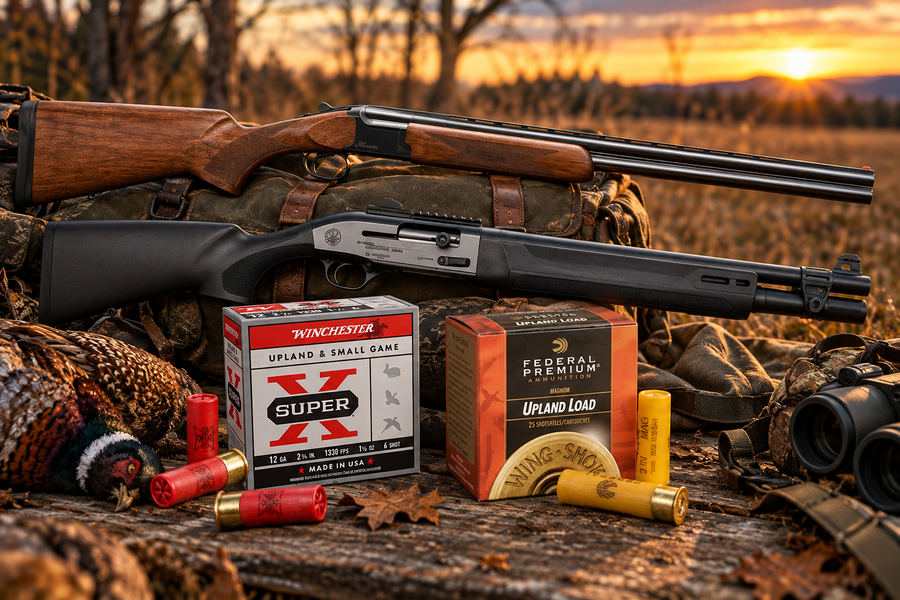
For most buyers who want one shotgun with the broadest possible range of factory ammunition and firearm choices, the 12 gauge remains the stronger all-around option. It is deeply established in clay shooting, upland hunting, waterfowl hunting, turkey hunting, and other lawful sporting applications, with an enormous range of target, field, nontoxic, and specialty loads available from major manufacturers.
The 20 gauge makes a particularly strong case for buyers who value a lighter, more compact field shotgun. Many 20-gauge models use receivers, barrels, and stocks scaled specifically around the smaller bore, which can reduce carrying weight and create a noticeably different handling experience compared with a full-size 12 gauge.
That does not mean a 20 gauge always recoils less. Recoil depends on the complete combination of projectile or shot payload, velocity, powder charge, firearm weight, stock fit, recoil pad, and operating system. A light 20-gauge field gun firing a relatively heavy hunting load can feel sharper than a heavier 12-gauge target gun firing mild ammunition.
For most shoppers, the better gauge is therefore determined by the complete shotgun and its intended use rather than by bore diameter alone. Someone seeking maximum versatility may lean toward 12 gauge, while a hunter who values lighter carry weight and prefers the handling of a dedicated smaller-frame gun may find the 20 gauge more appealing.
Key Takeaways
- The 12 gauge has a larger nominal bore diameter and the broadest overall selection of factory shotgun ammunition and firearm configurations.
- The 20 gauge is often offered in lighter, more compact shotguns, but the amount of weight reduction depends on the actual model.
- Gauge alone does not determine recoil. Load weight, velocity, shotgun weight, stock fit, recoil pad, and operating system all influence the shooting experience.
- Both gauges are well established for clay shooting and numerous hunting applications when paired with appropriate ammunition and used in accordance with applicable regulations.
- Pattern quality is determined by the shotgun, choke, ammunition, and individual barrel rather than by gauge alone.
- 12 gauge generally provides more ammunition choices, particularly in specialized hunting and nontoxic-shot categories.
- 20 gauge can be especially attractive for upland hunters and other shooters who prioritize carrying weight and lively handling.
- The best comparison is between complete factory shotguns, not just the numbers 12 and 20 printed on the barrel.
Understanding Shotgun Gauge
Shotgun gauge uses a traditional measurement system that can appear backward to someone more familiar with rifle and handgun calibers. The gauge number is historically based on the number of spherical lead balls, each having the same nominal diameter as the bore, that would collectively weigh one pound.
Under that system, a lead sphere matching a 12-gauge bore would weigh approximately one-twelfth of a pound, while a sphere matching a 20-gauge bore would weigh approximately one-twentieth of a pound. Because fewer larger lead balls are required to make one pound, the smaller gauge number identifies the larger bore.
The 12 gauge has a nominal bore diameter of approximately 0.729 inch, while the 20 gauge is approximately 0.615 inch. Those figures describe the nominal bore and should not be confused with the outside diameter or complete dimensions of the shotshell.
Individual shotgun barrels can also vary somewhat within manufacturing standards, particularly when manufacturers use overbored barrel designs or other internal geometry intended to influence patterning or recoil characteristics. The gauge designation therefore identifies the general bore category rather than one microscopic measurement that every barrel must share exactly.
Why Is 12 Gauge Larger Than 20 Gauge?
The historical gauge system explains why a 12 gauge is larger than a 20 gauge even though the number is smaller. Twelve bore-sized lead balls weighing one pound must each be larger than twenty balls that collectively weigh the same amount.
This numbering system differs completely from most modern cartridge names, where a larger numerical caliber often corresponds to a larger projectile diameter. Buyers unfamiliar with shotguns can therefore understandably assume that 20 gauge must be larger or more powerful because the number is higher.
Gauge also does not tell you exactly how much shot will be inside a particular shell. Manufacturers offer overlapping payload weights across gauges, and individual shotshell specifications vary according to shell length, application, shot material, shot size, velocity, and product design.
12 Gauge vs. 20 Gauge: Basic Comparison
| Feature | 12 Gauge | 20 Gauge |
|---|---|---|
| Nominal Bore Diameter | Approx. 0.729 in. | Approx. 0.615 in. |
| Common Shell Lengths | 2¾, 3, and 3½ in. | 2¾ and 3 in. |
| Typical Factory Gun Size | Often larger or heavier | Frequently lighter or scaled down |
| Factory Ammunition Selection | Extremely broad | Broad, but generally narrower |
| Target Ammunition | Extensive selection | Widely available |
| Hunting Ammunition | Extensive selection | Strong selection in common applications |
| Recoil | Load and firearm dependent | Load and firearm dependent |
| Common Buyer Priority | Maximum versatility | Lighter handling and carrying weight |
The table illustrates why neither gauge can be ranked using one specification. The 12 gauge has a larger bore and usually offers more load options, while the 20 gauge often gains its appeal from the shotgun built around it rather than from the gauge designation in isolation.
Why Choose a 12-Gauge Shotgun?
The 12 gauge is one of the dominant shotgun chamberings in the modern sporting market. It appears in inexpensive pump guns, premium over-unders, inertia-operated semiautomatics, gas-operated hunting guns, competition shotguns, turkey configurations, waterfowl guns, slug guns, and numerous other designs.
That enormous platform variety is one of the 12 gauge's biggest practical strengths. A buyer can move from an entry-level field pump to a dedicated trap gun or lightweight upland semiautomatic without abandoning the same gauge.
The ammunition market is equally broad. Manufacturers offer light target loads, heavier field loads, waterfowl ammunition using approved nontoxic shot materials, turkey loads, buckshot, slug ammunition, and numerous specialty products.
This does not mean one 12-gauge shotgun can perform every possible role equally well. A heavy 32-inch target over-under and a light field pump may use the same gauge but handle very differently because barrel length, stock dimensions, action type, balance, choke system, and overall weight are different.
Why 12 Gauge Became the General-Purpose Standard
The 12 gauge sits in a useful middle ground between very large historical shotgun bores and smaller sporting gauges. It can accommodate relatively light target ammunition while also supporting substantially heavier field loads in firearms designed for them.
That flexibility encouraged firearm and ammunition manufacturers to invest heavily in the gauge. The resulting market depth reinforces itself: more shooters use 12 gauge because ammunition is plentiful, and manufacturers continue offering more ammunition because the shooter base is so large.
For someone who owns only one shotgun, that broad support can be reassuring. Local stores are generally more likely to have multiple 12-gauge target or hunting options available than the same number of comparable 20-gauge products, especially when the desired load is specialized.
Why Choose a 20-Gauge Shotgun?
The 20 gauge uses a smaller nominal bore and has a long history in hunting, recreational shooting, youth-sized sporting guns, and lightweight field shotguns. It remains one of the most commercially important shotgun gauges rather than a niche alternative to 12 gauge.
Its greatest advantage is often the firearm designed around it. Manufacturers can build a smaller receiver, lighter barrel assembly, narrower fore-end, and more compact stock around the 20-gauge cartridge, which can produce a shotgun that feels noticeably lighter and quicker in the hands.
That can be especially attractive when the shotgun spends much more time being carried than fired. Walking several miles across upland terrain with a six-pound field gun can feel very different from carrying a substantially heavier target-oriented shotgun, even if both are comfortable when fired from a stationary position.
Not every manufacturer scales the action to the gauge, however. Some shotgun families share substantial architecture between chamberings, which can reduce the amount of weight or size difference. The actual published specifications remain more useful than simply assuming the 20-gauge version will be dramatically smaller.
Why Some Hunters Prefer 20 Gauge
Many hunters choose 20 gauge because of how a well-designed small-frame shotgun carries and points. A lighter firearm can move quickly between targets and may be less tiring during a full day of walking through fields, timber, or uneven terrain.
This is one reason the 20 gauge remains closely associated with upland bird hunting. The shotgun may be carried for hours before only a few shooting opportunities appear, making weight and balance extremely important parts of the overall experience.
The 20 gauge also has enough commercial support that hunters are not limited to a tiny handful of ammunition choices. Major manufacturers offer target, upland, turkey, waterfowl, and other sporting loads, although the number of available combinations is generally smaller than in 12 gauge.
Does 12 Gauge Have More Recoil Than 20 Gauge?
The simple answer is that it often can, but gauge by itself is not enough information to predict recoil. A 12-gauge shell can contain a heavier payload or operate at a different velocity than a 20-gauge shell, but the shotgun's weight and design also change the recoil experienced by the shooter.
Free recoil is influenced by the momentum of the shot, wad, and propellant gases moving forward and the mass of the firearm moving rearward. If two shotguns fire substantially different payloads at different speeds and weigh different amounts, comparing them only according to gauge is incomplete.
SAAMI reference information illustrates how loads can differ even within ordinary categories. Its reference tables include a 12-gauge 2¾-inch lead field load using a 1¼-ounce payload at a nominal 1,330 fps, while the comparable 20-gauge reference uses a 1-ounce payload at 1,220 fps. Those are laboratory reference loads rather than universal hunting recommendations, but they show why gauge and load specifications need to be considered together.
A 20 gauge firing a lighter payload from a shotgun of similar weight will generally produce less calculated recoil than a comparable heavier 12-gauge load. The complication is that 20-gauge field guns are frequently much lighter, which can narrow the difference or change how sharply the recoil impulse feels.
Free Recoil and Felt Recoil Are Not the Same Thing
Calculated free recoil is a physics problem. Felt recoil is a human experience.
Two shotguns producing similar calculated recoil energy can feel noticeably different because the force is delivered through different stock shapes, recoil pads, operating systems, and weight distributions. The shooter's body position, clothing, mounting technique, and physical build also affect the sensation.
This is why recoil discussions are often contradictory. One shooter may describe a particular shotgun as exceptionally soft, while another finds the same model uncomfortable because the stock dimensions do not fit properly.
For someone especially sensitive to recoil, actually handling and, where possible, shooting the firearm can provide much more useful information than comparing gauge numbers alone.
Shotgun Weight Has a Major Effect on Recoil
Other variables being equal, a heavier shotgun accelerates rearward less violently than a lighter one when the same ammunition is fired. This is why heavy clay-target guns can feel surprisingly comfortable through large round counts despite being chambered in 12 gauge.
The tradeoff appears during carrying and movement. A nine-pound target gun may feel comfortable during a hundred-shot range session but become tiring during a long walk through upland cover.
A lightweight 20 gauge reverses that equation. It can be easy to carry and extremely responsive, but the reduced gun weight means there is less mass available to absorb the momentum generated by the shot.
The best configuration depends on whether the buyer values carry comfort, shooting comfort, or a compromise between the two.
Stock Fit Can Matter More Than Gauge
A shotgun's stock determines how the firearm interfaces with the shooter's shoulder, face, and hands. Length of pull, drop at comb, drop at heel, cast, grip geometry, and recoil-pad shape can all influence comfort and consistency.
A poorly fitting shotgun can concentrate pressure against the cheek or shoulder, making mild ammunition feel unpleasant. A properly fitting heavier shotgun can distribute recoil much more comfortably and also mount more consistently.
That is why simply recommending 20 gauge to every recoil-sensitive shooter can be counterproductive. The smaller gun may have a stock that fits worse or may be so light that it feels sharper than expected.
Does a Semiautomatic Shotgun Recoil Less?
The operating system can influence perceived recoil because a semiautomatic spreads parts of the operating cycle over time. Gas-operated shotguns in particular redirect propellant gas to cycle the action, which can change the shape of the recoil impulse compared with many fixed-breech or manually operated firearms.
This does not eliminate recoil or guarantee that every gas-operated shotgun will feel softer than every pump, break-action, or inertia-operated model. Gun weight, stock design, ammunition, recoil-pad construction, and the specific operating system all matter.
Beretta's A300 Ultima provides a useful example. The current A300 family uses a gas-operated action, and standard Ultima sporting models incorporate Beretta's Kick-Off recoil-reduction system. That combination gives buyers a way to manage shooting comfort without automatically moving to a smaller gauge.
12 Gauge vs. 20 Gauge Ammunition Selection

Ammunition availability remains one of the clearest advantages of 12 gauge. Nearly every major shotshell manufacturer devotes a large portion of its catalog to the gauge, covering recreational clay shooting, hunting, specialized nontoxic loads, slug ammunition, and numerous other uses.
The 20 gauge also has a healthy ammunition market. Common target and hunting products are readily available in many areas, and manufacturers increasingly offer specialized 20-gauge turkey and waterfowl ammunition as well.
The difference becomes more obvious when a buyer wants a very specific shot material, velocity, payload, or shot size. In those narrower categories, 12 gauge often provides more choices and may be easier to find locally.
Anyone who lives far from large sporting-goods retailers should check local ammunition availability before selecting a less common configuration. The best shotgun becomes less convenient when the preferred ammunition is difficult to replace during hunting season.
Common Shotshell Lengths
The most familiar modern 12-gauge shotshell lengths are 2¾ inches, 3 inches, and 3½ inches, although shorter specialty ammunition also exists. Twenty-gauge ammunition is commonly offered in 2¾- and 3-inch lengths.
The shell-length designation generally refers to the length of the fired case after the crimp has opened. An unfired shell can therefore appear physically shorter than the chamber designation printed on the box.
This is an important safety issue because an unfired longer shell may appear to fit into a chamber that is not rated for it. The firearm's marked gauge and chamber length, along with the manufacturer's instructions, determine which ammunition may be used.
A shotgun marked for 3-inch shells can generally also use compatible shorter shells of the same gauge when permitted by the manufacturer. The reverse is not true, and a longer shell must never be fired simply because it can be inserted into the chamber.
Do You Need a 3½-Inch 12 Gauge?
For many shooters, no. The 3½-inch 12-gauge chamber provides access to heavier or specialized loads, but that does not mean those loads are necessary for every application.
Modern 2¾- and 3-inch ammunition covers an enormous range of clay and hunting uses. Longer shells can increase payload capacity, but they can also increase recoil and ammunition cost depending on the load.
A 3½-inch-capable shotgun can still be attractive because it expands ammunition compatibility. The value comes from having the option rather than from assuming the longest available shell is always the best choice.
Payload Weight Matters More Than Gauge Alone
The payload is the weight of the shot charge or other projectile carried by the shell. A heavier payload sends more material downrange but also contributes to recoil and can alter velocity and pattern behavior.
There is substantial overlap between the payload ranges available in 12 and 20 gauge. This is another reason simple claims such as “12 gauge always throws more shot” can be misleading when discussing individual shells.
The 12 gauge does offer more room for heavy payloads overall, particularly in larger 3- and 3½-inch shells. The 20 gauge can still deliver substantial sporting payloads in its own 2¾- and 3-inch ammunition.
Shot Size Is Independent of Gauge
Shot size refers to the diameter of the individual pellets, not the gauge of the shotgun. Both 12- and 20-gauge shells can be loaded with the same nominal shot size, depending on the ammunition design and intended use.
A shell containing smaller pellets will generally hold more individual pellets for a given payload weight than one loaded with larger pellets. The appropriate shot size depends on the target or game, shot material, ammunition design, applicable regulations, and range.
Gauge determines the bore through which that payload travels. It does not change the nominal diameter of a No. 7½ or No. 4 pellet simply because the shell is 12 or 20 gauge.
Does 12 Gauge Throw a Wider Pattern?
Not automatically. Pattern diameter and pellet distribution depend on the actual shotgun, choke, ammunition, shot construction, velocity, wad design, and distance.
A 20-gauge shotgun does not inherently throw a narrower pattern merely because it has a smaller bore. Likewise, a 12 gauge does not automatically create a wider or more useful pattern.
The only reliable way to understand how a shotgun patterns with a particular load is to test that exact combination on paper at appropriate distances. Pattern testing can reveal differences that are impossible to predict from the gauge label on the barrel.
Choke Matters Enormously
A choke modifies the effective constriction near the muzzle and influences how the shot cloud develops after leaving the barrel. Common designations include cylinder, improved cylinder, modified, improved modified, and full, along with numerous specialized turkey and sporting constrictions.
Two shotguns of the same gauge can produce very different patterns when fitted with different chokes. The same choke designation can also perform differently with different ammunition because pellet material, wad design, shot hardness, and velocity influence the result.
This is why gauge comparisons should not replace actual pattern testing. A well-matched 20-gauge load and choke can produce an excellent hunting pattern, while a poorly matched 12-gauge combination can produce disappointing pellet distribution.
12 Gauge vs. 20 Gauge for Clay Shooting

Both gauges are legitimate choices for clay target shooting. Twelve gauge dominates much of the trap, skeet, and sporting-clays market because of the enormous variety of target guns and ammunition available.
The 12 gauge also allows shooters to use relatively light target loads in a heavier firearm, which can create a comfortable combination during high-volume shooting. This is one reason dedicated target guns are frequently heavier than field guns.
Twenty gauge remains popular in recreational clays and in events or categories where smaller gauges are used. A shooter who already owns a well-fitting 20-gauge field or sporting gun can enjoy clay shooting without feeling obligated to move to 12 gauge.
Competition rules matter as well. Organized disciplines can establish gauge, ammunition, payload, or equipment requirements, so competitors should consult the current rules of the organization they intend to shoot.
Why 12 Gauge Is So Common in Sporting Clays and Trap
The 12 gauge provides a massive selection of target-oriented ammunition, barrels, choke systems, and dedicated sporting shotguns. Manufacturers also offer many adjustable stocks and competition-oriented configurations in 12 gauge because the market demand is so large.
High-volume clay shooters often prefer a somewhat heavier gun because smooth movement and manageable recoil can matter more than reducing carrying weight. The shotgun may be carried only between stations rather than through several miles of hunting terrain.
This is a good example of the same gauge producing very different ideal firearm designs. A heavy 12-gauge target over-under and a light 12-gauge upland semiautomatic are both logical products because their intended jobs are different.
Is 20 Gauge Good for Recreational Clays?
Yes. Twenty gauge is fully capable of recreational clay shooting and can be especially enjoyable in a shotgun that fits the user well.
The main limitation is not basic capability but market depth. Shooters will generally find more dedicated 12-gauge target guns and a greater range of inexpensive 12-gauge target ammunition.
Someone who already owns a 20 gauge or strongly prefers its handling should not interpret that market difference as a reason the smaller gauge is unsuitable. For recreational use, fit, ammunition availability, and comfort matter more than following the dominant gauge at a competition range.
12 Gauge vs. 20 Gauge for Upland Hunting

Upland hunting is one of the clearest areas where the 20 gauge can shine. The combination of a smaller receiver, lighter barrels, and reduced overall firearm weight can produce a shotgun that is easy to carry during long days covering ground.
That does not automatically make 20 gauge better. The 12 gauge remains widely used for upland hunting and gives the hunter access to an enormous range of loads, shot materials, and firearm styles.
The best choice often comes down to how much time the shotgun will spend being carried compared with fired. A hunter walking all day may place a high value on every saved ounce, while another hunter may prefer the steadier swing and additional ammunition options of a heavier 12 gauge.
12 Gauge vs. 20 Gauge for Waterfowl

The 12 gauge is especially dominant in waterfowl hunting because manufacturers offer a broad range of steel, bismuth, tungsten-based, and other approved nontoxic loads. Larger payload options and extensive shotgun selection give hunters substantial flexibility when matching ammunition to species, conditions, and local regulations.
Twenty gauge has become increasingly capable in the same role. Modern nontoxic ammunition allows hunters to choose from several 20-gauge waterfowl products, and some hunters strongly prefer carrying a lighter shotgun in marshes, fields, or flooded timber.
Federal law requires hunters pursuing waterfowl and coots in the United States to use shot approved as nontoxic. State regulations and specific public hunting areas can impose additional restrictions, so hunters should verify current federal, state, and location-specific rules before the season.
The gauge itself does not determine legality. Both 12- and 20-gauge ammunition can be produced with approved nontoxic shot materials, but the available product selection is generally broader in 12 gauge.
12 Gauge vs. 20 Gauge for Turkey Hunting

Both gauges have substantial representation in modern turkey hunting. Twelve gauge offers the widest selection of dedicated turkey shotguns, choke tubes, and ammunition, including very heavy payload options.
Twenty gauge has gained considerable popularity because modern ammunition can provide dense patterns from smaller and lighter shotguns. Dedicated 20-gauge turkey guns can be especially attractive to hunters who value compact dimensions or reduced carrying weight.
The critical issue is pattern performance. Turkey loads can behave very differently from one barrel and choke combination to another, so hunters should verify the pattern produced by the specific shotgun and ammunition they plan to use.
Applicable shot-material rules and seasonal regulations also vary by location. The ammunition that performs best on paper still needs to be lawful where the hunt occurs.
12 Gauge vs. 20 Gauge for Deer Hunting

Shotguns remain legal for deer hunting in certain jurisdictions and hunting zones, with exact equipment rules varying considerably by state and season. Both 12- and 20-gauge slug ammunition are commercially available, and suitable slug-gun configurations have been produced in both gauges.
Twelve gauge generally offers a larger selection of slug loads and dedicated shotgun configurations. Twenty gauge remains a legitimate option where allowed, particularly for hunters who prefer a lighter firearm or specific 20-gauge slug platform.
Deer ammunition should be selected according to the shotgun manufacturer's recommendations and current hunting regulations. Smoothbore barrels, rifled barrels, rifled slugs, and sabot ammunition are not interchangeable concepts, and the correct combination depends on the firearm.
Which Gauge Is Better for Beginners?
Neither gauge deserves a universal beginner label. A beginner needs a shotgun that fits correctly, can be mounted consistently, produces manageable recoil with appropriate ammunition, and is supported by qualified instruction.
The 20 gauge is often recommended because smaller and lighter guns are available. That can help a smaller-framed shooter manage the firearm's size, but a very light shotgun can also transmit recoil more sharply.
A heavier 12-gauge semiautomatic firing mild target ammunition may feel considerably softer than a light 20-gauge break-action firing a stout field load. This is why the complete shotgun and ammunition should be evaluated rather than relying on gauge reputation.
Is 20 Gauge Better for Smaller-Framed Shooters?
It can be, but the reason is often gun dimensions rather than gauge alone. Manufacturers frequently build shorter stocks, slimmer fore-ends, and reduced-weight configurations around the 20 gauge.
That can make the shotgun easier to mount and control for someone who struggles with the proportions of a full-size 12 gauge. The improvement comes from fit and handling, not simply from a smaller bore.
Many 12-gauge manufacturers also offer compact stocks or adjustable systems. A properly fitted 12 gauge should therefore remain in the comparison rather than being eliminated immediately.
12 Gauge vs. 20 Gauge for High-Volume Shooting
Someone firing hundreds of rounds in one day should think carefully about gun weight, recoil impulse, stock fit, and ammunition cost. The lightest shotgun is not necessarily the most comfortable choice when carrying weight becomes less important than repeated recoil.
This is why clay-target guns are commonly heavy. Additional mass smooths the swing and can reduce rearward acceleration, making the firearm more comfortable over long shooting sessions.
A light 20-gauge hunting shotgun may be wonderful to carry but less pleasant during several boxes of ammunition. Buyers who want one shotgun to serve both field and high-volume range roles may need to compromise between portability and shooting comfort.
12 Gauge vs. 20 Gauge for Carrying in the Field
Field carry reverses the priorities. A shotgun that saves a pound may become significantly more enjoyable after several hours of walking, especially in hilly terrain or thick cover.
This is where a true scaled-frame 20 gauge can deliver an advantage that cannot be duplicated simply by putting a 20-gauge barrel on a full-size 12-gauge receiver. The entire gun can be narrower, shorter, and lighter.
Hunters should compare actual catalog weights and handle the firearm whenever possible. Balance can make two shotguns with similar published weights feel surprisingly different.
Factory Shotgun Examples
Several major shotgun families help illustrate the differences between gauges because they are or have recently been offered in both 12- and 20-gauge versions. Comparing similar product families removes some of the confusion created when a lightweight 20-gauge field gun is placed against a heavy 12-gauge target model.
Mossberg's Model 500, the Remington Model 870 family, Beretta's A300 Ultima, and Browning's Citori line represent pump-action, gas-operated semiautomatic, and over-under approaches. The exact model specifications still vary, so buyers should compare individual SKUs rather than treating each product-family name as one universal gun.
Mossberg 500: A Traditional Pump-Action Comparison

The Mossberg 500 is one of the longest-running American pump-action shotgun families and remains a useful platform for comparing 12 and 20 gauge. Mossberg's current manual covers 500-series models in 12 gauge, 20 gauge, and .410 bore, with 12- and 20-gauge configurations designed around compatible 2¾- and 3-inch shells according to the specific firearm marking.
The 500 family has appeared in numerous field, combo, turkey, deer, youth, and general sporting configurations. This breadth makes the platform useful for understanding how much the complete firearm can change even when the action design and manufacturer remain familiar.
A 20-gauge 500 can be noticeably lighter or more compact than certain 12-gauge configurations, but the difference depends on stock, barrel, magazine, and receiver setup. A buyer should compare the exact factory weights instead of relying on the assumption that every 20-gauge 500 will be dramatically smaller.
Remington 870: A Current Platform With a Changing 2026 Catalog

The Remington Model 870 remains one of the most established pump-action shotguns ever produced, and the platform is still represented in current 2026 Remington materials. Its steel receiver, dual action bars, interchangeable barrel concept, and enormous historical production base have made the 870 a long-term reference point in the shotgun market.
The recent RemArms-era FieldMaster lineup included both 12- and 20-gauge field configurations, along with several barrel-length and compact-stock options. In late 2026, however, Remington's firearms business is transitioning under Frontier Defense Group and the company's new website has not yet republished the full individual-SKU catalog.
That means shoppers should verify current availability rather than assuming every recent FieldMaster version remains continuously produced. The broader 870 platform is still current, but late-2026 model availability is less settled than it was under the previous catalog.
This is also a reminder that support and parts availability can matter as much as the original specification sheet. The 870's enormous installed base provides an advantage, but buyers should still verify the current manufacturer, warranty, and replacement-part situation for a new purchase.
Beretta A300 Ultima: Comparing Both Gauges in a Gas Gun

The Beretta A300 Ultima provides an especially useful semiautomatic comparison because Beretta currently specifies the standard sporting family in both 12 and 20 gauge. The platform uses a gas-operated semiautomatic action, an aluminum-alloy receiver, and chambers intended for compatible 2¾- and 3-inch ammunition.
Standard A300 Ultima sporting models also use Beretta's Kick-Off recoil-reduction system in the stock. This allows buyers to evaluate the effect of gauge inside a platform specifically designed around recoil management rather than assuming the bore diameter tells the whole story.
A 20-gauge A300 Ultima can appeal to a hunter who wants lighter handling while retaining gas operation. A 12-gauge version provides access to the largest ammunition market and may still feel extremely manageable because of the shotgun's operating system, stock design, and recoil equipment.
Browning Citori: Gauge Choice in an Over-Under

Browning's Citori family has been in production since the 1970s and remains active in the 2026 catalog. Current and recent Citori variants include 12- and 20-gauge configurations across field and clay-oriented models, giving buyers another useful way to compare gauges within the same basic over-under architecture.
Because an over-under does not use a gas or inertia system to cycle the action, the relationship among gun weight, stock fit, and ammunition becomes especially apparent. A light 20-gauge field Citori can feel lively and easy to carry, while a heavier 12-gauge sporting model can feel smoother during sustained clay shooting.
The Citori also demonstrates that 20 gauge should not be treated as a budget or beginner category. Premium 20-gauge over-unders can cost as much as or more than many 12-gauge semiautomatics and pump guns because price is driven by the complete firearm, materials, fitting, engraving, and market position.
Representative Factory Platform Comparison
| Platform | Operating System | Gauge Availability | Typical Role | Main Comparison Point |
|---|---|---|---|---|
| Mossberg 500 | Pump action | 12 and 20 gauge | Field and general sporting use | Configuration and weight |
| Remington 870 Family | Pump action | 12 and 20 gauge represented in recent lineups | Field and general sporting use | Current model availability |
| Beretta A300 Ultima | Gas-operated semiautomatic | 12 and 20 gauge | Hunting and sporting use | Recoil system, fit, and weight |
| Browning Citori | Over-under | 12 and 20 gauge among multiple gauges | Field and clay shooting | Model-specific balance and price |
Which Gauge Has Better Ammunition Availability?
The 12 gauge wins this category clearly. Its dominant market share gives buyers more choices in shot size, payload, shell length, velocity, shot material, slug design, and specialized hunting ammunition.
Twenty gauge still has enough commercial support for most common sporting uses. A hunter or recreational shooter using mainstream target, upland, turkey, or waterfowl loads is unlikely to find the gauge unsupported.
The difference becomes more important when ammunition availability is inconsistent or the user wants a very particular specialized load. In those situations, the breadth of the 12-gauge market can make ownership easier.
Which Gauge Is Usually Cheaper to Shoot?
There is no rule that 12-gauge ammunition must always cost less than 20 gauge, but the enormous 12-gauge market can create more options at competitive prices. High production volume and broad distribution frequently make entry-level 12-gauge target ammunition easy to find.
Twenty-gauge target ammunition is also widely available, but individual stores may stock fewer brands or load variations. Premium hunting ammunition in either gauge can cost substantially more than ordinary range shells.
The useful comparison is therefore between equivalent products in the same category. Comparing a basic 12-gauge target load with a premium 20-gauge tungsten hunting shell would say nothing meaningful about the general cost difference between gauges.
Which Gauge Has Better Shotgun Selection?
Again, 12 gauge has the broader market. Nearly every major shotgun manufacturer offers multiple 12-gauge designs across pump, semiautomatic, over-under, side-by-side, and specialized sporting categories.
Twenty gauge still enjoys far more platform support than smaller gauges such as 28 gauge or .410 bore. Buyers can find inexpensive pumps, premium semiautomatics, lightweight field guns, and high-end doubles without moving into an obscure market.
The distinction matters most for buyers who want a very specific stock geometry, action type, barrel length, finish, or accessory system. The 12 gauge is simply more likely to have several models matching a narrow list of requirements.
Does 12 Gauge Have Better Range?
Gauge alone does not establish one fixed effective range. The useful distance of a shotgun depends on pattern density, pellet size and material, remaining pellet energy, choke, ammunition design, target type, firearm performance, and the shooter's ability.
A larger 12-gauge payload can provide more pellets in some load comparisons, which may help maintain pattern density under certain conditions. That does not mean every 12-gauge load is automatically effective farther than every 20-gauge load.
Hunters should pattern the actual shotgun and ammunition combination at realistic distances and remain within the performance envelope of the load. Manufacturer guidance and hunting regulations should also determine what constitutes an appropriate application.
Does 20 Gauge Pattern More Tightly?
No universal rule supports that assumption. The smaller bore does not automatically compress the shot into a tighter downrange pattern.
Choke constriction, wad design, shot material, pellet quality, bore geometry, forcing-cone design, and ammunition all influence how the pattern develops. Two 20-gauge loads fired through the same shotgun can produce noticeably different patterns.
This is another area where paper targets are more useful than internet folklore. Patterning reveals the actual pellet distribution and can identify both insufficient density and uneven gaps.
What About Pellet Deformation?
When a payload travels through the bore, some pellets can deform under acceleration and contact with other shot, the wad, and barrel surfaces. Deformed pellets can behave differently in flight from more spherical pellets and may contribute to flyers outside the central pattern.
Shot hardness, buffering, plating, wad design, payload size, and bore geometry can all influence deformation. Premium hunting ammunition may use specialized shot construction to manage these effects.
It is tempting to reduce the topic to a simple claim that one gauge always produces better shot columns or less deformation, but modern shotshell design is more complicated. The finished pattern from the actual shell remains the meaningful result.
What About Nontoxic Shot Materials?
Nontoxic ammunition has become an increasingly important part of shotgun selection. Steel remains extremely common, while manufacturers also offer approved bismuth and various tungsten-based products depending on application and current regulations.
Federal waterfowl rules require approved nontoxic shot for ducks, geese, swans, and coots. Additional state or public-land regulations can extend nontoxic requirements to other species or locations.
The 12 gauge generally offers the largest selection of these products. Twenty-gauge nontoxic ammunition is well established, but hunters looking for a very specific shot size or premium material may have fewer choices.
Does 20 Gauge Make More Sense With Modern Premium Ammunition?
Modern ammunition has unquestionably expanded what hunters can accomplish with a 20 gauge. Dense nontoxic materials and advanced wad systems can provide performance that would have been more difficult to achieve using older ammunition technology.
That does not erase the physical differences between 12 and 20 gauge or make payload capacity irrelevant. It simply gives shooters more viable options within the smaller gauge.
The practical result is that hunters should evaluate current ammunition rather than relying entirely on assumptions formed decades ago. A modern 20-gauge setup may fit an application extremely well, while the 12 gauge still provides greater overall flexibility.
12 Gauge vs. 20 Gauge for One-Shotgun Ownership
If someone intends to own only one shotgun and wants to use it across several sporting activities, 12 gauge is generally the safest recommendation. The breadth of ammunition and firearm support gives the owner more ways to adapt the same gauge to different roles.
A 12-gauge semiautomatic with interchangeable chokes, for example, can serve recreational clays and several hunting applications with appropriate ammunition. A pump-action field gun can offer similar versatility at lower cost.
The 20 gauge can still serve as a one-shotgun solution, especially for someone whose interests center on upland hunting and recreational shooting. The choice simply involves accepting a somewhat smaller ammunition and platform market in exchange for access to many lighter firearms.
12 Gauge vs. 20 Gauge for Multiple-Shotgun Owners
The comparison changes when the buyer already owns several shotguns. There is less pressure for every firearm to cover every sporting role.
A 12-gauge target gun can remain dedicated to clays while a lightweight 20-gauge over-under or semiautomatic becomes the upland gun. In that situation, specialization becomes an advantage rather than a limitation.
This is one reason experienced shotgun owners frequently end up with several gauges. The guns are selected according to handling and use rather than because one chambering has been declared universally superior.
What Should Hunters Prioritize?
Start with the game, terrain, regulations, and type of shooting expected. Then determine which ammunition is appropriate and legal before choosing the firearm.
For upland hunting, carry weight and fast handling may push the decision toward a dedicated 20 gauge. For waterfowl, the broader 12-gauge nontoxic-ammunition market may become more important.
For turkey or deer hunting, the exact shotgun, choke or barrel type, and ammunition can matter more than the gauge itself. The rifle-style question of simply choosing the larger bore does not capture how shotguns actually perform.
What Should Clay Shooters Prioritize?
Fit and balance should move near the top of the list. A shotgun that mounts consistently and swings naturally will generally provide more benefit than choosing a gauge based solely on published payload capacity.
High-volume shooters should also consider recoil comfort and ammunition price. A heavier 12-gauge sporting gun can be extremely comfortable over a long session, while a very light field shotgun may become tiring even if it uses 20-gauge ammunition.
Competition rules should be reviewed before buying a gun specifically for organized events. Recreational shooters have much more flexibility and should choose the setup they enjoy shooting.
What Should Recoil-Sensitive Buyers Prioritize?
Start with the complete shotgun rather than automatically selecting 20 gauge. Compare gun weight, stock fit, recoil pad, operating system, and the actual ammunition you expect to use.
A gas-operated 12 gauge firing light target loads can be surprisingly gentle. A lightweight 20-gauge pump or over-under with heavier field ammunition can feel noticeably sharper.
If possible, try several combinations before purchasing. Comfort is too personal to reduce to a single gauge recommendation.
What Should Buyers Who Walk Long Distances Prioritize?
This is where the 20 gauge deserves especially serious consideration. A scaled-frame shotgun can reduce weight enough to make a meaningful difference during a full day in the field.
Balance matters alongside total weight. A well-balanced six-pound shotgun may feel more natural than another firearm that is only slightly heavier but carries too much mass toward the muzzle.
Published specifications provide a starting point, but actual handling remains difficult to predict from numbers alone.
Quick Buying Decision Guide
| Buyer Priority | Gauge Worth Considering | Main Reason |
|---|---|---|
| Broadest ammunition selection | 12 gauge | Largest overall factory market |
| Maximum shotgun model variety | 12 gauge | Extensive choices across operating systems |
| Lightweight upland gun | 20 gauge | Many scaled-frame field models |
| High-volume clay shooting | Usually 12 gauge | Large target-gun and ammunition market |
| Casual recreational clays | Either | Fit and comfort matter most |
| Waterfowl hunting | Often 12 gauge | Broader nontoxic ammunition selection |
| Upland bird hunting | Either | Weight and balance determine much of the appeal |
| Turkey hunting | Either | Pattern, choke, and ammunition matter more than gauge alone |
| Reduced felt recoil | Either | Complete firearm and load determine comfort |
| One shotgun for several activities | 12 gauge | Maximum versatility |
Common Mistake: Assuming 20 Gauge Always Kicks Less
This is probably the most common oversimplification in the entire comparison. Twenty-gauge ammunition often uses lighter payloads, which can reduce recoil, but manufacturers also build many 20-gauge shotguns specifically to be light.
The reduced gun weight can offset part of the recoil advantage. Heavy hunting loads can make that difference even more noticeable.
Anyone selecting 20 gauge purely to reduce recoil should compare real shotgun weights and representative ammunition rather than assuming the smaller bore guarantees comfort.
Common Mistake: Assuming 12 Gauge Is Always Too Heavy
Twelve-gauge shotguns vary dramatically in weight. Lightweight field semiautomatics and over-unders can be much easier to carry than the heavy target guns many shooters associate with the gauge.
A buyer who dismisses 12 gauge because one eight- or nine-pound target gun felt cumbersome may be comparing the wrong style of firearm. Field-oriented 12 gauges can offer very different handling.
The same applies in reverse. Not every 20 gauge is featherweight, particularly when the manufacturer uses a substantial receiver or builds the gun for high-volume target shooting.
Common Mistake: Assuming the Larger Bore Automatically Patterns Better
The 12 gauge can hold larger payloads in many load categories, but that does not automatically create a more even or effective pattern. Shot distribution depends on far more than pellet count.
A poorly matched choke and ammunition combination can produce large gaps even when the shell contains more pellets. A carefully selected 20-gauge load can produce excellent pattern density.
Patterning the gun is therefore more valuable than arguing about theoretical superiority.
Common Mistake: Ignoring Shell Length
Gauge alone is not enough to determine whether a shell belongs in the firearm. The marked chamber length matters just as much.
A 3-inch shell should not be fired in a shotgun whose barrel is marked only for 2¾-inch ammunition. A 3½-inch 12-gauge shell likewise requires a firearm specifically chambered for that length.
Manufacturer warnings should be taken literally. The fact that an unfired shell appears to fit does not establish that it is safe to fire.
Common Mistake: Putting the Wrong Gauge Shell in a Shotgun
Using the incorrect gauge can create an extremely dangerous barrel obstruction. A smaller-gauge shell can enter a larger-gauge chamber and lodge farther forward, potentially allowing another shell of the correct gauge to be loaded behind it.
Manufacturers specifically warn against this scenario because firing with the smaller shell obstructing the barrel can cause catastrophic damage and serious injury. Shooters should examine ammunition before loading and keep different gauges separated when practical.
This is especially important when 12- and 20-gauge ammunition are present on the same range or hunting trip.
Common Mistake: Buying the Gauge Before Choosing the Activity
The correct order is usually the opposite. Determine what the shotgun needs to do, then identify which gauge and firearm provide the best combination of ammunition, weight, handling, and price.
A buyer primarily interested in carrying a lightweight upland gun may arrive at 20 gauge naturally. Someone wanting one firearm for clays, waterfowl, turkey, and general sporting use may find 12 gauge much more practical.
Beginning with the application prevents the gauge debate from becoming a contest between numbers rather than a useful buying decision.
Which Gauge Makes More Sense?
For the broadest possible range of uses, 12 gauge remains the more flexible option. It gives buyers the largest selection of factory ammunition, the widest range of shotgun designs, and extensive support across target shooting and hunting.
Twenty gauge makes the strongest argument when the owner specifically values the size, weight, and balance of a smaller shotgun. It can deliver an excellent sporting experience without requiring the shooter to carry a full-size 12-gauge platform.
The difference is therefore not simply “more power versus less recoil.” The real comparison is versatility and market depth on one side, against the potential for lighter and more compact firearms on the other.
Final Thoughts
The 12 gauge and 20 gauge are both mature, capable shotgun chamberings with enormous histories in North American sporting use. Neither one needs to be defended as the universal winner because they solve overlapping problems through different combinations of bore size, payload capacity, firearm dimensions, and ammunition availability.
The 12 gauge remains the obvious choice when versatility is the first priority. It offers the largest overall ammunition market, the widest selection of shotguns, strong representation in nearly every major clay discipline, and substantial support across upland, waterfowl, turkey, and other hunting categories.
The 20 gauge becomes particularly compelling when the shotgun itself is scaled around the smaller bore. A dedicated small-frame gun can be noticeably lighter and easier to carry, making it especially appealing for hunters who spend hours walking with the firearm in their hands.
Recoil should not be used as a shortcut for choosing between them. A smaller gauge can use a lighter payload, but the lighter gun commonly associated with it can change the recoil equation significantly. Stock fit, recoil pad, semiautomatic operating system, ammunition velocity, payload weight, and shooter technique all contribute to perceived comfort.
Ammunition choice is equally important. Twelve gauge provides the broadest selection and gives buyers the greatest chance of finding multiple target, field, nontoxic, and specialty loads locally. Twenty gauge remains well supported for common applications, but the selection narrows as the ammunition becomes more specialized.
Modern ammunition has also expanded the usefulness of 20 gauge. Premium turkey and nontoxic hunting loads give smaller-bore shotguns capabilities that deserve to be evaluated according to actual pattern performance rather than assumptions based on gauge.
The firearm ultimately matters just as much as the ammunition. A Mossberg 500 pump, Beretta A300 Ultima semiautomatic, Browning Citori over-under, and Remington 870 may all be available in or associated with both gauges, but each operating system and configuration creates a very different shooting experience.
For a first-time buyer seeking one general-purpose sporting shotgun, 12 gauge remains the easiest recommendation because of its flexibility and market support. It gives the owner room to explore several activities without changing chamberings simply because a particular load is unavailable.
For someone who already knows they want a lighter field gun, especially for upland hunting or extended carry, a well-designed 20 gauge can make more sense even though the ammunition market is smaller.
The most useful question is therefore not which gauge is objectively better. It is which complete shotgun provides the right fit, weight, ammunition support, and handling for the activity the owner actually intends to pursue.
Neither the 12 gauge nor the 20 gauge is automatically the better choice for every shooter. The 12 gauge offers exceptional versatility, ammunition availability, and platform selection, while the 20 gauge can provide a lighter, more manageable alternative for hunters and recreational shooters.
The better choice depends on firearm fit, intended use, recoil tolerance, and ammunition availability rather than gauge alone. Those considering a shotgun for home protection can also explore defensive applications for 12-gauge shotguns to better understand how that specialized role differs from general hunting and sporting use.

Sterling 12 Gauge Field Range Can
$249.00
at Pro Armory
Prices accurate at time of writing
Frequently Asked Questions
Is a 12 gauge more powerful than a 20 gauge?
The 12 gauge generally supports a broader range of ammunition and can accommodate heavier payloads in many load categories. That does not mean every 12-gauge shell produces more energy or better sporting performance than every 20-gauge shell. The specifications of the actual ammunition determine the comparison.
Does a 20-gauge shotgun kick less than a 12 gauge?
Not automatically. Twenty-gauge loads often use lighter payloads, but 20-gauge shotguns are also frequently lighter. Payload weight, velocity, firearm weight, operating system, recoil pad, stock fit, and the individual shooter all influence recoil.
Is a 20 gauge good for beginners?
It can be, particularly when the firearm's dimensions fit the shooter well. A lighter shotgun is not always softer shooting, so buyers should compare complete shotgun configurations and appropriate ammunition rather than assuming a smaller gauge guarantees easier handling.
Is 12 gauge better for beginners?
A 12 gauge can also be an excellent beginner option, particularly in a properly fitting semiautomatic or heavier sporting gun firing mild target ammunition. Its broad ammunition availability and large firearm market can make ownership easier.
Is 20 gauge good for upland hunting?
Yes. The 20 gauge is widely used for upland hunting and is especially attractive in lightweight, scaled-frame field shotguns. Actual suitability depends on the game, ammunition, firearm, and local hunting regulations.
Is 12 gauge or 20 gauge better for waterfowl?
The 12 gauge generally offers the broader selection of approved nontoxic waterfowl ammunition and is extremely common for the application. Twenty gauge is also a viable choice with appropriate ammunition. Federal law requires approved nontoxic shot for waterfowl and coots, and additional state or location-specific regulations may apply.
Can you hunt turkey with a 20 gauge?
Yes, where lawful. Many manufacturers offer dedicated 20-gauge turkey shotguns, choke tubes, and ammunition. Pattern testing and compliance with current hunting regulations remain essential.
Can you hunt deer with a 20 gauge?
The 20 gauge has an established history in deer hunting in jurisdictions where shotguns and the appropriate ammunition are legal. Hunters should verify the shotgun barrel, ammunition type, manufacturer guidance, and current state hunting regulations.
Does a 12 gauge shoot farther than a 20 gauge?
Gauge alone does not establish useful range. Pattern density, projectile material, pellet size, velocity, choke, ammunition construction, target type, and the specific shotgun all determine effective sporting performance.
Does a 20 gauge make a tighter pattern?
Not inherently. Patterning depends on ammunition, choke, wad design, shot material, bore geometry, barrel, and distance. The only dependable way to compare patterns is to test the actual shotgun and load.
What are the normal shell lengths for 12 gauge?
Common modern 12-gauge shell lengths include 2¾, 3, and 3½ inches, with some shorter specialty loads also available. The firearm's chamber marking determines which lengths may be used safely.
What are the normal shell lengths for 20 gauge?
Modern 20-gauge ammunition is commonly available in 2¾- and 3-inch lengths. Shooters should always use shells that match the gauge and chamber-length markings on the shotgun.
Why does 20 gauge have a smaller bore even though the number is larger?
The gauge system is historically based on the number of bore-diameter lead balls required to weigh one pound. Because twenty smaller balls are needed to make one pound while only twelve larger ones are needed, 20 gauge has the smaller bore.
What is the bore diameter of a 12 gauge?
The nominal bore diameter is approximately 0.729 inch, although individual barrel designs can vary within manufacturing standards.
What is the bore diameter of a 20 gauge?
The nominal bore diameter is approximately 0.615 inch, with individual barrel dimensions varying according to manufacturer design and applicable standards.
Is 12-gauge ammunition cheaper?
Not always, but the very large 12-gauge market often gives buyers more options across price categories. Ammunition cost varies by shot material, payload, manufacturer, product line, and market conditions.
Is a 20-gauge shotgun lighter?
It often is, particularly when the manufacturer uses a dedicated smaller receiver and scaled components. Some 20-gauge models share substantial architecture with larger shotguns, so the exact factory weight should always be checked.
Is a semiautomatic shotgun softer shooting than a pump?
It can be. Gas-operated semiautomatics can change how the recoil impulse is delivered and may feel softer than some manually operated designs. Weight, stock fit, recoil pad, ammunition, and the specific shotgun still influence the result.
Do 12 gauge and 20 gauge use the same shot sizes?
They can. Shot size identifies pellet diameter, while gauge identifies the shotgun bore. Manufacturers offer many of the same shot sizes in both gauges depending on the intended ammunition application.
Which gauge is better for clay shooting?
The 12 gauge dominates much of the organized target-shotgun market because of its enormous ammunition and firearm selection. Twenty gauge remains fully capable for recreational clays and certain competition applications. Fit, balance, recoil comfort, and the rules of the intended discipline should guide the decision.
Which gauge is better for one-shotgun ownership?
For most buyers wanting one shotgun for several sporting activities, 12 gauge is the stronger general recommendation because of its broader ammunition and firearm market. A 20 gauge can still make an excellent one-gun choice for someone whose priorities strongly favor lighter carrying weight and smaller-frame handling.
About the Author
The ProArmory editorial team includes experienced hunters, competitive shooters, military veterans, firearms instructors, and firearms industry professionals committed to producing accurate, practical, and research-based content. Our articles draw on manufacturer specifications, current industry information, and real-world shooting experience to help readers make informed decisions about firearms, ammunition, optics, and related equipment.
Disclaimer
This article is intended for educational and informational purposes only. Shotgun specifications, ammunition offerings, chamberings, product availability, and hunting regulations can change over time.
Always use ammunition matching the exact gauge and chamber length marked on the firearm and approved by the manufacturer. Do not assume that an unfired shotshell is safe to use simply because it can be inserted into the chamber.
Hunters should verify current federal, state, and local regulations, including applicable nontoxic-shot requirements and species-specific equipment restrictions. Follow manufacturer instructions, established firearm-safety practices, and all applicable laws and regulations.


