



Quick Answer
The CZ Tactical Sport 3 Orange, officially styled CZ TS 3 ORANGE, is a premium 9mm competition pistol developed around the demands of modern practical shooting. First unveiled at IWA OutdoorClassics in February 2026 and announced for U.S. dealer availability in September, it represents a substantial evolution of CZ's Tactical Sports platform rather than a simple optics-ready refresh of the TS 2 Orange.
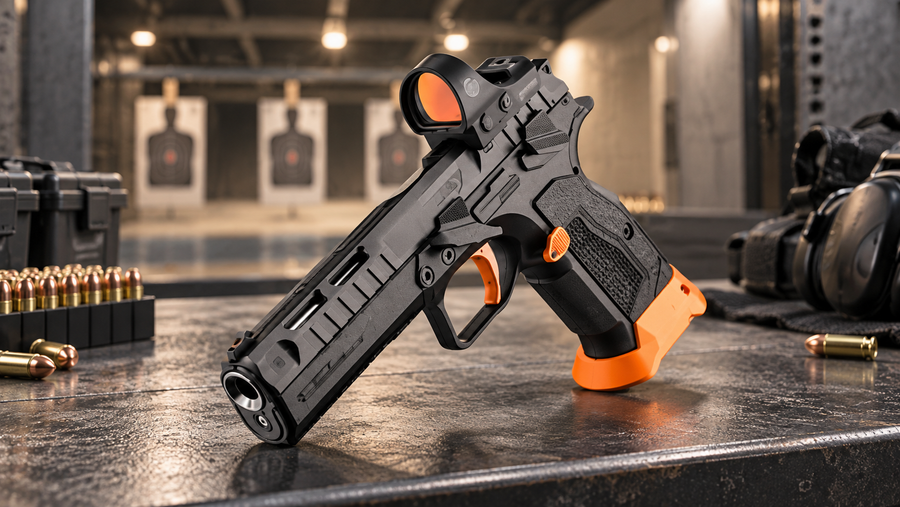
The biggest change is the factory direct-mount optics system. CZ designed the slide to support RMR, RMSc, DeltaPoint Pro, and Holosun K footprints through its integrated mounting arrangement without relying on a conventional adapter plate.
The rest of the pistol received equally serious attention. The TS 3 Orange uses a redesigned steel frame machined from a solid piece of steel, deeper undercuts beneath the trigger guard and beavertail, revised competition controls, a five-position magazine release, G10 grips, a newly developed competition hammer, and an exceptionally light single-action-only trigger with an approximately 1.3-pound manufacturer-rated pull.
Its heavy cold-hammer-forged bull barrel receives revised chamber geometry, a redesigned crown, a polished nitrided exterior, and individual fitting to the slide and frame. The pistol weighs roughly 51 to 52 ounces unloaded, holds 20+1 rounds in its standard configuration, and carries a U.S. MSRP of $3,549.
This is therefore not a pistol intended to compete with ordinary full-size striker-fired handguns. It belongs in the world of specialized practical-shooting equipment where trigger characteristics, balance, recoil behavior, control geometry, optic mounting, and manufacturing consistency matter enough to justify substantial cost.
For a serious competitor who specifically wants a factory-built Tactical Sports pistol for optics-oriented competition, the TS 3 Orange offers a compelling and unusually complete package.
For an existing TS 2 Orange owner, a recreational shooter, or someone who does not plan to exploit the direct-mount optic system and competition controls, the $3,549 upgrade becomes much harder to justify.
Key Takeaways
- CZ unveiled the TS 3 Orange at IWA OutdoorClassics in February 2026 and announced U.S. availability in September 2026.
- The U.S. MSRP is $3,549, placing the pistol firmly in premium competition-gun territory.
- The slide directly supports RMR, RMSc, DeltaPoint Pro, and Holosun K footprints without a conventional adapter plate.
- The pistol uses a redesigned steel frame, deeper grip undercuts, revised controls, G10 grips, and a five-position adjustable magazine release.
- The heavy cold-hammer-forged bull barrel receives revised chamber geometry, a redesigned crown, a nitrided polished exterior, and individual fitting.
- The single-action-only trigger is manufacturer rated at approximately 1.3 pounds with adjustable take-up and overtravel.
- CZ developed the pistol with input from elite IPSC competitor Eric Grauffel and explicitly targeted modern optics-oriented practical shooting.
- Grauffel won the 2026 CZ Extreme Euro Open's IPSC Optics division using the TS 3 Orange, providing meaningful early competition validation.
- The TS 3 Orange is a specialized sporting pistol, not an all-purpose handgun, and its value depends heavily on whether the owner will actually use its competition-specific features.
What Is the CZ TS 3 Orange?
The TS 3 Orange is the newest flagship in CZ's Tactical Sports family of steel-framed competition pistols.
The Tactical Sports concept has historically centered on substantial steel construction, single-action triggers, high magazine capacity, long barrels, and controls optimized for practical shooting rather than defensive carry.
The TS 3 preserves that philosophy while updating the platform around how top-level matches are increasingly shot.
Slide-mounted red dots now play a major role in practical-shooting competition, and CZ designed the TS 3 around that reality instead of treating optics as an accessory added to an iron-sight platform after the fact.
The result is a pistol whose frame, slide, trigger, barrel, magwell, controls, and optic mounting were all revised together.
This Is More Than a TS 2 With an Optic Cut
The most obvious visual difference between the TS 2 Orange and TS 3 Orange is the optics-ready slide, but describing the new pistol as a TS 2 with a red-dot cut undersells the redesign.
CZ changed the frame geometry, trigger components, barrel details, grip treatment, thumb rest, safety geometry, magazine release, and magwell.
The frame itself is machined from a solid piece of steel and receives deeper undercuts at the trigger guard and beavertail.
Those changes alter how high the shooter's hands can sit relative to the bore and how the major controls interact with the support hand.
The TS 3 is therefore a new generation of the Tactical Sports platform rather than a cosmetic update.
CZ TS 3 Orange Specifications
| Specification | CZ TS 3 Orange |
|---|---|
| Manufacturer | CZ |
| Model | TS 3 ORANGE |
| Caliber | 9×19mm |
| Action | Short-recoil semiautomatic |
| Trigger | Single-action-only |
| Trigger Pull | Approx. 1.3 lb. manufacturer specification |
| Trigger Adjustment | Take-up and overtravel |
| Frame | Steel, machined from a solid piece |
| Barrel | Heavy cold-hammer-forged bull barrel |
| Barrel Length | Approx. 5.2 inches / 133 mm |
| Overall Length | Approx. 9 inches / 229 mm |
| Width | Approx. 1.9 inches / 48 mm |
| Height | Approx. 5.9 inches / 149 mm |
| Weight | Approx. 51–52 oz. unloaded |
| Magazine Capacity | 20+1 rounds in standard configuration |
| Optics Interface | Factory direct-mount multi-footprint system |
| Supported Footprints | RMR, RMSc, DeltaPoint Pro, Holosun K |
| Grips | G10 |
| Magazine Release | Five-position adjustable |
| Sights | Competition iron sights for non-optic use |
| MSRP | $3,549 |
| U.S. Availability | September 2026 |
The specifications immediately show how specialized the pistol is. At more than three pounds unloaded with a roughly 1.3-pound trigger and competition controls, the TS 3 Orange occupies a completely different category from an ordinary duty or concealed-carry pistol.
The Direct-Mount Optics System Is the Headline Upgrade
The most consequential new feature is the slide's multi-footprint direct-mount optic interface.
CZ supports several major footprint families including RMR, RMSc, DeltaPoint Pro, and Holosun K.
The system uses an integrated mounting arrangement rather than placing a conventional adapter plate between the red dot and slide.
This removes one major component from the mounting stack and can allow compatible optics to sit lower than they would on some plate-based systems.
Why Direct Mounting Matters in Competition
Every component added between the optic and slide contributes height, hardware, and additional mechanical interfaces.
A plate-based system is not inherently unreliable, and many excellent competition pistols use adapter plates successfully.
Direct mounting simply gives designers another route.
By machining the slide around several supported footprints, CZ can eliminate a conventional intermediate plate while keeping the pistol compatible with multiple optic families.
Lower Optic Height Can Change the Sight Picture
A lower-mounted dot may require less vertical adjustment in head position compared with a taller optic stack.
That can make presentation feel more natural to some shooters and can keep the red dot visually closer to the bore axis.
The benefit is ergonomic rather than magical.
A lower optic does not automatically produce faster stage times or better accuracy. The shooter still needs a consistent draw, presentation, grip, visual process, and zero.
Multiple Footprints Add Flexibility, but Exact Fit Still Matters
RMR, RMSc, DeltaPoint Pro, and Holosun K describe mounting patterns rather than guarantees that every sight carrying a related name will fit identically.
Screw length, locating features, housing dimensions, and individual optic variations can still matter.
Buyers should verify the exact optic model against CZ's current mounting instructions before installation.
That is especially important on a competition pistol where loose hardware or incorrect screw engagement can become a match-ending problem.
The TS 3 Orange Still Includes Iron Sights

The pistol does not require an optic simply because the slide supports one.
Competition iron sights remain part of the factory configuration, allowing the pistol to be used without a red dot where rules and shooter preference permit.
This broadens the pistol's sporting usefulness even though optics integration is clearly one of the TS 3's defining features.
The Redesigned Steel Frame Is Just as Important
The optic cut may receive most of the attention, but CZ also redesigned the frame around the way high-level practical shooters grip the pistol.
The steel frame is machined from one solid piece and incorporates deeper undercuts beneath the trigger guard and beavertail.
Those surfaces are intended to let the hands ride higher on the pistol.
A higher grip can change leverage against muzzle movement, but the actual benefit depends on hand size, grip technique, and the complete pistol.
Heavy Steel Construction Is Intentional
The TS 3 Orange weighs roughly 51 to 52 ounces before ammunition and an optic are added.
That is enormous compared with many conventional full-size 9mm pistols.
It is also entirely intentional.
CZ is not trying to produce a lightweight pistol that happens to be competition capable. Mass is part of the platform's handling philosophy.
What Does the Extra Weight Do?
A heavier pistol generally moves differently under recoil than a much lighter one firing the same ammunition.
More mass can reduce the acceleration the shooter feels through the firearm and can help some competitors maintain a stable sight picture during rapid strings.
Balance matters as much as total weight, however.
Adding mass in the frame, barrel, magazine, magwell, or optic does not affect handling identically.
Weight Is Not Free Performance
A 51-ounce pistol also requires the shooter to draw, transition, and hold that mass through an entire match.
Some competitors thrive with extremely heavy steel guns.
Others prefer a lighter pistol that starts and stops more quickly between targets.
The TS 3's weight should therefore be handled in person whenever possible rather than assumed to be universally beneficial.
The Deeper Trigger-Guard Undercut Changes Grip Access
CZ enlarged the undercut beneath the trigger guard to provide more room for the shooting hand.
This can help the hand sit higher on the frame and reduce interference between the middle finger and trigger guard.
The exact benefit remains highly personal because hand dimensions vary dramatically among shooters.
The Beavertail Was Revised Too
The rear of the frame received a deeper undercut around the beavertail area.
Together with the trigger-guard changes, this alters the relationship between the shooter's hand and bore axis.
The TS 3 therefore does not achieve its revised grip merely by installing different grip panels.
The steel underneath them has changed.
G10 Replaces the Previous Orange-Series Grip Approach
The new pistol uses G10 grip panels rather than relying on the earlier TS 2 Orange's aluminum-grip treatment.
G10 provides a rigid composite surface that can be machined with aggressive texture while avoiding some of the temperature feel associated with bare metal grip panels.
Whether it actually feels better remains subjective.
Competitive shooters place enormous importance on grip texture, and one person's ideal level of aggression may be unpleasant to another.
The Thumb Rest Is More Than Decoration
The TS 3 Orange receives a redesigned competition thumb rest with a raised profile intended to support a consistent support-hand position.
CZ developed the geometry with practical-shooting use in mind rather than simply carrying over the TS 2 part.
The thumb rest is paired with a revised manual safety whose angle follows the same general geometry.
The 25-Degree Control Geometry Is Deliberate

CZ specifies a roughly 25-degree relationship for the thumb rest and safety.
The idea is to create a repeatable surface for the shooter's thumbs and support-hand pressure.
Small control-angle changes can sound trivial outside competition.
Inside practical shooting, where competitors repeat the same draw, grip, transitions, and reloads thousands of times, those details can become meaningful.
Left-Handed Competitors Receive More Consideration
CZ's launch material identifies reversibility in the thumb-rest and safety arrangement to improve adaptability for left-handed shooters.
The exact accessory configuration should still be verified before assuming every component needed for a left-side or right-side setup is included in the U.S. box.
The Five-Position Magazine Release Is Unusually Adjustable
The magazine release can be configured through five positions.
That allows shooters to alter its relationship to the firing hand rather than adapting their grip around one fixed button position.
This can be useful for competitors with different thumb lengths or hand sizes.
It also creates another setup variable that should be tested carefully.
More Reach Is Not Always Better
An aggressively positioned magazine release can make reloads easier while also increasing the chance of accidental activation if it interferes with the shooter's grip.
The ideal setup is the position that can be reached quickly without compromising grip integrity or releasing a magazine unintentionally.
The five-position system gives competitors room to find that balance.
The Magwell Was Redesigned Around Reloading
The TS 3 Orange uses a newly contoured magwell intended to guide magazines into the pistol during fast reloads.
Unlike a general-purpose pistol where minimizing external size may matter, a dedicated match pistol can devote more space to creating a generous loading funnel.
This is another example of the design prioritizing competition efficiency over concealability or everyday portability.
The Heavy Bull Barrel Remains Central to the Tactical Sports Formula

CZ retains a heavy cold-hammer-forged bull barrel in the TS 3 Orange.
The approximately 5.2-inch barrel contributes considerable mass toward the front of the pistol and continues one of the most recognizable mechanical characteristics of the Orange-series Tactical Sports platform.
The TS 3 version receives more than a carryover barrel, however.
CZ also revised the chamber geometry and muzzle crown.
What Is a Bull Barrel?
A bull barrel uses a relatively thick external profile rather than tapering aggressively toward the muzzle.
The additional material increases barrel mass and changes the balance of the pistol.
In a competition gun, that can influence how the front end moves during recoil and transitions.
A heavy barrel does not automatically produce smaller groups.
The Revised Chamber Is a More Important Detail Than It Looks
CZ specifically identifies revised chamber geometry as part of the TS 3 barrel update.
Chamber dimensions and finish affect how cartridges are supported, fed, fired, extracted, and aligned relative to the bore.
That makes the chamber part of both reliability and precision rather than simply an empty space behind the rifling.
The New Muzzle Crown Matters Too
The crown is the finished geometry at the end of the barrel surrounding the bore.
Consistency at this surface matters because escaping propellant gases act around the projectile as it leaves the barrel.
Damage or asymmetry can influence consistency.
CZ's redesigned crown should therefore be viewed as part of the complete precision-focused barrel package, not as a standalone guarantee of smaller groups.
The Barrel Exterior Is Polished and Nitrided
The TS 3 Orange's bull barrel receives a mirror-polished exterior and nitride treatment.
Nitriding modifies the surface properties of the steel and can improve wear and corrosion resistance.
The polished appearance contributes to the pistol's premium presentation, but the functional significance lies more in the surface treatment and barrel manufacturing than in visual shine.
Cold Hammer Forging Does Not Automatically Mean More Accurate
Cold hammer forging is a barrel-manufacturing process in which the barrel is formed through mechanical deformation around a mandrel.
It can support consistent production and durable barrel construction.
The process itself does not guarantee that a hammer-forged barrel will outshoot a premium barrel made through another established rifling method.
Accuracy belongs to the finished component.
Hand-Fitting Is a Major Orange-Series Feature
CZ says the slide, frame, and barrel are individually fitted.
That is an important distinction between the TS 3 Orange and mass-production pistols assembled almost entirely around broad interchangeability.
Hand-fitting gives the manufacturer an opportunity to refine the relationship between individual major components.
That additional labor also helps explain the pistol's price.
Hand-Fitted Does Not Automatically Mean More Accurate
The phrase can easily become marketing shorthand for premium quality.
What matters is what the gunsmith actually accomplishes through the fitting process.
A carefully engineered production pistol built from consistent interchangeable components can be extremely accurate.
Likewise, poorly executed fitting does not become valuable merely because it required human labor.
The TS 3 should be evaluated according to the finished result, not the romance of the term.
The 1.3-Pound Trigger Defines the Pistol's Specialized Role

CZ rates the new single-action-only trigger at approximately 1.3 pounds.
That is dramatically lighter than the triggers found on most defensive, service, or general-purpose handguns.
The trigger also includes adjustable take-up and overtravel along with a very short reset.
CZ pairs it with a newly developed competition hammer.
Trigger Weight Is Only One Part of Trigger Quality
A very light trigger can reduce the force needed to release the hammer, but pull weight alone does not tell the complete story.
Take-up consistency, break characteristics, overtravel, reset, sear geometry, trigger-shoe shape, and shooter technique all affect how the trigger feels and performs.
The TS 3 gives competitors several adjustment tools rather than relying solely on a low pull-weight number.
A 1.3-Pound Trigger Is Not for Every Shooter
The same trigger characteristics that make sense on a dedicated sporting pistol may be inappropriate for a completely different role.
The TS 3 Orange should not be evaluated as though CZ were attempting to create an everyday carry gun with an unusually light trigger.
This is specialized competition equipment designed for experienced users operating under structured match and range conditions.
The Pistol Was Built Around Optics Competition
CZ explicitly developed the TS 3 Orange with modern practical-shooting optics divisions in mind.
The direct-mount slide, large magwell, adjustable controls, heavy frame, and very light trigger all point in the same direction.
The pistol's features make considerably more sense when evaluated according to that intended use rather than general handgun ownership.
IPSC Optics Is a Natural Home
Current IPSC Optics rules require an optical or electronic sight mounted on the upper rear of the slide.
The division does not impose a minimum trigger pull or maximum handgun size.
Compensators and barrel ports are prohibited, but the TS 3 Orange uses an uncompensated conventional competition barrel.
That framework aligns closely with the pistol's factory design.
The TS 3 Orange Already Has Major-Match Results
The pistol is new to American dealers, but it is not entering the market without competition use.
At the 2026 CZ Extreme Euro Open, Eric Grauffel won the overall IPSC Optics division using a CZ TS 3 Orange.
That is a meaningful datapoint because it demonstrates the pistol functioning at an elite practical-shooting event rather than existing only as a showroom prototype.
It does not prove that every competitor will shoot better with one.
One Champion's Result Is Not an Accuracy Test
Top-level practical-shooting performance involves far more than pistol specifications.
Movement, stage planning, transitions, visual processing, reload execution, grip, trigger control, and years of training all matter.
An elite competitor winning with the TS 3 proves that the platform can perform at that level in capable hands.
It does not allow buyers to purchase the shooter's skill along with the pistol.
USPSA Limited Optics Is Also Part of CZ's Target
CZ's U.S. launch material specifically identifies USPSA Limited Optics as one of the pistol's intended applications.
That makes sense given the single-action trigger, high-capacity magazine system, slide-mounted optic, magwell, and competition controls.
Competitors should still consult the current USPSA rulebook before a match.
Division rules can change, and exact configuration matters.
Competition Eligibility Should Always Be Verified
A manufacturer's intended division is not the final rules authority.
Optic type, magazine length, holster arrangement, external controls, modifications, and other equipment details can affect eligibility.
The exact pistol as configured for a match should be checked against the current rulebook of the sanctioning organization.
That remains true even when a firearm was explicitly developed with a particular division in mind.
IPSC Optics Is Not IPSC Production Optics
The names sound similar, but the divisions have substantially different equipment requirements.
Production Optics uses a more restrictive production-pistol framework and specifically excludes single-action-only pistols.
The TS 3 Orange is therefore not a Production Optics pistol simply because it carries a slide-mounted red dot.
Its natural IPSC home is the separate Optics division.
TS 3 Orange vs. TS 2 Orange
| Feature | CZ TS 2 Orange | CZ TS 3 Orange |
|---|---|---|
| Core Platform | Second-generation Tactical Sports | Third-generation Tactical Sports |
| Caliber | 9mm and other configurations depending on market | 9mm U.S. launch configuration |
| Trigger | Single-action-only | Revised single-action-only competition system |
| Frame | Steel | Redesigned solid-steel frame |
| Factory Optic Mounting | Primarily iron-sight oriented | Multi-footprint direct-mount system |
| Barrel | Heavy bull barrel | Revised CHF bull barrel, chamber, crown, nitrided exterior |
| Grip Panels | Earlier Orange-series configuration | G10 |
| Frame Undercuts | Previous generation | Deeper trigger-guard and beavertail undercuts |
| Magazine Release | Competition oriented | Five-position adjustable |
| Thumb Rest / Safety | Previous-generation geometry | Revised 25-degree competition geometry |
| Magwell | Competition magwell | Redesigned blended magwell |
The TS 3's Biggest Advantage Over the TS 2 Is Not Just the Dot
The optic system will probably motivate many upgrades, but the frame and control changes may matter just as much to an experienced competitor.
A shooter who already has a TS 2 Orange with an aftermarket optic solution may still prefer the new frame undercuts, control placement, release adjustability, magwell geometry, and trigger.
Another owner may discover that their existing TS 2 already fits them perfectly.
That is why the TS 3 does not automatically make the TS 2 obsolete.
Existing TS 2 Owners Should Avoid Assuming Parts Compatibility
The visual relationship between the two generations makes it tempting to assume springs, controls, grips, safeties, trigger components, or other parts will interchange.
CZ has substantially redesigned several major areas of the pistol.
Unless the manufacturer specifically confirms compatibility, buyers should treat TS 3 components as model specific rather than assuming TS 2 parts will transfer.
TS 3 Orange vs. CZ Shadow 2 Orange

The Shadow 2 Orange is one of the most obvious internal-CZ alternatives, but it serves a different competition philosophy.
The Shadow 2 platform uses a traditional double-action/single-action operating system, while the TS 3 Orange is single-action-only.
That distinction influences trigger operation, division eligibility, handling, and how the shooter approaches the pistol.
The question is therefore not simply which is the higher-specification CZ.
The Shadow 2 Is a Different Branch of CZ Competition Design
CZ has established the Shadow 2 family heavily within Production and Production Optics-style competition.
The Tactical Sports family is built around a larger, more specialized single-action platform.
Someone wanting a DA/SA competition gun may find the Shadow 2 architecture more appropriate regardless of the TS 3's newer design.
Someone specifically wanting a dedicated SAO race-style CZ will likely prefer the Tactical Sports branch.
The Trigger Systems Alone Can Decide the Comparison
The TS 3 Orange's approximately 1.3-pound SAO trigger is fundamentally different from starting a stage with a traditional double-action first pull on a DA/SA competition pistol when required by division rules.
Competitors who have trained extensively on one system may value familiarity more than a specification-table advantage.
TS 3 Orange vs. Double-Stack 1911-Style Competition Pistols

The premium competition market also contains numerous double-stack 1911-derived pistols.
Those designs can provide extremely good single-action triggers, high magazine capacity, broad aftermarket support, and mature race-gun ecosystems.
The TS 3 approaches the same competition problem through CZ's own steel-frame architecture rather than adopting the 1911 operating and grip system.
Neither approach is inherently superior.
Why the CZ Architecture Appeals to Some Shooters
The TS 3 places the slide inside the frame rails rather than riding over the outside in the same way as many other semiautomatic pistol designs.
This creates the low-profile slide appearance associated with CZ's competition pistols and changes the relationship among the bore, frame, and gripping surfaces.
Some shooters strongly prefer the resulting feel.
Others may find a 2011-style pistol more natural.
Premium Competition Pistol Buying Priorities
| Priority | Why It Matters |
|---|---|
| Competition Division | The pistol and final configuration need to comply with current rules |
| Trigger System | SAO and DA/SA platforms create very different operating experiences |
| Grip Fit | A premium pistol still needs to fit the shooter's hands correctly |
| Weight and Balance | Influences recoil behavior, transitions, and fatigue |
| Optic Mounting | Determines compatibility, mounting height, and hardware requirements |
| Magazine System | Availability, cost, reliability, and legal capacity all matter |
| Parts Support | Competition use creates recurring maintenance and replacement needs |
| Holster Support | Large thumb rests and unusual frame geometry can affect fit |
The Magazine System Is Part of the Ownership Cost
The TS 3 Orange ships around a 20-round competition magazine system in its standard unrestricted configuration.
One magazine is not enough for serious practical-shooting training.
Competitors need to account for additional magazines, base pads where permitted, springs, followers, maintenance, and the possibility of keeping dedicated practice and match magazines.
A $3,549 pistol is therefore only the beginning of the complete competition budget.
Holster Selection Matters More Than It Does on a Conventional Pistol
The large thumb rest, magwell, optic, and overall frame geometry can affect which competition holsters fit correctly.
A generic full-size CZ holster should not be assumed to fit the TS 3 Orange.
Buyers should confirm compatibility with the exact pistol, optic, thumb-rest configuration, and applicable match rules.
An Optic Adds More Cost
The pistol's defining new feature does not include the red dot itself in the $3,549 MSRP.
A serious competition optic can add several hundred dollars to the initial investment.
Additional batteries, mounting hardware, spare screws, optic covers, and possible backup equipment add more.
The relevant price is therefore the cost of the finished match setup, not merely the pistol.
A Competition Belt and Magazine Pouches Add More Again
A premium pistol cannot be evaluated in isolation from the equipment required to use it effectively in its intended sport.
Holster, belt, magazine pouches, spare magazines, optic, ammunition, maintenance parts, match fees, and training time all contribute to total ownership cost.
For a dedicated competitor, those expenses are expected.
For a recreational buyer attracted primarily by the pistol itself, they illustrate how specialized the platform really is.
The Light Trigger Demands Proper Handling
The approximately 1.3-pound trigger deserves respect.
It is one of the pistol's most attractive competition features, but it also leaves much less room for careless trigger contact than a heavier general-purpose system.
The correct handling standard does not change: keep the finger outside the trigger guard until the decision to fire has been made.
Competition equipment rewards disciplined habits rather than replacing them.
Does the TS 3 Orange Need Aftermarket Work?
One of the strongest arguments for the pistol is that it is designed to reduce the amount of custom work a serious competitor needs immediately.
The trigger, magwell, controls, bull barrel, grips, hand-fitting, and optics interface are already part of the factory configuration.
That does not mean every competitor will leave it untouched.
Competition shooters are famously particular about springs, grips, controls, magazines, and sights.
Factory Integration Has Real Value
The difference is that the owner can begin with a cohesive manufacturer-supported system rather than a base pistol that requires extensive milling, control replacement, and gunsmith fitting before it resembles a match gun.
That integration has value even when the individual parts could theoretically be reproduced through aftermarket work.
Factory Integration Does Not Guarantee Better Results
A professionally modified TS 2, Shadow 2, 2011-style pistol, or another competition platform may perform extremely well.
The advantage of the TS 3 is convenience and design coherence, not proof that factory equipment automatically beats custom work.
How Much Does Hand-Fitting Matter at $3,549?
At this price, buyers should expect more than premium branding.
CZ's individual fitting of the slide, frame, and barrel is one of the clearest areas where additional manufacturing labor is being applied.
The same is true of the revised trigger components, polished barrel, specialized controls, and frame machining.
The $3,549 price needs to be judged against those manufacturing choices rather than compared directly with mass-production service pistols.
Is the TS 3 Orange Overpriced?
That depends almost completely on the buyer.
For a casual range shooter who wants an accurate 9mm, yes, there are dramatically less expensive pistols that will provide excellent recreational performance.
For a dedicated practical-shooting competitor already considering premium steel pistols, high-end 2011-style guns, gunsmith-built platforms, or extensively modified competition packages, $3,549 exists within a very different context.
Price Does Not Buy Skill
The TS 3 Orange can provide sophisticated equipment.
It cannot provide stage planning, visual discipline, transitions, movement, recoil control, or thousands of rounds of productive practice.
A less expensive pistol in the hands of a better-trained competitor can easily outperform a TS 3 owner.
Competition equipment should complement training rather than substitute for it.
The Grauffel Connection Matters, but Keep It in Perspective
CZ developed the TS 3 Orange with input from Eric Grauffel, one of the most accomplished shooters in IPSC history.
That input matters because competition specialists can identify details in control geometry, grip access, trigger behavior, and reload ergonomics that ordinary product development may overlook.
It does not mean every shooter will automatically prefer the exact geometry selected by an elite professional.
Competition ergonomics remain personal.
The Exact Championship Count Is Less Important Than the Development Input
Current CZ-associated launch materials and CZ's shooter biography do not present Grauffel's world-title tally completely consistently.
Rather than making that number central to the product story, the more useful fact is that CZ worked with an internationally dominant IPSC competitor while developing the pistol.
That contribution is visible in the adjustable controls, support-hand geometry, optic integration, and competition-specific frame work.
The 2026 Extreme Euro Open Result Adds Credibility
Grauffel's overall Optics victory with the TS 3 Orange at the 2026 CZ Extreme Euro Open gives the pistol something more useful than an endorsement quote.
The platform has now been used successfully under elite-level match conditions.
That does not eliminate the need for broader owner experience or long-term durability data, but it is meaningful early evidence.
What the TS 3 Orange Still Needs to Prove
The Tactical Sports lineage is well established, but the TS 3-specific hardware is still new.
The multi-footprint optic interface needs longer-term experience across different red dots and round counts.
The revised magazine-release mechanism, new trigger components, redesigned controls, G10 grip arrangement, and new frame geometry will also accumulate a clearer service record as more competitors use them heavily.
Optic-Mount Durability Will Be Worth Watching
Competition pistols cycle aggressively and can subject slide-mounted optics to substantial acceleration.
Direct mounting removes a conventional adapter plate but still relies on correct screws, locating geometry, torque, optic construction, and slide machining.
Owners should inspect mounting hardware regularly and follow CZ and optic-manufacturer specifications.
Finish Wear Is Normal Competition-Gun Evidence, Not Automatic Failure
A pistol used hard in holsters and high-volume training will acquire finish wear.
The TS 3 Orange's premium price does not mean the firearm will remain cosmetically new while being used for its intended purpose.
The important distinction is between normal finish wear and problems affecting corrosion protection, mechanical fit, or function.
Spring and Small-Part Life Matters More Than Cosmetics
Serious match use accumulates round count rapidly.
Competitors should track recoil springs, firing-pin components, extractor condition, trigger components, magazines, and other wear items according to CZ's service guidance.
A competition pistol is performance equipment, and preventive maintenance is part of ownership.
Who Should Buy the CZ TS 3 Orange?
The strongest buyer is an experienced practical-shooting competitor who specifically wants a heavy, steel-framed, single-action CZ designed around slide-mounted optics.
It also makes sense for someone who values factory hand-fitting and wants to avoid sending a TS 2 or another pistol out for extensive custom work.
A shooter committed to IPSC Optics or USPSA Limited Optics is much more likely to exploit the features that justify the price.
Who Should Consider the TS 2 Orange Instead?
A competitor who primarily wants an iron-sight Tactical Sports pistol may still find the TS 2 Orange extremely compelling.
Existing TS 2 owners whose pistols already fit them well and perform reliably should not assume the TS 3 makes their equipment obsolete.
The upgrade becomes logical when the direct-mount optic system and new ergonomics solve problems the older pistol actually has for that owner.
Who Should Consider a Shadow 2 Instead?
A shooter who prefers CZ's DA/SA competition ecosystem or intends to participate in divisions better suited to the Shadow platform may receive much more value from a Shadow 2 configuration.
The TS 3 is not simply the more expensive CZ and therefore the universally better CZ.
It is a different tool.
Who Probably Should Not Buy the TS 3 Orange?
Someone seeking a concealed-carry pistol should look elsewhere.
Someone wanting one handgun for defensive use, travel, recreational shooting, and occasional competition can also find substantially more versatile options.
The 51-plus-ounce weight, large magwell, thumb rest, long slide, and extremely light trigger all reveal exactly what the TS 3 was designed to do.
Versatility was not the priority.
Is the Direct-Mount System Alone Worth Upgrading?
For some TS 2 owners, yes.
A factory system supporting several common optic footprints can eliminate the need for aftermarket milling and may preserve a cleaner manufacturer-supported setup.
For someone already running a reliable custom optic solution on a TS 2, the answer becomes less obvious.
The rest of the frame and control changes then become more important to the upgrade decision.
Is the Trigger Worth the Premium?
Again, not by itself.
A 1.3-pound trigger is impressive, but premium competition pistols are evaluated according to complete handling and consistency rather than one pull-weight number.
The trigger becomes much more persuasive when combined with the optics system, frame redesign, bull barrel, magwell, controls, and hand-fitting.
Is the Weight Worth It?
Only if the shooter prefers what the mass does to the pistol's handling.
The TS 3 Orange is heavy enough that buyers should resist purchasing solely from a specification sheet.
Handling one, drawing one, and shooting one provide much more useful information than comparing ounces online.
Is the $3,549 Price Worth It?
For the right competitive shooter, it can be.
The price buys a specialized steel-frame platform with factory hand-fitting, an unusually light adjustable SAO trigger, a heavy competition barrel, revised frame geometry, configurable controls, a large magwell, high capacity, and a versatile direct-mount optics system.
What it does not buy is an all-purpose pistol.
That distinction is central to the value calculation.
The Best Value Is Avoided Custom Work
The TS 3 makes the strongest financial argument when it already resembles the pistol a competitor would otherwise spend substantial time and money building.
Custom slide milling, trigger work, frame fitting, control changes, grips, magwells, and optic mounting can add considerable cost to another platform.
When CZ has already assembled the desired configuration at the factory, $3,549 becomes easier to understand.
The Worst Value Is Paying for Features You Will Not Use
A recreational shooter who never mounts an optic, never adjusts the magazine release, never uses the thumb rest competitively, and never benefits from the light SAO trigger is paying for a large amount of specialized equipment that remains functionally irrelevant.
That buyer may still appreciate the craftsmanship.
Appreciation and value are not necessarily the same thing.
Final Thoughts
The CZ TS 3 Orange is a meaningful redesign of the Tactical Sports concept rather than a TS 2 Orange with a modern optic cut milled into the slide.
The direct-mount optics interface is the headline feature because it brings CZ's flagship single-action competition platform directly into the slide-mounted-red-dot era. Support for RMR, RMSc, DeltaPoint Pro, and Holosun K footprints gives competitors considerably more flexibility than a single-pattern factory cut.
The frame redesign may ultimately matter just as much.
Deeper trigger-guard and beavertail undercuts change how high the hands can sit. The revised thumb rest and safety use competition-focused geometry. The magazine release offers five adjustment positions. The magwell is redesigned around fast reloads, while G10 panels change the gripping surface.
The heavy bull barrel remains a defining Tactical Sports feature but receives revised chamber geometry, a new crown, a polished nitrided exterior, and individual fitting to the slide and frame.
The trigger leaves no doubt about the intended audience. An approximately 1.3-pound single-action pull with adjustable take-up and overtravel is not a generic service-pistol specification. It is dedicated competition equipment.
At roughly 51 to 52 ounces unloaded, the pistol is equally unapologetic about weight.
That mass can make the pistol feel extremely stable to shooters who prefer heavy steel race guns, but it will not suit everyone. Transition speed, fatigue, grip strength, and personal balance preference remain individual variables.
CZ's collaboration with elite IPSC competitors also appears to extend beyond marketing. The control placement, grip geometry, optic mounting, magazine release, and other changes are the kinds of details that matter most to people measuring performance in fractions of seconds.
Early match results add credibility. Eric Grauffel won the 2026 CZ Extreme Euro Open's IPSC Optics division with the TS 3 Orange, demonstrating that the pistol is already functioning successfully at the top level of the sport.
That still does not make the platform automatically better than a TS 2 Orange, Shadow 2, premium 2011-style gun, or other high-end competition pistol.
Competition handguns are unusually personal tools.
The trigger system, grip shape, weight distribution, optic height, control placement, magazine system, division rules, and parts ecosystem all matter.
For an existing TS 2 Orange owner, the decision should revolve around whether the direct-mount optics system and revised ergonomics meaningfully improve the current setup. A pistol that already performs reliably and fits the shooter well does not become obsolete because CZ released a third generation.
For someone entering the Tactical Sports family specifically for optics competition, the TS 3 Orange makes a much stronger case.
It is already configured around the role rather than requiring the owner to turn an iron-sight competition gun into one.
That may be the best explanation for the $3,549 price.
The TS 3 Orange is expensive because it is specialized, hand-fitted, and extensively equipped from the factory.
If those are the exact features a competitor intends to pay for anyway, the package can make sense.
If they are not, there are many less expensive ways to own an accurate and capable 9mm pistol.
The CZ TS 3 Orange is a highly specialized competition pistol, and its value depends on whether the buyer needs the features that distinguish it from more conventional metal-framed handguns.
Its hand-fitted construction, direct-mount optics system, refined controls, and competition-oriented design make it fundamentally different from a general-purpose range or defensive pistol. Readers considering where those differences matter can explore our comparison of metal-framed semi-auto pistols for a broader look at the options available across different budgets and applications.
Magtech 9mm 115gr FMJ
$20.00
at Pro Armory
Prices accurate at time of writing
Frequently Asked Questions
When was the CZ TS 3 Orange introduced?
CZ unveiled the TS 3 Orange at IWA OutdoorClassics in February 2026 and announced U.S. dealer availability in September 2026.
How much does the CZ TS 3 Orange cost?
The U.S. manufacturer's suggested retail price is $3,549. Actual dealer pricing may be lower or higher depending on inventory and market conditions.
What caliber is the CZ TS 3 Orange?
The U.S. launch model is chambered in 9×19mm.
How much does the CZ TS 3 Orange weigh?
Published figures place the pistol at roughly 51 to 52 ounces unloaded, depending on source and measurement convention.
How long is the barrel?
The heavy cold-hammer-forged bull barrel is approximately 5.2 inches, or 133 mm, long.
How many rounds does it hold?
The standard unrestricted configuration uses 20-round magazines for a 20+1 capacity. Magazine-capacity restrictions may apply in some jurisdictions.
Is the CZ TS 3 Orange optics ready?
Yes. Optics integration is one of the pistol's defining features.
What red-dot footprints does the TS 3 Orange support?
CZ identifies RMR, RMSc, DeltaPoint Pro, and Holosun K footprints as supported through the factory direct-mount system. Buyers should verify the exact optic model and required mounting hardware before installation.
Does the TS 3 Orange use adapter plates?
The factory system is designed to mount supported optic footprints directly to the slide without a conventional adapter plate.
What is the TS 3 Orange trigger pull?
CZ reports an approximately 1.3-pound pull for the single-action-only competition trigger. The system also provides adjustable take-up and overtravel and uses a newly developed competition hammer.
Is the trigger really suitable for general-purpose use?
The pistol is designed as dedicated competition equipment. Its exceptionally light trigger is one of several reasons the TS 3 Orange should not be evaluated as a typical defensive or general-purpose handgun.
Is the TS 3 Orange hand fitted?
CZ says the slide, frame, and barrel are individually fitted as part of the Orange-series manufacturing process.
What is different about the TS 3 Orange frame?
The new steel frame is machined from a solid piece and uses deeper trigger-guard and beavertail undercuts. CZ also redesigned the thumb rest, manual safety, magwell, magazine release, and grip arrangement.
Is the magazine release adjustable?
Yes. CZ specifies five available positions for the magazine release.
Does the TS 3 Orange have a bull barrel?
Yes. It uses a heavy cold-hammer-forged bull barrel with revised chamber geometry, a redesigned crown, and a polished nitrided exterior.
What is the difference between the TS 2 Orange and TS 3 Orange?
The TS 3 adds factory multi-footprint direct-mount optics capability, a redesigned steel frame, deeper grip undercuts, revised thumb-rest and safety geometry, G10 grips, a five-position magazine release, redesigned magwell, updated trigger components, and barrel refinements.
Are TS 2 parts compatible with the TS 3?
CZ has substantially redesigned the pistol, and buyers should not assume parts interchangeability unless CZ or the component manufacturer specifically confirms compatibility.
Can the CZ TS 3 Orange be used in IPSC Optics?
Yes. CZ specifically designed the pistol with IPSC Optics competition in mind, and Eric Grauffel won the 2026 CZ Extreme Euro Open's Optics division with a TS 3 Orange. Competitors should still verify the current rulebook and exact match configuration.
Can the TS 3 Orange be used in IPSC Production Optics?
No. Current IPSC Production Optics rules prohibit pistols deemed single-action-only. The TS 3 Orange is a single-action-only competition pistol and belongs in a different equipment category.
Can the CZ TS 3 Orange be used in USPSA Limited Optics?
CZ specifically developed and markets the TS 3 Orange with USPSA Limited Optics in mind. Competitors should always check the current USPSA rules and their exact equipment configuration before entering a match.
Is the TS 3 Orange better than the CZ Shadow 2 Orange?
Not universally. The TS 3 uses a dedicated single-action-only Tactical Sports architecture, while the Shadow 2 family uses a double-action/single-action operating system and is associated with different competition divisions. Trigger preference, division rules, ergonomics, and intended use should determine the choice.
Is the TS 3 Orange worth $3,549?
It can be for a serious competitor who specifically wants a heavy, hand-fitted, single-action CZ with factory direct-mount optics, configurable competition controls, a very light trigger, and a purpose-built sporting frame.
For recreational shooters, existing TS 2 owners who are satisfied with their current setup, or buyers who will not use the pistol's specialized competition features, the price is much harder to justify.
About the Author
The ProArmory editorial team includes experienced hunters, competitive shooters, military veterans, firearms instructors, and firearms industry professionals committed to producing accurate, practical, and research-based content. Our articles draw on manufacturer specifications, current competition rules, independent industry information, and real-world shooting experience to help readers make informed decisions about firearms, ammunition, optics, and related equipment.
Disclaimer
This article is intended for educational and informational purposes only. Product specifications, pricing, magazine capacity, availability, optic compatibility, and competition eligibility reflect information available as of October 2026 and may change.
Competition divisions and equipment rules are controlled by the applicable sanctioning organizations and may be revised. Always review the current IPSC, USPSA, or other governing rulebook before selecting equipment for a match.
Manufacturer trigger-pull, accuracy, durability, and performance claims should not be interpreted as guarantees that every individual pistol will produce identical results. Follow CZ's current instructions, use established firearm-safety practices, and comply with applicable federal, state, and local laws.


