








Quick Answer
Polygonal and traditional lands-and-grooves rifling are two established approaches to creating the internal barrel geometry that spins and stabilizes a projectile. Both accomplish the same fundamental task, but they engage the bullet through somewhat different bore profiles.
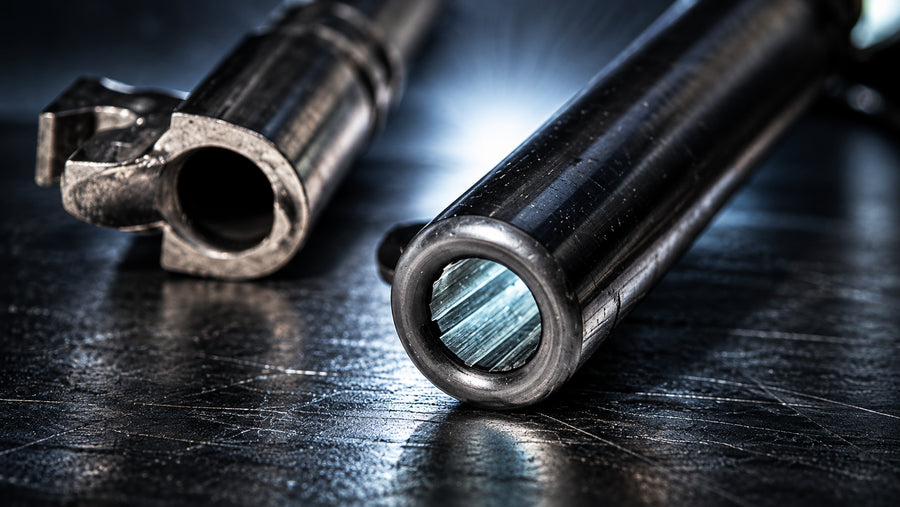
Traditional rifling uses clearly defined raised lands and recessed grooves. Polygonal rifling generally uses smoother, more rounded transitions that create a polygon-like internal shape rather than the sharper land-and-groove profile most shooters recognize.
That definition still requires some flexibility. Polygonal rifling is not one universal geometry, and manufacturers describe their barrels differently. Heckler & Koch, for example, currently specifies some VP-series barrels as having a polygonal profile with six grooves. The important distinction is therefore not that polygonal barrels contain absolutely no groove-like features, but that their internal geometry differs from conventional sharply defined lands and grooves.
Neither system automatically produces greater accuracy, higher velocity, longer barrel life, or better reliability. Those outcomes depend on the complete barrel, including bore dimensions, chamber quality, rifling consistency, crown, barrel material, surface treatment, ammunition, and manufacturing quality.
Polygonal barrels are strongly associated with manufacturers such as Glock and Heckler & Koch. Glock's Gen5 Marksman Barrel uses enhanced polygonal rifling, while several HK pistol families also use polygonal cold-hammer-forged barrels.
The most important practical difference for many owners involves ammunition compatibility. Glock currently recommends jacketed ammunition only for its pistols. Other manufacturers may publish different guidance, so ammunition restrictions should always be checked for the exact firearm rather than assumed from rifling geometry alone.
For most buyers choosing between two otherwise capable firearms, rifling type should be a secondary consideration. A well-manufactured barrel using either system can provide excellent performance.
Key Takeaways
- Traditional rifling uses clearly defined lands and grooves, while polygonal rifling generally uses smoother polygon-like transitions inside the bore.
- Polygonal rifling is not one universal specification. Different manufacturers use different profiles and terminology.
- Both rifling types can deliver excellent practical and mechanical accuracy when manufactured correctly.
- Claims that polygonal rifling automatically increases velocity, reduces fouling, or extends barrel life should be treated as design-specific or manufacturer-specific rather than universal.
- Glock currently recommends jacketed ammunition only, making manufacturer ammunition guidance particularly important for owners considering unjacketed lead bullets.
- Rifling geometry and rifling manufacturing method are separate specifications. A barrel can be polygonal or conventional while also being hammer forged, button rifled, or produced through another process.
- For most buyers, manufacturing quality, ammunition compatibility, reliability, and the complete firearm matter more than bore geometry alone.
What Is Rifling?
Rifling consists of helical internal features formed along the bore of a firearm barrel. As a projectile travels through the barrel, those features cause it to rotate around its longitudinal axis.
The resulting spin provides gyroscopic stability after the projectile leaves the muzzle. Without appropriate stabilization, a projectile may yaw excessively or become unstable during flight.
Rifling is therefore fundamental to the operation of most modern rifles and handguns.
The concept sounds simple, but rifling involves several variables beyond its visible shape. Twist rate determines how rapidly the projectile rotates. Bore and groove dimensions influence how the projectile engages the barrel. Surface finish, chamber geometry, projectile construction, and manufacturing consistency can also affect performance.
This is why reducing barrel quality to polygonal versus conventional misses much of what actually determines how a firearm shoots.
How Does Traditional Rifling Work?
Conventional rifling uses alternating raised and recessed portions inside the bore.
The raised surfaces are called lands. The recessed channels are called grooves.
As the projectile moves through the barrel, the lands engage its outer surface and force it to follow the helical rifling pattern. That interaction imparts the spin required for stabilization.
The number, width, depth, and shape of lands and grooves vary significantly among barrel designs. A barrel may use four, five, six, or another number of grooves, and manufacturers can select different twist rates and internal dimensions depending on the cartridge and intended projectile.
Traditional rifling therefore is not one standardized internal geometry. It is a broad design category.
What Is Polygonal Rifling?
Polygonal rifling performs the same basic function but uses a different internal shape.
Rather than relying on sharply defined rectangular-looking lands and grooves, the bore has smoother transitions that form a polygon-like cross-section. The projectile still engages the rifling and receives rotational force as it moves through the barrel.
The result can look noticeably smoother when viewed through the bore, especially to someone accustomed to conventional rifling.
That smoother appearance sometimes leads to the mistaken belief that polygonal barrels are nearly smoothbore firearms.
They are not.
Polygonal Rifling Is Still Rifling
A polygonal barrel contains helical internal geometry specifically designed to rotate the projectile.
The transitions may look less dramatic than conventional lands and grooves, but they still create the mechanical engagement necessary to impart spin.
A true smoothbore lacks the corresponding helical geometry used to produce the same controlled spin stabilization.
The difference is therefore one of rifling profile, not the presence or absence of rifling itself.
Polygonal Does Not Always Mean “No Grooves”
This is one of the most important technical nuances in the comparison.
Polygonal rifling is often described as having no traditional lands and grooves, which can be useful as a basic explanation. Taken too literally, however, that description can become misleading.
HK currently describes VP9-series barrels as having a polygonal profile with six grooves. Other HK documentation describes polygonal bores as lacking traditional lands-and-grooves rifling.
Those statements are not necessarily contradictory. They reflect the fact that polygonal is a family of internal profiles rather than one universally standardized shape.
The better definition is that polygonal barrels use smoother, less sharply defined transitions than conventional rifling, with exact geometry determined by the manufacturer.
Polygonal vs. Traditional Rifling Comparison
| Feature | Polygonal Rifling | Traditional Rifling |
|---|---|---|
| General Bore Shape | Smoother polygon-like transitions | Clearly defined lands and grooves |
| Primary Purpose | Impart projectile spin | Impart projectile spin |
| Accuracy Potential | Excellent with quality manufacturing | Excellent with quality manufacturing |
| Velocity | Some manufacturers claim a small advantage | Depends on complete barrel and ammunition |
| Fouling | Geometry may influence deposits | Geometry may influence deposits |
| Lead-Bullet Compatibility | Manufacturer-specific restrictions may apply | Still subject to manufacturer ammunition guidance |
| Barrel Life | No universal advantage | No universal advantage |
| Common Modern Examples | Selected Glock and HK pistols | Widely used across pistols and rifles |
The similarities are arguably more important than the differences. Both systems create friction, heat, projectile deformation, and fouling. Both depend heavily on manufacturing quality. Both can provide long service lives and excellent accuracy.
Traditional Rifling Has Enormous Design Flexibility

Conventional rifling remains widespread partly because manufacturers can alter its geometry to suit very different firearms and cartridges.
Land width, groove depth, groove count, twist rate, bore diameter, rifling angle, and manufacturing process can all be adjusted.
That makes traditional rifling suitable for everything from precision rifles to service pistols, hunting firearms, revolvers, and sporting rifles.
Its long history also gives barrel manufacturers an enormous amount of accumulated production knowledge.
Traditional Rifling Is Not Automatically Old-Fashioned
The fact that conventional lands and grooves have existed for generations does not make them technologically obsolete.
Many of the most accurate modern precision barrels still use recognizable conventional rifling.
Manufacturers continue refining tooling, bore preparation, rifling geometry, stress relief, lapping, chambering, and quality-control procedures even when the basic internal shape remains familiar.
Barrel development is therefore not a simple progression where polygonal rifling replaced an older inferior system.
Polygonal Rifling Is Not Automatically More Advanced Either

Polygonal rifling can look more sophisticated because the bore profile is unusual, but unusual geometry does not automatically produce superior performance.
The design is simply another engineering solution for engaging and stabilizing the projectile.
Its effectiveness depends on how well the manufacturer produces that geometry and integrates it with the chamber, barrel material, firearm design, and intended ammunition.
Glock and Polygonal Rifling
Glock is probably the manufacturer most shooters associate with polygonal-style barrels.
The company's barrel designs have evolved over time, making it important not to treat every Glock generation as internally identical.
Glock's Gen5 family introduced the Glock Marksman Barrel, commonly abbreviated GMB.
Glock describes the Marksman Barrel as using enhanced polygonal rifling along with an improved barrel crown and other dimensional refinements intended to improve accuracy.
What Changed With the Glock Marksman Barrel?

The GMB should not be described simply as the same historical Glock barrel with a new name.
Glock specifically identifies enhanced rifling and an improved crown as part of the Gen5 barrel design.
The company attributes improved accuracy to the complete package rather than to polygonal geometry alone.
That distinction matters because accuracy is the product of the entire barrel design.
Glock's Current Lead-Ammunition Guidance
Glock's current U.S. owner FAQ states that the company recommends jacketed ammunition only and says not to use lead bullets.
Owners should follow that guidance for their factory Glock barrels.
The important editorial distinction is that this should not become a universal claim that every firearm with polygonal rifling prohibits every unjacketed projectile.
The restriction belongs to the manufacturer's current ammunition guidance for the firearm.
Lead Core Does Not Mean Unjacketed Lead
This terminology causes considerable confusion.
Many common handgun bullets contain lead at their core. Full metal jacket and jacketed hollow-point ammunition typically surrounds most or all of that lead core with another metal jacket.
That is different from a cast or swaged unjacketed lead bullet whose lead surface directly contacts the bore.
A warning against lead bullets therefore should not automatically be interpreted as a warning against every cartridge containing a lead-core projectile.
Plated Bullets Are Another Separate Category
Plated bullets use a metallic layer deposited around the underlying core.
Their construction differs from both traditional thick-jacketed bullets and completely unjacketed lead projectiles.
Because plating thickness and ammunition construction vary, owners should not automatically assume that a plated bullet is interchangeable with any ammunition specifically identified as jacketed by the firearm manufacturer.
The current firearm manual remains the best source for compatibility requirements.
Heckler & Koch and Polygonal Rifling

HK has an equally important history with polygonal barrel technology.
Current VP9-series technical data identifies a polygonal profile with six grooves and a 1:9.8-inch right-hand twist in 9mm models.
HK has also used polygonal cold-hammer-forged barrels extensively throughout other handgun families, including much of the USP line.
This provides a useful example of a manufacturer combining rifling geometry with a particular manufacturing process rather than treating the two specifications as the same thing.
HK's Performance Claims Need Proper Context
HK's own manuals credit polygonal barrels with several advantages, including easier cleaning, longer barrel life, improved gas sealing, and a small increase in velocity.
Those claims are useful because they explain why HK selected the design.
They should still remain attributed to HK.
A design performing that way within one manufacturer's barrels does not prove that every polygonal barrel from every company will exhibit the same advantage over every conventional barrel.
Does Polygonal Rifling Increase Velocity?
Possibly in a particular comparison, but not as a universal rule.
The usual explanation is that a polygonal bore may create a strong projectile-to-bore seal, reducing the amount of propellant gas that moves around the projectile.
Glock and HK both make versions of this argument in their technical materials.
The mechanical concept is plausible. The difficulty comes from proving that rifling geometry alone caused the measured velocity difference.
Many Variables Affect Muzzle Velocity
Barrel length is one obvious variable, but it is far from the only one.
Chamber dimensions, bore diameter, groove dimensions, projectile construction, ammunition pressure, powder burn characteristics, surface finish, temperature, and individual barrel tolerances can all influence chronograph results.
Two pistols from different manufacturers therefore cannot establish a clean polygonal-versus-conventional velocity comparison merely because one produces a few more feet per second.
Even Two Barrels From the Same Model Can Differ
Manufacturing tolerances mean individual barrels can produce slightly different velocities even when their basic specifications are nominally identical.
A meaningful experiment attempting to isolate rifling geometry would need to control far more variables than most informal tests do.
For the average handgun buyer, the small possible difference attributable exclusively to rifling profile is unlikely to outweigh reliability, fit, sights, trigger, ammunition performance, and overall firearm quality.
Does Polygonal Rifling Produce Better Accuracy?
Not automatically.
Both polygonal and conventional barrels can provide excellent mechanical accuracy.
Accuracy depends on bore uniformity, chamber consistency, barrel fit, lockup, crown geometry, projectile quality, ammunition consistency, sighting system, and numerous other factors.
Rifling geometry is one variable within that system.
Why the Glock Marksman Barrel Does Not Prove Polygonal Is Superior

Glock says its Marksman Barrel improves accuracy and also says the barrel uses enhanced polygonal rifling.
Those facts do not establish that polygonal rifling alone caused the improvement.
The GMB also incorporates changes to the crown and other barrel specifications.
The accurate conclusion is that Glock's complete Marksman Barrel design is intended to improve accuracy, with enhanced rifling forming one part of that design.
Precision Rifles Demonstrate the Strength of Conventional Rifling
Traditional lands-and-grooves designs remain common throughout high-accuracy rifle-barrel manufacturing.
That alone demonstrates why polygonal geometry cannot claim an inherent monopoly on precision.
Premium conventional barrels can be cut, button rifled, hammer forged, honed, hand lapped, and chambered to exceptionally demanding standards.
The shape of the finished rifling remains only one part of their performance.
Mechanical Accuracy vs. Practical Accuracy
Mechanical accuracy refers to the firearm's inherent ability to produce consistent shot placement under controlled conditions.
Practical accuracy includes the shooter.
Grip, trigger control, sight alignment, optic quality, recoil management, shooting position, and environmental conditions can easily overshadow small differences among otherwise competent barrels.
This is another reason most handgun buyers should not choose a firearm primarily according to rifling profile.
Does Polygonal Rifling Last Longer?
There is no universal lifespan advantage that applies across all firearms.
HK specifically attributes longer service life to its polygonal cold-hammer-forged barrels, but that claim describes HK's complete barrel architecture.
It combines rifling geometry with steel selection, hammer forging, dimensions, surface treatment, ammunition requirements, and the rest of the firearm's design.
A conventional barrel from another manufacturer may have an entirely different material, treatment, and service life.
Barrel Life Depends on More Than Bore Shape
Material selection influences wear.
Surface treatments influence wear and corrosion behavior.
Pressure, projectile material, firing schedule, temperature, cleaning, and maintenance also influence the condition of the bore.
A firearm repeatedly subjected to extremely high round counts and intense heat can experience different wear from the same model fired occasionally at a recreational range.
Handgun Barrel Life Is Also Defined by Performance Standards
A barrel rarely reaches one exact round count and suddenly becomes unusable.
Wear tends to develop gradually.
A competitive shooter with demanding group-size requirements may replace a barrel earlier than an owner using the same firearm for recreational practice.
That makes universal round-count comparisons particularly weak unless the manufacturer explains exactly how it defines the end of useful barrel life.
Does Polygonal Rifling Reduce Fouling?
The smoother transitions inside a polygonal bore create a reasonable basis for claims that fouling behavior may differ from conventional rifling.
Glock says its polygonal rifling contributes to reduced barrel residue, while HK has described its polygonal bores as easier to clean.
Those statements should again be treated as manufacturer claims about their own designs.
Actual fouling depends heavily on ammunition.
Powder and Bullet Construction Matter to Fouling
Combustion residue, copper deposits, lead deposits, lubricant, and other material can accumulate differently depending on ammunition construction and the barrel.
A clean-burning jacketed load may leave a very different bore from inexpensive ammunition using another powder or projectile construction.
Surface finish can also influence how easily deposits adhere.
A carefully finished conventional bore may be extremely easy to clean, while a polygonal barrel can still accumulate significant residue.
Neither Design Is Self-Cleaning
No rifling geometry removes the need for maintenance.
Every barrel should be inspected and maintained according to the firearm manufacturer's instructions.
That is especially important when ammunition or firing conditions can produce significant deposits.
Why Unjacketed Lead Can Become a Concern
Lead bullets can deposit material inside a bore when operating conditions, projectile hardness, velocity, lubrication, bore dimensions, and surface characteristics allow lead to smear or accumulate.
If fouling becomes excessive, usable bore volume and dimensions can change.
That can affect firearm performance and potentially create unsafe pressure conditions in severe cases.
This concern is one reason ammunition compatibility discussions frequently appear alongside polygonal barrels.
The Problem Is More Complicated Than “Polygonal Equals No Lead”
Not every polygonal barrel uses identical geometry.
Not every conventional barrel is automatically suitable for every cast-lead load.
Manufacturers also apply different ammunition restrictions based on the design and testing of the complete firearm.
The safe rule is therefore model specific: follow the firearm manufacturer's current ammunition guidance.
Conventional Rifling Can Accumulate Lead Too
Traditional lands and grooves do not make a barrel immune to leading.
Unjacketed projectile hardness, diameter, velocity, lubrication, gas cutting, and bore surface condition can all affect deposits.
A conventional barrel firing an unsuitable lead load can foul heavily as well.
The difference is that many firearms specifically intended for cast-bullet use employ conventional rifling and have manufacturer guidance supporting those projectiles.
Why Ammunition Guidance Matters More Than Internet Experience
Owners can easily find anecdotal reports of someone firing a particular projectile through a barrel that the manufacturer does not recommend.
That does not change the manufacturer's instructions for another owner's firearm.
Different ammunition, round count, maintenance, environmental conditions, barrel dimensions, and tolerance for risk can produce different outcomes.
Manufacturer-approved ammunition should remain the baseline.
Rifling Profile and Rifling Manufacturing Method Are Different
This is another major source of confusion.
Polygonal and conventional describe the geometry of the finished bore.
Cold hammer forging, button rifling, broach cutting, and cut rifling describe ways of manufacturing rifled barrels.
One term does not automatically tell buyers the other.
What Is Cold Hammer Forging?
Cold hammer forging forms the barrel through repeated mechanical deformation around a hardened mandrel.
The mandrel can incorporate the negative geometry needed to form the rifling profile.
Manufacturers such as HK use cold hammer forging in conjunction with polygonal barrel geometry.
Other companies use cold hammer forging to produce barrels with more conventional rifling profiles.
The process is therefore not synonymous with polygonal rifling.
Does Cold Hammer Forging Make a Barrel Better?
Not by itself.
Hammer forging can support efficient high-volume production and consistent geometry when tooling and process control are excellent.
It can also create durable barrels suited to demanding applications.
Those advantages do not automatically mean a hammer-forged barrel will outshoot a properly manufactured button-rifled or cut-rifled barrel.
What Is Button Rifling?
Button rifling uses a very hard tool to form rifling inside a prepared bore.
The button is pushed or pulled through the barrel and displaces material to create the desired profile.
High-quality button-rifled barrels are widely used in both sporting and precision applications.
The process can produce excellent results when bore preparation, tooling, stress relief, and inspection are controlled carefully.
What Is Cut Rifling?
Cut rifling creates the rifling by removing material in controlled passes.
The process can be relatively slow but gives manufacturers precise control over groove geometry.
It appears frequently in premium precision barrels.
Its presence is not an automatic accuracy guarantee any more than hammer forging or polygonal geometry is.
Manufacturing Method vs. Rifling Profile
| Term | What It Describes |
|---|---|
| Polygonal | Finished internal bore geometry |
| Lands and Grooves | Finished internal bore geometry |
| Cold Hammer Forged | Barrel manufacturing method |
| Button Rifled | Rifling manufacturing method |
| Cut Rifled | Rifling manufacturing method |
| Nitrided | Surface treatment |
| Chrome Lined | Internal surface plating |
| Stainless Steel | Underlying barrel material |
Keeping those categories separate makes barrel specifications dramatically easier to understand.
Twist Rate Matters More Than Many Buyers Realize
Rifling geometry gets considerable attention, but twist rate has a much more obvious relationship with projectile stabilization.
Twist rate describes how far the projectile travels down the barrel during one complete rotation.
HK's current VP9 documentation, for example, specifies a right-hand twist of approximately one turn in 9.8 inches.
Another pistol can use a different rate while remaining completely reliable and accurate with its intended ammunition.
Projectile Stability Is a System

Bullet length, mass distribution, diameter, velocity, and atmospheric conditions all interact with twist rate.
This becomes especially important in rifles, where projectile lengths and velocities can vary widely across one cartridge family.
The term polygonal tells the buyer very little about twist suitability by itself.
Barrel Crown Quality Matters Too
The muzzle crown is the final barrel surface surrounding the projectile as it exits.
Damage, asymmetry, or poor machining at the crown can negatively affect consistency by altering how gas escapes around the projectile.
Glock specifically highlights an improved barrel crown as part of the Marksman Barrel design.
That is another reminder that Glock's accuracy claims should not be reduced solely to polygonal rifling.
Chamber Quality Matters Too
The chamber supports and positions the cartridge before firing.
Dimensions, surface finish, throat geometry, and relationship with the bore all contribute to firearm function and performance.
A beautifully formed polygonal bore cannot compensate for an incorrectly manufactured chamber.
Likewise, a premium conventional barrel depends on the quality of the complete chamber-and-bore system.
Barrel Fit and Lockup Matter in Handguns
Most modern semiautomatic service pistols use moving-barrel locking systems.
The consistency with which the barrel returns to its locked position can influence mechanical accuracy independently of rifling geometry.
Barrel hood fit, locking surfaces, slide dimensions, recoil assembly, and manufacturing tolerances therefore deserve attention when discussing handgun accuracy.
HK Provides a Good Example
Several specialized HK USP models use an O-ring near the muzzle to help maintain consistent barrel positioning within the slide.
HK attributes part of those pistols' accuracy to that lockup feature alongside the hammer-forged polygonal barrel.
Again, the complete barrel-and-pistol system creates the result.
Does Polygonal Rifling Seal Gas Better?
Both Glock and HK discuss improved bullet-to-bore fit or gas sealing in connection with polygonal rifling.
The idea is that the smoother polygonal profile can create substantial circumferential projectile contact while reducing some of the deeper land engraving associated with conventional rifling.
This may influence gas leakage and velocity in specific designs.
The extent of any advantage depends on the actual bore and projectile dimensions.
Does Better Gas Sealing Mean Better Accuracy?
Not necessarily.
Consistency matters more than simply maximizing one characteristic.
A conventional barrel with excellent bore uniformity and ammunition compatibility can be extremely accurate even if its projectile engagement differs from that of a polygonal barrel.
Accuracy is not a single-variable competition.
Does Polygonal Rifling Create Less Bullet Deformation?
Polygonal rifling can engrave a projectile differently because its bore profile is smoother and distributes contact differently.
That does not mean the bullet passes through untouched.
The projectile must engage the rifling strongly enough to rotate, which requires mechanical interaction between bullet and bore.
The shape and degree of engraving depend on projectile material, bore dimensions, rifling geometry, pressure, and firearm design.
What About Forensic Marks?
Both conventional and polygonal barrels can leave characteristic markings on fired projectiles.
The patterns differ according to barrel geometry and individual microscopic surface characteristics.
This is a specialized forensic topic and should not be confused with whether one rifling type is more accurate or durable for an ordinary firearm owner.
Which Is Easier to Clean?
Polygonal barrels are often marketed as easier to clean because their internal transitions are smoother.
HK specifically makes this claim for certain polygonal barrels.
In practical ownership, ammunition, surface finish, cleaning interval, and firing volume may influence maintenance effort just as much.
A well-finished conventional bore can also clean very easily.
How Often Should Either Barrel Be Cleaned?
There is no universal round-count schedule applicable to every firearm.
Some manufacturers recommend cleaning after each firing session. Others provide maintenance intervals according to operating conditions.
Environmental exposure can also matter. A firearm exposed to rain, mud, dust, perspiration, or other contamination may deserve inspection and maintenance even after a low round count.
The firearm manual should take priority over generic rifling-based advice.
Do Polygonal Barrels Need Special Cleaning Tools?
Not necessarily.
Owners should use cleaning equipment and solvents approved by the firearm or barrel manufacturer.
Correct rod diameter, properly fitting patches, appropriate brushes, and sensible cleaning technique matter more than seeking a special tool solely because the rifling is polygonal.
Aggressive Cleaning Can Damage Either Barrel
No bore profile is immune to careless maintenance.
Improper rods, abrasive compounds, harsh chemicals, or repeated contact with the muzzle crown can potentially damage important surfaces.
More cleaning is not automatically better cleaning.
Polygonal Rifling in Service Pistols
The prevalence of polygonal barrels in established duty-oriented pistols demonstrates that the design is mature and reliable when engineered properly.
HK and Glock have produced large numbers of polygonal-barreled pistols used by private owners, agencies, and professional users.
That history establishes polygonal rifling as a legitimate production method.
It does not establish that another service pistol using conventional rifling is mechanically inferior.
Traditional Rifling in Precision Firearms
The opposite side of the market reinforces the same lesson.
Many precision rifles continue to use conventional rifling geometries and achieve exceptional accuracy.
If polygonal rifling inherently produced greater precision, conventional designs would have disappeared from demanding accuracy applications long ago.
They have not.
Why Manufacturers Choose Different Systems
Manufacturing equipment plays a role.
Production volume plays a role.
Material selection, barrel geometry, intended ammunition, expected service conditions, cost targets, and historical engineering experience also matter.
A manufacturer with decades of successful experience hammer forging polygonal barrels may have little reason to abandon that system.
Another manufacturer may achieve its desired results with conventional button-rifled or cut-rifled barrels.
What Should Handgun Buyers Actually Compare?
For most handgun buyers, grip fit, trigger quality, reliability, sights, optics compatibility, controls, magazine availability, holster availability, service support, and verified ammunition performance deserve more attention than bore geometry.
Rifling becomes more important when the owner has a specific ammunition requirement or when two otherwise similar models differ meaningfully in barrel design.
What Should Precision Shooters Compare?
Precision-oriented buyers should look for actual group data, barrel manufacturing methods, chamber quality, crown design, ammunition testing, and manufacturer reputation.
The presence of polygonal or conventional rifling alone provides too little information to predict results.
What Should High-Volume Shooters Compare?
High-volume shooters may care more about barrel material, heat treatment, surface treatment, wear history, replacement cost, and manufacturer support.
Rifling geometry contributes to the complete design but does not independently establish service life.
Which Rifling Type Is Better for Lead Bullets?
There is no safe universal answer based solely on geometry.
Conventional rifling is commonly found in firearms whose manufacturers approve cast or unjacketed ammunition, making it a familiar choice for shooters who routinely use those projectiles.
That still does not mean every conventional barrel is approved for every lead load.
If frequent use of unjacketed lead is a major buying requirement, choose a firearm whose manufacturer explicitly approves the intended ammunition.
Which Rifling Type Is Better for Jacketed Defensive Ammunition?
Either can work extremely well.
Modern defensive ammunition is extensively used through both conventional and polygonal barrels.
The meaningful comparison is how the exact firearm performs with the exact defensive load being considered.
Function, point of impact, group consistency, and manufacturer approval matter more than the general rifling category.
Which Rifling Type Is Better for General Range Use?
Again, either.
Someone firing ordinary factory jacketed ammunition from a quality handgun may notice little practical difference attributable specifically to rifling geometry.
The trigger, sights, grip, recoil characteristics, and ammunition quality may dominate the shooting experience instead.
Buyer Priorities
| Buyer Priority | What Matters Most |
|---|---|
| General recreational shooting | Reliability, ammunition cost, firearm fit, manufacturer guidance |
| Defensive handgun | Reliability with chosen defensive load, sights, controls, support |
| Precision shooting | Documented barrel and ammunition performance |
| Frequent unjacketed lead use | Explicit manufacturer ammunition approval |
| High round count | Complete barrel construction, heat treatment, maintenance, replacement support |
| Premium handgun comparison | Complete firearm design rather than rifling profile alone |
Common Mistake: Assuming Polygonal Means More Accurate
Polygonal rifling can be extremely accurate.
So can conventional rifling.
Without controlled comparison data, the rifling label alone cannot tell the buyer which barrel will group better.
Common Mistake: Assuming Conventional Rifling Is Outdated
Traditional rifling remains widespread because it continues to work exceptionally well.
Modern manufacturing has not rendered distinct lands and grooves obsolete.
Common Mistake: Assuming Polygonal Means Higher Velocity
Some manufacturers specifically claim improved gas sealing or small velocity benefits from their polygonal designs.
That does not justify applying the claim universally.
Chronograph data from the specific firearm and ammunition combination is more useful.
Common Mistake: Assuming All Glock Barrels Are the Same
Glock barrel designs have changed across generations.
The Gen5 Marksman Barrel incorporates enhanced polygonal rifling and a revised crown compared with earlier designs.
Buyers should verify the exact generation and model instead of applying one description to the company's entire history.
Common Mistake: Assuming All HK Barrels Are the Same
HK likewise has produced numerous pistol and rifle families with different barrel specifications.
Current VP9 documentation provides one set of polygonal specifications, while USP variants and other HK firearms may differ.
The manufacturer name alone does not define every bore.
Common Mistake: Confusing Lead Core With Lead Bullet
A jacketed bullet can contain a lead core.
The ammunition restriction relevant to bore fouling often concerns an exposed or unjacketed lead projectile, not simply the elemental composition hidden beneath a jacket.
Always read the manufacturer's actual language.
Common Mistake: Confusing Hammer Forging With Polygonal Rifling
Cold hammer forging describes how the barrel is produced.
Polygonal describes its internal rifling geometry.
A manufacturer can combine the two, but they are not synonyms.
Does Barrel Design Really Matter?
Yes, but usually not in the simplistic way marketing debates suggest.
Bore geometry influences how the projectile engages the barrel. That interaction can affect friction, fouling behavior, gas sealing, projectile engraving, and potentially velocity.
Those effects are real engineering considerations.
They still operate alongside dozens of other variables.
The Finished Barrel Matters More Than the Category
A high-quality conventional barrel can outperform a mediocre polygonal barrel.
A carefully engineered polygonal barrel can outperform a poorly manufactured conventional barrel.
That makes the finished product the useful unit of comparison.
The rifling label simply tells the buyer one part of how that product was designed.
Final Thoughts
Polygonal and traditional lands-and-grooves rifling are both proven methods of stabilizing bullets, and neither deserves a universal performance crown.
Traditional rifling uses clearly defined lands and grooves. Polygonal rifling uses smoother polygon-like transitions, although exact manufacturer terminology varies enough that the difference should not be defined too rigidly.
HK provides a good example. Its modern VP9 technical specifications describe a polygonal profile with six grooves, while other HK manuals contrast polygonal bores with traditional lands-and-grooves rifling. The design concept is consistent even though the terminology is more nuanced than a simple grooves-versus-no-grooves comparison.
Glock provides another useful example. Its Gen5 Marksman Barrel uses enhanced polygonal rifling and an improved crown as part of an accuracy-focused barrel redesign. Glock currently recommends jacketed ammunition only, making ammunition compatibility one of the most important practical considerations for owners.
Neither manufacturer proves that polygonal rifling is universally superior.
Claims involving higher velocity, reduced fouling, longer service life, or easier cleaning have a technical basis within certain designs, and both Glock and HK make some of those claims for their own barrels. They should remain manufacturer-specific claims rather than rules applied to every polygonal barrel.
The same restraint should be applied to accuracy.
Polygonal barrels can shoot extremely well. Conventional barrels can shoot extremely well. Chamber quality, lockup, bore consistency, crown geometry, ammunition, barrel material, manufacturing process, and the rest of the firearm all contribute to the final result.
Rifling geometry should therefore be treated as one specification within a complete barrel design.
For most buyers using ordinary factory jacketed ammunition, the difference may have little noticeable effect on everyday ownership. Reliability, ergonomics, sights, trigger characteristics, support, and ammunition performance will probably matter more.
The issue becomes more important for owners who regularly use unusual projectile constructions or unjacketed lead ammunition. In those cases, manufacturer guidance needs to take priority over general assumptions about barrel geometry.
The same applies to cleaning and barrel life. Neither polygonal nor conventional rifling eliminates maintenance, and neither guarantees a universal service-life advantage.
Ultimately, barrel design does matter.
It simply does not matter enough to make the word polygonal or traditional a shortcut for quality.
The better barrel is the one that is manufactured consistently, works reliably with approved ammunition, provides the accuracy required for its intended role, and is supported by clear manufacturer guidance.
Frequently Asked Questions
What is the difference between polygonal and traditional rifling?
Traditional rifling uses clearly defined lands and grooves. Polygonal rifling generally uses smoother, rounded transitions that form a polygon-like bore profile. Exact polygonal geometry varies by manufacturer.
Does polygonal rifling still have grooves?
That depends on terminology and manufacturer design. HK currently describes some VP-series barrels as having a polygonal profile with six grooves, while other descriptions contrast polygonal rifling with traditional lands and grooves. Polygonal is therefore better understood as a different bore profile rather than a universal no-groove specification.
Is polygonal rifling more accurate?
Not inherently. Polygonal and traditional barrels can both deliver excellent accuracy. Chamber quality, bore consistency, barrel fit, crown geometry, ammunition, and overall manufacturing generally matter more than rifling category alone.
Does polygonal rifling increase muzzle velocity?
Some manufacturers, including Glock and HK, attribute improved gas sealing or increased velocity to their polygonal designs. That does not establish a universal velocity advantage. Barrel length, dimensions, ammunition, chamber, and individual manufacturing tolerances also affect velocity.
Does polygonal rifling last longer?
There is no universal lifespan advantage. Some manufacturers attribute long service life partly to their polygonal barrel designs, but barrel material, treatment, manufacturing process, firing conditions, ammunition, and maintenance all influence wear.
Is polygonal rifling easier to clean?
Some manufacturers claim the smoother internal profile reduces residue or makes cleaning easier. Actual fouling also depends heavily on ammunition, bore finish, firing volume, and maintenance interval.
Does Glock use polygonal rifling?
Yes. Glock currently describes its barrel technology as polygonal, and its Gen5 Marksman Barrel uses enhanced polygonal rifling along with an improved barrel crown.
Can I shoot lead bullets through a Glock barrel?
Glock's current U.S. guidance recommends jacketed ammunition only and states that lead bullets should not be used. Owners should follow the current manual and manufacturer guidance for their exact pistol.
Does HK use polygonal rifling?
Yes. HK uses polygonal barrels in several handgun families. Current VP9A1 technical data specifies a polygonal profile with six grooves, while many USP models also use polygonal cold-hammer-forged barrels.
Is polygonal rifling the same as a smoothbore?
No. Polygonal rifling contains helical internal geometry that engages and spins the projectile. A smoothbore lacks the corresponding rifling used for that form of spin stabilization.
Is cold hammer forging the same as polygonal rifling?
No. Cold hammer forging is a manufacturing method. Polygonal describes the shape of the rifling. A cold-hammer-forged barrel can use polygonal or another rifling geometry.
Is button rifling traditional rifling?
Not necessarily. Button rifling describes how rifling is formed, while traditional or polygonal describes the resulting geometry. Manufacturing process and bore profile are separate specifications.
Does conventional rifling work better with unjacketed lead bullets?
Many firearms designed for cast or unjacketed bullets use conventional rifling, but compatibility remains firearm specific. Owners should use ammunition expressly approved by the manufacturer rather than assuming conventional rifling makes every lead load acceptable.
Can conventional rifling lead foul?
Yes. Lead deposits can develop in conventional barrels as well. Projectile hardness, diameter, lubrication, velocity, bore condition, and ammunition design all influence leading.
Is the Glock Marksman Barrel completely different from older Glock barrels?
It remains based on Glock's polygonal-barrel concept but incorporates enhanced rifling, a revised crown, and other accuracy-oriented refinements. Buyers should not assume every Glock generation uses mechanically identical barrel specifications.
Which rifling type is best for a defensive handgun?
Neither geometry is universally best. Reliability with the intended ammunition, firearm fit, sights, controls, trigger characteristics, support, and demonstrated performance are generally more important than whether the bore is polygonal or conventionally rifled.
Which rifling type is best for accuracy?
Choose according to the quality and demonstrated performance of the specific barrel. Both polygonal and conventional designs are capable of excellent accuracy.
Should rifling type influence which pistol I buy?
It can be one consideration, especially if ammunition compatibility matters to you. For most owners using ordinary factory jacketed ammunition, rifling geometry should rank below reliability, ergonomics, trigger quality, sights, support, and overall firearm construction.
About the Author
The ProArmory editorial team includes experienced hunters, competitive shooters, military veterans, firearms instructors, and firearms industry professionals committed to producing accurate, practical, and research-based content. Our articles draw on manufacturer specifications, current industry information, technical documentation, and real-world shooting experience to help readers make informed decisions about firearms, ammunition, optics, and related equipment.
Disclaimer
This article is intended for educational and informational purposes only. Barrel geometry, ammunition compatibility, maintenance requirements, and manufacturer specifications vary by firearm model and may change over time.
Performance claims involving accuracy, velocity, fouling, barrel life, or durability should not be assumed to apply universally across firearms merely because they use the same general rifling type.
Always follow the firearm manufacturer's current ammunition and maintenance instructions, use ammunition approved for the specific firearm, observe established firearm-safety practices, and comply with applicable federal, state, and local laws.


