





Quick Answer
For most general-purpose AR-15 buyers, a well-manufactured nitrided chrome-moly-vanadium barrel offers an excellent balance of cost, corrosion resistance, wear resistance, and practical accuracy. Chrome-lined CMV barrels remain highly attractive for shooters who prioritize established service-rifle construction and durability under demanding use. Quality 416R stainless barrels are especially common in precision-oriented rifles because the material is well suited to consistent machining, rifling, chambering, and lapping.
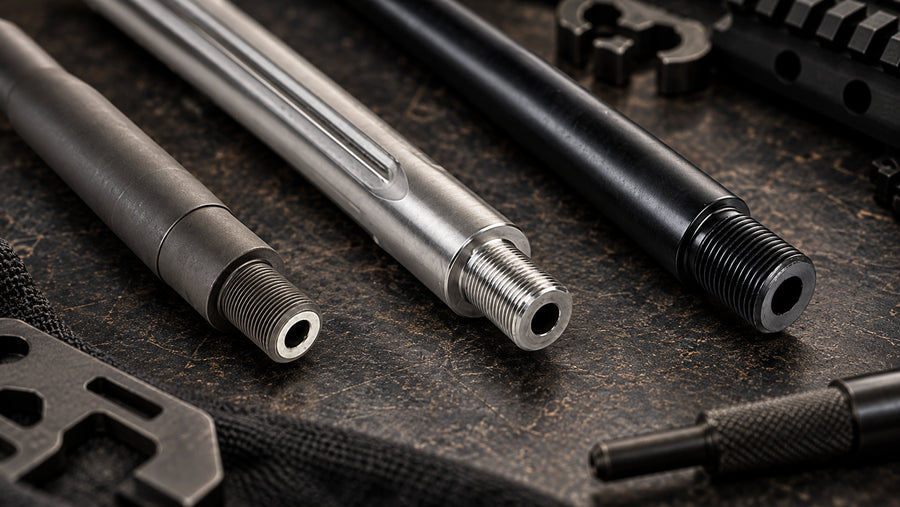
None of those descriptions automatically identifies the best barrel.
The first thing buyers need to understand is that chrome lining, nitride, and stainless steel are not three equivalent types of barrel finish.
Chrome lining is a layer of hard chromium deposited onto internal barrel surfaces. Nitriding or ferritic nitrocarburizing modifies the surface of the barrel steel itself rather than adding a separate bore lining. Stainless steel describes the underlying barrel material, and a stainless barrel can be left untreated, bead blasted, coated, or even nitrided.
That distinction changes how these specifications should be compared.
A carefully manufactured chrome-lined barrel can provide excellent accuracy. A properly nitrided CMV barrel can deliver excellent durability and corrosion protection at relatively modest cost. A high-quality 416R stainless barrel can provide exceptional precision, while a poorly manufactured stainless barrel may shoot worse than either alternative.
Barrel steel and surface treatment matter, but manufacturing quality matters more. Bore uniformity, chamber dimensions, rifling, crown quality, stress relief, barrel profile, ammunition, and quality-control procedures all influence the finished product.
For most buyers, the right question is not simply, “Which finish is best?” It is, “Which complete barrel best matches what I need the rifle to do?”
Key Takeaways
- Chrome lining is an internal plating, nitriding is a surface-modification process, and stainless steel is a barrel material.
- Quality chrome-lined barrels can provide excellent accuracy; chrome lining does not automatically make a rifle inaccurate.
- Nitrided CMV barrels are especially attractive for general-purpose rifles because they combine useful corrosion and wear resistance with competitive pricing.
- 416R stainless is widely used in precision-oriented barrels because its material properties support consistent machining, rifling, chambering, and lapping.
- Stainless steel can also be nitrided, so “stainless versus nitride” is not always an either/or comparison.
- Plain 4150, 4150 CMV, and military barrel-steel specifications should not automatically be treated as identical terms.
- No barrel treatment guarantees a universal round-count lifespan. Cartridge, heat, firing schedule, ammunition, maintenance, and accuracy expectations all influence useful barrel life.
- The best barrel is usually determined by complete manufacturing quality and intended use rather than one specification on the product page.
First, Separate Barrel Material From Barrel Treatment
Much of the confusion surrounding AR-15 barrels begins because manufacturers and retailers place steel type and surface treatment beside one another in the same specification list.
A listing might describe one barrel as 4150 CMV, chrome lined, and phosphate finished. Another might be advertised as 4150 CMV with QPQ nitride. A third might be described simply as 416R stainless.
Those phrases describe different parts of the barrel's construction.
The steel designation tells buyers what the barrel itself is made from. Chrome lining describes a layer added to the inside of the barrel. Nitriding describes a thermochemical process that modifies the surface of suitable steel.
Keeping those categories separate makes the rest of the comparison considerably easier.
AR-15 Barrel Construction Comparison
| Characteristic | Chrome-Lined CMV | Nitrided CMV | 416R Stainless |
|---|---|---|---|
| Underlying Material | Commonly service-oriented chrome-moly or CMV steel | Commonly 4140 or 4150-class chrome-moly / CMV steel | 416R stainless steel |
| Bore Treatment | Hard chromium layer | Nitrogen/carbon diffusion treatment | May be untreated, polished, coated, or nitrided |
| Exterior Protection | Usually separate finish such as phosphate | Treatment commonly covers exterior as well | Depends on manufacturer's finish |
| Corrosion Resistance | Excellent where chrome is applied | Excellent when properly processed | Good, but not corrosion proof |
| Wear Resistance | Long service-rifle history | Strong general-purpose performance | Depends heavily on barrel and treatment |
| Accuracy Potential | Excellent with controlled manufacturing | Excellent with controlled manufacturing | Frequently selected for precision-oriented barrels |
| Typical Market Position | General-purpose and duty-oriented rifles | Budget through premium general-purpose rifles | Precision, competition, and match-oriented rifles |
| Primary Buying Question | Is the lining applied consistently? | How well was the nitride process controlled? | How well was the barrel actually manufactured? |
The overlap in that table is intentional. None of these constructions owns an exclusive claim on accuracy, durability, or corrosion resistance.
What Is Chrome-Moly-Vanadium Barrel Steel?
Chrome-moly-vanadium, commonly abbreviated CMV, refers to alloy steel containing chromium, molybdenum, and vanadium along with the base iron and other specified elements.
These materials are widely associated with service-oriented AR barrels because manufacturers can combine useful strength, heat-treatment characteristics, wear performance, and relatively efficient production.
The terminology can become sloppy in commercial listings, however.
A barrel advertised simply as 4150 should not automatically be assumed to have the same chemistry as every barrel advertised as 4150 CMV. Likewise, the phrase MIL-SPEC should not substitute for an actual material specification.
If material chemistry matters to the purchasing decision, buyers should use the manufacturer's exact steel designation rather than attempting to infer composition from a shortened marketing description.
4140 vs. 4150: What Does the Number Mean?
4140 and 4150 are both chromium-molybdenum alloy steels, but they differ in composition, including nominal carbon content.
The difference is real, yet buyers should resist turning it into another simplistic quality ranking.
A barrel's behavior depends on more than the last two digits of its steel designation. Heat treatment, stress relief, bore dimensions, rifling, profile, surface treatment, and manufacturing consistency remain important.
For a general-purpose AR, knowing that a manufacturer uses an established barrel steel and controls its production carefully is more useful than assuming every 4150 barrel automatically outperforms every 4140 barrel.
CMV Is Not the Same Thing as Chrome Lining
The word chrome appears in both chrome-moly steel and chrome lining, but the terms describe completely different things.
Chromium is one of the alloying elements within chrome-moly and CMV steels.
Chrome lining is a separate manufacturing process that adds a layer of hard chromium to selected internal surfaces after the barrel has been manufactured.
A CMV barrel can therefore be chrome lined, nitrided, or finished using another process depending on the manufacturer's design.
What Is 416R Stainless Steel?
416R is a chromium stainless steel developed specifically for rifle-barrel manufacturing.
Its material properties are well suited to operations such as gun drilling, reaming, rifling, chambering, and lapping. This is one reason it appears so frequently in precision-oriented AR barrels and bolt-action barrels.
That manufacturing advantage often gets simplified into the statement that stainless steel is more accurate.
That is not quite correct.
416R can help a skilled manufacturer produce extremely consistent barrel geometry. The steel itself does not guarantee that the manufacturer actually achieved that consistency.
Stainless Does Not Mean Rustproof
416R contains enough chromium to provide useful corrosion resistance, but stainless steel should not be interpreted literally as material that cannot corrode.
Moisture, residue, environmental exposure, improper storage, and neglected maintenance can still produce oxidation.
Precision-barrel manufacturers themselves caution that stainless barrels still require normal care.
The correct statement is that 416R provides greater inherent corrosion resistance than many untreated chrome-moly steels, not that maintenance becomes unnecessary.
Chrome-Lined AR Barrels: How the Process Works

Chrome lining applies a layer of hard chromium to internal barrel surfaces. On service-oriented AR barrels, manufacturers commonly chrome line the bore and chamber while using another protective finish on the barrel exterior.
The chromium layer creates a hard, corrosion-resistant surface between the projectile, combustion residue, and underlying barrel steel.
This manufacturing approach has an extensive history in military and service firearms, where barrels may encounter adverse environments, substantial firing schedules, and inconsistent maintenance.
That history remains one of the strongest arguments for chrome-lined barrels.
What Does Chrome Lining Actually Provide?
The main advantages involve protection of the surfaces where combustion and projectile movement create some of the harshest operating conditions.
Chrome plating can improve corrosion resistance in the bore and chamber, reduce exposure of the underlying steel, and provide a wear-resistant internal surface.
These characteristics make the treatment especially attractive for general-purpose rifles and firearms expected to tolerate extensive use.
Chrome lining does not make the barrel indestructible.
The throat can still erode. Rifling can still wear. Excessive heat can still damage the barrel. The crown can still be damaged mechanically, and neglected exterior surfaces still require appropriate protection.
Does Chrome Lining Reduce Accuracy?
Not inherently.
The claim developed because chrome lining introduces an additional manufacturing step inside a surface where dimensional uniformity matters. If plating thickness varies significantly, the resulting bore geometry can become less consistent.
That makes chrome lining a manufacturing challenge.
It does not mean accurate chrome-lined barrels are impossible.
Companies such as Criterion have demonstrated that carefully controlled bore preparation and chrome application can produce barrels intended for high levels of precision while retaining the durability advantages of lining.
The appropriate conclusion is therefore that chrome-lining quality matters.
Modern Chrome-Lined Barrels Can Be Extremely Accurate
The existence of accurate chrome-lined barrels is useful because it breaks down one of the oldest oversimplifications in AR barrel marketing.
A shooter does not necessarily have to choose between durability and useful precision.
A high-quality chrome-lined barrel may easily provide all the practical accuracy required for a general-purpose, duty-oriented, hunting, or training rifle.
Someone seeking the smallest possible groups from a specialized precision build may still prefer a premium stainless match barrel, but that is a different requirement from claiming chrome lining itself is inaccurate.
Who Benefits Most From Chrome Lining?
Chrome lining makes the strongest case for buyers who value a service-oriented barrel configuration with a long history of wear and corrosion protection.
This can include high-volume recreational shooters, training rifles, defensive carbines, institutional firearms, or owners who simply prefer traditional M4- and M16-style barrel construction.
A shooter firing relatively modest round counts under controlled conditions may never experience a dramatic real-world advantage over a quality nitrided barrel.
That does not make chrome lining unnecessary. It means the extra value depends on actual use.
Nitrided AR Barrels: What Does Nitride Actually Mean?

Nitriding is fundamentally different from chrome lining because it does not require depositing a separate metal layer inside the bore.
Processes commonly encountered on firearm barrels fall within the broader family of nitriding and ferritic nitrocarburizing treatments. Nitrogen, and in nitrocarburizing processes carbon as well, diffuses into the surface of the steel at controlled temperature.
This changes the properties of the steel near its surface, producing a harder and more wear-resistant case while allowing the component to retain its underlying dimensions to a high degree.
That dimensional characteristic is one of the reasons nitriding became popular with barrel manufacturers.
Nitride Is Not Simply Black Paint
The dark exterior appearance of many nitrided barrels can make the process look like a conventional coating.
It is not.
The primary surface modification takes place within the steel itself rather than by depositing an ordinary paint-like exterior film.
Some processes also include oxidation or other finishing stages that produce the familiar black appearance and improve corrosion behavior.
What Does QPQ Mean?
QPQ stands for quench-polish-quench.
The term describes a finishing sequence commonly associated with salt-bath ferritic nitrocarburizing. After the initial treatment, the surface is polished and subjected to an additional oxidation stage.
The goal is to combine the wear characteristics of the nitrocarburized surface with improved surface finish and corrosion resistance.
QPQ therefore describes more than the initial diffusion process by itself.
What Is Melonite?
Melonite is a commercial name associated with liquid or salt-bath nitrocarburizing technology.
In firearm marketing, Melonite, nitride, QPQ, and salt-bath nitride are sometimes used so loosely that they appear interchangeable.
They should not be treated as perfectly identical specifications.
The processing sequence, temperature, time, polishing, oxidation, treatment depth, barrel preparation, and quality-control standards can differ among manufacturers.
The important purchasing question is not whether a product description contains the most impressive version of the word nitride. It is whether the manufacturer executes the process properly.
Why Nitride Became So Popular
Nitriding gives manufacturers a way to improve surface hardness, wear resistance, and corrosion behavior without installing a separate bore lining.
The same treatment can also be applied across much of the barrel's exterior, reducing the need to rely on one process for the bore and another completely different finish for the outside.
That manufacturing efficiency can help keep cost competitive.
This combination has made nitrided CMV barrels extremely common on modern general-purpose AR-15s.
Does Nitride Preserve Bore Dimensions Better?
Because nitriding modifies the existing steel surface rather than depositing a distinct chrome layer, it avoids the plating-thickness variable associated with chrome lining.
This is one reason manufacturers often discuss nitride in connection with bore dimensional consistency.
That advantage should still be kept in perspective.
The treatment cannot correct a poorly machined bore, inconsistent rifling, or poorly cut chamber. The barrel needs to be manufactured correctly before surface treatment.
Process control remains critical.
Can Nitriding Hurt a Barrel?
Any metallurgical treatment can create problems when performed incorrectly.
Barrel manufacturers need to account for treatment temperature, material, prior heat treatment, barrel-extension installation, dimensional growth, and the characteristics of the underlying steel.
A low-cost barrel is not automatically well treated simply because the product description says QPQ.
The manufacturer's experience and quality control matter just as much as the process name.
Does Nitride Offer the Best Value?
For a large portion of recreational AR-15 owners, it probably offers one of the strongest value propositions.
Quality nitrided CMV barrels are widely available at reasonable prices and can provide excellent practical accuracy, corrosion protection, and useful service life.
That makes them particularly easy to recommend for rifles that will see normal training, recreational shooting, range use, or general-purpose ownership.
The important qualifier is quality.
A properly manufactured nitrided barrel can be an excellent value. An inexpensive barrel with poor machining does not become excellent simply because it was nitrided afterward.
Current Faxon Barrels Show How Much These Categories Overlap
Faxon's current barrel lineup provides a useful real-world demonstration because the company uses several different combinations of steel and treatment depending on product mission.
Its Duty Series uses 4150 CMV steel with salt-bath nitride. The Combat Series uses 4150 CMV with a chrome-lined bore and chamber plus a phosphate exterior.
The Match Series moves to 416R stainless with nitride treatment, while the company's MATCH-X line uses 416R stainless with an uncoated, honed and lapped bore.
Those four configurations illustrate why buyers should stop thinking of chrome, nitride, and stainless as three mutually exclusive categories.
Stainless Steel Barrels: Why Precision Manufacturers Like Them

The association between stainless steel and precision is not imaginary. It simply requires more careful explanation.
416R is specifically suited to precision barrel-manufacturing operations. Manufacturers can gun drill, ream, rifle, chamber, lap, and polish the steel with a high degree of control when the process is executed correctly.
This makes it attractive to companies producing barrels where bore uniformity and chamber consistency are major selling points.
The result is that many premium match barrels happen to be stainless.
That does not mean stainless steel itself creates the accuracy.
A Stainless Barrel Is Not Automatically a Match Barrel
Two barrels can both be made from 416R and still perform very differently.
One might receive extensive bore preparation, precise chambering, hand lapping, careful stress relief, and individual inspection.
The other may be produced to a lower price point with less manufacturing time devoted to those operations.
The material label remains the same.
The finished barrels do not.
Why Match Barrels Often Cost More
Premium barrel pricing usually reflects far more than the cost of the steel blank.
Additional expense can come from bore inspection, hand lapping, tighter dimensional standards, chambering operations, stress relief, rifling process, crown finishing, low production volume, inspection time, and rejection of components that do not meet the manufacturer's requirements.
When evaluating a $300 or $400 stainless match barrel against a substantially cheaper general-purpose barrel, buyers are rarely paying only for a different alloy.
Does Stainless Steel Wear Faster?
There is no useful universal round-count answer.
Stainless precision barrels can show accuracy degradation sooner than some service-oriented barrel configurations under intensive heat and firing schedules, but several variables determine what barrel life actually means.
Most importantly, shooters use different standards for deciding that a barrel is worn out.
A precision competitor may replace a barrel when groups increase enough to affect match performance. A recreational shooter might continue using that same barrel for thousands of additional rounds because its remaining accuracy still exceeds what they require.
Barrel Life Is an Accuracy Standard, Not Just a Failure Point
A barrel normally does not reach one magical round count and suddenly stop functioning.
The throat gradually erodes. Surface condition changes. Velocity may change. Groups may begin opening. Particular ammunition may no longer perform the way it did when the barrel was new.
When those changes become unacceptable depends on the rifle's purpose.
This makes universal claims such as “this barrel lasts 20,000 rounds” less useful than they initially appear unless the manufacturer explains what performance standard defines the end of life.
Heat May Matter More Than Buyers Realize
Round count alone does not tell the complete story because firing schedule strongly influences barrel temperature.
A rifle fired slowly during recreational range sessions experiences a very different thermal cycle from a rifle subjected to repeated rapid strings.
Heat accelerates throat erosion and can affect barrel life regardless of whether the bore is chrome lined, nitrided, or stainless.
A shooter who regularly allows the barrel to cool may see a very different useful lifespan from someone who routinely fires the same quantity of ammunition through an extremely hot barrel.
Cartridge Selection Also Changes Barrel Life
Not every AR cartridge stresses a barrel in the same way.
Case capacity, powder charge, bore diameter, chamber pressure, projectile velocity, and firing schedule can all influence erosion.
This is one reason barrel-life figures should not be transferred blindly from one cartridge to another simply because the barrels use the same steel or treatment.
Chrome vs. Nitride: Which Is More Durable?
There is no universal answer that applies to every barrel.
Chrome lining has an exceptionally long record in military and service rifles and remains attractive when resistance to demanding wear is a primary goal.
Modern nitrided barrels can also provide substantial surface hardness and wear resistance.
The result depends on underlying steel, treatment quality, bore preparation, heat exposure, ammunition, and the owner's performance standard.
A premium chrome-lined barrel should not be compared with the cheapest available nitrided barrel as though the finish were the only variable.
Chrome vs. Nitride: Which Is More Accurate?
Again, neither treatment wins automatically.
Nitride avoids adding a separate plating layer to the bore, which can simplify dimensional control.
Chrome lining introduces another production step in which bore uniformity needs to be maintained.
A manufacturer with excellent chrome-lining control can still produce an exceptionally precise barrel.
A poorly machined nitrided barrel can still shoot poorly.
Chrome vs. Stainless: Which Is Better?
That depends heavily on the intended rifle.
A chrome-lined CMV barrel makes intuitive sense on a general-purpose carbine expected to tolerate a demanding firing schedule and environmental exposure.
A high-quality 416R stainless barrel makes intuitive sense when precision is one of the rifle's dominant requirements.
Neither automatically becomes the correct choice simply because the other is associated with a different market segment.
Nitride vs. Stainless Is Often the Wrong Question
A stainless barrel can also receive nitride treatment.
That single fact demonstrates why the usual three-way comparison can become misleading.
The proper comparison might actually be among an untreated 416R match barrel, a nitrided 416R barrel, a nitrided 4150 CMV barrel, and a chrome-lined CMV barrel.
Those are complete construction combinations rather than three disconnected marketing labels.
Should a Precision Barrel Be Nitrided?
Manufacturers disagree because they prioritize different characteristics.
Some precision-barrel companies prefer an untreated stainless bore that is carefully lapped and finished. Others apply nitride to stainless match barrels to add surface hardness and corrosion protection.
Neither philosophy is universally correct.
A buyer should look at the manufacturer's complete process and demonstrated performance rather than assuming another treatment always improves a premium stainless barrel.
What About Cold-Hammer-Forged Barrels?

Cold hammer forging describes a barrel-manufacturing process rather than its steel or bore treatment.
A cold-hammer-forged barrel may also be chrome lined. Another manufacturer may hammer forge a barrel and use a different surface treatment.
That makes CHF another specification buyers should keep in its own category.
Hammer forging, button rifling, and cut rifling describe how the internal geometry is produced. Chrome lining and nitriding describe surface treatment. CMV and 416R describe material.
Mixing all of those terms into one quality ranking makes comparisons much less useful.
Button Rifled Does Not Mean Low Quality
Button rifling is widely used across both general-purpose and premium barrel production.
The process forms the rifling using a hardened tool drawn or pushed through the barrel blank.
Like every manufacturing method, quality depends heavily on tooling, bore preparation, stress relief, process control, and final inspection.
The presence of button rifling should not be treated as proof that a barrel is inferior to a cut-rifled or hammer-forged alternative.
Barrel Profile Can Matter More Than Finish
One specification that often receives less attention than chrome versus nitride is barrel profile.
Profile affects weight, balance, heat capacity, rigidity, and how rapidly barrel temperature changes during firing.
A thin pencil barrel can make a rifle dramatically easier to carry. A heavier profile provides additional thermal mass and can change how the barrel behaves through longer strings.
Those differences may influence the shooter's actual experience far more than the difference between two high-quality surface treatments.
Chamber Specification Matters Too
Buyers comparing AR barrels should also verify the chamber rather than concentrating exclusively on steel and finish.
5.56 NATO, .223 Remington, and .223 Wylde are related but not identical chamber specifications.
The appropriate chamber depends on the intended ammunition and the manufacturer's design.
A premium finish does not compensate for purchasing the wrong barrel configuration for the ammunition and rifle the owner intends to use.
Twist Rate Deserves the Same Attention
Twist rate influences projectile stability and should be matched reasonably to the bullet lengths, weights, velocities, and ammunition the rifle will use.
A chrome-lined 1:7 barrel and a nitrided 1:8 barrel therefore differ in more than treatment.
Once again, complete specifications matter more than one marketing label.
The Crown Still Matters

The muzzle crown is the final surface the projectile interacts with before leaving the barrel.
Damage or poor machining at the crown can negatively influence consistency even when the rest of the barrel uses excellent material and surface treatment.
Manufacturers may use recessed, target-style, conventional, or muzzle-device-protected crowns depending on barrel design.
Gas-Port Quality Matters on an AR Barrel
Unlike a bolt-action barrel, an AR barrel normally includes a gas port as part of a self-loading operating system.
Gas-port diameter and location interact with barrel length, ammunition, gas-system length, buffer mass, spring rate, muzzle equipment, and other components.
A barrel can possess an excellent bore and still produce an unpleasant or unreliable rifle if the complete gas system is poorly configured.
This is another reason complete-barrel quality matters more than finish alone.
Barrel Extension and Headspace Matter
The AR bolt locks into the barrel extension rather than directly into the upper receiver.
Manufacturing and assembly of the barrel extension, chamber, and bolt relationship therefore deserve more attention than the finish color on the exterior of the barrel.
Established manufacturers typically incorporate headspace checks and other inspection procedures into production.
When comparing barrels, documented quality-control procedures can be more meaningful than broad labels such as premium or match grade.
Magnetic-Particle Inspection Is Another Specification, Not a Magic Stamp
Many service-oriented barrel manufacturers advertise magnetic-particle inspection or other nondestructive testing procedures.
These processes can help identify certain material discontinuities or manufacturing defects.
They do not guarantee accuracy or infinite service life.
The useful question is how the manufacturer integrates inspection into its overall production process and whether testing occurs on every barrel or only selected samples.
Corrosion Resistance: Chrome Lining
Chrome lining provides excellent corrosion protection on the surfaces actually covered by the chromium layer.
The external steel normally receives another finish, frequently phosphate on traditional service-oriented barrels.
That means a chrome-lined barrel should not be interpreted as chrome protected everywhere.
Corrosion Resistance: Nitride
When the complete barrel receives an appropriate nitriding or nitrocarburizing process, both the bore and exterior surfaces can benefit from the treatment.
This is one reason nitrided barrels frequently have a uniform dark appearance without a separate traditional phosphate exterior.
Actual corrosion performance still depends on the process and subsequent finishing steps.
Corrosion Resistance: Stainless
416R stainless contains chromium that improves corrosion resistance relative to ordinary untreated carbon or alloy steel.
It still needs sensible storage and maintenance.
Fingerprints, moisture, salts, residue, and prolonged environmental exposure can all affect stainless surfaces.
Which Barrel Is Easiest to Maintain?
For ordinary AR ownership, the practical maintenance difference among quality modern barrels may be smaller than marketing suggests.
Chrome lining, nitride, and stainless all provide forms of protection that can make normal maintenance easier than caring for untreated low-alloy steel.
None eliminates cleaning and proper storage.
Owners should follow the barrel or firearm manufacturer's recommendations rather than using overly aggressive cleaning methods because they assume one treatment is indestructible.
Do You Need to Break In a New AR Barrel?
Barrel-break-in recommendations vary widely among manufacturers.
Some premium barrel makers publish detailed cleaning-and-firing procedures. Others consider elaborate break-in unnecessary, particularly when the bore has already been polished, lapped, or subjected to a particular surface treatment.
There is no universal procedure appropriate for every barrel merely because it is stainless, nitrided, or chrome lined.
The manufacturer's instructions for the specific barrel should take priority over generic internet formulas.
Cleaning Methods Can Damage Any Barrel
A durable bore treatment does not protect against every cleaning mistake.
Improper use of hard cleaning rods, damaged jags, unsuitable chemicals, aggressive abrasives, or careless cleaning from the muzzle can damage important surfaces.
Good equipment and correct technique matter regardless of steel or finish.
What Determines Practical Accuracy?
The barrel material contributes to how the component can be manufactured, but practical accuracy depends on the complete shooting system.
Barrel dimensions, bore consistency, chamber, crown, ammunition, optic, trigger, barrel temperature, rest quality, receiver assembly, and shooter technique all influence the groups that appear on paper.
This makes broad statements such as “stainless is more accurate” especially misleading.
Match-Grade Is Not a Standardized Accuracy Guarantee
The phrase match-grade appears throughout the firearm industry, but it does not represent one universal manufacturing standard or group-size guarantee.
One manufacturer may use it to describe steel, rifling, chamber dimensions, inspection, or expected precision. Another may apply it largely as product positioning.
Buyers should look for measurable specifications, documented manufacturing processes, independent testing, or an actual accuracy guarantee rather than relying on the phrase by itself.
Mil-Spec Needs Context Too
MIL-SPEC is another term frequently used without enough detail.
A military specification describes defined requirements for a particular component or material. It does not simply mean high quality, and the specification relevant to one part of a barrel may not describe every aspect of the finished product.
Buyers should look for the actual material or manufacturing requirement being referenced rather than assuming the phrase alone proves superiority.
Which Barrel Makes the Most Sense for a General-Purpose AR?
A quality nitrided CMV barrel is probably the easiest recommendation for the broadest group of civilian AR owners.
It can provide excellent practical precision, strong corrosion protection, useful wear resistance, and competitive pricing without requiring a premium service-rifle or match-barrel budget.
That does not mean it beats every chrome-lined or stainless barrel.
It simply represents an unusually strong middle ground.
Which Barrel Makes Sense for a Service-Oriented Rifle?
A chrome-lined CMV barrel remains a natural choice when the buyer deliberately wants traditional service-rifle construction and a bore treatment with decades of demanding-use history.
High-quality examples can still provide considerably more accuracy than a general-purpose carbine realistically requires.
For someone building around durability and proven construction rather than minimum price, chrome lining remains highly relevant.
Which Barrel Makes Sense for a Precision AR?
A premium 416R stainless barrel is a logical starting point when precision is the dominant requirement.
The important word is premium, not stainless.
A carefully manufactured stainless barrel from a company known for bore consistency, chamber quality, lapping, and inspection is very different from an inexpensive barrel selected purely because the product listing says stainless.
Which Barrel Makes Sense for a Budget Build?
A reputable nitrided CMV barrel frequently offers the strongest balance.
Nitride treatment is widely used enough that buyers can find good barrels without paying large premiums solely for the surface treatment.
The budget should not be reduced so far that quality control, chambering, bore consistency, or manufacturer support become questionable.
Which Barrel Makes Sense for High-Volume Shooting?
A quality chrome-lined or nitrided CMV barrel is generally more naturally aligned with high-volume general-purpose use than buying a precision stainless barrel whose primary value lies in extremely demanding accuracy standards.
Firing schedule remains critical.
Repeatedly overheating any barrel can shorten useful service life.
AR Barrel Selection by Buyer Priority
| Buyer Priority | Configuration Worth Considering | Why |
|---|---|---|
| General recreational shooting | Quality nitrided CMV | Strong balance of cost, durability, corrosion resistance, and practical precision |
| Traditional service-oriented build | Chrome-lined CMV | Established construction with extensive demanding-use history |
| Precision-focused rifle | Premium 416R stainless | Material commonly paired with precision-oriented manufacturing |
| Budget-conscious build | Reputable nitrided CMV | Widely available at competitive prices |
| High-volume general-purpose use | Quality chrome-lined or nitrided CMV | Both can provide substantial wear resistance when properly manufactured |
| Maximum emphasis on tiny groups | Proven stainless match barrel | Choose according to actual manufacturer precision standards rather than steel alone |
Chrome-Lined vs. Nitride vs. Stainless: The Accuracy Winner
There is no automatic winner.
A premium stainless match barrel may offer the best precision among three specific products because its manufacturer devoted more effort to chambering, bore finishing, lapping, and inspection.
A Criterion-quality chrome-lined barrel may outperform a lower-cost stainless barrel.
A carefully produced nitrided barrel may provide more than enough precision for a rifle whose primary purpose is not benchrest shooting.
Accuracy belongs to the finished barrel, not the category name.
Chrome-Lined vs. Nitride vs. Stainless: The Durability Winner
The answer is almost as dependent on the specific barrel.
Chrome lining has the strongest historical association with service use and remains an excellent solution for buyers who prioritize a highly wear-resistant bore treatment.
Nitriding can provide excellent surface hardness and corrosion resistance without a separate plating layer.
Stainless barrels can provide long useful service as well, particularly under moderate firing schedules, but many are purchased primarily because precision rather than extreme service life is the dominant requirement.
Chrome-Lined vs. Nitride vs. Stainless: The Value Winner
For most general-purpose AR owners, nitrided CMV has the strongest claim.
The treatment is common, manufacturing cost can remain competitive, and good examples offer excellent practical performance.
That answer changes once the buyer has a specialized requirement.
A precision shooter may receive more value from an expensive stainless barrel because the additional accuracy potential matters. A high-volume service-oriented user may consider chrome lining worth the premium.
Common Mistake: Choosing by Finish Before Choosing the Rifle's Purpose
The intended role should come first.
A shooter building a lightweight recreational carbine, a hunting rifle, a high-volume training gun, and a precision SPR-style rifle may reasonably select four different barrels.
Trying to identify one universal best finish before defining those roles reverses the decision-making process.
Common Mistake: Assuming More Expensive Means Longer Lasting
A premium precision barrel may cost more because of additional machining and inspection rather than because it is designed to survive a more aggressive firing schedule.
Likewise, a moderately priced service barrel may be engineered around wear characteristics that matter very little to a precision competitor.
Price needs to be interpreted according to what the manufacturer actually did to the barrel.
Common Mistake: Treating Surface Hardness as Barrel Life
Surface hardness is only one characteristic.
Throat erosion is driven by the extreme thermal and chemical environment near the chamber. Barrel profile affects thermal mass. Cartridge design affects heat and pressure. Firing schedule affects temperature.
A hardness number by itself does not provide a complete prediction of useful barrel life.
Common Mistake: Buying Stainless Solely for Accuracy
Stainless becomes attractive when a manufacturer uses its properties as part of a high-quality precision-manufacturing process.
The word stainless alone does not provide that process.
A buyer should look for who made the barrel, how it was rifled, whether it was lapped or honed, how the chamber was produced, what inspection was performed, and whether meaningful accuracy data exists.
Common Mistake: Assuming Chrome Is Old Technology
Chrome lining has been used for decades, but age does not automatically make a manufacturing process obsolete.
Modern control over bore preparation and plating can produce substantially better uniformity than poorly executed historical examples.
The fact that companies continue developing premium chrome-lined barrels reflects the process's continuing usefulness.
Common Mistake: Assuming Nitride Is Always the Modern Upgrade
Nitriding offers genuine advantages, but it is not simply a newer process that universally replaces chrome.
The treatments solve overlapping problems in different ways and can be optimized around different manufacturing strategies.
Both remain relevant.
What Should Buyers Look For Beyond Barrel Finish?
A serious comparison should include several specifications rather than stopping at chrome, nitride, or stainless.
Look at the actual steel designation, chamber, twist rate, barrel length, gas-system length, profile, rifling method, muzzle threads, crown, inspection process, manufacturer reputation, warranty, and documented performance.
If precision matters, look for meaningful accuracy information instead of simply a match-grade label.
If durability matters, look for realistic manufacturer testing and pay attention to the intended firing schedule rather than unsupported universal round-count claims.
Manufacturer Reputation Matters More Than Many Buyers Expect
Two manufacturers can use the same nominal barrel steel and surface treatment yet produce noticeably different results.
Tooling condition, bore preparation, stress relief, chamber reamers, rifling process, treatment control, inspection, and rejection standards all influence the barrel that reaches the customer.
This is why the reputation of the company performing the manufacturing deserves as much attention as the specification list.
Final Thoughts
Chrome-lined, nitrided, and stainless AR barrels are often presented as though buyers are choosing among three directly competing finishes. They are not.
Chrome lining is a hard internal plating. Nitriding and ferritic nitrocarburizing modify the steel surface through diffusion. Stainless steel describes the underlying barrel material and can itself be combined with treatments such as nitride.
Understanding that distinction immediately makes the buying decision more rational.
For most general-purpose AR owners, a well-made nitrided CMV barrel provides an excellent balance. The treatment can protect both internal and external surfaces, offers strong corrosion and wear characteristics, avoids adding a separate bore lining, and is widely available at competitive prices.
Chrome-lined CMV barrels remain highly relevant. Their long service-rifle history makes them particularly appealing to buyers who prioritize established durability and resistance to demanding wear conditions. The old assumption that chrome lining automatically destroys accuracy should also be retired. Modern manufacturers can produce remarkably precise chrome-lined barrels when plating uniformity and bore preparation are controlled properly.
416R stainless remains one of the strongest options for precision-focused rifles, but the reason is more nuanced than stainless simply being more accurate. The material was developed around rifle-barrel manufacturing and supports precise drilling, reaming, rifling, polishing, and lapping. Those characteristics give skilled manufacturers an excellent foundation for precision work.
The manufacturer's work still determines the result.
A cheap stainless barrel is not automatically a match barrel. A nitrided barrel is not automatically more durable than every chrome-lined barrel. A chrome-lined barrel is not automatically less accurate than both.
The same caution applies to barrel-life claims. Useful service life depends on cartridge, firing schedule, heat, ammunition, cleaning, maintenance, barrel profile, treatment quality, and the owner's definition of acceptable accuracy.
The rifle's mission should therefore come before the finish.
If the goal is an affordable general-purpose AR, start by looking at quality nitrided CMV barrels.
If the goal is a service-oriented rifle with traditional demanding-use construction, quality chrome-lined CMV deserves serious consideration.
If precision is the dominant priority, investigate proven 416R stainless match barrels and pay close attention to the manufacturer's actual production methods. Then compare the specifications that often matter just as much: chamber, twist, profile, gas system, crown, rifling, inspection, and warranty.
The best AR barrel is not the one with the most impressive finish name. It is the barrel whose complete construction, manufacturing quality, and intended use align with the rifle you are actually trying to build or buy.
There is no universally superior AR-15 barrel material or treatment. Chrome-lined barrels remain relevant for durability-focused applications, nitrided barrels offer a different balance of wear resistance and cost, and stainless steel barrels are common in precision-oriented configurations.
Beyond those choices, barrel construction and weight can also shape the overall rifle. For readers who prioritize a lighter precision or hunting platform, our guide to carbon-fiber-wrapped rifle barrels provides an additional perspective on the benefits and compromises of moving beyond traditional all-steel barrel profiles.
Frequently Asked Questions
Is a chrome-lined or nitrided AR-15 barrel better?
Neither is universally better. Chrome-lined barrels have an extensive history in service-oriented firearms and provide excellent bore protection when manufactured properly. Nitrided barrels can provide excellent hardness, wear resistance, corrosion protection, and practical accuracy at competitive prices. The better choice depends on the specific barrel and intended use.
Are stainless steel AR barrels more accurate?
Not automatically. 416R stainless is popular among precision-barrel manufacturers because it is well suited to consistent drilling, reaming, rifling, chambering, polishing, and lapping. Actual accuracy still depends on how well the manufacturer produces the finished barrel.
Does chrome lining hurt accuracy?
Chrome lining creates an additional manufacturing challenge because the applied chromium layer needs to remain consistent throughout precision internal surfaces. Poor plating can negatively affect uniformity, but high-quality modern chrome-lined barrels can still deliver excellent accuracy.
What is the difference between nitride and chrome lining?
Chrome lining deposits a hard chromium layer onto the internal barrel surface. Nitriding or ferritic nitrocarburizing changes the properties of the existing steel surface through diffusion rather than installing a separate lining.
Is nitride a coating?
Not in the same sense as paint, Cerakote, or chrome plating. The primary nitriding or nitrocarburizing treatment modifies the surface region of the steel itself. Some processes add oxidation or other finishing stages afterward.
What does QPQ mean?
QPQ means quench-polish-quench. It refers to a finishing sequence commonly used with salt-bath ferritic nitrocarburizing to improve surface characteristics and corrosion resistance.
Is Melonite the same thing as nitride?
Melonite is a commercial process name associated with salt-bath nitrocarburizing. In firearm marketing the terms Melonite, salt-bath nitride, QPQ, and nitride are sometimes used loosely, but they should not be assumed to identify exactly the same processing sequence or specification.
Can a stainless steel AR barrel be nitrided?
Yes. Stainless steel describes the underlying barrel material, while nitriding is a surface treatment. Some manufacturers sell nitrided 416R stainless barrels, while others intentionally leave premium stainless bores untreated and finish them through honing or lapping instead.
Is 4150 CMV the same as 4150 steel?
Not necessarily. Commercial terminology can be inconsistent, and chrome-moly-vanadium specifications identify alloying chemistry beyond simply calling a material 4150. Buyers should use the manufacturer's actual published material specification rather than assuming every 4150 listing represents identical steel.
Is 4150 CMV always mil-spec?
No broad marketing description should automatically be treated as proof that a barrel conforms to a particular military material specification. Buyers should look for the actual specification or certification claimed by the manufacturer.
What is 416R stainless steel?
416R is a chromium stainless steel developed specifically for rifle-barrel manufacturing. Its machinability and response to drilling, reaming, rifling, polishing, lapping, and heat treatment make it popular in precision-oriented barrels.
Can 416R stainless rust?
Yes. It is corrosion resistant, not corrosion proof. Moisture, salts, residue, and poor storage can still produce oxidation, so normal maintenance remains important.
Do chrome-lined barrels last longer than nitrided barrels?
There is no universal rule covering every barrel. Chrome lining has an extensive service history, while properly nitrided barrels can also provide substantial wear resistance. Actual lifespan depends on steel, treatment quality, cartridge, firing schedule, heat, ammunition, maintenance, and the owner's accuracy standard.
How many rounds does an AR barrel last?
There is no single correct round count. A barrel generally experiences gradual throat erosion and accuracy changes rather than suddenly becoming unusable. Cartridge, firing schedule, barrel temperature, treatment, ammunition, and the level of accuracy the owner requires all affect useful service life.
Does rapid fire shorten barrel life?
Repeated high-temperature firing can accelerate throat erosion and wear. Two barrels with the same total round count can therefore have very different service lives if one was routinely fired through intense hot strings and the other was allowed to cool between slower shooting sessions.
Is a nitrided barrel good for an everyday AR-15?
Yes. A quality nitrided CMV barrel is one of the strongest general-purpose choices because it can combine reasonable cost, corrosion resistance, wear resistance, and excellent practical accuracy.
Is chrome lining still worth it?
It can be. Buyers who value traditional service-rifle construction and a proven wear-resistant bore treatment may find chrome lining highly desirable. Modern high-quality chrome-lined barrels can also provide excellent practical accuracy.
What barrel is best for a precision AR?
A proven premium 416R stainless match barrel is a logical starting point, but buyers should evaluate the manufacturer, rifling, chamber, bore preparation, lapping, inspection, profile, twist rate, and demonstrated accuracy rather than choosing solely because the barrel is stainless.
What barrel is best for a budget AR?
A reputable nitrided CMV barrel often provides excellent value. Buyers should still prioritize established manufacturing quality and correct specifications rather than selecting the cheapest barrel carrying a nitride label.
Is cold hammer forging better than chrome lining or nitride?
Those terms describe different things. Cold hammer forging is a barrel-manufacturing method. Chrome lining and nitriding are surface treatments. A cold-hammer-forged barrel can also be chrome lined or receive another treatment.
Does barrel material matter more than barrel manufacturer?
Both matter, but the manufacturer often determines how effectively the material is turned into a finished barrel. Bore consistency, chambering, rifling, stress relief, treatment, inspection, and overall quality control can create substantial differences between barrels made from nominally similar steel.
About the Author
The ProArmory editorial team includes experienced hunters, competitive shooters, military veterans, firearms instructors, and firearms industry professionals committed to producing accurate, practical, and research-based content. Our articles draw on manufacturer specifications, metallurgy references, current industry information, and real-world shooting experience to help readers make informed decisions about firearms, ammunition, optics, and related equipment.
Disclaimer
This article is intended for educational and informational purposes only. Barrel materials, treatments, manufacturing specifications, performance, accuracy, corrosion resistance, and useful service life vary among manufacturers and applications.
No particular steel, rifling process, surface treatment, or barrel finish guarantees a specific level of accuracy or a universal round-count lifespan. Manufacturer performance claims should be evaluated within the testing conditions and standards used to produce them.
Always verify current specifications and compatibility with the firearm or barrel manufacturer, follow manufacturer-recommended maintenance procedures and established firearm-safety practices, and comply with applicable federal, state, and local laws.


