




Quick Answer
The .22 Winchester Magnum Rimfire and .17 Hornady Magnum Rimfire occupy a useful middle ground between conventional .22 Long Rifle ammunition and centerfire rifle cartridges, but they approach that role very differently. The .17 HMR is built around small-diameter, lightweight projectiles moving at very high velocity, while the .22 WMR typically uses heavier bullets and offers a broader variety of projectile designs. Both can be excellent choices for recreational shooting, small-game hunting, and varmint use when the cartridge and ammunition are appropriate for the application.
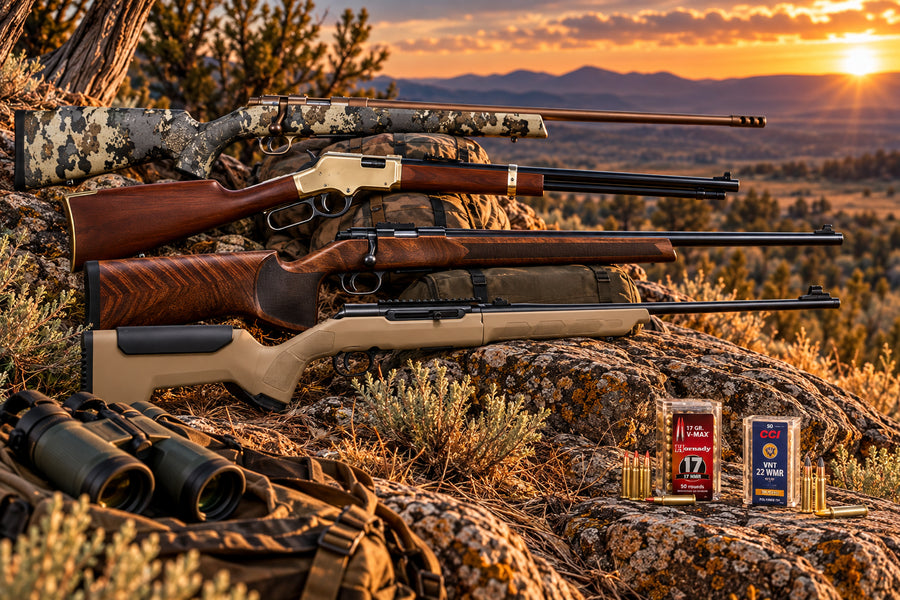
For a shooter primarily interested in a flat-shooting rimfire rifle, small targets, and precision-oriented varmint applications, the .17 HMR is particularly attractive. Common 17-grain loads run around 2,550 feet per second, with some current factory ammunition reaching approximately 2,650 fps. That velocity gives the cartridge its familiar flat trajectory and makes holdover relatively straightforward across the distances where magnum rimfires are commonly used.
The .22 WMR takes a different approach. Familiar 40-grain loads commonly run around 1,875 fps, while lighter 30-grain varmint ammunition can reach roughly 2,200 fps. The cartridge also supports a much wider range of bullet weights and constructions, including jacketed hollow points, polymer-tipped projectiles, full-metal-jacket loads, segmented bullets, and other specialized designs.
Neither cartridge is universally better. The .17 HMR generally offers the stronger trajectory advantage, while the .22 WMR provides more projectile mass, broader ammunition variety, and an unusually diverse selection of firearm types. Current rifle offerings also make the comparison closer than it once was, because .17 HMR is no longer confined almost entirely to bolt guns. Savage offers semiautomatic .17 HMR rifles, and Henry's expanded 2026 H1 lineup now includes select .17 HMR lever actions.
For most buyers, the correct choice comes down to intended use. Choose the .17 HMR when flat trajectory, small-target shooting, and varmint-oriented performance are the priorities. Choose the .22 WMR when heavier bullets, broader ammunition selection, and greater flexibility across traditional sporting-rifle formats matter more.
Key Takeaways
- The .17 HMR typically uses lightweight 16- to 20-grain bullets and emphasizes high velocity and relatively flat trajectory.
- The .22 WMR commonly uses bullets from roughly 30 to 50 grains and offers a wider variety of factory projectile designs.
- Common 17-grain .17 HMR loads run around 2,550 fps, while selected current loads reach approximately 2,650 fps.
- Traditional 40-grain .22 WMR loads commonly run around 1,875 fps, while lighter 30-grain loads can reach roughly 2,200 fps.
- The .17 HMR generally offers the flatter trajectory, but wind performance depends on the exact projectile, velocity, ballistic coefficient, distance, and conditions.
- The .22 WMR and .17 HMR are completely separate cartridges and are not interchangeable.
- Savage, Ruger, CZ, and Henry currently provide meaningful rifle choices in both chamberings.
- Henry's 2026 H1 expansion now includes select .17 HMR lever-action rifles, reducing what was once a clear platform advantage for .22 WMR.
- Ammunition cost, local availability, hunting regulations, rifle design, and intended use matter more than choosing solely according to muzzle velocity.
Understanding the .22 WMR and .17 HMR
Both cartridges are rimfire designs, meaning the priming compound is contained around the rim of the cartridge case rather than in a separate centerfire primer. That places them in the same broad ammunition family as the .22 LR, although neither cartridge should be treated as simply a more powerful .22 LR load. Their case dimensions, operating pressures, chambers, and firearm requirements are different.
The .22 WMR came first and established the basic magnum-rimfire concept that remains familiar today. The .17 HMR arrived decades later by adapting the .22 WMR case to a much smaller projectile diameter. That shared ancestry explains why the cartridges look related while also highlighting why they cannot be interchanged.
The practical difference is visible immediately in the projectile. The .22 WMR uses a conventional .22-caliber bullet and has enough case capacity to push relatively light .22-caliber projectiles considerably faster than .22 LR. The .17 HMR reduces bullet diameter and projectile weight dramatically, allowing manufacturers to pursue much higher velocity and flatter short- to medium-range trajectory.
Those design priorities shape almost every other difference between the cartridges, including ammunition selection, rifle configuration, field performance, and the types of shooters most likely to prefer one over the other.
What Is the .22 WMR?
The .22 Winchester Magnum Rimfire was developed in 1959 and became one of the most successful modern rimfire cartridges introduced after the .22 LR era was already well established. It is commonly called the .22 Magnum, .22 Mag, or simply .22 WMR. Although those informal names are widely understood, the cartridge designation marked on the firearm and ammunition should always be followed exactly.
The .22 WMR was designed to provide substantially more performance than conventional .22 LR while retaining the simplicity and compact dimensions associated with rimfire ammunition. Traditional 40-grain loads are among the most familiar, but the modern market includes lighter 30-grain high-velocity projectiles and heavier specialized bullets as well.
That broad ammunition selection is one of the cartridge's greatest advantages. A buyer can find loads emphasizing rapid expansion on varmints, heavier projectiles for small-game applications, full-metal-jacket designs, polymer-tipped bullets, and specialized ammunition from several major manufacturers.
The cartridge has also been chambered in an unusually wide variety of firearms. Bolt-action rifles, semiautomatic rifles, lever actions, revolvers, and other handgun configurations have all been produced in .22 WMR. That platform variety is part of the reason the cartridge has remained relevant for more than six decades.
Common .22 WMR Factory Loads
Current ammunition catalogs illustrate just how broad the .22 WMR category has become. CCI's familiar 40-grain Maxi-Mag JHP remains rated around 1,875 fps from the manufacturer's rifle test setup. The company also offers 30-grain VNT, TNT, and V-MAX-style ammunition reaching approximately 2,200 fps, while other products move in the opposite direction with heavier bullets and specialized terminal designs.
This means describing .22 WMR simply as a 40-grain cartridge no longer captures the full market. A 30-grain varmint load and a 40- or 46-grain hunting-oriented load can behave very differently despite sharing the same chambering. Bullet construction can be just as important as bullet weight when the cartridge is being selected for hunting.
The variety gives the .22 WMR unusual flexibility for a rimfire cartridge, but it also means buyers need to compare specific loads instead of relying on the caliber name alone. A high-velocity polymer-tipped load and a heavier jacketed hollow point should not be expected to produce identical trajectory or terminal behavior.
What Is the .17 HMR?
The .17 Hornady Magnum Rimfire was introduced commercially in 2002 and quickly became one of the most successful modern rimfire developments. Hornady worked with firearm and ammunition manufacturers during development, using the .22 WMR case as the basis for a necked-down cartridge that accepts approximately .172-inch projectiles.
The defining feature of the cartridge is speed. Common 17-grain factory loads are typically advertised around 2,550 fps, while selected loads reach approximately 2,650 fps. Twenty-grain options are also available and generally trade some velocity for additional projectile mass and different terminal characteristics.
That combination of small diameter and high velocity gave the .17 HMR an immediate identity as a varmint and small-target cartridge. Compared with traditional .22 rimfire ammunition, the projectile spends less time in flight across typical rimfire distances and therefore follows a noticeably flatter trajectory.
The cartridge should not be interpreted as a miniature centerfire rifle round, however. It remains a rimfire cartridge firing extremely lightweight bullets, and its limitations become more noticeable as distance, wind, and target size increase.
The .17 HMR Is Based on the .22 WMR Case, but They Are Not Interchangeable
The two cartridges share a family relationship, but that relationship should never be confused with compatibility. The .17 HMR case is necked down and shouldered to hold the smaller projectile, creating a chamber profile that is completely different from the straight-walled .22 WMR.
A rifle marked .22 WMR should use only ammunition approved for that chambering by the firearm manufacturer. A firearm marked .17 HMR requires .17 HMR ammunition. Neither cartridge should ever be substituted for the other simply because their case heads appear similar.
The same rule applies to magazines and conversion components. Some rifle families use related magazine systems across the two cartridges, while others require chambering-specific parts. Manufacturer documentation should always settle compatibility questions.
.22 WMR vs. .17 HMR Specifications
| Specification | .22 WMR | .17 HMR |
|---|---|---|
| Full Name | .22 Winchester Magnum Rimfire | .17 Hornady Magnum Rimfire |
| Commercial Introduction | 1959 | 2002 |
| Bullet Diameter | Approx. .224 in. | Approx. .172 in. |
| Common Bullet Weights | Approx. 30–50 gr. | Approx. 16–20 gr. |
| Representative Traditional Load | 40 gr. JHP at approx. 1,875 fps | 17 gr. V-MAX/JHP at approx. 2,550 fps |
| High-Velocity Examples | 30 gr. loads around 2,200 fps | 17 gr. loads around 2,650 fps |
| Primary Market Character | Versatile magnum rimfire | High-velocity precision/varmint rimfire |
| Common Firearm Types | Bolt, lever, semiauto, handgun | Bolt, semiauto, selected lever actions |
The velocities shown here are representative factory figures rather than universal cartridge specifications. Actual velocity varies with ammunition, barrel length, chamber dimensions, temperature, and individual firearm characteristics.
Representative Current Factory Loads
| Cartridge | Representative Load | Bullet Weight | Advertised Muzzle Velocity |
|---|---|---|---|
| .22 WMR | CCI Maxi-Mag JHP | 40 gr. | Approx. 1,875 fps |
| .22 WMR | CCI V-MAX | 30 gr. | Approx. 2,200 fps |
| .22 WMR | CCI VNT | 30 gr. | Approx. 2,200 fps |
| .17 HMR | CCI V-MAX | 17 gr. | Approx. 2,550 fps |
| .17 HMR | CCI TNT JHP | 17 gr. | Approx. 2,550 fps |
| .17 HMR | CCI VNT | 17 gr. | Approx. 2,650 fps |
The table reveals an important point that can disappear in a simple caliber comparison. Modern .22 WMR and .17 HMR ammunition overlap in intended use even when their ballistic approaches differ significantly. Both cartridges now have lightweight polymer-tipped varmint ammunition, conventional hollow points, and other specialized loads.
Which Cartridge Is Faster?
The .17 HMR is generally the faster cartridge when common factory loads are compared. A traditional 17-grain load at approximately 2,550 fps has a clear velocity advantage over the familiar 40-grain .22 WMR load at approximately 1,875 fps.
The comparison becomes less dramatic when modern lightweight .22 WMR ammunition is used. Thirty-grain .22 Magnum loads around 2,200 fps close part of the gap, although common .17 HMR ammunition still remains substantially faster.
Velocity is useful because it influences time of flight and trajectory, but it should not be treated as a universal performance score. The heavier .22-caliber projectile begins with substantially more mass, while projectile design and ballistic coefficient influence what happens after either bullet leaves the muzzle.
Which Cartridge Shoots Flatter?
The .17 HMR generally wins the trajectory comparison. Its combination of high initial velocity and relatively aerodynamic small-caliber projectiles produces less drop than many traditional .22 WMR loads over comparable distances.
That is one reason the .17 HMR developed such a loyal following among shooters engaging small targets. When the target itself is only a few inches across, reducing trajectory variation can make range estimation and holdover less demanding within the cartridge's normal operating window.
The advantage should not be exaggerated into the idea that .22 WMR has a dramatically curved trajectory at ordinary hunting distances. Modern 30-grain .22 WMR varmint ammunition is considerably faster than the older 40-grain reference loads and can provide relatively flat performance of its own.
The practical conclusion remains the same: if trajectory is the dominant deciding factor, .17 HMR is normally the stronger option.
Why Test-Barrel Velocity May Not Match Your Rifle
Factory velocity data is a useful reference, but it is not a promise that every rifle will produce the number printed on the box. Manufacturers generate published ballistic data under controlled conditions using specified test barrels and ammunition lots.
An individual sporting rifle can produce higher or lower velocity. Barrel length, chamber dimensions, bore characteristics, ammunition lot, ambient temperature, and the firearm itself can all influence chronograph results.
This is especially relevant when comparing rifle and handgun performance in .22 WMR. A 40-grain load advertised around 1,875 fps from a rifle test barrel should not be expected to reach the same number from a short revolver or compact semiautomatic pistol.
Which Cartridge Handles Wind Better?
Wind is one of the areas where overly simple cartridge comparisons become misleading. The .17 HMR fires a much lighter bullet, which sounds like an obvious disadvantage, but its high velocity reduces flight time. The .22 WMR fires heavier projectiles, but those bullets are generally moving more slowly.
The actual wind deflection depends on the exact projectile's ballistic coefficient, velocity, distance, atmospheric conditions, and angle of the wind. A high-quality .17-caliber polymer-tipped load can compare surprisingly well against some .22 WMR loads because it reaches the target much sooner.
That does not make the .17 HMR immune to wind. Its lightweight bullets can still move substantially when conditions become strong or inconsistent, particularly as distance increases and velocity falls.
The useful rule is to compare specific loads rather than saying the .22 WMR always wins because it has a heavier bullet or that the .17 HMR always wins because it is faster.
Which Cartridge Produces More Muzzle Energy?
The .22 WMR's heavier bullets can give it an energy advantage over some .17 HMR loads despite the lower velocity. A traditional 40-grain .22 WMR load around 1,875 fps produces roughly 312 foot-pounds of muzzle energy, while a 17-grain .17 HMR load around 2,550 fps falls closer to the mid-200-foot-pound range.
That difference does not mean the .22 WMR is automatically the more effective hunting cartridge for every species. Terminal performance depends on what the bullet actually does after impact, including expansion, fragmentation, penetration, and how those characteristics interact with the intended target.
Energy is therefore one useful specification among several. Projectile construction and the ammunition manufacturer's intended application deserve equal attention.
Bullet Weight Changes the Character of the Cartridges
The .17 HMR's common projectile range is narrow compared with the .22 WMR. Most mainstream ammunition sits between approximately 16 and 20 grains, with 17 grains remaining the classic reference point.
The .22 WMR provides considerably more variation. Modern factory loads can use lightweight 30-grain varmint projectiles, familiar 40-grain bullets, heavier 46-grain segmented designs, and additional specialized options from other manufacturers.
This broader spread lets ammunition companies tune the .22 WMR around different applications without changing the underlying chambering. That versatility remains one of the cartridge's strongest advantages over the .17 HMR.
Projectile Construction Matters More Than Caliber Reputation
A polymer-tipped varmint bullet is designed to behave differently from a conventional jacketed hollow point, soft point, full-metal-jacket projectile, or segmented bullet. Comparing cartridges without considering construction can therefore create misleading conclusions.
This is especially important for hunting. A lightweight projectile designed for rapid expansion may perform very differently on edible small game than a load intended to penetrate more deeply or preserve more of the animal.
The cartridge gives the manufacturer a ballistic envelope. The projectile design determines how that envelope is used.
.17 HMR for Varmint Hunting

The .17 HMR has developed one of the strongest varmint-hunting identities in the rimfire market. High-velocity 17-grain polymer-tipped and hollow-point loads provide the flat trajectory and rapid terminal performance many shooters want when engaging small pests and varmints at distances beyond ordinary .22 LR use.
The trajectory advantage also becomes valuable when the target itself is small. A cartridge that requires less elevation correction can make field shooting more forgiving when distance estimation is not perfect.
The limitations remain important. Lightweight projectiles lose energy and velocity as distance increases, while wind can become increasingly significant. The cartridge should be used only for species, distances, and applications appropriate to the specific load and permitted by applicable regulations.
.22 WMR for Varmint Hunting

The .22 WMR approaches the same job with heavier projectiles and a wider ammunition selection. Thirty-grain polymer-tipped loads offer substantially more velocity than the classic .22 Magnum stereotype suggests, while heavier bullets provide different penetration and terminal characteristics.
This makes the cartridge attractive to hunters who want one magnum rimfire rifle capable of using several different factory load types. The buyer can choose ammunition according to the target rather than being limited primarily to one narrow bullet-weight range.
That versatility does not mean every .22 WMR load is suitable for every animal. The exact ammunition and the manufacturer's intended use remain more useful than broad assumptions about the cartridge.
Small Game and Meat Preservation
Rabbits and squirrels create a different ammunition-selection problem from pest control because hunters may want to preserve edible meat. Extremely rapid-expansion varmint ammunition can damage considerably more tissue than necessary depending on shot placement and the animal involved.
The .22 WMR's broad projectile range can be useful here because hunters have several bullet designs to consider. That said, the additional power over .22 LR may itself be unnecessary in some environments, particularly where shots are close.
The .17 HMR can also be used for lawful small-game applications with appropriate ammunition, but buyers should recognize how aggressively some varmint-oriented projectiles are designed to fragment or expand.
Hunters should choose ammunition for the actual game rather than selecting the fastest load available simply because it produces the most dramatic specification sheet.
Local Hunting Rules Matter
Hunting regulations vary by state, game species, season, and sometimes even by geographic area within a state. Rimfire cartridges may be permitted for one species and prohibited for another, while ammunition requirements can also differ.
A cartridge being ballistically capable of taking a particular animal does not automatically mean its use is legal or appropriate. Regulations should be checked before the firearm and ammunition are selected specifically for hunting.
Which Cartridge Is More Accurate?
Neither cartridge is inherently guaranteed to be more mechanically accurate than the other. The .17 HMR has developed a particularly strong reputation for accuracy because its flat trajectory and high velocity make it well suited to small-target shooting, but trajectory and mechanical precision are not the same concept.
A quality .22 WMR rifle with ammunition it prefers can produce excellent groups. A poor .17 HMR rifle or incompatible ammunition can produce disappointing results. Barrel manufacturing, chamber quality, stock or chassis consistency, trigger, optic, ammunition, environmental conditions, and shooter technique all matter.
The better question is which complete rifle-and-ammunition combination produces the performance the buyer needs.
Why the .17 HMR Feels Easier at Distance
The .17 HMR's trajectory can make practical accuracy feel easier because the shooter has fewer vertical corrections to manage across moderate distances. That is especially noticeable on small reactive targets where a minor range-estimation error can move the point of impact enough to create a miss.
This advantage should not be confused with the cartridge somehow manufacturing smaller groups on its own. It simply reduces one of the ballistic variables the shooter needs to manage.
Ammunition Testing Still Matters With Rimfires
Rimfire rifles can show surprisingly strong ammunition preferences. Two loads using the same bullet weight can produce noticeably different groups from the same rifle because of differences in velocity, projectile construction, case characteristics, and the relationship between the ammunition and chamber.
A buyer interested in precision should test several appropriate factory loads rather than assuming the most expensive or fastest box will automatically win.
Once a rifle demonstrates a clear preference, staying with that load can simplify zero confirmation and ballistic data.
Ammunition Availability
Both cartridges have strong commercial support, but the .22 WMR retains the broader historical ammunition ecosystem. Major manufacturers offer numerous hunting, varmint, target, and specialized loads across a wider range of bullet weights.
The .17 HMR is far from obscure. Hornady, CCI, Federal, Winchester, and other established brands continue to support it, and its popularity in modern sporting rifles keeps ammunition widely represented in the rimfire market.
Local availability can still differ substantially. A buyer who shoots frequently should look at what nearby retailers actually keep on the shelf rather than relying only on national product catalogs.
Is One Cartridge Cheaper to Shoot?
There is no permanent winner. Retail pricing moves with manufacturer, bullet construction, package size, production cycle, retailer inventory, and promotions.
Both cartridges generally cost more per round than ordinary .22 LR. The difference becomes important to high-volume shooters because even a modest gap in cost per box accumulates over hundreds or thousands of rounds.
For someone primarily interested in inexpensive recreational shooting, the correct answer may therefore be neither magnum rimfire. Conventional .22 LR usually offers the strongest ammunition-cost advantage and the widest range of inexpensive target loads.
Why .22 LR Still Belongs in the Conversation
The ballistic advantage of a magnum rimfire is only useful when the owner actually needs it. A shooter spending most of their time at 25 or 50 yards punching paper may gain very little from paying significantly more per round for .17 HMR or .22 WMR.
.22 LR also offers an enormous rifle, pistol, and ammunition market. Match ammunition, high-velocity ammunition, subsonic loads, hunting loads, and bulk recreational ammunition all exist within the same basic cartridge family.
The magnum rimfires become more compelling when their velocity, trajectory, or projectile options solve a specific problem rather than simply producing larger numbers on the ammunition box.
Modern Rifle Selection Has Changed the Comparison
Older comparisons often gave the .22 WMR a decisive advantage in firearm variety. That remains partly true, particularly because .22 Magnum has long been offered in rifles and handguns, but the .17 HMR rifle market has expanded substantially.
Current Savage, Ruger, CZ, and Henry catalogs provide meaningful choices in both cartridges. Bolt guns remain the most common .17 HMR format, but semiautomatic and lever-action options are now established enough that buyers are no longer forced into one operating system.
Savage Magnum Rimfire Rifles
Savage currently has one of the broadest magnum-rimfire catalogs. The company says its .17 HMR lineup spans dozens of current configurations, including rifles from the 93/93R17 family, B Series, A17 semiautomatic platform, and REVEL family.
.22 WMR is equally well represented through the 93 family, B Series, A22 Magnum, and REVEL. This lets buyers compare not only calibers but operating systems, stocks, barrel profiles, and price tiers within the same manufacturer.
For a shopper who wants to compare .22 WMR and .17 HMR without changing brand philosophy entirely, Savage offers one of the most useful current catalogs.
The Savage 93 and 93R17

The Savage 93 family remains a recognizable bolt-action reference point for magnum rimfires. Specific configurations vary in stock, barrel contour, sights, trigger equipment, finish, and included accessories.
The platform's longevity also means used rifles and discontinued variants remain common. Buyers should verify the exact model number because two rifles carrying similar 93-series names may not have identical equipment.
Savage A17 and A22 Magnum

Savage also demonstrates how the operating-system comparison differs between the cartridges. The A17 is a semiautomatic rifle developed specifically around .17 HMR, while the A22 Magnum provides a comparable self-loading option in .22 WMR.
This is particularly important because .17 HMR semiautomatic use should never be assumed simply because a cartridge fits a magazine. Ammunition and firearm manufacturers may publish specific compatibility guidance for semiautomatic operation. Use only ammunition approved for the exact rifle.
Savage REVEL Adds Another Option

The newer Savage REVEL family expands the comparison into lever-action territory and is available in both magnum rimfire chamberings. That further reduces the old assumption that lever-action buyers must automatically choose .22 WMR.
As with any rifle family, exact capacity, barrel length, sights, threading, furniture, and configuration should be checked at the model level.
Ruger American Rimfire

The Ruger American Rimfire remains another clean comparison because Ruger currently supports both .22 Magnum and .17 HMR within the platform.
The magnum models use Ruger's detachable JMX-1 nine-round rotary magazine and can also accept the larger-capacity BX-15 Magnum magazine where lawful. This provides a common magazine architecture across both chamberings within the current rifle family.
The rifle also uses Ruger's adjustable Marksman trigger, Power Bedding system, cold-hammer-forged barrel, and 60-degree bolt throw in standard configurations.
For buyers who want a straightforward factory bolt gun and would rather make the caliber decision before the rifle-platform decision, the American Rimfire makes the comparison relatively simple.
Ruger 77-Series Options
Ruger's broader rimfire catalog also includes 77-series rifles, giving the company another established bolt-action route for magnum rimfire shooters.
Exact current chamberings and model configurations should be checked before purchase because Ruger's product mix evolves and distributor-exclusive versions can differ from standard catalog rifles.
CZ 457

The CZ 457 remains one of the strongest premium bolt-action rimfire platforms available in both .17 HMR and .22 WMR. Current 457 American specifications include both chamberings, while several other sporting models have also appeared in magnum-rimfire configurations.
The family uses a 60-degree bolt rotation, adjustable trigger, detachable magazine, and cold-hammer-forged barrel architecture. CZ also designed the 457 family around manufacturer-supported barrel and magazine changes, although buyers should verify exactly which components are required before assuming a caliber conversion is as simple as replacing the barrel.
The biggest attraction of the 457 may be the depth of the platform. Buyers can find traditional walnut sporting rifles, heavier varmint configurations, and more specialized rimfire models under the same basic action family.
CZ 457 American

The 457 American provides an especially clean side-by-side comparison because current specifications list both .17 HMR and .22 WMR versions with five-round detachable magazines and the same general sporting-rifle architecture.
This allows the shooter to focus on cartridge preference instead of comparing completely different rifle designs.
CZ 457 Varmint

The heavier Varmint configuration is particularly relevant to shooters interested in small-target or varmint applications. Current catalog information has included both magnum chamberings alongside .22 LR versions, with a heavier barrel intended to support the rifle's target-oriented role.
The heavier rifle may be less appealing to someone carrying it extensively in the field, which reinforces the importance of comparing complete rifle specifications instead of choosing only by cartridge.
Henry Lever Actions: An Important 2026 Change

One of the most significant changes to this comparison is Henry's expanded H1 rimfire lineup. Historically, .22 WMR had the obvious advantage among traditional lever-action buyers because Henry and other companies offered several .22 Magnum rifles while .17 HMR lever choices were comparatively limited.
Henry changed that equation substantially in 2026. The company expanded the H1 family and now offers select .17 HMR lever-action rifles alongside its much broader .22 Magnum catalog.
The H1 Frontier Rifle is currently available in .17 HMR with a 20-inch octagonal barrel and 13-round capacity. Henry also added a .17 HMR version of the H1 Sporter Rifle with an optics-oriented configuration and threaded barrel.
.22 WMR still holds the broader Henry catalog because numerous Classic, Western, Frontier, Sporter, Bandit, X Model, and other configurations are available in .22 Magnum. The important change is that a buyer who specifically wants a lever-action .17 HMR now has a current major-manufacturer option.
Current Rifle Platform Comparison
| Platform | Operating System | .22 WMR | .17 HMR | General Character |
|---|---|---|---|---|
| Savage 93 / 93R17 | Bolt action | Yes | Yes | Affordable sporting and varmint options |
| Savage B Series | Bolt action | Yes | Yes | Modern bolt-action rimfire family |
| Savage A Series | Semiautomatic | A22 Magnum | A17 | Dedicated self-loading magnum rimfires |
| Savage REVEL | Lever action | Yes | Yes | Modern takedown lever-rifle option |
| Ruger American Rimfire | Bolt action | Yes | Yes | General-purpose sporting rifle |
| CZ 457 | Bolt action | Yes | Yes | Sporting through premium varmint configurations |
| Henry H1 | Lever action | Broad availability | Select current models | Traditional and modern lever-action configurations |
Which Cartridge Offers Better Rifle Selection?
The .22 WMR still has the broader overall firearm ecosystem. Decades of production have resulted in bolt guns, lever actions, semiautomatics, revolvers, and other handgun designs from numerous manufacturers.
The gap is considerably smaller if the buyer wants a rifle. Both cartridges now have excellent bolt-action choices, Savage provides semiautomatics in each, and current Savage and Henry offerings create lever-action options in both chamberings.
This means rifle selection should increasingly be based on the exact model rather than assuming the cartridge dictates the operating system.
What About Handguns?
Here the .22 WMR retains a much clearer advantage. The cartridge has a long history in revolvers and has also appeared in semiautomatic handguns and other compact firearm formats.
.17 HMR handguns have existed, but the cartridge is much more strongly associated with rifles. The extremely high velocity figures that define .17 HMR are also derived from rifle-length test barrels, so shortening the barrel changes the performance equation substantially.
A buyer specifically interested in both rifle and handgun use therefore has more .22 WMR options to evaluate.
Semiautomatic .17 HMR Requires Extra Attention
The .17 HMR has an important historical relationship with semiautomatic rifle design. Ammunition manufacturers have published warnings advising users to confirm firearm-manufacturer approval before using certain .17 HMR loads in semiautomatic actions.
That does not mean the cartridge cannot function properly in a semiautomatic rifle. Savage's A17 is specifically engineered around .17 HMR, and CCI even developed its A17 ammunition in cooperation with that platform.
The takeaway is simply that chambering alone is not enough. Use ammunition and firearm configurations that the manufacturers specifically approve.
Magazine Capacity and Design
Magazine systems vary significantly among magnum rimfire rifles. Ruger uses its rotary Magnum magazine architecture in the American Rimfire, CZ commonly uses detachable box magazines in the 457, Savage uses platform-specific magazines, and Henry's traditional lever rifles feed from tubular magazines.
Capacity therefore depends much more on rifle design than cartridge alone. A buyer comparing a Henry Frontier with a CZ 457 or Ruger American Rimfire is comparing operating systems and magazine philosophies at the same time as ammunition.
Which Cartridge Is Better for a Bolt-Action Rifle?
Either can be excellent because bolt-action rifles offer the widest selection and the fewest operating-system complications. Savage, Ruger, and CZ all provide established choices in both chamberings.
The decision can therefore be based almost entirely on ballistic preference, ammunition availability, rifle weight, trigger quality, stock fit, and price.
Someone focused on small-target precision will often gravitate toward .17 HMR, while someone wanting broader ammunition flexibility may prefer .22 WMR.
Which Cartridge Is Better for a Lever Action?
The .22 WMR still provides more lever-action choices, but this category changed significantly in 2026. Henry now offers select .17 HMR H1 rifles, while Savage's REVEL family also supports the cartridge.
A buyer who prefers traditional wood, octagonal barrels, and classic lever-rifle styling can now obtain that experience in either magnum chambering from a major manufacturer.
.22 WMR remains the easier choice if maximum lever-gun variety is the priority.
Which Cartridge Is Better for a Semiautomatic Rifle?
Both have viable options, but the .22 WMR has the longer and broader semiautomatic history. Savage's A22 Magnum is a modern example.
The A17 proves that .17 HMR can also work successfully in a rifle designed around the cartridge. Buyers should simply pay closer attention to firearm and ammunition compatibility rather than assuming any semiautomatic rimfire design will work safely with any load.
Which Cartridge Is Better for Target Shooting?
The .17 HMR is particularly enjoyable when the target is small enough and distant enough for its trajectory advantage to matter. A quality bolt-action .17 can make precision-oriented rimfire shooting at moderate distance extremely satisfying.
The .22 WMR remains perfectly capable of accurate recreational shooting and offers the opportunity to experiment with a larger variety of bullet weights and ammunition types.
For high-volume target practice, however, both suffer the same fundamental disadvantage compared with .22 LR: ammunition normally costs considerably more.
Which Cartridge Is Better for a New Shooter?
Neither magnum rimfire automatically makes the best first rifle. If the primary goal is learning basic marksmanship and shooting large quantities of ammunition economically, a .22 LR may make more sense.
If the new shooter has a specific hunting or varmint application requiring more ballistic performance, either .22 WMR or .17 HMR can be considered. Recoil remains very mild compared with centerfire rifles, although muzzle report is noticeably greater than ordinary .22 LR.
The firearm's ergonomics, safety system, trigger, stock dimensions, and overall weight may matter more than the cartridge for a beginner.
Which Cartridge Makes More Sense for a Walking Rifle?
For a rifle carried extensively through fields or woods, complete firearm weight matters more than cartridge designation. A lightweight .22 WMR can be easier to carry than a heavy-barreled .17 HMR, and the opposite can also be true.
Action type, barrel contour, optic weight, stock material, and magazine system should all be included in the comparison.
The cartridge does not determine whether the finished rifle is light or heavy.
Which Cartridge Is Better for Longer Rimfire Distances?
The .17 HMR generally offers the easier ballistic solution as range increases within the practical limits of magnum rimfire performance. Its high velocity reduces trajectory curvature and can simplify elevation holds.
That does not eliminate the need to know distance and wind. At longer ranges the lightweight projectile is increasingly influenced by atmospheric conditions, and retained energy continues to decrease.
Someone interested primarily in pushing small rimfire targets farther away will often appreciate the .17 HMR's trajectory more than the .22 WMR's additional bullet mass.
Which Cartridge Offers Greater Versatility?
The .22 WMR still has the strongest claim to versatility. Its broader projectile range, larger firearm ecosystem, handgun availability, and variety of hunting-oriented loads give buyers more ways to use the same chambering.
The .17 HMR is more specialized, but specialization is not a disadvantage when the cartridge's strengths match the owner's needs. A shooter who wants a flat-shooting varmint and target rifle may have little reason to care that .22 WMR can be chambered in more handgun designs.
Which Cartridge Makes More Sense If You Already Own .22 LR?
The answer depends on what capability the new rifle is expected to add.
A .22 WMR creates a familiar progression into a faster, heavier-hitting .22-caliber rimfire while preserving a broad selection of bullet constructions. The .17 HMR creates a more distinct ballistic experience, emphasizing speed and trajectory rather than simply increasing the power of a familiar bullet diameter.
Someone who wants the largest practical difference from the existing .22 LR may therefore find .17 HMR particularly interesting. Someone wanting a versatile hunting-oriented rimfire step-up may prefer .22 WMR.
.22 WMR Advantages
The .22 WMR's strongest advantages are ammunition variety and firearm variety. Its six-plus decades of commercial history have created a large selection of rifles, handguns, magazines, and factory loads.
Heavier projectiles also give the cartridge a different terminal-performance envelope from the .17 HMR. Hunters can choose among several bullet weights and construction styles rather than working primarily within the narrow range of lightweight .17-caliber ammunition.
The cartridge also retains the stronger position for buyers who want one chambering available across traditional lever rifles, semiautomatics, bolt actions, and handguns.
.22 WMR Limitations
The cartridge does not normally match the trajectory of common .17 HMR ammunition. Traditional 40-grain loads are substantially slower, and even modern 30-grain high-velocity ammunition does not completely erase that gap.
It also costs considerably more to shoot than ordinary .22 LR, which can matter to high-volume recreational shooters.
Finally, the broader ammunition selection means buyers need to pay attention to the exact load. A heavy small-game load and a lightweight varmint load can behave so differently that treating them as one ballistic category is not very useful.
.17 HMR Advantages
The .17 HMR's greatest advantage is the combination of high velocity and relatively flat trajectory. Those characteristics make it especially appealing for small targets and varmint applications where precise shot placement at moderate distance matters.
Factory ammunition support is also strong. The cartridge has been commercially successful for more than two decades and is supported by major ammunition companies rather than existing as a niche wildcat-style product.
Rifle selection continues to improve as well. Bolt actions dominate, but Savage semiautomatics and current Henry and Savage lever actions have expanded the platform options significantly.
.17 HMR Limitations
The light projectile is both the cartridge's strength and its limitation. Wind becomes increasingly important as range grows, and retained energy drops despite the impressive muzzle velocity.
Factory bullet-weight selection is also much narrower than .22 WMR. Buyers generally choose among variations of lightweight varmint and small-game projectiles rather than a wide spectrum of projectile masses.
Ammunition cost can also make routine plinking more expensive than .22 LR, removing one of the traditional economic advantages people associate with rimfire shooting.
.22 WMR vs. .17 HMR by Buyer Priority
| Buyer Priority | Cartridge Worth Considering | Why |
|---|---|---|
| Flattest common magnum-rimfire trajectory | .17 HMR | High velocity with lightweight projectiles |
| Broader bullet-weight selection | .22 WMR | More common projectile weights and load types |
| Small-target shooting | .17 HMR | Trajectory advantage is particularly useful |
| Versatile hunting-ammunition selection | .22 WMR | Broader projectile construction choices |
| Bolt-action rifle | Either | Strong current factory support in both |
| Lever-action rifle | Either, with .22 WMR offering more choices | Henry and Savage now offer .17 HMR lever options |
| Semiautomatic rifle | Either, platform dependent | Savage supports both with dedicated designs |
| Handgun availability | .22 WMR | Much broader handgun ecosystem |
| High-volume inexpensive plinking | Consider .22 LR | Usually lower ammunition cost |
Common Mistake: Choosing Only by Muzzle Velocity
Muzzle velocity is the easiest number to compare and often the least complete way to choose ammunition. The .17 HMR is clearly faster with most common loads, but that does not tell the buyer which projectile construction is appropriate for the intended game or whether the rifle fits their needs.
The .22 WMR is slower, yet its heavier bullets and broader ammunition selection can make it the more practical cartridge for some hunters.
Common Mistake: Assuming Heavier Always Handles Wind Better
Projectile mass matters, but wind drift is affected by velocity, ballistic coefficient, time of flight, and atmospheric conditions. A heavy but relatively slow projectile does not automatically drift less than a smaller projectile moving several hundred feet per second faster.
Use actual ballistic data for the specific loads being compared.
Common Mistake: Assuming .17 HMR Is Automatically More Accurate
The trajectory can make accurate shooting easier at distance, but it does not guarantee smaller mechanical groups. Rifle quality and ammunition compatibility remain critical.
A premium CZ 457 in .22 WMR may easily outshoot a lower-quality .17 HMR rifle, and the reverse can also be true.
Common Mistake: Treating All .22 WMR Ammunition the Same
The difference between a 30-grain varmint bullet and a substantially heavier small-game or specialized projectile is large enough that one generic ballistic description cannot cover both accurately.
Compare product to product rather than cartridge name to cartridge name whenever possible.
Common Mistake: Assuming .17 HMR Is Only a Bolt-Action Cartridge
That was never completely true, and it is especially outdated today. Savage offers the A17 semiautomatic platform, while current Henry and Savage lever-action rifles expand the cartridge into additional operating systems.
Bolt guns remain the largest part of the market, but buyers now have meaningful alternatives.
Common Mistake: Assuming .22 WMR Still Owns the Lever-Action Category
.22 WMR continues to offer more lever-action choices, especially within Henry's current catalog, but it no longer has exclusive access to the category among major manufacturers.
Henry's 2026 H1 expansion introduced current-production .17 HMR lever rifles, and Savage's REVEL family also provides a modern lever option.
Common Mistake: Buying Magnum Rimfire When .22 LR Would Do the Job
The magnum cartridges are excellent tools when their additional performance matters. They are poor value when the owner's actual use consists primarily of short-range recreational shooting where .22 LR already provides more than enough capability.
Ammunition expense should be part of the purchase decision before the rifle is bought.
How to Choose Between .22 WMR and .17 HMR
Begin with the target or application rather than the cartridge. If the rifle will primarily be used for small-target shooting and varmint work where relatively flat trajectory matters, start by evaluating .17 HMR rifles.
If the goal is a more versatile magnum rimfire with heavier projectile choices, multiple hunting-load types, and broad firearm support, begin with .22 WMR.
Then compare actual rifles. Stock dimensions, trigger quality, safety placement, magazine design, barrel profile, weight, optic mounting, and manufacturer support may change the answer after the cartridge decision appears settled.
Finally, look at ammunition. Determine what local retailers stock, what each box costs, and whether the loads appropriate to the intended use are available consistently.
The Rifle Can Matter More Than the Cartridge
A shooter choosing between a lightweight Ruger American Rimfire, a walnut-stocked CZ 457, a heavy Savage varmint rifle, and a Henry lever action is comparing far more than caliber.
Those rifles differ in balance, trigger systems, magazine operation, sights, weight, stock geometry, and handling. A buyer may reasonably choose the rifle they prefer first and then select whichever of the two magnum chamberings best fits that platform.
There is no rule requiring the cartridge decision to come first when both options already satisfy the intended application.
Final Thoughts
The .22 WMR and .17 HMR are both successful magnum rimfire cartridges because they solve different problems rather than because one replaced the other.
The .17 HMR is the more trajectory-focused cartridge. Common 17-grain ammunition around 2,550 fps, and selected loads around 2,650 fps, give shooters an unusually flat rimfire option well suited to small targets and varmint-oriented applications.
The .22 WMR is the more flexible cartridge. Traditional 40-grain ammunition around 1,875 fps remains widely available, while modern 30-grain varmint loads reaching roughly 2,200 fps show that the cartridge can also deliver substantial velocity. More importantly, the market offers a wider range of bullet weights and projectile constructions than the .17 HMR.
That flexibility extends to firearms. .22 WMR continues to enjoy one of the broadest magnum-rimfire ecosystems, spanning bolt actions, semiautomatics, lever actions, revolvers, and other handgun formats.
The .17 HMR rifle market has caught up considerably. Savage offers dozens of current configurations, Ruger and CZ maintain established bolt-action platforms, and both Savage and Henry now offer lever-action options. The old assumption that a lever-gun buyer automatically needs .22 WMR is no longer accurate in 2026.
Accuracy should not decide the comparison by reputation alone. Both cartridges can shoot exceptionally well in a quality rifle using ammunition the barrel prefers. The .17 HMR's flatter trajectory can make small-target shooting easier, but that is not the same thing as proving greater inherent mechanical accuracy.
Wind also needs more nuance than the usual internet shorthand. The .17 HMR fires an extremely light bullet but moves it quickly, while the .22 WMR uses more projectile mass at lower velocity. Specific bullet design and flight time matter enough that neither cartridge should be declared the universal wind winner without comparing actual loads.
For hunting, projectile construction deserves at least as much attention as caliber. Rapid-expansion varmint ammunition and heavier small-game-oriented loads serve different purposes, and the fastest load is not automatically the best choice for edible game.
Cost matters as well. Both magnum rimfires generally cost considerably more to shoot than .22 LR. If most of the rifle's life will be spent punching paper at short distance, the ordinary .22 LR may still provide the strongest practical value.
Choose .17 HMR when the appeal is speed, flat trajectory, and a precision-oriented varmint rifle.
Choose .22 WMR when the appeal is heavier projectiles, broader ammunition selection, handgun availability, and the widest range of firearm configurations.
If both seem appropriate, choose the better rifle.
That may ultimately matter more than the headstamp.

CCI Maxi-Mag .22 WMR 30 Grain Speer Tnt JHP
$20.00
at Pro Armory
Prices accurate at time of writing
Frequently Asked Questions
Is .17 HMR better than .22 WMR?
Not universally. The .17 HMR generally provides higher velocity and a flatter trajectory with common factory loads. The .22 WMR offers heavier projectiles, a broader selection of ammunition types, and a wider overall firearm ecosystem. The better cartridge depends on how the firearm will actually be used.
Which is faster, .17 HMR or .22 WMR?
The .17 HMR is generally faster. Common 17-grain loads are rated around 2,550 fps, with selected ammunition reaching approximately 2,650 fps. Common .22 WMR loads range from roughly 1,875 fps with traditional 40-grain bullets to approximately 2,200 fps with lighter 30-grain ammunition.
Which shoots flatter, .17 HMR or .22 WMR?
The .17 HMR generally provides the flatter trajectory with common factory loads because of its higher muzzle velocity and lightweight projectile design. Exact drop depends on the specific ammunition, zero, firearm, and environmental conditions.
Which has more energy, .22 WMR or .17 HMR?
Many traditional 40-grain .22 WMR loads produce more muzzle energy than common 17-grain .17 HMR ammunition because the .22 uses substantially more projectile mass. Energy alone does not determine terminal performance or hunting suitability.
Is .17 HMR more accurate than .22 WMR?
Not inherently. The .17 HMR's flat trajectory can make accurate shooting easier at moderate distance, but mechanical accuracy depends on the rifle, barrel, ammunition, optic, conditions, and shooter. Quality rifles in either chambering can perform extremely well.
Which handles wind better?
It depends on the exact ammunition. The .22 WMR usually fires a heavier bullet, while the .17 HMR's substantially higher velocity reduces time of flight. Ballistic coefficient, velocity, distance, and conditions all influence wind drift.
Can you shoot .17 HMR in a .22 WMR rifle?
No. The cartridges are not interchangeable. A firearm should use only ammunition specifically approved for the chambering marked by its manufacturer.
Is .17 HMR just a necked-down .22 WMR?
The .17 HMR was developed from the .22 WMR case by necking and shouldering it down to accept a smaller approximately .172-inch projectile. The finished cartridges use different chamber dimensions and are not interchangeable.
What bullet weight does .17 HMR use?
Common factory ammunition generally uses bullets from approximately 16 to 20 grains. The classic 17-grain load remains especially common.
What bullet weight does .22 WMR use?
Modern factory ammunition commonly ranges from approximately 30 to 50 grains, depending on manufacturer and application. Forty-grain loads remain a traditional reference point.
Is .17 HMR good for varmint hunting?
It is widely used for varmint applications where the cartridge is appropriate and legal. Its high velocity and relatively flat trajectory are particularly useful on small targets. Hunters should choose ammunition designed for the intended species and conditions.
Is .22 WMR good for varmint hunting?
Yes. The cartridge offers several lightweight, high-velocity varmint loads as well as heavier projectile options. Its broad ammunition selection is one of its strongest advantages.
Which is better for squirrels and rabbits?
Either can be appropriate where lawful, but ammunition selection matters. Rapid-expansion varmint bullets can create more tissue damage than desired on edible small game. Hunters should choose a load suitable for the intended species and comply with local regulations.
Which is better for target shooting?
The .17 HMR has an advantage when small targets and flatter trajectory are priorities. The .22 WMR also provides excellent recreational accuracy in quality rifles. For high-volume inexpensive target shooting, .22 LR is usually more economical than either magnum cartridge.
Is .17 HMR more expensive than .22 WMR?
Not consistently. Pricing varies by load, manufacturer, bullet design, retailer, and package size. Buyers should compare current cost per round for the ammunition they actually intend to use.
Are .22 WMR and .17 HMR more expensive than .22 LR?
Generally, yes. Conventional .22 LR usually remains substantially less expensive for high-volume recreational shooting.
What rifles are available in both .22 WMR and .17 HMR?
Current families with configurations in both chamberings include the Savage 93/B Series and REVEL, Ruger American Rimfire, and CZ 457. Henry also currently offers selected H1 lever-action rifles in .17 HMR alongside a broader .22 WMR lineup.
Does Henry make a .17 HMR lever action?
Yes. Henry expanded its H1 rimfire lineup in 2026 and currently lists select .17 HMR lever-action rifles, including Frontier and Sporter configurations. This is a significant change from older comparisons in which Henry's magnum rimfire lever guns were associated almost entirely with .22 WMR.
Does Savage make semiautomatic rifles in both cartridges?
Yes. Savage offers the A17 in .17 HMR and A22 Magnum in .22 WMR. Owners should follow the firearm and ammunition manufacturers' compatibility guidance, particularly with semiautomatic .17 HMR ammunition.
Does Ruger offer both cartridges?
Yes. Current Ruger American Rimfire magnum models are available in .22 Magnum and .17 HMR and use the company's Magnum rotary-magazine system.
Does CZ offer the 457 in both cartridges?
Yes. Current CZ 457 configurations include rifles chambered in .17 HMR and .22 WMR, including the 457 American family.
Which cartridge has more firearm options?
The .22 WMR still has the broader overall firearm selection, particularly when handguns are included. The rifle-only difference is much smaller because .17 HMR now has strong bolt-action support along with current semiautomatic and lever-action choices.
Is .17 HMR good in a semiautomatic rifle?
It can be when the firearm is specifically designed and approved for the cartridge. Savage's A17 is a prominent example. Users should follow the exact rifle and ammunition manufacturers' guidance rather than assuming all .17 HMR ammunition is approved for all semiautomatic actions.
Which cartridge makes more sense if I already own a .22 LR?
The .17 HMR creates the larger change in trajectory and velocity, while the .22 WMR provides a more traditional step upward in projectile weight, energy, and ammunition versatility. The better choice depends on what capability is missing from the existing .22 LR rifle.
Which one should I buy?
Choose .17 HMR if flat trajectory, small-target shooting, and varmint-oriented performance are the priorities. Choose .22 WMR if heavier bullets, ammunition variety, handgun availability, and the broadest range of firearm configurations matter more. If both cartridges fit the application, compare the actual rifles and select the platform that fits you best.
About the Author
The ProArmory editorial team includes experienced hunters, competitive shooters, military veterans, firearms instructors, and firearms industry professionals committed to producing accurate, practical, and research-based content. Our articles draw on manufacturer specifications, current industry information, and real-world shooting experience to help readers make informed decisions about firearms, ammunition, optics, and related equipment.
Disclaimer
This article is intended for educational and informational purposes only. Firearm specifications, ammunition performance, velocities, magazine capacities, product availability, pricing, and manufacturer offerings may change.
Published velocity figures are manufacturer data produced under specified test conditions and should not be interpreted as guarantees that every firearm will produce identical results. Actual velocity and accuracy depend on ammunition, barrel length, firearm dimensions, environmental conditions, and other variables.
Hunting laws, legal game species, ammunition requirements, and firearm restrictions vary by jurisdiction. Verify current state and local wildlife regulations before selecting a cartridge or ammunition for hunting.
Always use only the ammunition designated for the firearm's exact chambering, follow the firearm and ammunition manufacturers' instructions, observe established firearm-safety practices, and comply with applicable federal, state, and local laws.


