



Quick Answer
The difference between cheap ammo and premium ammo usually comes down to manufacturing consistency, component selection, quality control, intended use, and brand positioning. Premium ammunition may offer tighter production tolerances, specialized bullet designs, or additional quality assurance, but a higher price does not automatically guarantee better results in every firearm.
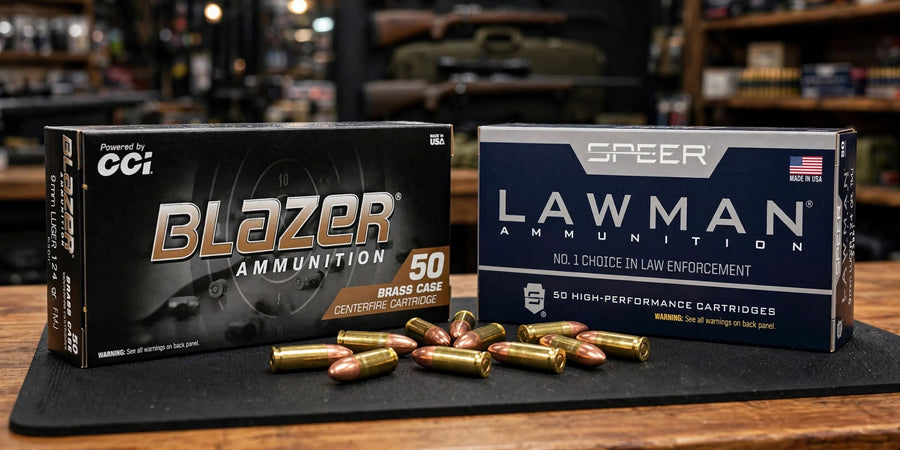
Budget ammunition can be a practical choice for recreational range use when it meets the firearm manufacturer's requirements and comes from a reputable source. Premium ammunition may justify its higher price when a buyer needs particular product characteristics, such as a specialized hunting projectile or documented match-grade specifications.
The real question is whether the additional cost provides something the buyer can actually use. Premium ammunition may offer specialized projectile construction, more detailed manufacturer specifications, or characteristics developed for particular sporting and hunting applications. For ordinary recreational shooting, those differences may offer little practical value compared with reputable economical ammunition that meets the firearm manufacturer's requirements.
Key Takeaways
- Cheap ammunition is not automatically unsafe, and premium ammunition is not automatically superior.
- Price differences can reflect components, manufacturing processes, testing, packaging, and brand positioning.
- Ammunition must match the firearm manufacturer's caliber, chambering, and other compatibility requirements.
- Premium labels such as match, defense, and hunting describe different intended markets, not one universal quality standard.
- Brass-cased, steel-cased, and aluminum-cased ammunition may differ in price, characteristics, and manufacturer compatibility guidance.
- Bulk purchases can reduce cost per round but require careful attention to storage conditions and product details.
- The most useful premium features are those supported by manufacturer documentation and relevant to the buyer's needs, rather than packaging claims or price alone.
Why Is Some Ammo So Much More Expensive?
Browse an ammunition retailer's shelves, and you'll often find substantial price differences between products with the same cartridge designation. Two boxes of 9mm ammunition may contain the same number of cartridges and use similar bullet types, yet one can cost considerably more than the other. The difference is not always obvious from the packaging.
Ammunition prices reflect a combination of manufacturing decisions and market conditions. Component materials, production scale, quality-control processes, product development, distribution expenses, and brand positioning can all influence the final price. Specialized ammunition may also incorporate more complex projectile designs or additional manufacturer testing intended for particular applications.
The important distinction is that higher manufacturing costs and higher retail prices are not the same thing as guaranteed better performance. Understanding what contributes to the price helps buyers determine whether they are paying for useful product characteristics, manufacturing differences, or simply a more expensive market position.
Bullet Construction Can Change the Price

One of the most important differences between ammunition products is bullet design.
Not all bullets are manufactured for the same purpose.
Some are intended primarily for economical recreational shooting. Others are designed for particular hunting applications or organized shooting disciplines.
Full Metal Jacket Ammunition
Full metal jacket, or FMJ, ammunition commonly appears in recreational range offerings.
FMJ bullets generally have a lead or other core material enclosed by a metallic jacket over much of the bullet.
These projectiles are widely manufactured, and many FMJ products are positioned as economical range ammunition.
However, FMJ construction alone doesn't determine quality or price.
Different manufacturers can use different materials, production standards, and inspection processes.
Hollow Point Ammunition
Hollow point bullets have a cavity in the nose.
Some hollow point products are engineered for controlled expansion under specified conditions, while others serve different purposes, including certain target-shooting applications.
Because designs and intended uses vary, buyers should not assume that every hollow point cartridge performs identically.
Specialized bullet construction and development may contribute to higher prices.
Hunting Ammunition
Hunting ammunition may incorporate projectile designs intended for specific game animals and hunting conditions.
Examples include bonded bullets, polymer-tipped designs, and controlled-expansion projectiles.
These features can involve more complex construction than basic economical range ammunition.
Buyers should consult manufacturer specifications and applicable hunting regulations rather than relying on a premium label alone.
Manufacturing Consistency Costs Money

Ammunition production involves numerous components and manufacturing stages.
These can include cartridge cases, primers, propellant, bullets, assembly processes, and inspection.
Manufacturers may differ in how they monitor dimensions, component characteristics, and finished-product specifications.
Why Consistency Matters
Production consistency is important because ammunition must function within established specifications and the firearm manufacturer's requirements.
Specialized ammunition may be marketed around additional consistency-related characteristics.
However, a premium label does not prove that a particular product has tighter tolerances than every lower-priced competitor.
Meaningful comparisons require manufacturer documentation or credible, controlled testing.
Does Cheap Ammo Mean Poor Quality Control?
Not necessarily.
Large-scale manufacturing and efficient distribution can help reputable producers offer economical ammunition.
A lower price may reflect production volume, simpler packaging, or a less specialized bullet rather than inadequate manufacturing.
At the same time, unusually cheap ammunition with unclear origins or missing specifications deserves caution.
The important distinction is between affordable ammunition from a credible source and ammunition whose quality and origin cannot be verified.
For buyers, manufacturing consistency matters because it can affect how predictably a product meets its published specifications. Premium ammunition manufacturers may emphasize uniform components, additional inspection, or narrower internal production targets. However, those characteristics should be evaluated through credible product documentation rather than assumed from price. A lower-cost product from an established manufacturer may already provide the consistency required for ordinary recreational use.
Cartridge Case Material Affects Cost

Cartridge cases are commonly made from brass, steel, or aluminum, depending on the ammunition product.
Case material can influence manufacturing cost, product characteristics, and compatibility considerations.
Brass-Cased Ammo
Brass is widely used in commercial centerfire ammunition.
It offers established manufacturing characteristics and is commonly associated with both economical and premium product lines.
Brass-cased ammunition is not automatically premium. Many budget-friendly cartridges use brass cases.
Steel-Cased Ammo
Steel-cased ammunition is often associated with economical imported or bulk ammunition.
However, the price advantage varies by product and market conditions.
Some firearm manufacturers discourage or restrict particular case materials, so compatibility should never be assumed.
Aluminum-Cased Ammo
Aluminum cases appear in certain commercial ammunition lines.
They may offer an alternative to brass in products designed for specific applications.
As with steel cases, buyers should review firearm and ammunition manufacturer guidance before use.
Brass vs. Steel vs. Aluminum Cases
| Case Material | Common Market Position | Main Buying Consideration |
|---|---|---|
| Brass | Budget through premium | Widely available; verify exact product specifications |
| Steel | Often economy-oriented | Check firearm manufacturer compatibility guidance |
| Aluminum | Commonly positioned as economical | Confirm compatibility and follow manufacturer instructions |
Case material alone does not establish ammunition safety, accuracy, or reliability.
Premium Ammo May Include More Specialized Development

Some ammunition is developed for a narrower purpose than general recreational shooting.
A manufacturer may invest in specialized projectile designs, product validation, or testing for particular performance characteristics.
Those expenses can contribute to the retail price.
Match-Grade Ammunition
Match ammunition is generally marketed toward precision-oriented shooting disciplines.
Manufacturers may emphasize component uniformity and consistency-related specifications.
However, match-grade is not a universal certification that guarantees a specific result.
Different products may use the term in different ways.
Hunting Ammunition
Hunting ammunition may involve specialized bullet designs and manufacturer testing for intended applications.
Premium hunting products can cost more because of their projectile construction and development requirements.
A hunter should still confirm that the ammunition is appropriate for the firearm and lawful for the intended activity.
Personal-Protection Ammunition
Ammunition marketed for personal protection may incorporate specialized projectile construction and manufacturer testing.
Its higher price can reflect design complexity, smaller production volumes, and market positioning.
No ammunition can guarantee a particular real-world outcome.
Buyers should prioritize lawful ownership, manufacturer compatibility, and credible product information rather than marketing promises.
Specialization should not be confused with universal superiority. Ammunition developed for a particular application may include features that are unnecessary for another. A product intended for precision competition, for example, is not automatically the best value for routine recreational shooting. Likewise, a specialized hunting projectile should be evaluated according to its documented intended use rather than treated as a general upgrade over every economical cartridge.
Brand Reputation Influences Ammo Prices

Established ammunition manufacturers often invest in production facilities, quality assurance, distribution, customer support, and product development.
Those investments can influence pricing.
But brand reputation is not a substitute for evaluating the actual product.
Why Familiar Brands Often Cost More
Recognizable brands may charge more because of their market position, distribution arrangements, and perceived value.
Some buyers are willing to pay a premium for documented specifications, accessible customer support, or familiarity with a manufacturer.
Those are legitimate considerations, but they should not be confused with proof of superior performance.
Are Lesser-Known Ammo Brands Worth Considering?
A less familiar manufacturer is not necessarily unreliable.
Some manufacturers are better known in certain regions or markets than others.
Before purchasing an unfamiliar brand, look for clear product labeling, manufacturer information, applicable standards, and accessible support resources.
Avoid relying solely on anonymous reviews or unusually low prices.
Imported Ammo Can Be Cheaper for Reasons Unrelated to Quality

Imported ammunition can be competitively priced because of differences in manufacturing costs, currency exchange rates, distribution agreements, and production scale.
Those factors can change over time.
Why Country of Origin Doesn't Tell the Whole Story
Ammunition manufactured outside the United States is not automatically lower quality.
Likewise, domestic manufacturing does not guarantee that every product is superior.
Quality depends on the specific manufacturer, product line, specifications, and production practices.
What Buyers Should Check
Look for clear caliber markings, manufacturer identification, product descriptions, and any relevant warnings or restrictions.
Purchase through reputable retailers that provide accurate product information.
Be cautious of ammunition with damaged packaging, questionable labeling, or uncertain origin.
Bulk Ammunition Changes the Cost Equation

Bulk ammunition is often advertised as a way to reduce the price per round.
Larger quantities may lower packaging and distribution costs per cartridge.
However, a bulk listing is not automatically the best value.
Cost Per Round Matters More Than Box Price
Consider a hypothetical comparison:
| Ammunition Package | Total Price | Quantity | Cost Per Round |
|---|---|---|---|
| Economy box | $15.00 | 50 | $0.30 |
| Mid-priced box | $19.00 | 50 | $0.38 |
| Premium box | $30.00 | 50 | $0.60 |
| Bulk case | $280.00 | 1,000 | $0.28 |
Prices are illustrative examples, not current ProArmory listings or market quotes.
A larger package may offer a lower unit price, but shipping, applicable taxes, and other charges can change the total.
Don't Overlook Storage
Ammunition should be stored according to manufacturer recommendations and applicable laws.
Protect it from excessive moisture, heat, and other unsuitable conditions.
Keep ammunition secured against unauthorized access, especially in households with children or other vulnerable occupants.
Purchasing more than you can store appropriately may not be a sensible way to save money.
Premium Packaging Doesn't Guarantee Premium Performance

Ammunition packaging can influence how buyers perceive a product.
Some premium lines feature elaborate branding, detailed technical descriptions, and specialized packaging.
Others use relatively simple boxes.
What Packaging Can Tell You
Useful packaging information may include:
- Manufacturer and product line.
- Caliber or cartridge designation.
- Bullet weight and construction.
- Quantity.
- Lot number.
- Manufacturer warnings and handling instructions.
- Intended-use information.
These details help buyers identify the product and evaluate compatibility.
What Packaging Cannot Prove
An attractive box cannot establish that ammunition will perform better in a particular firearm.
Terms such as premium, elite, or professional may be marketing descriptions rather than standardized technical classifications.
Product documentation and credible evidence are more useful than packaging design.
Cheap Ammo Isn't Always the Cheapest Choice

The lowest advertised price does not always represent the lowest total cost. Shipping charges, taxes, minimum-order requirements, and differences in package quantities can change the final cost per round. A product that initially appears less expensive may lose much of its advantage once those expenses are included.
Value also depends on purchasing ammunition that meets the firearm manufacturer's requirements and the buyer's intended lawful use. Buying a large quantity of an unsuitable product creates unnecessary expense, regardless of the discount.
For ordinary recreational use, the best value may be a moderately priced product from a reputable manufacturer rather than the absolute cheapest listing. The goal is to compare the complete purchase, not simply the price printed beside a box.
Premium Ammo Isn't Always Worth the Extra Money

Premium ammunition can offer meaningful differences, but those differences are not equally valuable to every buyer.
A recreational shooter may not need the specialized characteristics advertised by a high-priced product.
Conversely, a buyer with a specific sporting or hunting requirement may find that an appropriate specialized product justifies its cost.
When the Price Difference May Matter
The premium may reflect a distinct bullet design, manufacturer-documented specifications, or an intended application that differs from ordinary range ammunition.
Those differences should be evaluated against the buyer's actual needs.
When Paying More May Not Add Value
If two products both meet the relevant manufacturer requirements and the buyer does not need the specialized features of the more expensive option, the higher price may offer limited practical benefit.
That doesn't mean the premium product is inferior.
It simply means its added characteristics may not be necessary for that buyer.
What Are You Actually Getting for the Extra Money?
Paying more for ammunition can provide tangible differences, but the value depends on the specific product. Some premium lines use specialized bullet construction, additional product development, or manufacturer-documented specifications intended for particular applications. Others cost more partly because of packaging, distribution, smaller production volumes, or brand positioning.
The most meaningful distinction is between features that serve a specific purpose and features that simply increase the retail price. A specialized projectile may be worth considering when its documented characteristics match a legitimate hunting or sporting requirement. For general recreational range use, those same characteristics may offer little additional value over properly specified economical ammunition.
Buyers should also distinguish published product information from marketing terminology. Terms such as premium, match, and professional do not establish one universal standard of performance. The more useful comparison is between specific ammunition products, their documented characteristics, and the needs of the individual buyer.
Ultimately, the extra money is worthwhile only when it buys a characteristic that matters for the intended use. A higher price alone does not establish that the ammunition is safer, more accurate, more reliable, or better suited to every firearm.
Cheap Ammo vs. Premium Ammo: Side-by-Side Comparison
| Category | Budget Ammunition | Premium Ammunition |
|---|---|---|
| Typical positioning | Economy and general recreational use | Specialized or higher-priced product lines |
| Bullet construction | Often conventional FMJ or other economical designs | May include specialized projectiles |
| Case material | Brass, steel, or aluminum depending on product | Often brass, but varies |
| Manufacturing claims | Product-dependent | May emphasize consistency or additional testing |
| Packaging | Often simple, bulk-oriented | May include more detailed marketing or packaging |
| Price per round | Generally lower | Generally higher |
| Intended use | Commonly recreational range use | May target hunting, competition, or other specialized markets |
| Guaranteed superior performance | No | No |
These are general market tendencies. Individual ammunition products can differ substantially from these descriptions.
What Do Ammunition Standards Actually Mean?
Buyers may encounter references to industry standards when researching ammunition.
In the United States, SAAMI, the Sporting Arms and Ammunition Manufacturers' Institute, publishes voluntary technical standards relating to commercial firearms and ammunition.
International markets may also reference C.I.P., the Permanent International Commission for the Proof of Small Arms.
These organizations play different roles, and their systems should not be treated as interchangeable.
Why Standards Matter
Published standards provide technical frameworks used by participating manufacturers and relevant industries.
However, a consumer should not assume that every ammunition product is independently certified merely because a manufacturer references an industry standard.
The safest purchasing approach is to rely on accurate product identification, manufacturer documentation, and the firearm's specified ammunition requirements.
Review Manufacturer Support
Consider whether the manufacturer provides accessible product documentation, safety notices, and customer service.
This can be particularly important when researching unfamiliar brands.
Store Ammunition Properly
Follow the manufacturer's storage recommendations and applicable legal requirements.
If ammunition appears damaged, corroded, contaminated, or otherwise questionable, do not use it. Seek guidance from the manufacturer or a qualified professional.
Common Ammo Buying Mistakes
| Mistake | Why It Matters | Better Approach |
|---|---|---|
| Buying based only on price | Ignores compatibility and product details | Review the full specifications |
| Assuming premium means better | Marketing categories are not guarantees | Evaluate documented differences |
| Ignoring case material | Some firearms have manufacturer restrictions | Confirm compatibility |
| Comparing box prices only | Different quantities distort comparisons | Calculate cost per round |
| Buying unfamiliar ammunition without research | Product origin or support may be unclear | Verify manufacturer information |
| Overbuying because of a sale | Creates unnecessary storage demands | Plan around secure storage capacity |
| Ignoring damaged packaging | May indicate handling or storage concerns | Inspect before accepting or using |
| Treating every product in one caliber as identical | Bullet construction and intended use vary | Compare exact product lines |
Final Thoughts
The difference between cheap ammo and premium ammo is more complicated than a simple good-versus-bad comparison.
Budget ammunition can offer practical value through efficient manufacturing, simpler projectile designs, and economical packaging.
Premium ammunition may cost more because of specialized components, additional development, manufacturing processes, or market positioning.
But neither price category guarantees a particular outcome.
For ProArmory shoppers, the most useful approach is to look beyond the price tag.
Understand the cartridge designation, review manufacturer specifications, compare the cost per round, and consider whether the product's intended purpose matches your needs.
Be cautious of unusually cheap ammunition with unclear origins, and don't assume that expensive packaging establishes superior quality.
The best ammunition value isn't always the cheapest box or the most expensive one. It's a properly specified, reputable product that meets your needs without paying for features you don't require.
The smartest ammunition purchase isn't necessarily the cheapest box on the shelf or the most expensive load available. Value depends on whether the ammunition is compatible with the firearm, performs reliably, and delivers the characteristics required for its intended purpose.
Standard factory ammunition can be an economical choice for regular practice, while specialized premium loads may offer advantages for precision shooting, competition, hunting, or other applications. Readers interested in a closer examination of precision-focused ammunition can explore our factory match vs. standard ammunition comparison to better understand when additional spending may be justified.
Frequently Asked Questions
Is Cheap Ammo Bad for Your Gun?
Not necessarily. Lower-priced ammunition from a reputable manufacturer may be appropriate when it meets the firearm manufacturer's specifications.
Always confirm compatibility and follow manufacturer instructions. Stop using ammunition that appears damaged or causes a suspected malfunction.
Is Premium Ammo More Accurate Than Cheap Ammo?
Some premium products are marketed around consistency or precision-related characteristics, but a higher price does not guarantee better accuracy in every firearm.
Meaningful comparisons require credible evidence and clearly defined testing conditions.
Why Is Some 9mm Ammo So Expensive?
9mm ammunition prices can vary because of bullet construction, case material, manufacturing costs, quality-control processes, distribution expenses, and market demand.
Specialized product lines may also cost more than ordinary FMJ range ammunition.
Is Brass Ammo Better Than Steel Ammo?
Neither case material is universally superior for every application.
Brass and steel have different characteristics, and some firearm manufacturers provide specific guidance about acceptable case materials.
Follow the instructions for the particular firearm.
Is Bulk Ammo Always Cheaper?
Bulk ammunition often has a lower cost per round, but not always.
Shipping, taxes, product differences, and promotional pricing can affect the final comparison.
Calculate the total delivered cost before deciding.
What Does Match-Grade Ammo Mean?
Match-grade ammunition is generally marketed for precision-oriented shooting applications.
However, the term does not guarantee a universal level of performance across all manufacturers or firearms.
Review the specific manufacturer's claims and supporting information.
Is Premium Hunting Ammo Worth the Money?
Specialized hunting ammunition may offer bullet construction intended for particular applications.
Whether the additional cost is justified depends on the firearm, intended lawful use, applicable regulations, and manufacturer specifications.
Does Higher-Priced Ammo Mean Better Reliability?
Not necessarily.
Reliability depends on the specific ammunition, firearm, maintenance condition, and other factors.
No price category guarantees reliable functioning in every firearm.
About the Author
The ProArmory Editorial Team creates practical, research-informed content for firearm owners, ammunition shoppers, hunters, and shooting enthusiasts. Our articles focus on product education, buying considerations, firearm safety, and responsible ownership. We aim to help readers understand their options and make informed purchasing decisions without exaggerated performance claims or unnecessary hype.
Disclaimer
This article is intended for general educational and informational purposes only. Ammunition specifications, pricing, availability, and manufacturer recommendations may change. Always verify that ammunition is appropriate for your specific firearm by consulting the firearm and ammunition manufacturers' instructions. Follow established firearm safety practices, use appropriate protective equipment, and comply with all applicable federal, state, and local laws. ProArmory does not guarantee the performance, reliability, or suitability of any ammunition product discussed in this article.


