


















Quick Answer
The SIG Sauer XRAY5 may represent one of the more significant changes to pistol red-dot architecture in years, but its importance goes beyond replacing adjustment screws with electronic controls. Introduced at SIG NEXT 2026, the XRAY5 is a fully enclosed reflex sight built around a fixed 15-by-15 matrix containing 225 selectable illuminated positions.
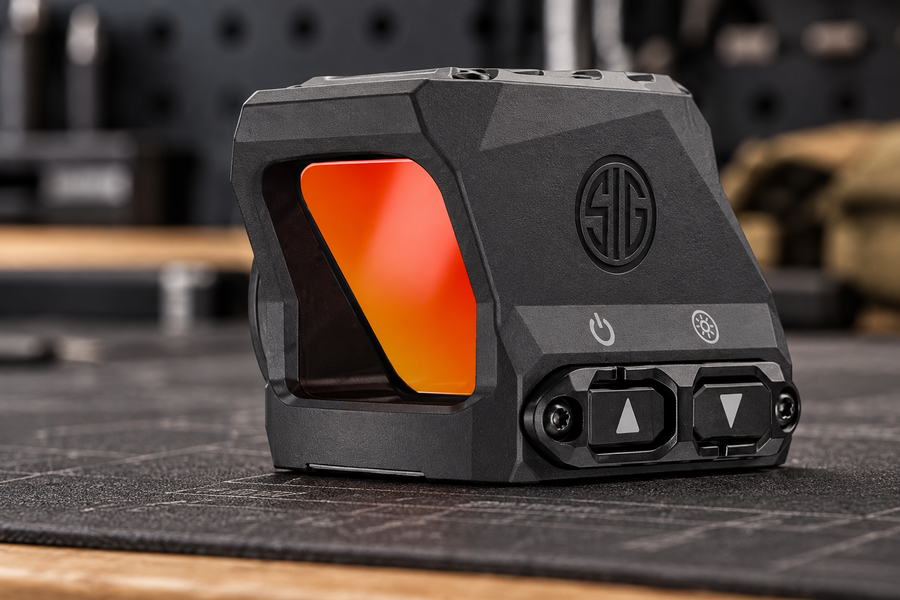
Instead of mechanically moving an emitter assembly to change windage or elevation, the XRAY5 changes which position within that fixed matrix produces the visible 3.5-MOA aiming dot. The zeroing assembly therefore does not depend on the traditional combination of adjustment screws, springs, and a movable emitter carrier.
SIG combines that architecture with its Zero Distortion Optical system, multiple stored zero profiles, smartphone connectivity, an electronic Round Counter, MOTAC motion activation, and LightFight integration with compatible SIG weapon lights. The optic also uses a sealed and argon-purged optical housing, side-loading CR2032 battery, 15 brightness settings, and a stated runtime of up to 10,000 hours.
The result is a pistol optic designed around a different set of assumptions from conventional red dots. Most established pistol optics compete through durability, glass quality, battery life, window size, reticle options, and mounting systems. SIG is attempting to change the internal zeroing architecture itself while adding software-driven features that conventional optics generally do not provide.
The central question is whether those capabilities produce meaningful advantages for ordinary shooters or introduce complexity into a category where simplicity has traditionally been one of the red dot's greatest strengths.
As of October 2026, SIG still lists the XRAY5 family as Coming Soon. Specifications, pricing, support documentation, and the XRAY5 application are already public, but broad independent field testing of production optics remains limited. For now, the XRAY5 is best evaluated as an unusually ambitious new optical architecture rather than a product with an established long-term service record.
Key Takeaways
- The SIG XRAY5 uses a fixed 15-by-15 matrix containing 225 illuminated positions rather than a conventional mechanically adjustable emitter assembly.
- Four mounting configurations are announced: Enclosed Compact, Enclosed Pro, SIG-LOC Compact, and SIG-LOC Pro, with published prices from $499.99 to $599.99.
- SIG's Zero Distortion Optical system places the collimating lens in the roof of the housing so the shooter looks through a flat front objective rather than directly through a curved collimating lens.
- The XRAY5 supports multiple stored zero profiles, physical-button zeroing, app-guided adjustment, a Round Counter, MOTAC, and LightFight integration with compatible SIG weapon lights.
- SIG publishes 80 MOA of total windage travel and 80 MOA of total elevation travel, but has not yet published the MOA value of each digital adjustment step.
- The XRAY5 remains a newly announced optic, so SIG's durability and performance claims still need broad independent verification across production examples.
What Is the SIG Sauer XRAY5?
The XRAY5 is a fully enclosed pistol reflex sight developed by SIG Sauer Electro-Optics. It is not a holographic sight, even though its internal design differs substantially from the traditional single-emitter architecture used by most pistol red dots.
In a conventional reflex sight, an LED emitter projects an aiming point toward an optical surface that reflects the dot back toward the shooter's eye. Zero adjustments typically reposition the emitter assembly or another part of that optical relationship through mechanical windage and elevation controls.
The XRAY5 replaces that movable zeroing architecture with a permanently mounted 15-by-15 array of 225 selectable illuminated positions. When the shooter changes the zero, the matrix itself does not move. The electronics select a different illuminated position within the array.
That is the central engineering change around which nearly everything else in the XRAY5 is built. SIG refers to the design as solid-state because the zeroing system does not depend on a mechanically repositioned emitter carrier.
The optic is also part of a broader electronic ecosystem. It can communicate with the XRAY5 mobile application, retain multiple zero profiles, track firing activity through its Round Counter, manage MOTAC and other settings, and communicate with compatible LightFight weapon lights.
That makes the XRAY5 more than a traditional enclosed red dot with digital buttons. SIG is attempting to create a software-supported pistol-optic platform in which the electronics manage not only illumination but also zero data and accessory interaction.
SIG XRAY5 Models, Footprints, and Pricing
SIG is launching four standalone XRAY5 configurations. The underlying optical and digital-zero architecture remains broadly consistent, while the major difference is the mounting interface and corresponding optic size.
| Model | Mounting Interface | Published Price |
|---|---|---|
| XRAY5 Enclosed Compact | Shield RMSc footprint | $499.99 |
| XRAY5 Enclosed Pro | DeltaPoint Pro footprint | $549.99 |
| XRAY5 SIG-LOC Compact | SIG-LOC Compact | $549.99 |
| XRAY5 SIG-LOC Pro | SIG-LOC Pro | $599.99 |
The standard Enclosed Pro uses an industry-standard DeltaPoint Pro footprint, while the Enclosed Compact uses the Shield RMSc footprint. Those models attach through conventional top-mounted hardware and can be relevant beyond SIG pistols when the host slide uses the correct interface.
The SIG-LOC versions are different. SIG-LOC mounts the optic from beneath the slide and is part of SIG's proprietary low-profile mounting architecture. SIG currently identifies SIG-LOC Pro compatibility with newer pistols including the P211 and P385, as well as appropriate SIG-LOC versions of the P320 and P226X. SIG-LOC Compact is intended around compatible P365-family slides.
The four interfaces should not be treated as interchangeable simply because the optics share the XRAY5 name. Buyers need to match the exact optic version to the actual mounting system machined into the pistol.
SIG also lists XRAY5 and FOXTROT2R LightFight combination packages. Current pricing is $649.99 for the Compact combination and $699.99 for the Pro combination.
SIG XRAY5 Core Specifications
| Specification | Published XRAY5 Detail |
|---|---|
| Optic Type | Fully enclosed reflex sight |
| Reticle | Red 3.5-MOA dot |
| Digital Matrix | 15 × 15, 225 illuminated positions |
| Clear Aperture | 24mm diagonal |
| Adjustment Method | Digital, using optic buttons or XRAY5 application |
| Total Windage Travel | 80 MOA |
| Total Elevation Travel | 80 MOA |
| Published Adjustment Step | Not currently specified |
| Brightness Settings | 15 total, 13 daylight and 2 night vision |
| Battery | Side-loading CR2032 |
| Advertised Runtime | Up to 10,000 hours |
| Waterproof Rating | IPX8, up to 40 meters / 132 feet |
| Housing | 7075 aluminum |
| Lens Protection | Grade 5 titanium top cover / lens shield |
| Motion Activation | MOTAC |
| Connectivity | XRAY5 application / Bluetooth-supported functions |
| Warranty | SIG Sauer Infinite Guarantee |
The specification sheet places the XRAY5 firmly in the premium enclosed-optic category. Its battery, construction, waterproofing, illumination range, and sealed housing are all competitive characteristics, but several established pistol optics already offer strong housings, enclosed emitters, night-vision settings, and long battery life.
The XRAY5's real distinction is the combination of solid-state digital zeroing, the ZDO optical path, software-controlled profiles, and integrated accessory features. Those are the areas where the optic needs to justify both its price and its increased electronic sophistication.
How Digital Zeroing Changes the Traditional Red Dot
Traditional pistol red dots generally use a mechanically adjustable relationship between the emitter and optical system. Turning a windage or elevation control physically changes part of that relationship so the apparent aiming point moves relative to the housing.
The system has worked successfully for decades, but it depends on adjustment hardware retaining its physical position through repeated recoil, impacts, vibration, and long-term use.
The XRAY5 approaches that problem differently. Its 225 illuminated positions are fixed permanently in a 15-by-15 matrix. Rather than physically moving an emitter assembly during zeroing, the electronics select another position in the grid.
That means the traditional windage-and-elevation carrier mechanism disappears from the zeroing process. There is no spring-loaded emitter assembly being moved incrementally by adjustment screws.
This is the most important technical claim behind the XRAY5 because it addresses a real mechanical system rather than simply adding a software feature on top of a conventional optic.
It is also important not to stretch the claim too far. Eliminating moving components from the zeroing assembly does not mean the complete optic is immune to every failure mode. Electronics, battery contacts, housing integrity, lens retention, seals, mounting screws, and the firearm's optic interface still matter.
The useful question is whether removing one mechanical adjustment system creates a measurable improvement in zero retention and long-term durability. That is plausible. It still needs independent validation.
One Important Question: How Fine Is the Digital Adjustment?

SIG currently publishes 80 MOA of total windage travel and 80 MOA of total elevation travel. It also publishes the 15-by-15 matrix and the total number of 225 available illuminated positions.
What SIG has not yet published is a conventional MOA-per-step specification explaining the angular change between adjacent selectable aiming positions. That prevents a direct comparison with optics advertised with 1-MOA, 0.5-MOA, or similar mechanical click values.
This is more than a technical curiosity. Fine adjustment matters when a shooter is trying to center a group precisely at a known distance, particularly on an optic intended to compete in the premium market.
The XRAY5 may handle that relationship differently because the ZDO optical path and emitter geometry are not equivalent to simply projecting a 15-by-15 grid directly onto the target. The published total travel and matrix dimensions therefore should not be reverse-engineered into an assumed adjustment value without SIG providing that information.
Until the company publishes the step resolution, the accurate description is straightforward: the XRAY5 provides 80 MOA of total windage and elevation travel through digital dot selection, but the angular value of an individual adjustment step is not yet publicly specified.
Zeroing Without Tools Is an Immediate Practical Change
One advantage of the digital system does not require years of testing to understand. The XRAY5 does not require a screwdriver, cartridge rim, coin, or specialized adjustment tool to change the zero.
SIG provides two physical buttons on the optic that can control windage and elevation directly. The XRAY5 application offers another interface, including an app-guided zeroing process, but the phone is not required for basic adjustment.
That distinction is important because an optic that depended entirely on a smartphone for basic zeroing would create a very different ownership problem. Phones run out of power, applications change, wireless connections can fail, and users may not want to bring another device into a basic range session.
The XRAY5 retains local controls for critical functions, including power, brightness, digital zero, and lockout. The application expands what the optic can do rather than serving as the only way to make it functional.
Multiple Zero Profiles Are One of the Most Interesting Consequences
The digital architecture allows the XRAY5 to save and recall multiple zero profiles. That capability is much harder to reproduce elegantly with a conventional mechanically adjusted pistol optic because a traditional sight physically retains only one windage-and-elevation position at a time.
A stored digital profile could be useful for owners who have legitimate reasons to maintain more than one verified setting. Different ammunition, specific firearm configurations, or another documented setup can potentially have its own saved profile rather than forcing the owner to record mechanical adjustments and dial back to them later.
The feature also introduces responsibilities. The shooter needs to know which profile is active, understand exactly what that profile represents, and verify the selected configuration before relying on it.
Saving an electronic zero is not the same thing as guaranteeing that the firearm will return to the identical physical point of impact after the optic has been removed, remounted, transferred between pistols, or subjected to other mechanical changes.
Mounting consistency, ammunition performance, barrel behavior, slide fit, and the relationship between the optic and firearm remain physical variables. The XRAY5 can remember an electronic aiming setting. It cannot eliminate the need to confirm that the firearm still shoots to that setting.
The XRAY5 Application Makes the Optic More Software Driven
The XRAY5 application is already publicly available and provides a clearer picture of what SIG means by an intelligent optic. It allows users to establish and manage Digital Zero settings, create and recall multiple zero profiles, configure optic functions, and review Round Counter information.
The application also manages features such as MOTAC behavior, LightFight integration, auto-off settings, battery information, and other configurable electronic functions. That moves the XRAY5 beyond the familiar model of a red dot with two brightness buttons and mechanical turrets.
For some buyers, that is a strength. Managing multiple profiles and viewing round-count data through one interface can be useful, particularly for someone already invested in SIG's ecosystem.
For others, it raises questions about long-term support. A mechanical adjustment screw does not care which version of a phone operating system exists ten years later. A software-connected optic introduces considerations involving application compatibility, firmware, wireless standards, and manufacturer support.
SIG's decision to keep basic zeroing and illumination controls available directly on the optic helps mitigate that concern. Even so, the XRAY5's long-term ownership experience will depend partly on how well the company supports its electronic ecosystem after launch.
What Does the Round Counter Actually Add?
The XRAY5 includes an electronic Round Counter that can track firing activity and make that information available through the application. That feature is unusual in a pistol optic because most conventional red dots have no reason to know how many rounds the host firearm has fired.
Round-count information can be useful for maintenance planning, especially for owners who follow replacement intervals for recoil springs, batteries, or other wear components. Competitive shooters and high-volume users may also appreciate an easier way to track how much firing a particular configuration has accumulated.
The feature should still be treated as supplemental information rather than a substitute for actual inspection. A pistol does not automatically require maintenance because an electronic counter reaches one specific number, and different ammunition, firing schedules, environments, and components can produce very different wear patterns.
The more interesting point is what the Round Counter says about SIG's broader product philosophy. The company is treating the optic as an information device rather than only an illuminated sight.
Zero Distortion Optical Changes What the Shooter Looks Through
The XRAY5's other major engineering departure is SIG's Zero Distortion Optical system, or ZDO. In a conventional reflex sight, the shooter typically looks through an optical surface that also plays a central role in reflecting the illuminated aiming point toward the eye.
The XRAY5 moves its aspheric collimating lens into the roof of the housing, outside the direct line of sight. The aiming point first interacts with that upper optical system before reflecting from the flat front objective toward the shooter's eye.
The shooter therefore looks through a flat front window rather than directly through the curved collimating element. SIG says this produces a cleaner and less distorted view of the target area.
The concept is technically significant because optical distortion can affect how target edges, straight lines, and the surrounding scene appear through a pistol sight. Tint, reflections, lens curvature, coating quality, and image distortion can all influence how natural an optic feels during use.
Architecture alone cannot establish final optical quality, however. Manufacturing tolerances, coatings, brightness, reflections, individual eyesight, and environmental conditions all affect the experience.
The ZDO system gives the XRAY5 a genuine engineering distinction, but SIG's strongest clarity claims should remain manufacturer claims until side-by-side independent optical testing becomes available.
The XRAY5 Changes Both Zeroing and the Optical Path

This is what separates the XRAY5 from many product launches that add one new feature to an otherwise familiar red dot. SIG changed two foundational parts of the design at the same time.
The first is how zero is adjusted. The second is where the collimating optics sit relative to the shooter's direct view.
Either change would have made the XRAY5 technically interesting. Combining them with an enclosed housing, mobile application, stored profiles, Round Counter, and LightFight system makes this a much broader attempt to rethink the pistol optic.
That ambition is also why the XRAY5 deserves more scrutiny than an ordinary incremental update. A new housing shape or larger window can be evaluated relatively quickly. A different zeroing architecture and software ecosystem need considerably more time.
LightFight Connects the Optic to the Weapon Light
LightFight is one of the XRAY5's more unusual electronic features. Traditional pistol optics and weapon-mounted lights generally operate independently. Turning on a bright white light does not automatically tell the optic to alter reticle brightness.
That separation can create a visibility problem. A dot that is clearly visible in a dark environment may become comparatively difficult to see when a powerful weapon light suddenly illuminates a nearby light-colored surface.
SIG developed LightFight to address that specific transition. When the XRAY5 is paired with a compatible LightFight-enabled SIG weapon light, activating the light can cause the optic to raise reticle brightness immediately.
SIG specifically explains that LightFight is not conventional ambient auto-brightness. The optic is responding to the paired weapon light's activation rather than continuously attempting to interpret changing environmental light levels.
That distinction could make the behavior more predictable than an ambient sensor that brightens or dims based on whatever light reaches the optic. It also means LightFight only provides its intended benefit when the user chooses compatible SIG equipment.
LightFight Is an Ecosystem Feature, Not a Universal One
The current XRAY5 combinations pair the optic with the FOXTROT2R LightFight weapon light. SIG lists standalone and combination products separately, which gives buyers the choice of adopting the optic without committing to the light system.
For someone already using a different weapon light from SureFire, Streamlight, Modlite, or another manufacturer, LightFight may offer little immediate value unless SIG expands the compatibility model.
That is not necessarily a flaw. Integrated systems can provide capabilities that independent accessories cannot easily reproduce, but the benefit comes with greater dependence on one manufacturer's ecosystem.
The correct way to evaluate the XRAY5 is therefore as a capable standalone optic first. LightFight should be treated as an additional feature for users who specifically want coordinated optic-and-light behavior.
Battery Life Is Competitive, Not Revolutionary
SIG advertises up to 10,000 hours of operation from a single CR2032 battery. The battery is side loading, allowing it to be replaced without removing the optic from the pistol and disturbing the mounting interface.
That is a practical design decision because battery replacement should not require reinstallation of the optic solely to restore power. It also helps preserve the physical relationship between the optic and slide.
The XRAY5 uses MOTAC motion-activated illumination to reduce unnecessary battery consumption. SIG says the optic powers illumination in response to movement and powers it down when inactive.
Ten thousand hours is useful, but it is not the headline feature of the XRAY5. Several premium pistol optics already offer extremely long advertised runtimes, and actual battery life varies significantly with brightness, motion settings, wireless functions, temperature, battery quality, and user behavior.
The more interesting question is whether the XRAY5 can deliver competitive battery life while supporting substantially more electronics than a conventional red dot. SIG's stated figure suggests that the company believes it can.
Bluetooth Can Be Disabled
One detail that may matter to buyers concerned about unnecessary wireless activity is that SIG allows Bluetooth to be disabled. The optic can still perform critical functions locally through its control buttons.
That gives owners several ways to use the XRAY5. Someone interested in the complete electronic ecosystem can pair the sight with the application and LightFight equipment, while a shooter who prefers a simpler setup can limit or disable wireless functionality.
The feature also matters for battery management because keeping unnecessary wireless functions inactive may help reduce power consumption depending on the selected settings.
Giving the user that choice makes more sense than designing the optic around permanent dependence on a phone or paired accessory.
The Enclosed Design Still Matters
The digital zero system may dominate discussion, but the XRAY5 is also a fully enclosed optic. SIG seals and argon purges the optical system, protecting the emitter path from direct intrusion by dust, water, mud, snow, or other debris.
This is one of the primary practical advantages enclosed pistol optics have over traditional open-emitter designs. An open system can allow contamination to interrupt the path between the emitter and reflective lens, potentially degrading or obscuring the reticle.
The XRAY5 carries an IPX8 waterproof specification to 40 meters, or approximately 132 feet. SIG builds the housing from 7075 aluminum and adds a Grade 5 titanium protective top cover around the optical area.
Those are serious construction specifications, but they also place the XRAY5 against a market that already includes durable enclosed optics with established professional use histories.
The enclosed housing therefore helps the XRAY5 meet current premium expectations. The digital architecture is what needs to separate it from the existing field.
Compact vs. Pro XRAY5
The Compact and Pro versions are not simply the same optic with different screw holes. Their dimensions and mounting interfaces correspond to different handgun categories.
| Feature | XRAY5 Compact | XRAY5 Pro |
|---|---|---|
| General Role | Compact / slim pistol applications | Full-size / duty-size pistol applications |
| Standard Footprint | Shield RMSc | DeltaPoint Pro |
| SIG-LOC Version | SIG-LOC Compact | SIG-LOC Pro |
| Overall Length | Approx. 1.74 inches | Approx. 1.90 inches |
| Overall Width | Approx. 1.32 inches | Approx. 1.32 inches |
| Published Weight With Battery | Approx. 1.35 oz. | Approx. 1.45 oz. |
| Reticle | 3.5 MOA | 3.5 MOA |
| Clear Aperture | 24mm diagonal | 24mm diagonal |
The Compact version naturally makes more sense for narrower carry pistols and the P365 ecosystem, while the Pro version fits the larger mounting standards associated with service-size pistols.
The important buying decision is the slide interface, not simply which XRAY5 appears visually smaller. An optic footprint is a mechanical compatibility requirement, and buyers should verify their exact slide before ordering.
SIG-LOC Changes How the Optic Is Mounted

SIG-LOC is another part of SIG's broader effort to rethink pistol-optic mounting. Instead of driving conventional mounting screws down through the top of the optic into the slide, SIG-LOC secures compatible optics through an underside mounting interface.
The system is intended to provide a low mounting height and a strong direct relationship between the optic and slide. It also allows SIG to design the optic and pistol together rather than adapting every future sight around a legacy screw pattern.
The tradeoff is ecosystem dependence. A DeltaPoint Pro or RMSc footprint has value precisely because multiple firearms and optic manufacturers support it. SIG-LOC is proprietary to compatible SIG products.
That makes the standard-footprint XRAY5 models attractive to buyers who want the technology without committing to a SIG-specific mounting system, while SIG-LOC may offer the cleaner solution for owners already using compatible P211, P385, P320, P226X, or P365 variants.
The XRAY5 Fits SIG's Newest Pistols Particularly Well
SIG's timing is not accidental. The company is expanding several handgun families while simultaneously building an optic architecture intended to integrate directly with them.
The new P211 and P385 families use SIG-LOC Pro compatibility, making the XRAY5 SIG-LOC Pro an obvious premium pairing. Compatible P365 configurations use SIG-LOC Compact, addressing the smaller carry-pistol side of the market.
That gives SIG something broader than a standalone optic launch. It can sell pistols, optics, and LightFight-enabled illumination as parts of one connected system.
For buyers already deeply invested in SIG products, that integration may be appealing. For someone deliberately trying to keep optics and accessories interchangeable across several pistol brands, the standard DPP and RMSc versions may make more practical sense.
Durability Is Where Digital Zeroing Has to Prove Itself
SIG's published construction details show that the XRAY5 was designed around demanding pistol use. The enclosed housing, 7075 aluminum body, titanium lens protection, IPX8 rating, and fixed emitter matrix all point toward durability as a primary engineering objective.
The digital adjustment system is particularly interesting because repeated slide acceleration and impact are exactly the conditions that can challenge small moving components over long round counts.
SIG claims extensive internal recoil and impact testing, and the solid-state design logically removes one traditional movement point from the optic. Those claims are worth taking seriously, but manufacturer validation and independent field history are not interchangeable.
Independent testing reveals how production examples behave across different slide velocities, pistols, ammunition, environmental conditions, mounting surfaces, maintenance habits, and accidental impacts.
The XRAY5 has not existed long enough to accumulate that evidence. The correct launch conclusion is that SIG has engineered a potentially meaningful durability advantage into the zeroing architecture, not that digital adjustment has already been proven superior to every conventional optic.
Could Digital Zeroing Reduce Zero Drift?
Conceptually, this is one of the strongest arguments for the XRAY5. If the aiming matrix is permanently bonded in place and zero adjustment simply selects another fixed emitter position, there is no conventional emitter carrier that can slowly shift within its adjustment system.
That removes one potential source of zero movement. It does not remove all of them.
The optic can still move relative to the slide if the mounting system loosens. Damage to the housing or optical components could still affect the relationship between the displayed dot and the firearm. Electronic faults could create different problems entirely.
The better framing is therefore that digital zeroing simplifies one part of the mechanical chain responsible for retaining zero. Whether that improvement materially changes failure rates in real ownership will require time.
More Electronics Create a Different Reliability Question
The XRAY5 reduces mechanical complexity in one area while increasing electronic sophistication in others. That tradeoff is important because reliability is not simply the number of moving pieces inside a device.
The optic relies on the matrix, control electronics, battery system, firmware, physical buttons, motion sensing, wireless connectivity, and software-supported configuration. None of those systems is inherently unreliable, but they create a different collection of things that need to function correctly.
A simple conventional red dot has a major philosophical advantage: there is relatively little for the user to manage. Install the battery, set brightness or motion activation, zero it mechanically, and use it.
The XRAY5 asks whether additional capability can be added without undermining that simplicity. The answer will depend heavily on software stability, control design, profile management, and whether the optic behaves predictably when advanced features are ignored.
SIG's decision to preserve direct physical controls is important because it means the sight can still function as a basic red dot even if the user does not want to interact constantly with the application.
Is the XRAY5 More Complicated Than It Needs to Be?
That will probably be one of the most divisive questions surrounding the product. Someone who wants a red dot to do exactly one job may see multiple profiles, Bluetooth, an application, Round Counter data, and accessory communication as unnecessary electronic furniture.
Another shooter may see the same feature set as the logical next stage of pistol optics. Digital settings can be saved, zero adjustments do not require tools, reticle brightness can interact directly with a weapon light, and round-count information can be stored automatically.
Neither reaction is unreasonable.
The deciding factor will be whether SIG makes the advanced features optional enough that the optic remains straightforward for someone who only wants a durable enclosed 3.5-MOA dot. Technology becomes much easier to accept when it adds capability without constantly demanding attention.
XRAY5 vs. a Conventional Premium Enclosed Red Dot
| Consideration | SIG XRAY5 | Conventional Premium Enclosed Dot |
|---|---|---|
| Zero Adjustment | Digital emitter-position selection | Mechanical windage/elevation system |
| Adjustment Tool | Not required | Usually required |
| Stored Zero Profiles | Yes | Generally no |
| Smartphone Integration | Yes, optional | Usually no |
| Round Counter | Yes | Usually no |
| Weapon-Light Integration | LightFight with compatible SIG light | Generally independent |
| Optical Path | ZDO roof collimator / flat front view | Conventional reflex architecture |
| Field History | New in 2026 | Potentially years of established use |
| Software Dependency | Optional advanced functionality | Minimal or none |
This comparison explains why the XRAY5 should not be evaluated solely by battery life, dot size, or housing material. Conventional premium enclosed optics already perform those basic tasks very well.
The XRAY5 has to prove that its digital architecture adds something meaningful without creating problems that mechanical systems avoided.
Is the SIG XRAY5 Worth $500 to $600?
At $499.99 to $599.99 for the standalone versions, the XRAY5 enters a part of the pistol-optic market populated by established premium products. Buyers at this price are not simply looking for any functioning red dot. They can reasonably expect strong construction, weather resistance, consistent zero retention, usable glass, and dependable electronics.
The XRAY5's argument is that it offers those premium fundamentals while adding a substantially different internal design. Someone specifically interested in digital zero management, ZDO optics, saved profiles, Round Counter data, or LightFight integration may see enough additional capability to justify the price.
Someone who primarily values a long independent service history may reach the opposite conclusion. Established optics from Aimpoint, Trijicon, Holosun, and other manufacturers already have extensive user bases and known performance characteristics.
The XRAY5 asks buyers to pay premium money for newer technology before years of independent field data exist. That does not make the purchase unreasonable, but it changes what type of buyer is most likely to be comfortable adopting it early.
Who Should Consider the XRAY5 First?
The strongest early buyer is someone who actively values the architecture rather than simply needing an enclosed pistol dot. Existing SIG owners using compatible SIG-LOC pistols are an obvious group because the mounting system, application, optic, and LightFight ecosystem can work together as designed.
High-volume shooters may also find the Round Counter and stored profile features more useful than casual owners. Someone who regularly changes ammunition or maintains carefully documented configurations may appreciate digital profile management.
Technology-oriented early adopters are another obvious audience. The XRAY5 is interesting precisely because it does not behave internally like the pistol optics most shooters already own.
The weaker case is someone who wants maximum simplicity and already trusts an established enclosed optic. If a conventional red dot reliably holds zero, has excellent battery life, and meets the owner's mounting and durability needs, digital zeroing must provide a practical advantage rather than novelty alone.
What the XRAY5 Still Has to Prove
The first question is long-term zero retention. The matrix architecture gives SIG a credible technical reason to expect strong durability, but production optics need substantial round counts and impact testing in independent hands before the advantage can be measured against established designs.
The second is adjustment behavior. SIG publishes the 80-MOA windage and elevation ranges but has not yet publicly specified the angular resolution between individual digital adjustment positions. Buyers interested in precise zeroing will want that question answered clearly.
The third is software longevity. The application exists today and the optic does not require it for critical functions, which is encouraging. Long-term ownership will still reveal how effectively SIG maintains application compatibility, firmware support, and connected features across several generations of phones and operating systems.
LightFight also needs broader real-world evaluation. The concept addresses a legitimate problem, but shooters need to see how reliably the optic and compatible light communicate under actual carry, training, and environmental conditions.
Finally, the optical system needs independent side-by-side testing. SIG's ZDO architecture is technically interesting, but claims involving exceptional clarity or distortion need to be evaluated against other premium enclosed sights under the same conditions.
Could Digital Zeroing Become the Next Pistol-Optic Standard?
Possibly, but only if it proves better enough to justify changing an architecture that already works. Mechanical adjustment systems remain popular because they are simple, understood, and reliable when properly engineered.
For digital zeroing to spread beyond one product family, shooters need to see clear benefits in durability, repeatability, ease of adjustment, or configuration management. Removing one mechanical movement point is an attractive idea, but it must survive recoil and environmental abuse just as convincingly as the systems it intends to replace.
The XRAY5 has one advantage in that it does not rely on digital technology merely for novelty. The 225-position matrix solves a specific engineering problem and enables additional functions such as stored zero profiles as a consequence.
If the architecture performs as intended over years of use, other manufacturers may eventually explore similar solid-state approaches. If the benefits prove marginal compared with excellent conventional optics, the XRAY5 may remain an interesting premium alternative rather than a new industry standard.
Final Thoughts
The SIG XRAY5 represents a genuine attempt to rethink how a pistol reflex sight works. Its fixed 225-position aiming matrix replaces the conventional moving zeroing assembly with electronic emitter selection, while the Zero Distortion Optical system changes how the shooter views the target through the optic.
Those are substantial engineering changes rather than cosmetic updates to an established red-dot design. Features such as multiple stored zero profiles, physical-button digital adjustment, Round Counter data, LightFight integration, optional smartphone control, and four mounting systems push the XRAY5 even further away from the traditional model.
The challenge is that innovation and validation are not the same thing. SIG's engineering arguments are credible, and the published construction specifications are competitive, but the XRAY5 is still too new to possess the independent reliability history of mature premium optics.
The unpublished per-step adjustment resolution is also something worth watching. SIG has clearly documented the 80-MOA total windage and elevation range, but buyers interested in fine zero adjustment deserve a clear specification explaining the angular change represented by each digital step.
At $499.99 to $599.99, the XRAY5 competes against established enclosed sights rather than inexpensive entry-level optics. Early buyers are therefore paying for a different architecture, not simply for the privilege of having another 3.5-MOA red dot.
If the digital zero system proves durable, the ZDO optical path performs as advertised, and SIG supports the connected features over the long term, the XRAY5 could influence how future pistol optics are designed.
For now, it is one of the more technically ambitious pistol optics announced in 2026, and perhaps the most interesting question is no longer whether electronics belong in a red dot. They already do. The question is how much of the optic's traditional mechanical architecture electronics can replace without sacrificing the simplicity shooters expect.
The XRAY5's digital zeroing system raises an interesting question about where pistol optics are heading. For decades, shooters have adjusted red dots through mechanical windage and elevation controls, but SIG's new approach moves those adjustments into an electronic interface with the ability to store multiple zero profiles.
That changes how shooters interact with the optic, although it doesn't change the fundamentals of establishing a reliable zero. Readers interested in understanding those principles can explore our complete red dot zeroing guide for a closer look at proper sight picture, point-of-aim versus point-of-impact relationships, and why zero verification still matters regardless of the technology behind the reticle.
Frequently Asked Questions
What makes the SIG XRAY5 different from a traditional red dot?
The XRAY5 uses a permanently fixed 15-by-15 matrix containing 225 selectable illuminated positions rather than a conventional mechanically repositioned emitter assembly. Changing the zero causes the electronics to select a different illuminated position instead of physically moving the traditional windage-and-elevation carrier.
Is the SIG XRAY5 a holographic sight?
No. SIG identifies the XRAY5 as a reflex sight. Its optical path is unusual because the collimating lens is mounted in the roof of the housing and the shooter looks through a flat front objective, but the system is not a holographic sight.
How much adjustment does the XRAY5 have?
SIG publishes 80 MOA of total windage travel and 80 MOA of total elevation travel. As of October 2026, SIG has not publicly specified the MOA value represented by each individual digital adjustment step.
Does the SIG XRAY5 require a smartphone?
No. Critical functions including power, brightness, windage, elevation, and lockout can be controlled through the optic's physical buttons. The XRAY5 application adds functions such as guided Digital Zero setup, multiple zero profiles, Round Counter information, LightFight configuration, and additional settings.
Can the XRAY5 store more than one zero?
Yes. SIG designed the XRAY5 to store and recall multiple digital zero profiles through its application. Shooters should still verify actual point of impact whenever a firearm, optic mount, ammunition configuration, or other physical variable changes.
What is SIG's Zero Distortion Optical system?
ZDO places the XRAY5's aspheric collimating lens in the roof of the optic rather than directly in the shooter's viewing path. The aiming point reflects through that system and from the flat front objective toward the shooter's eye, allowing the user to view the target through flat glass.
What is LightFight?
LightFight allows the XRAY5 to communicate with a compatible SIG weapon light, including current FOXTROT2R LightFight configurations. When the weapon light activates, the optic can immediately increase reticle brightness to help prevent the dot from becoming washed out against the newly illuminated target area.
Can Bluetooth be disabled on the XRAY5?
Yes. SIG allows Bluetooth functionality to be disabled when the owner does not want to use the application or LightFight pairing. Core optic functions remain accessible through the physical controls.
What battery does the SIG XRAY5 use?
The XRAY5 uses a side-loading CR2032 battery. SIG advertises up to 10,000 hours of runtime and includes MOTAC motion-activated illumination to help manage power consumption. Actual battery life will depend on brightness, settings, wireless use, temperature, and other operating conditions.
Is the XRAY5 waterproof?
SIG rates the enclosed optical system to IPX8 and lists submersion resistance to 40 meters, or approximately 132 feet. The optic is also argon purged to help resist internal fogging.
What optic footprints are available?
The standard XRAY5 Enclosed Compact uses the Shield RMSc footprint, while the Enclosed Pro uses DeltaPoint Pro. SIG also offers SIG-LOC Compact and SIG-LOC Pro versions for compatible SIG pistols using those proprietary underside-mounted interfaces.
Which XRAY5 fits the SIG P385 and P211?
Compatible P385 and P211 configurations use SIG-LOC Pro, making the XRAY5 SIG-LOC Pro the corresponding model. Buyers should still verify the exact slide and SKU because optic interfaces are mechanical compatibility requirements.
How much does the SIG XRAY5 cost?
The XRAY5 Enclosed Compact is listed at $499.99, the Enclosed Pro at $549.99, the SIG-LOC Compact at $549.99, and the SIG-LOC Pro at $599.99. SIG also lists LightFight combination packages beginning at $649.99.
Is the SIG XRAY5 available now?
As of October 2026, SIG's own store lists the four XRAY5 standalone models as Coming Soon and out of stock. Some retailers have created product listings, but buyers should verify actual inventory rather than treating a product page as proof of broad commercial availability.
Is the XRAY5 proven to be more durable than a conventional red dot?
Not yet through broad independent field experience. SIG's fixed matrix removes the traditional moving zeroing assembly and the company reports extensive internal durability testing, but the XRAY5 remains a newly announced product. Long-term independent testing of production examples is still needed before declaring the architecture superior to established premium optics.
About the Author
The ProArmory editorial team includes experienced hunters, competitive shooters, military veterans, firearms instructors, and firearms industry professionals committed to producing accurate, practical, and research-based content. Our articles draw on manufacturer specifications, current industry information, launch documentation, and real-world shooting experience to help readers make informed decisions about firearms, ammunition, optics, suppressors, and related equipment.
Disclaimer
This article is for informational and educational purposes only. XRAY5 specifications, pricing, mounting compatibility, software features, and availability reflect information available as of October 2026 and may change as production optics enter wider distribution.
Manufacturer performance and durability claims should not be interpreted as independently verified test results. Always confirm optic compatibility with the firearm and optic manufacturers, follow current installation instructions, and use established firearm-safety practices.


