









Quick Answer
A 30mm riflescope is not automatically better than a 1-inch scope. The larger main tube can provide more room for internal elevation and windage adjustments, but it does not inherently produce a brighter image, increase magnification, or improve optical clarity.
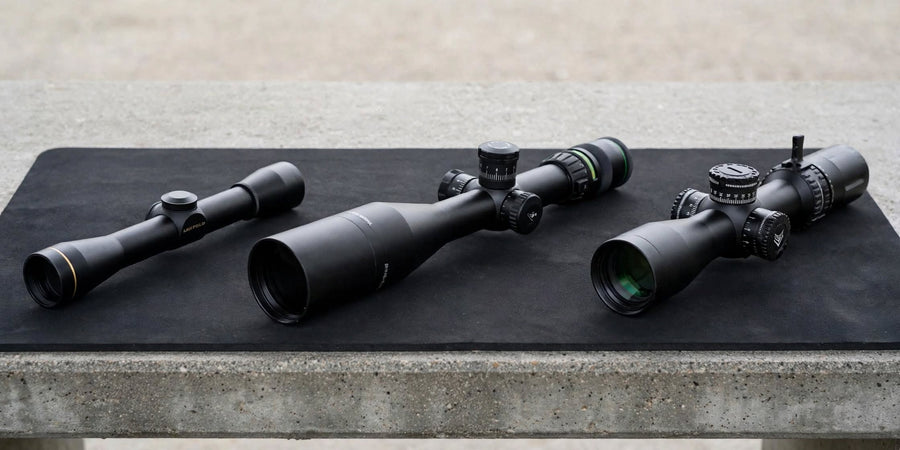
A 1-inch scope has a main tube measuring 25.4mm in diameter. A 30mm scope has a slightly larger housing that can accommodate different internal mechanical designs.
For hunters and recreational shooters, a quality 1-inch scope may offer everything needed in a lighter, relatively compact package.
For precision-oriented applications, a 30mm scope can be attractive because its larger housing may allow greater adjustment travel and additional design flexibility.
However, actual performance depends on the individual scope.
Buyers should compare published adjustment ranges, optical specifications, weight, and mounting requirements rather than assuming the larger tube is always superior.
Key Takeaways
- A 30mm main tube does not automatically transmit more light or provide a brighter image than a 1-inch tube.
- Larger main tubes can accommodate greater internal adjustment travel, but actual elevation and windage ranges vary by model.
- One-inch scopes remain practical for hunting and recreational shooting, especially when minimizing weight and bulk matters.
- Scope rings must match the main tube diameter; standard 1-inch and 30mm rings are not interchangeable.
- Glass quality, objective diameter, magnification, mechanical consistency, and intended use matter more than tube diameter alone.
1-Inch vs. 30mm Scope Tubes: The Differences That Matter

The main tube is the central housing of a riflescope. It connects the objective and ocular assemblies, contains important internal components, and provides the mounting surface for scope rings.
The diameter describes the outside measurement of that central housing, not the diameter of the objective lens.
Although the difference between 25.4mm and 30mm may seem small, it gives optical engineers additional room to arrange internal components.
That extra space can be valuable, but it does not guarantee that a manufacturer will use it to provide additional adjustment travel or improved mechanical performance.
1-Inch vs. 30mm Scope Comparison
| Feature | 1-Inch Main Tube | 30mm Main Tube |
|---|---|---|
| Outside tube diameter | 25.4mm | 30mm |
| Internal adjustment potential | Generally more constrained | Potentially greater |
| Light transmission | Depends on optical design | Depends on optical design |
| Image brightness | Not determined by tube diameter | Not determined by tube diameter |
| Weight | Often lighter in comparable designs | May be heavier |
| Mounting hardware | Requires 1-inch rings | Requires 30mm rings |
| Common applications | Hunting, general-purpose shooting | Hunting, precision shooting, versatile optics |
| Durability | Depends on construction | Depends on construction |
| Optical quality | Varies by model | Varies by model |
These distinctions describe design possibilities rather than fixed performance rankings.
A high-quality 1-inch scope may outperform a lower-quality 30mm scope in several meaningful categories.
A Larger Main Tube Does Not Automatically Mean a Brighter Image

One of the most persistent misconceptions in riflescope shopping is that a larger main tube gathers more light.
It is easy to understand where the assumption comes from.
A 30mm tube is physically larger than a 1-inch tube, so buyers may reasonably expect it to allow more light through the scope.
However, the main tube is not the primary light-collecting component.
That role belongs to the objective lens at the front of the scope.
Image brightness depends on the complete optical system, including objective diameter, magnification, lens coatings, light transmission, and exit pupil.
A larger main tube may provide flexibility for internal optical design, but its outside diameter alone does not establish how bright the image will appear.
Objective Lens Diameter Matters More
The objective lens gathers light entering the scope.
A larger objective lens can collect more light than a smaller objective under otherwise comparable conditions. However, that additional light does not automatically produce a brighter image for the shooter.
At a given magnification, a larger objective generally produces a larger exit pupil, but the benefit depends on the observer's eye pupil, the scope's optical transmission, and the surrounding lighting conditions. Once the exit pupil exceeds the observer's eye pupil, further increases in exit pupil diameter do not deliver additional light into the eye.
However, the amount of light reaching the shooter's eye also depends on magnification and the optical system's efficiency.
For example, a 3-9x40 scope and a 3-9x50 scope have different objective diameters.
At the same magnification, the larger objective can produce a larger exit pupil.
Whether that translates into a visibly brighter image depends on lighting conditions, the shooter's eye, and the quality of the optical systems.
Neither example requires a particular main tube diameter to demonstrate the relationship.
Exit Pupil Explains Much of the Difference
Exit pupil is the diameter of the light beam leaving the eyepiece.
For a conventional riflescope, its nominal diameter can be estimated by dividing objective lens diameter by magnification.
Consider two scopes with 40mm objectives.
At 4x magnification:
40 ÷ 4 = 10mm exit pupil.
At 8x magnification:
40 ÷ 8 = 5mm exit pupil.
Increasing magnification reduces exit pupil diameter when objective size remains unchanged.
That relationship helps explain why a scope can appear less bright at higher magnification, particularly under low-light conditions.
The main tube diameter does not appear in this calculation.
Real-world brightness also depends on optical transmission and the diameter of the shooter's pupil, so exit pupil should not be treated as a complete measurement of image quality.
Lens Coatings and Glass Quality Still Matter
Two riflescopes with identical objective diameters and magnification ranges can produce noticeably different images.
Lens coatings influence reflection and transmission across optical surfaces.
Glass quality and optical design affect resolution, contrast, distortion, and color reproduction.
Manufacturing tolerances and internal alignment also contribute to the finished image.
These characteristics cannot be determined from main tube diameter alone.
A well-designed 1-inch scope may deliver better contrast and clarity than a less expensive 30mm scope.
For buyers who prioritize low-light hunting performance, evaluating the actual optical system is more useful than choosing the larger tube by default.
Internal Adjustment Travel Is the Strongest Argument for 30mm

The most meaningful potential advantage of a 30mm main tube is additional space for internal adjustments.
Riflescopes use an internal optical assembly, commonly called the erector system, to manage the relationship between the reticle, image, and adjustment mechanisms.
The elevation and windage controls change the position of that internal assembly.
Its movement is limited by the scope's mechanical design and available internal space.
A larger main tube can provide additional room for movement, potentially allowing a greater adjustment range.
However, manufacturers must also account for erector-tube dimensions, wall thickness, spring systems, optical components, and other design requirements.
Consequently, two scopes with the same main tube diameter can have very different adjustment specifications.
Total Adjustment Is Not the Same as Available Adjustment
Manufacturers commonly publish elevation and windage travel as total adjustment ranges.
For example, a scope advertising 80 MOA of total elevation adjustment does not necessarily provide 80 MOA of upward adjustment after the rifle is zeroed.
If a scope provides 80 MOA of total elevation adjustment and its zero falls near the midpoint of the usable adjustment range, approximately 40 MOA may remain available in each direction. This is a simplified example rather than a guarantee. The actual upward and downward travel remaining after zeroing depends on the scope's internal adjustment limits, the rifle and mounting system, and the resulting zero position. Buyers should distinguish total advertised adjustment from the usable travel available on their particular setup.
In that simplified example, roughly 40 MOA would be available upward.
The actual amount depends on the scope, rifle, mounting system, and final zero position.
Vortex specifically explains this distinction in its published riflescope guidance.
That makes total adjustment travel an important specification, but one that buyers must interpret correctly.
Compare Published Travel Instead of Tube Diameter
Consider two hypothetical scopes:
| Specification | Scope A | Scope B |
|---|---|---|
| Main tube | 1 inch | 30mm |
| Total elevation adjustment | 60 MOA | 90 MOA |
| Total windage adjustment | 60 MOA | 70 MOA |
| Main advantage | Potentially lighter package | Greater published elevation range |
In this example, Scope B offers more elevation adjustment.
However, that advantage is established by its published specification, not merely by its 30mm tube.
A different pair of scopes could produce a different comparison.
For buyers evaluating precision-oriented optics, published adjustment travel should take priority over assumptions based on housing dimensions.
Does a 30mm Scope Hold Zero Better?

A larger main tube does not inherently guarantee better zero retention.
Holding zero depends on the integrity of the complete riflescope and mounting system.
Important factors include internal mechanical construction, component stability, manufacturing tolerances, housing design, and resistance to environmental or mechanical stress.
The mounting system also matters.
An expensive scope cannot compensate for incompatible or poorly fitted mounting hardware.
Tube Diameter Is Not a Durability Rating
Manufacturers may use different aluminum alloys, wall thicknesses, machining methods, and internal reinforcement strategies.
A larger outside diameter can provide structural design opportunities, but it does not reveal how the housing was constructed.
A 30mm scope with relatively thin walls is not automatically stronger than a well-engineered 1-inch scope.
Likewise, greater housing strength does not necessarily establish that the internal adjustment mechanism is more resistant to movement.
Buyers should look for documented testing, manufacturer specifications, and credible product history rather than relying on tube size as a substitute for durability evidence.
Weight and Handling: The Advantage of Keeping Things Simple
For a hunting rifle carried over long distances, scope weight deserves attention.
A relatively compact 1-inch riflescope may help keep the overall rifle package manageable.
However, not every 1-inch scope is lighter than every 30mm scope.
Weight also depends on magnification range, objective diameter, construction, turret design, and additional features.
A compact 30mm optic may weigh less than a large, feature-heavy 1-inch model.
The correct comparison is between complete scopes rather than tube dimensions alone.
Why Scope Weight Changes the Rifle's Feel
A riflescope adds weight above the rifle's receiver.
Changes in optic weight, length, and mounting height can influence how the rifle balances and handles.
A heavier scope may be entirely acceptable on a rifle primarily used from supported positions.
On a lightweight hunting rifle carried for hours, additional ounces may be less desirable.
Neither approach is universally better.
The goal is to match the scope's size and weight to the rifle's intended purpose.
Mounting Compatibility: The Difference You Cannot Ignore
A riflescope must be mounted using rings or a mounting system specifically approved for its main tube diameter. Standard 1-inch rings are designed for 25.4mm tubes, while standard 30mm rings are designed for 30mm tubes. These ring sizes are not directly interchangeable.
Some mounting systems offer manufacturer-approved inserts or adapters, but buyers should never attempt to compensate for a diameter mismatch using improvised materials or incompatible hardware.
The two standard ring sizes are not directly interchangeable.
Vortex explicitly confirms that standard 30mm rings do not properly fit a 1-inch tube.
Although some mounting systems offer manufacturer-approved inserts or adapters, buyers should never assume that mismatched rings are acceptable.
Ring Height Is a Separate Measurement
Tube diameter and ring height are different specifications.
Ring height determines the scope's position relative to the rifle.
Appropriate height depends on several factors, including objective-bell clearance, rifle geometry, mounting base dimensions, and shooter ergonomics.
A larger main tube does not automatically require high rings.
For example, a 30mm scope with a relatively small objective may be compatible with a lower mounting arrangement than a scope with a large objective bell.
The exact dimensions of the scope and mounting system determine what is suitable.
Changing Tube Size Can Add to the Purchase Cost
Buyers replacing an existing 1-inch scope with a 30mm model may need new rings or a compatible mount.
The additional expense should be included when comparing scope prices.
A modest difference in the optic's retail price can become more significant once mounting hardware is considered.
Checking the complete mounting requirements before purchasing helps avoid unnecessary expense and compatibility problems.
When a 1-Inch Scope Makes More Sense

A quality 1-inch riflescope remains a strong option for many hunters and recreational shooters.
Its potential advantages include relatively compact dimensions, lighter construction in comparable designs, and compatibility with existing 1-inch mounting systems.
For applications where extensive elevation adjustment is not required, the additional internal space of a 30mm tube may offer little practical benefit.
That does not mean every 1-inch scope is inexpensive or basic.
Manufacturers offer high-quality optical systems in 1-inch configurations, and tube diameter alone does not establish the scope's price category or performance level.
A buyer who prioritizes image quality, manageable weight, and straightforward features may find that a 1-inch scope offers the better overall value.
When a 30mm Scope Is Worth Considering

A 30mm scope becomes especially attractive when the buyer needs capabilities that benefit from the larger housing.
Greater published elevation adjustment is one example.
Some 30mm models also combine more elaborate turret systems, wider magnification ranges, illuminated reticles, or other specialized features.
Those characteristics are common product-design choices rather than automatic consequences of the 30mm diameter.
The larger tube provides manufacturers with additional design flexibility, but buyers still need to evaluate the finished optic.
A 30mm scope may also be appropriate for hunting when its optical performance, features, and weight suit the application.
There is no reason to reject a well-matched 30mm hunting scope simply because a 1-inch alternative might be lighter.
The Buying Decision Comes Down to Actual Specifications
When comparing riflescopes, tube diameter should be one specification among several.
The most useful comparison starts with the features that affect the intended application.
| Buying Priority | Specification to Compare |
|---|---|
| Low-light visibility | Objective size, optical quality, coatings, magnification |
| Adjustment capability | Published elevation and windage travel |
| Carry comfort | Actual scope weight and dimensions |
| Mounting compatibility | Main tube diameter, ring requirements, clearance |
| Image quality | Resolution, contrast, distortion, field of view |
| Mechanical performance | Adjustment consistency and documented testing |
| Overall value | Complete scope features, warranty, and mounting costs |
The main tube's diameter helps determine what mounting hardware is required and can influence the scope's internal mechanical possibilities.
It should not replace a comparison of the characteristics that matter to the buyer.
Does a 34mm Scope Offer an Even Bigger Advantage?

Buyers comparing 1-inch and 30mm scopes will also encounter 34mm main tubes, particularly among precision-oriented optics.
The same principles apply.
A 34mm housing provides additional internal space that manufacturers can use for greater adjustment travel or other mechanical design requirements.
However, it does not automatically produce a brighter image, better glass, or more accurate adjustments.
Some 34mm scopes offer substantial elevation adjustment, but the actual range depends on the individual model.
The larger tube may also contribute to increased weight and require mounting hardware that is less useful for a lightweight hunting setup.
For most buyers, moving from 30mm to 34mm should be justified by a specific scope's features rather than the assumption that bigger is always better.
Final Thoughts
A 30mm riflescope does not automatically outperform a 1-inch scope.
Its primary potential advantage is additional internal space, which manufacturers may use to provide greater adjustment travel or accommodate particular mechanical designs.
That advantage can be valuable, but it does not guarantee better light transmission, greater durability, or improved optical clarity.
For hunters who value manageable weight and straightforward functionality, a quality 1-inch scope remains an excellent option.
For buyers seeking greater adjustment capability or particular precision-oriented features, a 30mm scope may be the more appropriate choice.
The best riflescope is the one whose verified specifications match the intended application, not necessarily the one with the largest main tube.
The choice between a 1-inch and 30mm riflescope should come down to the optic's actual capabilities rather than tube diameter alone. A lightweight hunting setup may benefit from a compact scope with modest magnification, while a precision-oriented rifle may justify a larger optic offering extensive elevation adjustment and additional features.
Magnification design deserves consideration as well. Readers comparing these broader tradeoffs can explore whether fixed-power scopes are still worth buying for another perspective on matching optical features to practical needs.
Norma Whitetail .300 Winchester Magnum 150 Grain
$45.00
at Pro Armory
Prices accurate at time of writing
Frequently Asked Questions
Does a 30mm scope gather more light than a 1-inch scope?
Not inherently. Light collection and image brightness depend primarily on the objective lens and complete optical system. A larger main tube does not automatically improve light transmission.
Is a 30mm scope more durable than a 1-inch scope?
Not necessarily. Durability depends on housing construction, materials, wall thickness, internal components, and manufacturing quality. Tube diameter alone is not a reliable durability rating.
Can I use 1-inch scope rings on a 30mm scope?
No. Standard 1-inch rings are designed for a 25.4mm tube and are not compatible with a 30mm tube. Use mounting hardware approved for the exact scope dimensions.
Is a 30mm scope better for hunting?
It can be, depending on the model. However, many hunters benefit from the relatively compact dimensions and weight of a quality 1-inch scope. Optical performance and overall suitability matter more than tube size.
Is a 34mm scope better than a 30mm scope?
A 34mm tube can provide additional internal design space, potentially allowing greater adjustment travel. It does not automatically provide better optical quality or brightness. Compare the actual specifications before deciding.
About the Author
The ProArmory editorial team includes experienced hunters, competitive shooters, military veterans, firearms instructors, and firearms industry professionals committed to producing accurate, practical, and research-based content. Our articles draw on manufacturer specifications, current industry information, and real-world shooting experience to help readers make informed decisions about firearms, ammunition, optics, and related equipment.
Disclaimer
This article is for educational purposes only. Riflescope specifications, mounting requirements, and adjustment ranges vary by manufacturer and model. Always follow current manufacturer instructions, use compatible mounting equipment, and observe established firearm safety practices and applicable laws.


