






Quick Answer
Fixed-power rifle scopes use one magnification setting, while variable-power scopes allow the shooter to select from a range of magnifications. Both designs remain useful, but the modern optics market has shifted heavily toward variable-power scopes for hunting, recreational shooting, and general-purpose rifle use because one optic can adapt to changing distances, target sizes, and viewing conditions.
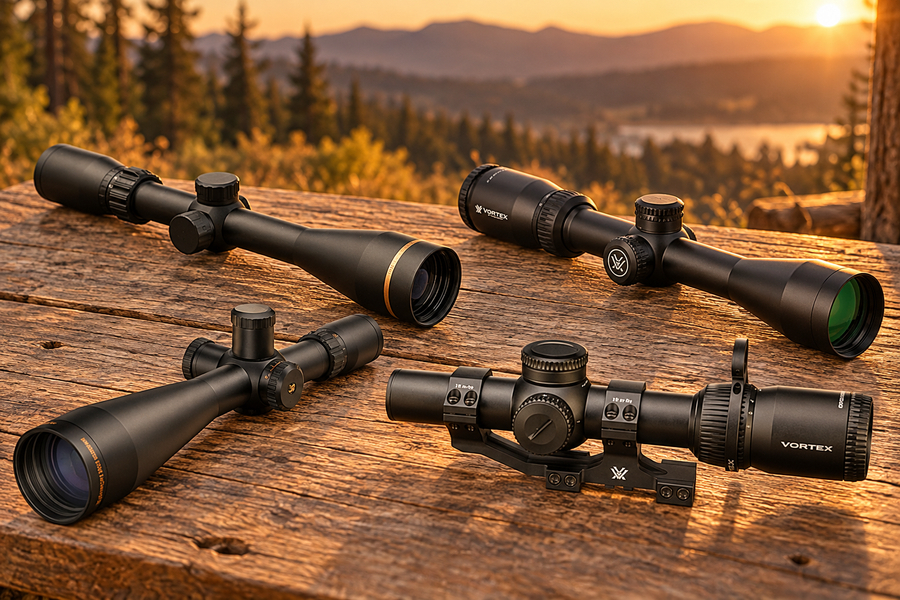
Fixed-power scopes remain worthwhile when their limitations align with the application. A fixed 4x or 6x hunting scope can provide a simple and consistent viewing experience, while high-magnification fixed scopes still serve specialized target and benchrest disciplines. Fixed magnification also remains extremely relevant in prism optics such as the Trijicon ACOG, although those products represent a different optical category from traditional hunting scopes.
The important correction is that fixed power should not automatically be associated with better clarity, greater durability, lower weight, brighter images, or lower price. A current Leupold VX-Freedom 3-9x40 variable scope weighs only 12.2 ounces, while specialized fixed-power target scopes can weigh considerably more. Optical quality, housing construction, lens coatings, reticle design, adjustment system, eye relief, and overall engineering matter more than whether the magnification ring moves.
For most hunters buying one new scope in 2026, a quality variable-power model remains the more flexible choice. Fixed-power scopes make the strongest argument for shooters who already know exactly what magnification their application requires and value consistency more than adaptability.
Key Takeaways
- Fixed-power scopes use one magnification setting, while variable-power scopes provide an adjustable range.
- Variable scopes dominate much of the current general-purpose hunting market because they adapt more easily to different shooting distances and environments.
- Traditional fixed-power hunting scopes are considerably less common in current major-manufacturer catalogs than they once were.
- Fixed-power scopes remain active in specialized target shooting and fixed-magnification prism-optic categories.
- Fixed magnification does not automatically make a scope lighter, cheaper, brighter, clearer, stronger, or more accurate.
- Exit pupil, lens quality, coatings, field of view, eye relief, reticle design, adjustment quality, and parallax behavior deserve more attention than magnification type alone.
- A variable scope is usually the better choice for a rifle expected to serve several purposes, while fixed power makes more sense when the required viewing magnification is already known.
What Is a Fixed-Power Rifle Scope?
A fixed-power rifle scope uses one magnification level. A traditional fixed 4x scope presents the viewed scene at approximately four times the apparent angular size seen with the unaided eye, while a fixed 6x provides six-power magnification. Because that magnification does not change, the scope does not need the external magnification-control ring found on most variable-power designs.
Fixed-power hunting scopes were once extremely common because they offered a straightforward way to add useful magnification without the additional cost and complexity historically associated with quality variable optics. A 2.5x, 4x, or 6x hunting scope could remain on the rifle for years without requiring the shooter to make many optical decisions once it was mounted and zeroed.
The modern market is different. Variable scopes have become available across nearly every price category, while many familiar fixed hunting models have disappeared from current catalogs. Fixed power now occupies a narrower but still meaningful group of specialized applications.
What Is a Variable-Power Rifle Scope?
A variable-power scope allows magnification to change within a specified range. A 3-9x40 optic, for example, can be adjusted from approximately 3x through 9x magnification while using a nominal 40mm objective lens. A 2-10x42 provides a different range, while precision-oriented designs may extend to 4-16x, 5-25x, 6-36x, or considerably higher.
The primary advantage is flexibility. Lower magnification generally offers a wider field of view and less apparent image movement, while higher magnification makes smaller or more distant details easier to see. A hunter moving from dense timber to an open field can therefore change the optical presentation without changing scopes.
The tradeoff is that a variable scope has to perform across several magnification settings instead of being designed exclusively around one. That creates additional optical and mechanical engineering requirements, but modern manufacturers have become extremely good at managing them. A quality variable-power scope can provide excellent optical clarity, repeatable adjustments, and durability across a broad operating range.
Understanding Scope Numbers
Riflescope names usually combine magnification with objective-lens diameter. A 3-9x40 has a magnification range from 3x through 9x and a nominal 40mm objective. A fixed 6x42 provides one 6x magnification setting with a nominal 42mm objective.
Those numbers are useful, but they reveal only part of the optical system. They do not tell the buyer the quality of the glass, coatings, reticle, adjustment system, eye box, internal baffling, mechanical construction, or overall image quality. Two scopes carrying the same 3-9x40 designation can provide dramatically different viewing experiences.
This is one reason magnification specifications should be treated as a starting point rather than a quality ranking. The scope needs to be evaluated as a complete product.
Fixed-Power vs. Variable-Power Scopes
| Feature | Fixed-Power Scope | Variable-Power Scope |
|---|---|---|
| Magnification | One setting | Adjustable range |
| Magnification Control | Not required | Usually adjustment ring or throw control |
| Viewing Flexibility | Limited to selected magnification | Can adapt to distance and conditions |
| Field of View | Consistent | Changes with magnification |
| Exit Pupil | Consistent for that optical configuration | Changes with magnification |
| Optical Design | Optimized around one magnification | Must perform throughout a zoom range |
| Durability | Product dependent | Product dependent |
| Weight | Product dependent | Product dependent |
| Price | Varies widely | Varies widely |
| Current Hunting Selection | Relatively limited | Extensive |
| Best General Advantage | Simplicity and consistency | Versatility |
The table reveals why broad assumptions about fixed scopes can be misleading. Eliminating the zoom mechanism does simplify one part of the optic, but it does not control the size of the objective lens, thickness of the housing, type of turret system, amount of adjustment travel, reticle construction, or overall level of mechanical reinforcement.
A high-magnification fixed target scope can therefore be larger and heavier than a compact variable hunting scope. Likewise, a premium fixed optic can cost substantially more than an entry-level variable model.
Why Did Variable-Power Scopes Become So Popular?
The simplest explanation is that modern variable scopes became good enough and affordable enough that the flexibility was increasingly difficult to ignore. A hunter who once bought separate rifles or optics around very specific conditions could instead mount one 3-9x, 2-10x, or similar variable scope and adapt its magnification as conditions changed.
Manufacturing improvements also allowed companies to offer reliable variable-power designs across much broader price ranges. Today's market contains inexpensive recreational scopes, lightweight hunting optics, premium long-range systems, competition scopes, and tactical LPVOs, all built around adjustable magnification.
The change is visible in current product catalogs. Leupold's traditional FX fixed-power hunting models are now discontinued, while its active VX-Freedom line includes variable configurations such as 3-9x40, 4-12x40, and other hunting-oriented models. Fixed magnification did not become technically obsolete, but consumer demand clearly pushed the mainstream sporting market toward variable designs.
Fixed-Power Scopes Did Not Completely Disappear

The decline of traditional fixed hunting scopes can create the impression that fixed magnification itself disappeared. It did not. Instead, the concept survived more strongly where one known magnification remains useful.
Sightron currently sells the SII Target 36x42, a dedicated fixed-power competition scope. SWFA's current SS Gen 2 family also includes fixed 10x42, 12x42, 16x42, and 20x42 configurations. These products are not trying to replace a 3-9x deer-hunting scope; they serve shooters who already know the magnification needed for a particular target application.
Fixed magnification is also prominent in prism optics. Trijicon's ACOG family continues to include fixed 4x32 and 3.5x35 models along with other configurations. An ACOG is mechanically and optically different from a conventional tube-style hunting riflescope, but its continued relevance demonstrates that fixed magnification remains useful when designers optimize around a specific role.
Are Fixed-Power Scopes More Durable?
This is probably the most persistent argument in favor of fixed magnification. Because a fixed scope does not need a magnification adjustment system, it has one fewer user-adjustable mechanical subsystem. That gives the durability argument some intuitive engineering logic.
The problem comes when that logic is converted into a universal conclusion. Modern variable scopes can be engineered to withstand substantial recoil, impacts, weather exposure, and repeated adjustment cycles. A poorly constructed fixed scope can still fail, while a carefully designed variable optic can provide years of hard service.
Manufacturer testing, product history, mechanical construction, environmental sealing, recoil rating, warranty support, and independent long-term performance are much better indicators of durability than magnification type alone.
Simpler Operation Is a Real Advantage
Mechanical superiority may be difficult to generalize, but operational simplicity is much easier to defend. A fixed-power scope cannot be accidentally left at maximum magnification when the shooter wanted a wider field of view. The image scale is always familiar because the scope presents the same magnification every time the rifle comes to the shoulder.
That consistency can appeal to hunters or target shooters who prefer equipment with very few decisions between identifying a target and establishing the sight picture. There is no magnification ring to adjust because there is nothing to choose.
Whether that simplicity is beneficial depends on the application. If the rifle regularly encounters dramatically different shooting distances, the inability to change magnification becomes a limitation rather than an advantage.
Are Fixed-Power Scopes Clearer?
A fixed-power optic can be designed specifically around one magnification, which gives optical engineers a narrower set of operating conditions to optimize. Historically, this helped create the reputation that fixed scopes offered superior optical performance for a given price.
Modern variable optics complicate that old rule. High-quality glass, advanced coatings, precise optical alignment, computer-aided lens design, improved manufacturing, and better control of aberrations allow current variable scopes to provide excellent images throughout their magnification ranges.
A premium fixed optic may still outperform a cheaper variable model, but the result cannot be attributed solely to the absence of a zoom ring. Lens quality and complete optical engineering matter more.
Clarity, Resolution, Contrast, and Brightness Are Different
Scope discussions often use the word clarity to describe several different characteristics. Resolution is the optic's ability to distinguish fine details. Contrast affects how clearly adjacent areas with different tones or colors appear, while perceived brightness is influenced by light transmission, exit pupil, ambient conditions, and the observer's eye.
A scope can perform very well in one characteristic without dominating all of them. A high-contrast image can appear subjectively impressive even when another optic resolves finer details. Buyers should therefore be cautious when a review simply calls one scope brighter or clearer without explaining what was actually compared.
Compare Fixed and Variable Scopes at Comparable Magnification
A fair optical comparison needs to control magnification reasonably well. A fixed 6x42 should not be compared against a variable scope set to 16x and then judged superior because it appears brighter or easier to look through. The two optics are presenting very different exit pupils, fields of view, and image scales.
A more useful comparison would place the variable optic near 6x and evaluate resolution, contrast, color, eye relief, eye box, field of view, and low-light behavior under similar conditions. Price and objective size should also be reasonably comparable.
Without those controls, the test may reveal more about magnification than about whether fixed or variable construction is better.
Exit Pupil and Low-Light Performance
Exit pupil is one of the most useful concepts for understanding why magnification affects the viewing experience. It can be approximated by dividing the objective-lens diameter by magnification.
A fixed 6x42 scope therefore produces a nominal 7mm exit pupil. A 3-9x40 variable scope produces approximately 13.3mm at 3x and approximately 4.4mm at 9x. The variable scope can therefore present very different exit-pupil conditions depending on the selected magnification.
This helps explain why dialing a variable scope down can make the sight picture easier to use as available light decreases. The shooter is not necessarily improving the scope's glass by reducing magnification; the optical relationship between objective diameter and magnification has changed.
A Huge Exit Pupil Is Not Unlimited Brightness
The observer's eye creates another limit. If a scope produces an exit pupil substantially larger than the pupil of the shooter's eye, the eye cannot use all of the available light bundle.
Age, ambient light, and individual physiology affect pupil diameter, so there is no one exit-pupil number that guarantees ideal low-light performance for everyone. Lens transmission, coatings, internal reflections, glare control, and image contrast also affect what the shooter actually perceives.
Exit pupil is therefore a useful optical calculation, not a complete low-light score.
Objective Lens Size Does Not Determine Brightness by Itself
Larger objectives can collect more light, but a 50mm objective does not automatically make a scope brighter or better than a 40mm optic. Magnification, optical transmission, coatings, lens quality, internal design, and the observer's eye all influence the final image.
A larger objective can also increase scope diameter, mounting height, weight, and bulk. That may be completely appropriate on a dedicated long-range rifle while becoming unnecessary on a lightweight hunting rifle.
The best objective size is therefore the one that fits the complete optical and rifle system rather than the largest number available.
Field of View: One of Variable Power's Most Practical Advantages
Field of view describes how much of the scene is visible through the optic at a specified distance. Lower magnification generally provides a wider field, while higher magnification narrows the visible area and enlarges the target image.
Variable scopes let the shooter change that relationship. A hunter can remain at lower magnification while moving through close cover and increase power after reaching a more open position. A fixed-power optic provides the same field of view every time, which is wonderfully consistent when that field is appropriate and restrictive when it is not.
This is one reason variable optics became so successful as general-purpose hunting scopes. They allow the shooter to adapt the view instead of requiring every situation to fit one predetermined magnification.
Eye Relief and Eye Box Matter More Than the Magnification Label
Eye relief describes the approximate distance between the shooter's eye and the rear lens at which the complete sight picture is visible. The eye box is the three-dimensional area in which the eye can move while maintaining a usable image.
A fixed-power design may provide an extremely consistent viewing relationship because magnification never changes. A variable optic can feel more forgiving at one end of its range and less forgiving at another, particularly as magnification increases.
That does not mean every fixed scope has superior eye relief or every high-power variable scope is difficult to use. Those characteristics depend on the actual optical design and should be evaluated model by model.
Parallax Matters in Specialized Fixed-Power Scopes
Low- and moderate-magnification hunting scopes are often configured around a fixed parallax distance selected by the manufacturer. Higher-magnification target optics frequently provide adjustable parallax because small errors in eye position become increasingly important as target size decreases and precision requirements rise.
Sightron's current fixed 36x42 target scope illustrates the point well. It includes an adjustable objective capable of focusing from 15 yards to infinity, along with fine 1/8-MOA target adjustments. That is far more specialized than a traditional fixed 4x deer scope even though both technically belong to the fixed-power category.
This reinforces why fixed power should not be equated with basic construction. A fixed target scope can contain highly specialized adjustment systems even without variable magnification.
Reticle Design Matters More Than Fixed vs. Variable
A simple duplex-style hunting reticle and a detailed competition reticle serve different purposes regardless of magnification type. Buyers should consider line thickness, hold references, illumination, visibility against complex backgrounds, and whether the reticle becomes too fine or too busy for the application.
Traditional fixed hunting scopes often used simple reticles because the scope's mission was equally straightforward. Modern variable scopes can use everything from plain duplex patterns to complex Christmas-tree-style reticles containing extensive elevation and wind references.
Neither approach is automatically better. The reticle should support the shooting task without obscuring information the user needs to see.
First Focal Plane vs. Second Focal Plane
Focal-plane terminology becomes especially important with variable scopes. In a first focal plane design, the reticle changes apparent size as magnification changes, allowing its angular subtensions to remain consistent throughout the magnification range.
In a second focal plane variable scope, the reticle generally maintains the same apparent visual size while the target image changes with magnification. The angular values represented by hold marks therefore vary with magnification and are typically calibrated at one specified setting.
For a fixed-power scope, the distinction is less consequential because magnification never changes. There is no zoom range across which reticle subtensions need to remain consistent.
Fixed-Power Scopes for Hunting
Traditional fixed hunting scopes remain appealing when the expected shooting environment is predictable. A moderate fixed magnification can provide enough target definition for many hunting situations while maintaining a familiar field of view and sight picture every time the rifle is mounted.
A hunter who spends an entire season in similar terrain and rarely feels the need to change magnification may gain little from having a large zoom range. Simplicity becomes a legitimate preference rather than nostalgia.
The challenge in 2026 is product selection. Major manufacturers now offer far fewer conventional fixed hunting scopes than they once did, so buyers may find themselves considering used or discontinued models instead of a broad selection of newly supported products.
The Secondary Market Requires More Caution
Older Leupold FX scopes and other respected fixed-power hunting optics remain available through used markets, but a historical reputation should not eliminate normal buying scrutiny. Lens condition, adjustment function, internal fogging, ring marks, previous recoil exposure, warranty eligibility, and manufacturer service support all deserve consideration.
A used premium fixed scope can still be an excellent optic. The comparison simply needs to include the advantages of buying a new variable scope with current warranty coverage and readily available replacement support.
Why 3-9x40 Became the Classic Variable Hunting Format
The 3-9x40 configuration remains one of the most recognizable variable hunting-scope formats because its range covers a broad set of ordinary hunting conditions without requiring an unusually large optic. At 3x, the shooter receives a substantially wider field of view than at 9x, while the upper end provides enough magnification for more precise aiming when conditions allow.
The configuration also benefits from massive competition among manufacturers. Entry-level, midrange, and premium 3-9x scopes have existed for decades, giving buyers a wide range of optical quality and pricing.
The designation still does not guarantee performance. A $190 and $1,000 3-9x40 can share the same magnification numbers while differing dramatically in glass, adjustment quality, finish, mechanical repeatability, warranty, and construction.
Leupold VX-Freedom 3-9x40: A Current Variable Example

The current Leupold VX-Freedom 3-9x40 demonstrates why the variable hunting scope has become difficult to displace. The Hunt-Plex version weighs approximately 12.2 ounces, uses a one-inch maintube, provides 4.2 to 3.7 inches of published eye relief, and offers a field of view from 33.1 to 13.6 feet at 100 yards as magnification changes.
That 12.2-ounce weight is particularly important to the fixed-versus-variable debate. A modern variable hunting scope does not need to be large or heavy simply because it contains a zoom mechanism. The product undermines the old shortcut that anyone seeking a lightweight rifle automatically needs fixed magnification.
Vortex Crossfire II 3-9x40: The Accessible Variable Example

The current Vortex Crossfire II 3-9x40 occupies a more affordable part of the market. Vortex currently lists the family around a $189.99 MSRP, with the common 3-9x40 configuration using a one-inch tube, capped MOA turrets, fully multi-coated lenses, and hunting-oriented reticle options.
Published weight is approximately 15 ounces depending on configuration. The Crossfire II demonstrates another major reason variable scopes dominate the market: adjustable magnification is no longer confined to expensive optics.
A buyer can now purchase a variable hunting scope at a price where older generations of shooters might have selected fixed power largely to remain within budget.
Fixed-Power Scopes for Target Shooting
Target shooting is one area where fixed magnification still makes obvious sense. If the shooter fires from a known position at targets of predictable size and distance, there may be little need to change magnification during the event.
A fixed target scope can therefore devote its design to one image scale while offering fine reticles, precise adjustment systems, and dedicated parallax control. The consistency of the sight picture becomes an advantage because the discipline itself is consistent.
This is a very different use case from a hunter moving between timber, fields, and changing engagement distances.
Sightron SII Target 36x42: Fixed Power Is Still Alive

Sightron's current SII Target 36x42 is a clear example of a fixed-power scope that continues to make sense in 2026. The scope uses fixed 36x magnification, a 42mm objective, a fine 0.125-MOA target-dot reticle, adjustable objective, 1/8-MOA adjustments, 3.2 inches of eye relief, and a narrow 3-foot field of view at 100 yards.
It weighs approximately 17.3 ounces and measures roughly 15.3 inches long. Those specifications immediately demonstrate why the scope should not be described as a lightweight fixed hunting optic simply because magnification does not change.
The design is optimized around precision target shooting. Its extremely high fixed magnification would be restrictive for many hunting applications but entirely logical for a benchrest or fixed-distance target environment.
SWFA SS 10x42 Gen 2: Another Modern Fixed-Power Approach

SWFA's current SS Gen 2 catalog also keeps fixed power alive in a more field-oriented target format. The 10x42 Gen 2 uses a 30mm tube, rear-focus parallax adjustment, zero stop, and either MIL- or MOA-based reticle and turret configurations.
The MIL version lists a 20.8-ounce weight, 11.8-foot field of view at 100 yards, 3.6 inches of eye relief, and parallax adjustment from approximately 10 meters to infinity. That is not a minimalist hunting scope. It is a fixed-magnification precision optic designed around repeatable adjustments and a consistent 10x viewing scale.
Current availability can fluctuate among specific SWFA configurations, but the existence of the redesigned Gen 2 line shows that fixed target scopes remain an active product category rather than purely a used-market curiosity.
Fixed Prism Optics Are a Different Branch of the Family
Anyone discussing fixed magnification in 2026 should acknowledge prism optics, but they need to remain separate from the traditional hunting-scope comparison. A fixed prism sight uses a prism-based optical architecture and is typically much more compact than a conventional long tube riflescope.
Trijicon's ACOG is the obvious example. Current ACOG offerings include fixed 4x32 and 3.5x35 configurations with illuminated etched reticles and designs intended around modern sporting, military, and professional rifle applications.
The ACOG proves that fixed magnification still has a strong modern role, but it does not mean someone shopping for a traditional 3-9x deer scope should automatically cross-shop a 4x32 ACOG. They serve different rifle systems and different user priorities.
What About LPVOs?
Low-power variable optics represent perhaps the clearest demonstration of how far variable magnification has evolved. An LPVO commonly starts near 1x and extends to 4x, 6x, 8x, or 10x depending on the model, allowing one optic to cover a broad visual range.
The concept competes directly against some traditional fixed-power rifle roles because the user can keep the optic at a low setting when speed and field of view matter, then increase magnification when more target detail is useful. The cost comes through additional weight, optical complexity, eye-box considerations, and often significantly higher price compared with simple fixed prism sights.
An LPVO also should not be assumed to look exactly like unaided vision simply because the magnification ring says 1x. Distortion, field of view, eye relief, illumination, and optical design remain product specific.
Variable Magnification Does Not Need to Be Used Constantly
One argument sometimes made against variable scopes is that shooters can become distracted by constantly changing magnification. That is an equipment-management issue rather than a requirement of the design.
A hunter can leave a 3-9x scope at 3x, 4x, or another preferred setting for most of the day and adjust it only when conditions justify doing so. Variable magnification provides the option to change power without requiring constant adjustment.
This is one reason variable scopes work so well as general-purpose optics. They can behave almost like fixed scopes until additional magnification becomes useful.
Does Fixed Power Improve Accuracy?
Not inherently. The rifle's mechanical accuracy does not improve merely because the optic lacks a magnification adjustment mechanism. Reticle visibility, parallax behavior, adjustment repeatability, mounting integrity, optic tracking, firearm quality, ammunition, and shooter technique influence actual results much more directly.
A fixed target scope can certainly support excellent precision because its design may include fine reticles and accurate turrets. A high-quality variable precision scope can do the same while adding magnification flexibility.
The useful question is whether the optic allows the shooter to aim and make corrections consistently, not whether its magnification number changes.
Does Fixed Power Cost Less?
It can, but the modern market does not guarantee that result. Fixed scopes contain fewer zoom-related components, but retail price also reflects glass, coatings, turrets, housing construction, production volume, warranty, country of manufacture, reticle design, and manufacturer positioning.
Market demand can work against fixed power. Variable scopes are manufactured in enormous quantities across numerous price tiers, giving buyers intense competition among brands. A specialized fixed target scope produced in smaller numbers may actually cost more than a mainstream variable hunting optic.
Price should therefore be compared product by product rather than predicted from magnification type.
Does Fixed Power Save Weight?
Sometimes, but not reliably. A very compact fixed 4x hunting scope can certainly be light, particularly when compared with a large high-magnification variable optic. That does not mean every fixed scope is lighter than every variable scope.
The current Leupold VX-Freedom 3-9x40 weighs approximately 12.2 ounces, while the fixed Sightron 36x42 target scope weighs approximately 17.3 ounces and the SWFA 10x42 Gen 2 approximately 20.8 ounces. Those optics serve different applications, but that is precisely the point.
Scope weight is determined by the complete design rather than by one feature.
Rifle Balance Matters More Than Scope Weight Alone
A few additional ounces may matter greatly on an ultralight mountain rifle and barely register on a heavy target platform. The location of that weight also influences handling because optics sit relatively high above the receiver.
Hunters who carry rifles for long distances should look at the complete rifle-and-optic weight rather than comparing scopes independently. Mounts and rings need to be included as well, particularly when moving from a lightweight one-inch hunting scope to a large 30mm or 34mm precision optic.
Which Is Better for a Lightweight Hunting Rifle?
Either can work. A compact fixed scope can preserve a very simple and lightweight hunting setup, but the current variable market contains exceptionally light choices as well.
The advantage of a lightweight variable scope is that the hunter does not necessarily sacrifice magnification flexibility to keep the rifle easy to carry. A 12- to 15-ounce 3-9x40 can provide considerable adaptability without turning a mountain rifle into a heavy long-range setup.
Buyers should compare actual published weights instead of assuming fixed power automatically wins.
Which Is Better for General Whitetail Hunting?
A moderate variable scope is usually the safer recommendation because whitetail terrain can vary dramatically. The same hunter may encounter close timber, a logging road, agricultural fields, or another open environment within one season.
A traditional fixed 4x or 6x can still work extremely well when the hunting conditions are familiar and the shooter prefers its consistent image. There is nothing inherently outdated about using one successfully.
The variable simply provides more room to adapt when the hunting environment changes.
Which Is Better for Western Hunting?
Variable power generally makes a stronger argument when the rifle may be used across widely changing distances and terrain. Lower magnification can help with field of view and target acquisition, while additional power can provide more detail when the hunter has time and a stable position.
That does not mean maximum magnification should be treated as a contest. Excessive power can narrow field of view, make apparent movement more distracting, and reduce exit pupil. The useful range is more important than the largest number printed on the scope.
Which Is Better for Benchrest or Fixed-Distance Target Shooting?
This is one of the strongest remaining cases for fixed power. If the target distance, target dimensions, and firing position remain predictable, adjustable magnification may contribute little to the actual task.
A dedicated fixed target optic can instead emphasize precise adjustments, fine reticle subtensions, parallax control, and optical performance at one known magnification. Current scopes such as the Sightron SII 36x42 exist because that specialized use case remains legitimate.
Which Is Better for a First-Time Scope Buyer?
A variable-power scope is generally easier to recommend because the buyer may not yet know exactly how the rifle will be used over the next several years. A moderate variable range provides room to experiment and learn without replacing the optic if the application broadens.
A fixed scope makes more sense when the buyer already understands the intended role. Someone building a dedicated benchrest rifle does not need the same flexibility as someone assembling a general-purpose hunting rifle.
Current Scope Examples
| Scope | Magnification | Objective | Approx. Weight | General Application |
|---|---|---|---|---|
| Sightron SII Target 36x42 | Fixed 36x | 42mm | 17.3 oz. | Dedicated target / benchrest |
| SWFA SS 10x42 Gen 2 | Fixed 10x | 42mm | 20.8 oz. | Precision / target-oriented use |
| Trijicon ACOG 4x32 | Fixed 4x | 32mm | Configuration dependent | Fixed prism rifle optic |
| Leupold VX-Freedom 3-9x40 | 3-9x | 40mm | 12.2 oz. | General-purpose hunting |
| Vortex Crossfire II 3-9x40 | 3-9x | 40mm | Approx. 15 oz. | Accessible hunting / recreational use |
These examples should not be treated as a direct ranking because they occupy very different price and application categories. The more useful lesson is that fixed-power scopes still exist, but current fixed products increasingly cluster around specialized target or prism-optic roles while mainstream hunting scopes remain heavily variable.
What Happened to the Leupold FX Series?
Leupold's FX fixed-power scopes are useful historical examples because they helped define the classic American fixed hunting scope. Models such as the FX-3 6x42 and FX-II Ultralight represented exactly the type of simple hunting optic that built the fixed-power reputation.
Leupold now lists those models as discontinued. Buyers can still encounter them used or as old inventory, but they should not be presented as active current-production alternatives to the VX-Freedom series.
This distinction matters for an article asking whether fixed scopes are still worth buying. The answer may be yes, but the buyer's options in the traditional hunting category are substantially narrower than they were when scopes such as the FX series were mainstream products.
Fixed Power Can Still Be the Better Choice
A product does not need to dominate retail shelves to remain useful. If the shooter knows that a fixed 6x, 10x, 36x, or another specific magnification fits the application perfectly, adjustable power may add capability that is rarely used.
The fixed optic can provide a consistent visual reference and remove the temptation to manage magnification during the shooting process. For target disciplines built around predictable conditions, that consistency can be especially appealing.
The limitation is equally obvious. When the application changes, the optic cannot change with it.
Variable Power Is Usually the Better General-Purpose Choice
For someone purchasing one scope for a rifle that may hunt several environments, spend time at the range, and possibly be used at several distances, adjustable magnification offers a substantial practical advantage.
Modern variable optics have also eroded many of the historical reasons shooters chose fixed power. They can be lightweight, relatively inexpensive, durable, optically excellent, and mechanically reliable.
The buyer therefore no longer needs to accept fixed magnification simply to obtain a manageable hunting scope.
Do Not Buy Magnification You Cannot Use
The dominance of variable scopes creates its own purchasing mistake: assuming more magnification range automatically produces a better optic. A 6-36x scope may be excellent for a precision rifle and unnecessarily large for a lightweight deer rifle.
Broader zoom ratios can increase optical and mechanical demands, and high maximum magnification can encourage buyers to pay for capability they rarely use. A modest 2-7x, 3-9x, or 2-10x may be more useful on a general sporting rifle than an enormous high-power optic.
Versatility has value only when the usable range matches the firearm's job.
Choosing Between Fixed and Variable Power
| Buyer Profile | Scope Type Worth Considering | Main Reason |
|---|---|---|
| First-time hunting-scope buyer | Variable | Greater flexibility while preferences develop |
| General whitetail hunter | Variable | Adapts well to changing terrain and distance |
| Traditional hunter with predictable conditions | Fixed or variable | Consistency may be worth sacrificing magnification adjustment |
| Lightweight rifle owner | Either | Compare actual published weight rather than magnification type |
| Fixed-distance target shooter | Fixed or variable | Known target format may reduce need for zoom |
| Benchrest competitor | Specialized fixed or variable | Discipline and target format determine requirements |
| General long-range shooter | Variable | Magnification flexibility across several target distances |
| Modern sporting rifle using prism optic | Fixed prism may be appropriate | Compact, role-specific fixed magnification |
| Buyer seeking maximum versatility | Variable | One optic supports more viewing conditions |
Questions to Ask Before Buying
Start with distance and terrain. Determine whether the rifle will routinely encounter a narrow range of predictable conditions or whether the viewing environment changes substantially. A hunter using one blind over one field has a very different optical problem from someone moving through timber and open country.
Then consider weight, reticle, eye relief, parallax, adjustment system, field of view, and manufacturer support. If the scope will be used for long-range target shooting, turret repeatability and reticle design may matter far more than whether magnification is fixed. If the scope will spend its life on a lightweight hunting rifle, physical weight and mounting height may carry more importance.
Finally, compare actual products rather than theoretical categories. A modern 12-ounce variable scope may fit a lightweight rifle better than a 20-ounce fixed target scope, while a compact fixed prism may be far more appropriate than either for another rifle.
Are Fixed-Power Scopes Obsolete?
No, but their market role has changed dramatically. Fixed-power hunting scopes once occupied a much larger portion of the ordinary sporting market because they combined useful magnification with comparatively straightforward construction.
Variable optics gradually absorbed most of that job. The modern buyer can now obtain lightweight, affordable, durable variable scopes across a broad range of magnifications and price levels, reducing the practical incentive to accept only one magnification setting on a general-purpose hunting rifle.
Fixed power survived where the limitation becomes an advantage or at least ceases to matter. Target scopes, benchrest optics, and fixed prism sights remain strong examples.
Final Thoughts
Fixed-power rifle scopes are still worth buying, but the reason has changed.
Decades ago, fixed power could be attractive because it offered a relatively simple path to a lightweight, affordable, durable scope at a time when high-quality variable optics carried greater cost and complexity. In 2026, many of those old assumptions no longer hold. Modern variable scopes can be light, rugged, optically excellent, and inexpensive enough to compete directly with fixed designs.
The current market reflects that shift. Leupold's familiar FX fixed hunting scopes are discontinued, while variable products such as the VX-Freedom 3-9x40 occupy the mainstream hunting role. Vortex likewise offers the Crossfire II and numerous other variable families across accessible price ranges.
Fixed magnification has not vanished. Sightron continues to sell dedicated fixed target scopes such as the SII 36x42, while SWFA maintains modern fixed-power precision designs. Trijicon's ACOG line demonstrates another successful branch of fixed magnification through compact prism optics.
Those surviving products share an important characteristic: they know exactly what job they are trying to perform. A 36x target scope does not need to become a 3x woods optic. A 4x ACOG does not need to transform into a 25x precision scope. Their fixed magnification is part of a defined application rather than merely a limitation imposed by technology.
That is the best way to evaluate fixed power today.
If the application is equally defined and one magnification does everything the shooter needs, a quality fixed-power optic can still be an excellent choice. The consistent sight picture and simple operation remain legitimate advantages.
If the rifle is expected to cover multiple hunting environments, different shooting distances, changing target sizes, or several sporting roles, a variable scope usually provides considerably greater flexibility with relatively little downside.
Neither design automatically wins on clarity, durability, weight, price, accuracy, or low-light performance. Those characteristics belong to the complete optic, not simply to its magnification mechanism.
For most buyers, the better question is therefore not whether fixed scopes are obsolete.
The better question is whether one fixed magnification matches the rifle's job well enough that adjustable power would provide little practical benefit.
If the answer is yes, fixed power is still very much worth buying.
If there is any significant uncertainty about how the rifle will be used, the modern variable-power scope remains the safer and more versatile choice.
Frequently Asked Questions
What is a fixed-power rifle scope?
A fixed-power rifle scope uses one magnification setting. A 4x scope always provides approximately 4x magnification, while a fixed 10x scope remains at approximately 10x. The shooter cannot change magnification without replacing the optic.
What is a variable-power rifle scope?
A variable scope allows the shooter to select magnification within a specified range. A 3-9x40 can be adjusted between approximately 3x and 9x, while configurations such as 2-10x42 or 5-25x56 serve different applications.
Are fixed-power scopes more accurate?
Not inherently. Scope adjustment quality, parallax, reticle design, mounting integrity, firearm accuracy, ammunition, and shooter consistency matter more than whether magnification is fixed.
Are fixed-power scopes clearer?
Not automatically. A fixed optical design can be optimized around one magnification, but modern variable scopes can provide excellent clarity throughout their ranges. Glass quality, coatings, alignment, contrast, and resolution should be compared between individual products.
Are fixed-power scopes brighter?
Not necessarily. Perceived brightness depends on objective diameter, magnification, exit pupil, lens transmission, coatings, ambient conditions, and the shooter's eye. A variable scope can also be dialed to lower magnification to increase its exit pupil.
Are fixed-power scopes more durable?
A fixed scope removes the magnification-adjustment mechanism, which simplifies part of the design, but that does not establish a universal durability advantage. Materials, internal construction, testing, sealing, recoil resistance, and overall manufacturing quality are more useful indicators.
Are fixed-power scopes lighter?
Not universally. A compact fixed hunting scope may be very light, but specialized fixed target scopes can be heavier than modern variable hunting scopes. The current Leupold VX-Freedom 3-9x40, for example, weighs approximately 12.2 ounces.
Are fixed scopes cheaper?
Sometimes, but not as a rule. Variable scopes now benefit from enormous production volume and competition among manufacturers, while specialized fixed scopes may occupy relatively small premium markets. Compare actual products rather than assuming fixed power costs less.
Are traditional fixed hunting scopes still made?
Yes, but selection is substantially narrower than it once was. Several historically important models, including Leupold's FX-series hunting scopes, are now discontinued. Fixed magnification remains easier to find in specialized target and prism-optic categories.
Is the Leupold FX-3 6x42 still made?
No. Leupold currently lists the FX-3 6x42 as discontinued. Examples may still appear through used markets or remaining dealer inventory.
Is the SWFA SS 10x42 still available?
SWFA currently lists redesigned SS Gen 2 fixed-power scopes including 10x42 models, although stock status can vary among individual configurations. The current Gen 2 versions add features such as zero stop and updated turret systems.
Does Sightron still make fixed-power scopes?
Yes. Sightron currently offers the SII Target 36x42, a specialized fixed-power target scope with an adjustable objective, 1/8-MOA adjustments, and a fine target-dot reticle.
Is an ACOG a fixed-power scope?
Many Trijicon ACOG models use fixed magnification, including familiar 4x32 and 3.5x35 designs. An ACOG is a prism-based optic, however, so it should be distinguished from a conventional tube-style hunting riflescope even though both can use fixed magnification.
Is a 3-9x40 better than a fixed 4x?
The 3-9x40 provides greater magnification flexibility and is generally better suited to a rifle expected to encounter varying distances. A fixed 4x provides a simpler and completely consistent viewing arrangement. The quality of the individual scopes still matters more than the magnification label alone.
Why are 3-9x40 scopes so common?
The configuration offers a useful compromise between field of view at lower magnification and target detail at higher power while remaining relatively compact. Extensive competition among manufacturers has also created options at nearly every price point.
What does 6x42 mean?
A 6x42 scope provides fixed 6x magnification and uses a nominal 42mm objective lens. Dividing 42 by 6 gives a nominal exit pupil of approximately 7mm.
What is exit pupil?
Exit pupil is the diameter of the light bundle leaving the eyepiece and can be approximated by dividing objective diameter by magnification. It affects viewing comfort and interacts with the pupil of the shooter's eye, but it does not independently determine optical quality.
Is a larger objective always better in low light?
No. A larger objective can collect more light, but magnification, exit pupil, lens transmission, coatings, glare control, contrast, and the observer's eye all influence the usable image. Larger objectives can also increase mounting height, bulk, and weight.
Is first focal plane better than second focal plane?
Not universally. First focal plane reticles maintain their angular subtensions throughout a variable scope's magnification range, which is useful for certain precision and competition applications. Second focal plane reticles maintain a more constant apparent size and remain extremely common in hunting optics.
Does focal plane matter on a fixed-power scope?
It is generally less significant because there is no magnification range across which reticle subtensions change. The user works at one magnification setting all the time.
Are fixed scopes better for benchrest shooting?
They can be. Fixed-distance target disciplines are one of the strongest remaining applications because the shooter may not need magnification flexibility. Specialized fixed scopes can instead emphasize fine reticles, parallax control, and precise adjustments.
Should I buy a used fixed-power hunting scope?
A good used fixed scope can still be an excellent optic, particularly if it comes from a respected manufacturer. Inspect lens condition, adjustment function, internal fogging, exterior damage, mounting marks, service availability, and warranty status before deciding whether it provides better value than a new variable scope.
Which type is better for hunting?
Variable power is the more versatile recommendation for most hunters because terrain and shooting distances can change. Fixed power remains completely viable when the hunter knows that one magnification fits the intended environment and prefers a consistent sight picture.
Are fixed-power scopes still worth buying in 2026?
Yes, but primarily when the application is well defined. Fixed-power scopes remain relevant for specialized target shooting, selected hunting applications, and fixed-magnification prism-optic systems. For general-purpose hunting and recreational rifle use, variable-power scopes now provide greater flexibility and a much broader selection of current products.
About the Author
The ProArmory editorial team includes experienced hunters, competitive shooters, military veterans, firearms instructors, and firearms industry professionals committed to producing accurate, practical, and research-based content. Our articles draw on manufacturer specifications, current industry information, and real-world shooting experience to help readers make informed decisions about firearms, ammunition, optics, and related equipment.
Disclaimer
This article is intended for educational and informational purposes only. Riflescope specifications, pricing, model availability, reticle options, and manufacturer product lines can change. Historical or discontinued products may have different warranty and service coverage from current-production optics.
Optical performance is affected by product design, environmental conditions, mounting, eyesight, firearm configuration, and individual preference. Published weights, eye-relief figures, field-of-view measurements, and other specifications should be verified against the manufacturer's current documentation for the exact model being considered.
Always install and use optics according to the manufacturer's instructions, confirm mounting integrity and zero before sporting use, follow established firearm-safety practices, and comply with applicable hunting, range, competition, federal, state, and local regulations.


