











Quick Answer
CCI Hunter Series .22 LR is a new rimfire ammunition line designed specifically for small-game hunting. First announced in January 2026 and formally announced as shipping to retailers nationwide on October 1, the series consists of two 40-grain lead flat-nose loads: a standard 1,235-fps version and a 1,050-fps subsonic load.
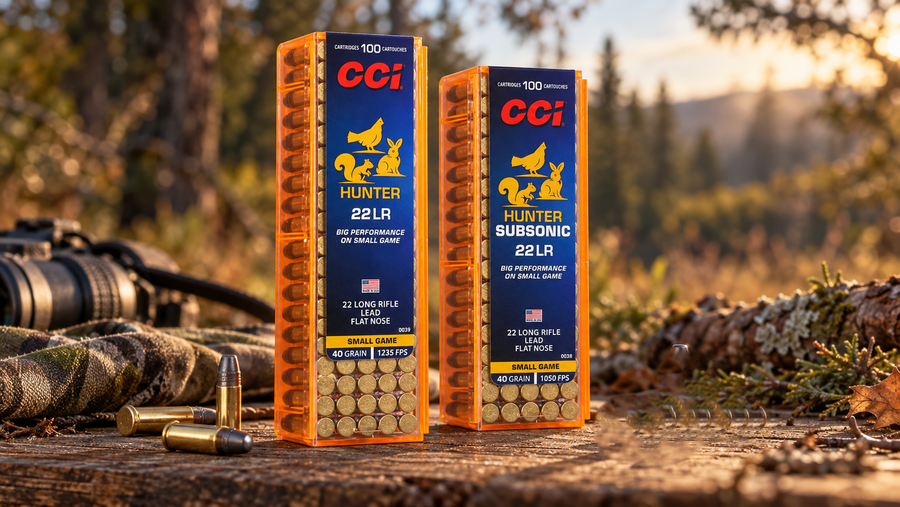
The central idea is straightforward. Instead of using the conventional round-nose projectile found in much of the .22 LR market or relying on an aggressively expanding hollow point, CCI selected a solid lead bullet with a flattened nose. The company says the design is intended to provide strong terminal performance on small game without causing excessive damage to edible meat.
That makes Hunter Series especially interesting for squirrel, rabbit, grouse, and similar small-game hunters who want ammunition developed around field performance rather than inexpensive target shooting alone. Both loads use the same 40-grain bullet weight, .125 ballistic coefficient, and basic projectile design, making velocity the primary difference between them.
The standard load leaves the muzzle at a published 1,235 fps and produces 135 ft-lb of muzzle energy. The subsonic version is rated at 1,050 fps and 98 ft-lb, trading some velocity, energy, and trajectory performance for operation below the speed of sound under typical conditions.
CCI announced a $13.99 MSRP per 100 rounds, although the company's own online store currently lists both loads at $12.99. Inventory can fluctuate, and the two versions may not always be available at the same time.
The important question is whether the flat-nose bullet actually provides a meaningful advantage over round-nose and hollow-point ammunition that hunters already use successfully. The answer depends on the animal, shot placement, the firearm's accuracy with a particular load, expected hunting distance, and how much terminal disruption the hunter wants.
Flat-nose ammunition offers a sensible middle ground between traditional solid bullets and expanding designs. Its shape alone, however, does not guarantee better performance in every rifle or every field situation.
Key Takeaways
- CCI first announced Hunter Series .22 LR in January 2026 and announced nationwide retailer shipments on October 1, 2026.
- Both loads use a 40-grain lead flat-nose bullet specifically positioned for small-game hunting.
- The standard Hunter Series load is rated at 1,235 fps and 135 ft-lb at the muzzle.
- Hunter Series Subsonic is rated at 1,050 fps and 98 ft-lb at the muzzle.
- CCI says the flat-nose design is intended to provide strong terminal performance without excessive damage to edible meat.
- The announced MSRP is $13.99 per 100 rounds, although CCI currently lists both products at $12.99 direct.
- The flat nose is a purposeful hunting design, but accuracy, firearm compatibility, shot placement, and actual field performance matter more than projectile shape alone.
What Is CCI Hunter Series .22 LR?
CCI Hunter Series is a purpose-built rimfire ammunition line developed around small-game hunting rather than general plinking or target use. CCI first revealed the ammunition ahead of the 2026 SHOT Show and identified squirrels, rabbits, grouse, groundhogs, and similar game as intended applications.
The company followed that introduction with an October announcement confirming that Hunter Series was being delivered to retailers nationwide. That distinction matters because the product was announced early in the year but did not begin its broader retail rollout until fall.
Unlike many new-ammunition launches built around greater velocity or a new hollow-point design, Hunter Series uses a comparatively traditional concept. Both versions feature a 40-grain lead flat-nose projectile, which CCI also describes as its Small Game Bullet design.
Instead of a rounded nose or a hollow cavity, the bullet presents a flattened forward surface. That geometry is the defining feature of the line and is intended to influence how the bullet interacts with small game without depending on dramatic expansion.
CCI's stated objective is to provide effective terminal performance while avoiding unnecessary destruction of edible meat. The company then gives hunters two velocity choices so they can balance trajectory, energy, noise characteristics, and firearm behavior according to the way they actually hunt.
CCI Hunter Series Specifications
| Specification | Hunter Series | Hunter Series Subsonic |
|---|---|---|
| Cartridge | .22 LR | .22 LR |
| Bullet Weight | 40 grains | 40 grains |
| Bullet Type | Lead flat nose | Lead flat nose |
| Muzzle Velocity | 1,235 fps | 1,050 fps |
| Muzzle Energy | 135 ft-lb | 98 ft-lb |
| Ballistic Coefficient | .125 | .125 |
| 50-Yard Velocity | 1,088 fps | 966 fps |
| 100-Yard Velocity | 992 fps | 902 fps |
| 100-Yard Energy | 87 ft-lb | 72 ft-lb |
| Package Quantity | 100 rounds | 100 rounds |
| Product Number | 3R40LFN | 2R40LFN |
| Announced MSRP | $13.99 | $13.99 |
| Current CCI Direct Price | $12.99 | $12.99 |
| Intended Use | Small-game hunting | Small-game hunting |
The specifications make CCI's strategy easy to understand. The company did not create two completely different projectiles and ask hunters to decipher which bullet construction they need. Instead, both loads use the same 40-grain lead flat-nose design, leaving velocity as the central variable.
The standard load begins with roughly 38 percent more muzzle energy than the subsonic version. It also retains a modest trajectory and velocity advantage as range increases. At 100 yards, CCI lists the standard load at 992 fps and 87 ft-lb, compared with 902 fps and 72 ft-lb for the subsonic load.
Those differences matter, but muzzle energy alone does not determine whether one load is better for a particular hunt. Accuracy, point of impact, firearm function, expected shot distance, and the terminal behavior of the bullet all matter alongside the numbers printed on the box.
Why CCI Chose a Flat-Nose Bullet
The most important feature of Hunter Series is not its velocity. It is the geometry of the bullet.
Traditional .22 LR ammunition frequently uses a round-nose lead or plated projectile. The design has an extremely long track record and continues to work well for target shooting, recreational use, and small-game hunting. There is nothing inherently obsolete about it.
Hollow-point bullets take a different approach by incorporating a cavity intended to encourage deformation or expansion when impact velocity and target resistance are sufficient. That can increase tissue disruption and provide more dramatic terminal behavior, but it may also create more meat damage than some hunters want on small edible game.
A flat-nose solid occupies a position between those two concepts. It does not depend on a hollow cavity for expansion, but its flattened frontal surface presents a broader initial contact area than a conventional round nose.
That can influence how energy is transferred and how tissue is displaced during penetration. It should not, however, be confused with a guarantee of expansion.
The Hunter Series bullet is a lead flat nose, not a hollow point. Its actual terminal behavior will depend on impact velocity, bullet construction, shot placement, the animal being hunted, and other conditions.
Flat Nose vs. Round Nose vs. Hollow Point
| Bullet Design | General Characteristic | Primary Small-Game Consideration |
|---|---|---|
| Lead round nose | Traditional solid projectile with rounded profile | Familiar performance and broad ammunition availability |
| Lead flat nose | Solid projectile with enlarged flat frontal surface | Designed to balance terminal effect and meat preservation |
| Lead or plated hollow point | Nose cavity intended to promote expansion | Can provide increased tissue disruption when expansion occurs |
| Segmented hollow point | Designed to separate into multiple sections under specified conditions | More specialized terminal effect with potentially greater tissue disruption |
There is no universal winner in this comparison. A round-nose load that groups exceptionally well in a particular rifle may be a better hunting choice than a flat-nose load that produces inconsistent accuracy. Likewise, an expanding hollow point may be preferable when the hunter deliberately wants more aggressive terminal performance.
The useful way to look at Hunter Series is as another purpose-built option. CCI is offering hunters a solid projectile designed around a broader frontal surface rather than claiming that every existing rimfire hunting bullet has suddenly become obsolete.
Does a Flat Nose Actually Hit Differently?

At the same diameter and similar construction, nose geometry changes the way the front of a projectile initially interacts with tissue. A round nose tends to present a gradually increasing frontal area as it penetrates, while a flat nose presents more of its frontal surface immediately.
That difference can contribute to a more direct crushing or displacement effect without requiring the projectile to open like a hollow point. In theory, that makes the concept attractive when the goal is more terminal effect than a conventional round nose without deliberately pursuing aggressive expansion.
The practical result still depends heavily on velocity and impact location. A flat nose striking bone can behave differently from the same bullet passing primarily through soft tissue, and a poorly placed shot does not become effective simply because the projectile has a broader nose.
This is why the flat-nose concept makes technical sense without automatically proving superiority. Its real value has to be demonstrated through accuracy and field performance.
Standard vs. Subsonic Hunter Series
CCI's decision to offer both a 1,235-fps load and a 1,050-fps version gives the Hunter Series two distinct ballistic personalities without changing the bullet itself.
The standard load is the more conventional high-velocity hunting option. Its additional velocity creates more muzzle energy and a somewhat flatter trajectory, which can make range estimation slightly less critical as distance increases.
The subsonic version takes a different approach. At an advertised 1,050 fps, it is intended to remain below the speed of sound under typical conditions and therefore avoid the ballistic crack produced by a supersonic projectile.
The speed of sound is not a fixed universal number, however. Temperature, elevation, atmospheric conditions, and actual firearm velocity can all influence whether a projectile remains below the local sound barrier.
Barrel length can affect velocity as well. CCI's figures come from controlled test conditions, and an individual rifle or handgun may produce somewhat different numbers.
The subsonic version therefore should not be treated as simply a quieter copy of the standard load. It trades velocity, energy, and trajectory performance for a different sound profile and potentially different behavior in the firearm.
CCI's Ballistic Data Shows the Tradeoff Clearly
| Distance | Standard Velocity | Standard Energy | Subsonic Velocity | Subsonic Energy |
|---|---|---|---|---|
| Muzzle | 1,235 fps | 135 ft-lb | 1,050 fps | 98 ft-lb |
| 50 yards | 1,088 fps | 105 ft-lb | 966 fps | 83 ft-lb |
| 75 yards | 1,035 fps | 95 ft-lb | 932 fps | 77 ft-lb |
| 100 yards | 992 fps | 87 ft-lb | 902 fps | 72 ft-lb |
The velocity difference becomes narrower as the two loads travel downrange, but the faster version retains an energy advantage throughout CCI's published 100-yard table. That does not automatically make it the better small-game round because hunting performance is not reducible to one energy figure.
The subsonic version may offer a worthwhile advantage to hunters who value reduced sound signature, particularly when used with compatible suppressed firearms. The standard version makes a stronger argument when trajectory and retained velocity receive greater priority.
Does Flat-Nose .22 LR Preserve More Meat?
This is the most important product claim behind Hunter Series and the one that deserves the most careful treatment. Small-game hunters frequently want enough terminal performance for a clean harvest without destroying unnecessary portions of an animal intended for the table.
CCI designed the Hunter Series around that objective. The company says its lead flat-nose bullet provides strong performance without excessive meat damage, positioning it as an alternative to hollow-point designs that may produce more disruption than a particular hunter wants.
The design philosophy is reasonable, but meat preservation is not determined by bullet shape alone. Shot placement, impact velocity, the size of the animal, bone strikes, range, and the projectile's actual behavior all influence the amount of tissue damage produced.
A precise head shot and a poorly placed body shot will not produce comparable results merely because the same ammunition was used. Likewise, a hollow point that fails to expand may behave differently from one that expands fully.
CCI's claim should therefore be understood as the design objective of Hunter Series rather than a proven percentage reduction in meat damage compared with every round-nose or hollow-point competitor.
Shot Placement Still Matters More Than Bullet Branding
Ammunition manufacturers can optimize projectile design, but hunters still determine where that projectile lands. On small animals, even relatively minor changes in impact location can dramatically change the amount of edible meat affected.
This is especially relevant with .22 LR because the cartridge is frequently used on game small enough that the relationship between impact location and usable meat is significant. A hunter attempting to preserve meat may place more emphasis on precise head or upper-vital-zone shots than someone using the cartridge solely for pest control.
That is why ammunition accuracy matters so much. A bullet designed to minimize unnecessary damage is only useful if the rifle places it consistently where the shooter intends.
Accuracy May Matter More Than the Flat Nose

Rimfire ammunition is well known for producing different levels of accuracy in different firearms. Two rifles of the same make and model can prefer different loads, and ammunition that groups exceptionally well in one barrel may perform less impressively in another.
That makes Hunter Series something hunters should evaluate in their own rifles rather than assuming a specialized hunting label guarantees better field performance. Group size, point-of-impact consistency, ignition reliability, and feeding all deserve testing before the ammunition is taken into the field.
The difference between the standard and subsonic loads adds another layer. Even though the projectiles share the same weight and general profile, their different velocities can produce different barrel harmonics and points of impact.
A rifle that strongly prefers the faster load may not shoot the subsonic version to the same point or with the same precision. Hunters switching between the two should verify zero rather than assuming their external similarities make them interchangeable.
Flat-Nose Feeding Is Worth Testing in Semiautomatics
The Hunter Series flat nose also changes the projectile profile that moves through the firearm during feeding. In manually operated rifles, this may present little practical concern, but semiautomatic rimfires can be sensitive to bullet shape, ammunition energy, magazine geometry, and chamber design.
A flat nose is not inherently unreliable. It simply presents a different geometry from the rounded profile used by much conventional .22 LR ammunition.
Owners of semiautomatic rifles and pistols should therefore confirm reliable feeding before depending on Hunter Series in the field. A box that functions perfectly in a bolt-action rifle may not behave identically in every semiautomatic host.
This is one of the reasons ammunition testing should include full magazines and realistic strings of fire rather than only firing a few isolated rounds for group size.
Will the Subsonic Load Cycle a Semiautomatic?
That depends on the firearm. Semiautomatic rimfires use energy from the fired cartridge to operate the action, and some guns are more tolerant of lower-velocity ammunition than others.
CCI's 1,050-fps Hunter Series Subsonic carries substantially more energy than ultra-low-velocity loads such as Quiet-22, but that does not guarantee reliable function in every semiautomatic rifle or pistol.
Spring weights, bolt mass, barrel length, suppressor use, cleanliness, temperature, and the individual firearm can all influence cycling. CCI itself offers several different subsonic and reduced-noise rimfire products because one velocity level does not serve every firearm identically.
The practical approach is simple: test the ammunition in the exact gun before relying on it for hunting. If the firearm does not cycle the subsonic version reliably, the standard Hunter Series load may make more sense, or a manually operated rifle may be better suited to the lower-velocity ammunition.
Where the Subsonic Version Makes the Most Sense
The clearest use case is a bolt-action or other manually operated .22 LR where cycling energy is irrelevant. In that environment, the hunter can use the lower-velocity load without worrying about whether it has enough energy to operate the action.
It can also be attractive in a suppressed rimfire. Removing the projectile's supersonic crack allows the suppressor to address the muzzle report without a second major sound event being generated by the bullet in flight.
That does not make the firearm silent. The action can still produce mechanical noise, the bullet still impacts the target, and the suppressor only reduces part of the complete sound signature.
Subsonic ammunition remains appealing because it removes a component of noise that no muzzle suppressor can eliminate once the projectile itself exceeds the speed of sound.
Hunter Series vs. CCI Mini-Mag

One of the most interesting comparisons is CCI's established 40-grain Mini-Mag round-nose load. Both it and Hunter Series Standard are rated around the same 1,235-fps muzzle velocity, meaning the most obvious difference is the projectile rather than speed.
Mini-Mag has an enormous track record among rimfire shooters and is widely known for dependable semiautomatic function. Hunter Series asks buyers to consider whether a solid flat nose offers enough hunting-specific value to choose it over an established general-purpose load traveling at essentially the same published velocity.
That is exactly the type of comparison where individual rifle testing becomes useful. If both loads group similarly, projectile preference may become the deciding factor. If one load clearly outshoots the other, accuracy may outweigh the theoretical terminal advantages of the alternate nose shape.
Hunter Series vs. CCI Sub-Sonic HP

The subsonic version creates a similarly useful comparison with CCI's established 40-grain Sub-Sonic hollow-point load, which is also listed around 1,050 fps.
Again, the interesting difference is bullet construction. Hunter Series uses a solid flat nose, while the established Sub-Sonic option uses a lead hollow point intended to expand under suitable conditions.
That gives hunters two very different philosophies at approximately the same published muzzle velocity. Someone deliberately seeking expansion may favor the hollow point, while a hunter trying to reduce unnecessary meat disruption may find the flat-nose concept more appealing.
Neither should be assumed superior without considering the game, firearm accuracy, and real-world terminal performance.
How Hunter Series Fits Within CCI's Existing Lineup
| Ammunition | Bullet Design | Published Velocity | Primary Distinction |
|---|---|---|---|
| Hunter Series | 40-grain lead flat nose | 1,235 fps | Purpose-built small-game flat-nose load |
| Hunter Series Subsonic | 40-grain lead flat nose | 1,050 fps | Lower-velocity small-game flat-nose option |
| Mini-Mag Target | 40-grain copper-plated round nose | 1,235 fps | Established high-velocity general-purpose load |
| Mini-Mag HP | 36-grain copper-plated hollow point | 1,260 fps | High-velocity expanding option |
| Sub-Sonic HP | 40-grain lead hollow point | 1,050 fps | Established subsonic expanding design |
Hunter Series does not replace these existing options. CCI already has one of the deepest rimfire catalogs in the market, and the new line simply fills a specific space within it.
The standard Hunter Series offers a flat-nose alternative at a familiar high-velocity level, while the subsonic version gives hunters the same bullet concept at a lower velocity. That makes projectile behavior rather than raw speed the primary reason to choose the new ammunition.
Is Hunter Series Actually More Specialized Than Mini-Mag?
Yes, at least in design intent. Mini-Mag has built its reputation as a broadly useful high-velocity rimfire load that works across recreational shooting, hunting, and semiautomatic use.
Hunter Series is marketed around a narrower job. CCI specifically developed the lead flat-nose design for small game and emphasizes terminal performance without excessive meat damage.
That narrower mission can be a strength if the ammunition performs as intended. It also means the buyer should not assume a hunting-specific product is automatically the best choice for general range use, competition, or high-volume plinking.
The question is whether the specialized feature matters enough in a particular rifle and hunting scenario to justify selecting it over proven general-purpose ammunition.
What Game Is CCI Targeting?
CCI specifically identifies squirrels, rabbits, grouse, groundhogs, and similar small game as appropriate applications for Hunter Series. Those examples cover animals with different body sizes and hunting environments, which helps explain why CCI offers both standard and subsonic versions.
A short-range squirrel hunt in thick woods presents a different ballistic problem from a longer shot at a groundhog in more open terrain. The faster load may be preferable when trajectory and retained velocity matter more, while the subsonic version may appeal in situations where reduced sound signature has greater value.
Hunters should still consider the legal requirements in their jurisdiction. Small-game ammunition rules can differ by state, season, and species, and local regulations should take priority over the fact that an ammunition manufacturer markets a load for hunting.
Trajectory Still Matters With Small Game
Small targets leave little room for errors in range estimation. Even with a cartridge as familiar as .22 LR, trajectory becomes increasingly important as distance grows.
The standard load's additional velocity gives it some advantage in this area. A faster projectile generally spends less time in flight and drops less over the same distance when other variables are similar.
The subsonic version gives up some of that margin. For close-range woodland hunting, the difference may be modest enough to matter little. At longer distances, the shooter needs to understand the load's trajectory and verify actual point of impact from the rifle being used.
Published ballistic tables are useful starting points, but field zeros should always be confirmed with the exact rifle, sights or optic, and ammunition lot.
The Blaze-Orange 100-Round Pack Makes Sense for Hunting
The packaging does not improve ballistics, but CCI did make a practical choice. Hunter Series comes in blaze-orange plastic 100-round packs that are easy to distinguish from other rimfire ammunition and durable enough for field use.
A 100-round quantity also fits the product's purpose. Small-game hunters may want enough ammunition for zero confirmation, practice, and several outings without buying the much larger bulk cartons commonly associated with inexpensive plinking ammunition.
The bright container is a small detail, but it reinforces that CCI designed the line around hunters carrying ammunition in the field rather than simply creating another paper-box range load.
Is CCI Hunter Series Worth the Higher Price?
CCI launched both Hunter Series loads at a $13.99 MSRP per 100 rounds, which works out to roughly 14 cents per round. CCI's own online store currently lists them at $12.99, although inventory varies between the standard and subsonic versions.
That places Hunter Series above much of the inexpensive bulk .22 LR market. Comparing it only with bargain ammunition, however, misses the point of the product.
CCI is selling Hunter Series as specialized hunting ammunition. For someone firing relatively few rounds during a hunting season, the difference between low-cost bulk ammunition and a purpose-built load may not materially affect the total cost of hunting.
That does not make the premium automatically worthwhile. If an inexpensive load already groups extremely well, functions perfectly, and produces the terminal performance the hunter wants, there may be little reason to replace it simply because Hunter Series has a more specialized label.
The value comes from whether the flat-nose bullet solves a real problem for the buyer. A new product name is not a substitute for measurable improvement.
Current Availability Is Still Developing
CCI announced on October 1 that Hunter Series was being delivered to retailers nationwide, so the ammunition is now in commercial distribution rather than simply awaiting launch.
That does not mean both versions will appear in every store simultaneously. CCI's own online shop currently lists the 1,235-fps load as available while the 1,050-fps subsonic version is temporarily unavailable direct.
Retail inventory is fluid, particularly during the first weeks of a product rollout. A temporary direct-store shortage should not be interpreted as discontinuation, just as one retailer having stock does not guarantee broad local availability.
Hunters specifically interested in one version should verify the exact part number and velocity rather than assuming every orange Hunter Series package contains the same ammunition.
What Hunter Series Still Needs to Prove
Hunter Series has a clear purpose, familiar bullet weight, sensible velocity choices, and CCI's established manufacturing infrastructure behind it. Those characteristics make it a credible addition to the company's hunting lineup.
What remains less certain is how consistently the flat-nose concept will deliver its intended advantage across different rifles, hunting distances, and shot placements.
CCI's claim that the bullet provides strong performance without excessive meat damage is central to the product's identity, but the line has only just begun reaching hunters in significant numbers. Broad independent field comparisons against round-nose and hollow-point loads are still limited.
Accuracy comparisons will be just as important. Rimfire hunters already have access to ammunition that performs extremely well in particular rifles, and Hunter Series will have to earn a place alongside those trusted loads through consistent groups and dependable function.
Semiautomatic reliability is another area to watch, particularly with the 1,050-fps load. Some firearms will digest it without complaint, while others may be more sensitive to lower operating energy.
Those are normal questions for ammunition that has only just entered widespread distribution.
Who Should Try CCI Hunter Series First?
The strongest candidate is a small-game hunter who already knows what they want from .22 LR terminal behavior. Someone who finds certain hollow points more destructive than necessary but wants a projectile with a broader frontal profile than a conventional round nose has a clear reason to test Hunter Series.
The standard version makes the strongest argument for hunters who want familiar high-velocity .22 LR performance with the new flat-nose bullet. Its 1,235-fps velocity mirrors established high-velocity rimfire territory and should feel familiar from a trajectory standpoint.
The subsonic version is more specialized. It may appeal particularly to hunters using bolt actions, suppressed rifles, or other firearms where reduced sound signature is a significant part of the system.
The weaker case is someone whose current ammunition already performs exceptionally well. Rimfire rifles can be remarkably individual in ammunition preference, and abandoning a proven load merely to use a newer bullet shape does not automatically improve field results.
Does Flat-Nose Ammo Make More Sense for Small Game?
It can, but not because flat nose is universally superior. The design makes sense when the hunter wants a solid projectile that presents more frontal area than a round nose without deliberately relying on hollow-point expansion.
That is a legitimate middle ground, particularly when preserving edible meat is an important part of the hunt. CCI's decision to offer the same bullet at both 1,235 and 1,050 fps also gives hunters meaningful control over the ballistic side of the equation.
The design still has to shoot accurately in the firearm. It still needs to feed and function reliably. The hunter still needs to place the shot correctly, understand trajectory, and choose a velocity appropriate for the hunting distance.
Those realities keep Hunter Series from becoming a magic answer to small-game ammunition selection. What CCI has done is add another useful tool to a rimfire market already full of capable choices.
Final Thoughts
CCI Hunter Series .22 LR introduces a practical alternative for small-game hunters who want something between traditional round-nose solids and expanding hollow-point ammunition. Both loads use the same 40-grain lead flat-nose projectile, allowing hunters to choose between conventional high-velocity performance at 1,235 fps and a 1,050-fps subsonic option.
The concept makes sense. A broad flat nose can provide a different type of terminal interaction than a round nose without depending on the aggressive expansion associated with some hollow-point designs. For hunters concerned with preserving edible meat, that is a reasonable design objective.
The important limitation is that bullet shape does not override everything else. Accuracy, firearm compatibility, point of impact, impact velocity, shot placement, and actual field performance remain more important than the words printed on the package.
CCI's published ballistic data also gives buyers a clear picture of the difference between the two loads. The standard version begins at 135 ft-lb and retains 87 ft-lb at 100 yards, while the subsonic starts at 98 ft-lb and retains 72 ft-lb. That makes the faster ammunition the more conventional trajectory-and-energy choice, while the slower version provides the sound advantage of remaining below the speed of sound under suitable conditions.
At a $13.99 announced MSRP and a current CCI direct price of $12.99 per 100 rounds, Hunter Series is more expensive than basic bulk ammunition but not so expensive that a small-game hunter cannot realistically test both loads and see what the rifle prefers.
That may be the best approach. Rimfire rifles are notoriously individual about ammunition, and a purpose-built hunting round still has to earn its place through accuracy and reliable function.
Hunter Series is not a revolution in .22 LR projectile design. It is something more practical: a deliberately configured hunting load that gives shooters another option between the familiar round nose and the expanding hollow point.
The CCI Hunter Series illustrates how even an established cartridge such as .22 LR continues to evolve. Its flat-nose bullet design emphasizes practical small-game performance, while the availability of higher-velocity and subsonic options gives hunters more flexibility in choosing ammunition for their intended application.
That evolution fits into the broader story of modern suppressed rimfire hunting, where traditional hunting cartridges are increasingly being paired with suppressor-ready firearms and more specialized ammunition. CCI's newest loads are another example of manufacturers responding to those changing preferences.

Federal .22 LR 36 Grain Copper Plated - Box of 525
$50.00
at Pro Armory
Prices accurate at time of writing
Frequently Asked Questions
What is CCI Hunter Series .22 LR designed for?
CCI designed Hunter Series specifically for small-game hunting. The company identifies squirrels, rabbits, grouse, groundhogs, and similar animals as intended applications and uses a 40-grain lead flat-nose bullet intended to provide strong terminal performance without excessive meat damage.
When did CCI Hunter Series start shipping?
CCI first announced the Hunter Series in January 2026 and announced on October 1, 2026 that the ammunition was being delivered to retailers nationwide.
What is the difference between Hunter Series and Hunter Series Subsonic?
Both use the same 40-grain lead flat-nose bullet with a .125 ballistic coefficient. The standard version is rated at 1,235 fps and 135 ft-lb at the muzzle, while the subsonic version is rated at 1,050 fps and 98 ft-lb.
Is the CCI Hunter Series bullet a hollow point?
No. Hunter Series uses a solid lead flat-nose projectile. It does not contain the nose cavity used by a conventional hollow-point design.
Is flat-nose .22 LR better than round-nose ammunition for hunting?
Not automatically. A flat nose presents a broader frontal surface and may offer a useful balance between a traditional round-nose solid and an expanding hollow point, but accuracy, shot placement, velocity, firearm compatibility, and target conditions remain critical.
Is flat-nose .22 LR better than hollow-point ammunition for small game?
That depends on the hunter's priorities. Hollow points are designed to encourage expansion, which can increase tissue disruption under the right conditions. A solid flat nose may appeal to hunters who want effective penetration and terminal performance while trying to limit unnecessary meat damage.
Will CCI Hunter Series Subsonic cycle a semiautomatic rifle?
It depends on the firearm. Some semiautomatic rimfire rifles and pistols function reliably with 1,050-fps ammunition, while others may require higher-energy loads for consistent cycling. Owners should follow the firearm manufacturer's guidance and test the load before relying on it for hunting.
Is Hunter Series Subsonic good for suppressed rifles?
The 1,050-fps load is designed to remain below the sound barrier under typical conditions, which eliminates the projectile's supersonic ballistic crack. That can make it particularly attractive in a compatible suppressed firearm, although actual velocity and sound characteristics vary with barrel length and environmental conditions.
How much energy does CCI Hunter Series have?
CCI lists the 1,235-fps standard load at 135 ft-lb of muzzle energy and 87 ft-lb at 100 yards. The 1,050-fps subsonic version is rated at 98 ft-lb at the muzzle and 72 ft-lb at 100 yards.
How much does CCI Hunter Series cost?
CCI announced an MSRP of $13.99 per 100-round pack. The company's own online store currently lists both loads at $12.99, although price and inventory can change.
Is CCI Hunter Series currently available?
CCI says the line is shipping to retailers nationwide. As of October 2026, CCI's own store lists the 1,235-fps version as available and the 1,050-fps subsonic version as temporarily unavailable direct, so inventory may vary by load and retailer.
Should I re-zero when switching between the standard and subsonic loads?
Yes, shooters should verify actual point of impact whenever changing ammunition. The two Hunter Series loads use the same bullet weight but have substantially different velocities, so trajectory and point of impact can differ even when fired from the same rifle.
About the Author
The ProArmory editorial team includes experienced hunters, competitive shooters, military veterans, firearms instructors, and firearms industry professionals committed to producing accurate, practical, and research-based content. Our articles draw on manufacturer specifications, current industry information, launch documentation, and real-world shooting experience to help readers make informed decisions about firearms, ammunition, optics, and related equipment.
Disclaimer
This article is for informational and educational purposes only. Ammunition specifications, pricing, availability, and manufacturer claims reflect information available as of October 2026 and may change as Hunter Series reaches wider distribution.
Manufacturer terminal-performance claims should not be interpreted as universal field results. Always verify ammunition compatibility with the specific firearm, follow established firearm-safety practices, and comply with current federal, state, and local hunting regulations for the intended game and jurisdiction.


