









Quick Answer
The American Tactical Alpha Maxx .410 approaches the defensive shotgun from a direction that looks considerably different from the traditional pump-action 12 gauge.
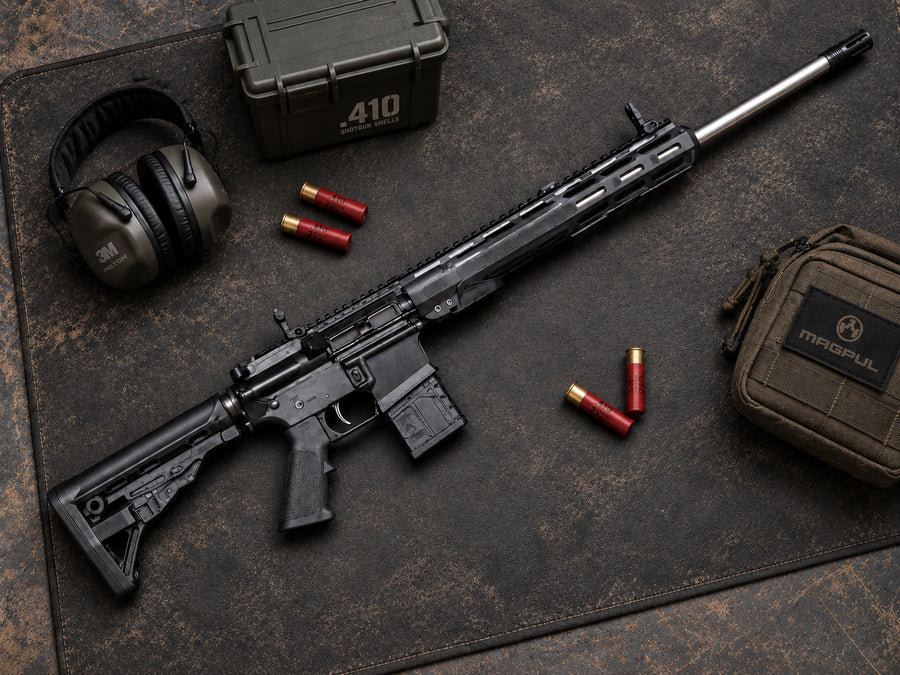
The current full-size version combines an 18.5-inch barrel, semiautomatic operation, detachable box magazine, AR-style controls and furniture, and .410-bore chambering in a package intended to feel familiar to shooters accustomed to the AR platform.
Published specifications for the later full-size Alpha Maxx are inconsistent about shell length.
Some current listings identify a 3-inch chamber and five-round detachable magazine, while other listings for the same general model identify a 2.5-inch chamber. Earlier hands-on coverage specifically described the AR-magwell version as feeding 2.5-inch shells because of magazine-length constraints.
For that reason, buyers should verify the markings, current manual, magazine compatibility, and exact SKU of the firearm in front of them rather than assuming every Alpha Maxx generation uses the same ammunition.
For home-defense buyers, the most obvious attraction is manageable recoil.
A .410 generally produces considerably less recoil than typical 12-gauge defensive loads, which can make the platform more approachable for recoil-sensitive shooters and potentially easier to practice with comfortably.
The Alpha Maxx combines that characteristic with a shoulder-fired semiautomatic platform rather than the lightweight single-shot and sporting shotguns many people still associate with .410 bore.
Those advantages do not automatically make the Alpha Maxx a better defensive shotgun.
The .410 carries substantially less shot payload than larger shotgun gauges, ammunition selection is particularly important, and a semiautomatic defensive firearm needs to demonstrate dependable operation with the exact ammunition its owner intends to use.
The detachable-magazine design and AR-style appearance may be appealing, but neither substitutes for reliability, appropriate ammunition, familiarity with the firearm, and responsible defensive planning.
The Alpha Maxx therefore makes the most sense when evaluated as a specialized low-recoil option rather than as a smaller 12 gauge.
Its real value depends on whether its combination of controllability, familiar ergonomics, ammunition capability, and semiautomatic operation solves a problem the individual buyer actually has.
Key Takeaways
- The Alpha Maxx .410 is a semiautomatic, detachable-magazine shotgun built around an AR-style layout rather than a conventional sporting or pump-action shotgun design.
- Current information for the later full-size model generally identifies an 18.5-inch smoothbore barrel, five-round detachable magazine, and M-LOK-equipped configuration, but published chamber and magazine shell-length specifications are inconsistent.
- Reduced recoil is one of the strongest arguments for a .410 defensive shotgun, particularly for shooters who struggle to control or practice comfortably with larger gauges.
- The .410's smaller payload makes defensive ammunition selection and pattern testing especially important. Reduced recoil should not be confused with equivalent performance to a 12 gauge.
- Buyers should evaluate the Alpha Maxx as a complete system, including firearm, magazines, ammunition, reliability, handling, and support, rather than choosing it primarily because it resembles an AR-15.
What Is the Alpha Maxx .410?
The Alpha Maxx .410 is American Tactical's attempt to combine shotgun capability with an AR-style firearm architecture.
Instead of using the receiver, tubular magazine, and traditional stock arrangement found on many defensive shotguns, the Alpha Maxx uses a detachable box magazine and controls that will appear much more familiar to someone who already owns or trains with an AR-pattern firearm.
The original Alpha Maxx concept went further than simply borrowing AR styling.
Contemporary launch coverage reported that American Tactical designed the shotgun around standard AR-15 lower-receiver architecture and planned to offer complete firearms as well as shotgun uppers, magazines, and the required buffer components.
That description requires some qualification because the Alpha Maxx has appeared in multiple forms, and published specifications do not always describe the same generation.
Earlier reporting from SHOT Show described a version using 2.5-inch .410 shells because of magazine-length constraints, along with five-round magazines and planned higher-capacity magazines.
Later full-size product listings instead identify an 18.5-inch smoothbore barrel and, in some cases, a 3-inch chamber.
Other current listings still describe a 2.5-inch chamber.
Buyers shopping for one should therefore confirm the specifications of the exact SKU or generation in front of them rather than assuming every Alpha Maxx .410 uses identical ammunition and components.
That generation distinction is particularly important in an article about defensive use.
Ammunition compatibility is not a minor specification when the firearm may be purchased for protection.
The shell length, magazine, and load all have to work together reliably, and information from an older review should not automatically be applied to a newer production gun.
Alpha Maxx .410 Specifications at a Glance
| Feature | Alpha Maxx .410 Full-Size Shotgun |
|---|---|
| Platform | AR-style semiautomatic shotgun |
| Chambering | .410 Bore |
| Action | Gas-operated semiautomatic |
| Barrel | 18.5-inch smoothbore |
| Chamber | Published listings vary between 2.5 and 3 inches; verify exact SKU and manual |
| Feeding System | Detachable box magazine |
| Standard Capacity | 5 rounds |
| Handguard | M-LOK-equipped configuration |
| Sights | Flip-up sights on current listings |
| Receiver Construction | Carbon-fiber-infused polymer reported on current models |
| Primary Appeal | Low recoil with AR-style ergonomics |
The specifications show why the Alpha Maxx occupies an unusual place in the shotgun market.
It is neither a conventional AR-15 that happens to fire shotshells nor a traditional shotgun wearing cosmetic AR furniture.
Its design attempts to bring the controls, detachable-magazine concept, and accessory layout associated with the AR family into a functional .410 semiautomatic shotgun.
That distinction also creates expectations the firearm has to meet.
A buyer attracted by the AR-style layout is likely to expect familiar handling, straightforward accessory mounting, and easy magazine changes.
At the same time, the firearm still has to deal with the characteristics of .410 shotshells and a gas-operated shotgun action, which means the experience should not be assumed to be identical to operating a 5.56 AR-15.
Why Build a Defensive Shotgun Around .410?

The .410 has traditionally occupied a very different position from 12 gauge in the American shotgun market.
It has long been associated with small-game hunting, recreational shooting, and lightweight sporting guns rather than serving as the default choice for defensive shotguns.
The reason is straightforward: the smaller bore generally carries a smaller payload than larger gauges, which places practical limitations on what can be delivered with each shot.
That disadvantage comes with an equally obvious benefit.
A .410 can be much easier to manage from a recoil standpoint, particularly when compared with common defensive 12-gauge loads.
For shooters who find 12 gauge unpleasant enough that they avoid meaningful practice, a lower-recoil platform can have genuine practical value.
A firearm that is theoretically more powerful but difficult for its owner to control or practice with deserves a different evaluation from one the owner can handle confidently and consistently.
The Alpha Maxx takes that low-recoil characteristic and places it in a firearm with more substantial dimensions and familiar AR-style handling.
That is different from relying on an extremely light .410 sporting gun, where low firearm weight can influence the shooting experience.
Early hands-on reporting with the Alpha Maxx noted mild recoil while firing buckshot and slug loads, although those observations concerned an earlier configuration and should not be treated as a performance guarantee for every current gun and load combination.
For home-defense buyers, the better question is therefore not whether .410 generally produces less recoil.
It is whether that reduction in recoil is worth the corresponding reduction in payload.
The answer depends heavily on the shooter, ammunition, firearm reliability, and the alternatives being considered.
Low Recoil Can Be a Real Defensive Advantage
Recoil is sometimes discussed as though it were merely a comfort issue.
In practice, comfort influences how frequently people train, and controllability influences how well they can manage a firearm.
A shooter who dreads practicing with a hard-recoiling shotgun is unlikely to become more competent simply because the larger gauge offers greater ballistic capability.
This is where the Alpha Maxx concept has its strongest argument.
A gas-operated semiautomatic .410 in a shoulder-fired AR-style package gives recoil-sensitive shooters an alternative to both a heavier-recoiling defensive shotgun and a traditional manually operated .410.
The semiautomatic action also means the shooter does not need to manually cycle the action between shots as would be required with a pump shotgun.
That does not make low recoil a substitute for training.
The owner still needs to understand the controls, magazine system, sights, safety, and operating characteristics of the firearm.
What reduced recoil can do is remove one obstacle that prevents some shooters from practicing enough to become familiar with their defensive firearm.
There is also a broader buyer lesson here.
Selecting a defensive firearm solely according to maximum cartridge power can ignore the person who has to operate it.
Strength, physical limitations, experience, firearm fit, and recoil tolerance all matter, and a smaller-gauge shotgun can be a rational choice when those considerations outweigh the advantages of a larger payload.
The .410 Payload Is the Tradeoff

The other side of that argument should not be minimized.
A .410 shotshell does not provide the same payload capacity as a 12-gauge shell, and the difference matters when evaluating defensive ammunition.
The smaller bore limits how much shot can be packaged into the shell and how pellets can be arranged.
Buckshot loads designed specifically for .410 defensive use do exist, but buyers should resist treating the word “buckshot” on the box as proof that two loads from different gauges are functionally interchangeable.
Pellet size, pellet count, velocity, pattern, penetration, and the distance involved all affect what a particular load actually does.
That makes ammunition selection more important rather than less important with .410.
Birdshot may be widely available for sporting purposes, but its existence should not lead buyers to assume that every .410 shell is equally appropriate for defensive use.
A home-defense firearm should be evaluated with ammunition specifically suited to that role, and the actual firearm should be tested with the exact load being considered.
Patterning deserves particular attention because a shotgun does not produce a uniform wall of shot.
At typical indoor distances, the pattern may remain considerably tighter than inexperienced shotgun owners expect.
The responsible way to understand a particular firearm-and-load combination is to test its pattern under safe range conditions rather than relying on generalized assumptions about how widely a shotgun spreads.
AR-Style Controls Are More Than a Cosmetic Feature
The Alpha Maxx's appearance will inevitably attract attention because it resembles an AR-pattern rifle, but the more useful question is whether that layout offers practical benefits.
For someone already familiar with AR controls, the basic architecture can reduce the amount of unfamiliarity involved in moving to a shotgun platform.
The pistol grip, shoulder-fired geometry, detachable magazine concept, and accessory-oriented handguard provide a different experience from a traditional shotgun with a tube magazine and conventional stock.
Current Alpha Maxx information also identifies an M-LOK-equipped handguard and flip-up sights, giving the platform a straightforward way to accommodate common sighting and accessory concepts.
That familiarity should not be overstated.
A .410 shotgun uses different ammunition, magazines, and operating dynamics from a centerfire AR rifle, and owners still need to learn the specific firearm rather than assuming previous AR experience covers everything.
The Alpha Maxx may reduce the ergonomic learning curve for an AR owner, but it does not eliminate the need to understand the shotgun itself.
For defensive buyers, that distinction matters because familiar-looking controls can create misplaced confidence.
The useful advantage is not that the firearm looks tactical.
It is that an owner who already understands the general layout may find the platform intuitive enough to practice with regularly.
Detachable Magazines Change the Shotgun Experience

Traditional defensive shotguns commonly feed from tubular magazines positioned beneath the barrel.
That arrangement has advantages, including a relatively streamlined firearm and the ability to replenish the magazine without removing it from the gun.
It also creates a loading process quite different from the detachable magazines used in modern rifles and pistols.
The Alpha Maxx uses a detachable box magazine instead.
Current full-size specifications identify a five-round magazine, while earlier reporting discussed both five-round magazines and higher-capacity options associated with the Alpha Maxx family.
As with shell compatibility, buyers should confirm which magazines are actually supported by the exact generation they are considering.
For an AR-oriented buyer, detachable magazines may feel more familiar and can simplify certain aspects of storage and range use.
The tradeoff is that shotshell magazines have to manage ammunition with very different geometry from conventional rifle cartridges.
Magazine quality and compatibility therefore become part of the reliability equation rather than an accessory consideration.
A defensive owner should place much more value on proven function with the magazines they actually possess than on advertised maximum capacity.
A five-round magazine that functions consistently with the selected ammunition is more useful than a higher-capacity option whose reliability has not been established in that individual firearm.
Semiautomatic Operation Makes Reliability Especially Important
The Alpha Maxx's semiautomatic action is another major part of its appeal.
The firearm cycles the action after each shot rather than requiring the manual fore-end movement of a pump shotgun, which can make the shooting sequence easier for someone who has difficulty operating a pump consistently.
Semiautomatic shotguns, however, depend on sufficient operating energy and proper interaction between ammunition and the firearm.
Early hands-on coverage of the original Alpha Maxx described an adjustable gas system intended to accommodate loads ranging from lighter birdshot to buckshot and slugs.
Buyers of later production guns should verify the gas-system configuration and adjustment procedure in the documentation for their exact model rather than assuming the early system remained unchanged.
That flexibility can be useful, but it also reinforces the importance of understanding the manufacturer's instructions for the exact production version.
For a recreational shotgun, discovering that a particular inexpensive load does not cycle reliably may simply be inconvenient.
A firearm selected for home defense deserves a much higher standard.
The owner should establish reliable function with the exact defensive ammunition and magazines intended for use rather than assuming that successful operation with another shell establishes universal reliability.
This is particularly important with .410 because ammunition can vary substantially in purpose and construction.
A platform expected to handle sporting ammunition, buckshot, and slugs is being asked to operate across loads developed for very different jobs.
Manufacturer recommendations and actual reliability testing should therefore carry more weight than the assumption that any shell of the correct nominal gauge and length will perform identically.
Does the Alpha Maxx Make Sense for Home Defense?
On paper, the Alpha Maxx combines several characteristics that can be useful in a defensive firearm: manageable recoil, shoulder-fired stability, semiautomatic operation, detachable magazines, familiar controls, and provisions for modern sights and accessories.
Those qualities give the platform a legitimate reason to exist beyond its unconventional appearance.
The limitations are just as important.
The .410 offers less payload than larger shotgun gauges, the platform is less established than long-running defensive shotgun designs, and the owner needs to pay close attention to generation-specific ammunition and magazine compatibility.
A buyer also has to decide how much confidence to place in an AR-style .410 compared with more mature pump and semiautomatic shotgun platforms with decades of service history and extensive parts support.
That makes the Alpha Maxx most compelling for a relatively specific buyer: someone who genuinely benefits from reduced recoil, prefers AR-style ergonomics, and is willing to verify the reliability of the complete firearm-and-ammunition combination.
For that person, the .410 chambering is not simply a compromise made to obtain a tactical-looking shotgun.
It is the feature that may make the firearm manageable enough to practice with consistently.
For a shooter who handles a 12- or 20-gauge defensive shotgun comfortably, the decision becomes less obvious.
Larger gauges provide greater payload capability and are supported by an enormous selection of established defensive firearms and ammunition.
In that situation, the Alpha Maxx needs to earn its place through handling, familiarity, and individual preference rather than through the assumption that AR-style construction automatically represents an upgrade.
The Alpha Maxx .410 is therefore best understood as an alternative rather than a replacement for the conventional defensive shotgun.
Its combination of reduced recoil and modern ergonomics addresses a real part of the market, but whether it is the right home-defense firearm depends on how well those advantages match the needs of the person who will actually rely on it.
How the Alpha Maxx Compares With Traditional Home-Defense Shotguns

The Alpha Maxx becomes easier to evaluate when it is compared according to function rather than appearance.
A conventional pump-action 12 gauge, a gas-operated 20 gauge, and an AR-style .410 can all be configured for defensive use, but they arrive at that role with different strengths.
The Alpha Maxx places greater emphasis on low recoil, familiar rifle-style ergonomics, and detachable-magazine operation, while traditional defensive shotguns generally offer broader ammunition availability, larger payloads, and much more established parts and support networks.
That distinction matters because the Alpha Maxx is unlikely to replace the traditional defensive shotgun for most experienced shotgun owners.
Instead, it gives buyers who have difficulty with larger gauges another way to approach the category.
The strongest argument for the platform is not that .410 somehow duplicates 12-gauge capability with less recoil.
It is that a manageable firearm can be more useful to a particular shooter than a more powerful platform they cannot operate comfortably or practice with consistently.
| Consideration | Alpha Maxx .410 | Traditional 20 Gauge | Traditional 12 Gauge |
|---|---|---|---|
| Recoil | Generally lowest | Moderate | Generally highest |
| Shot Payload | Lowest | Greater than .410 | Greatest of the three |
| Defensive Ammo Selection | More limited | Broad | Broadest |
| Common Defensive Platforms | Relatively limited | Well established | Extremely well established |
| Magazine System | Detachable box magazine | Usually tubular | Usually tubular |
| AR-Style Ergonomics | Yes | Usually no | Usually no |
| Best Reason to Consider | Recoil management and familiar controls | Balance of recoil and payload | Maximum platform and ammunition choice |
The table also illustrates why gauge alone should not determine the purchase.
A 20 gauge can represent a useful middle ground for someone who wants less recoil than a typical 12 gauge without reducing payload as far as .410, while the enormous 12-gauge market provides more choices in firearms, ammunition, replacement parts, and accessories.
The Alpha Maxx competes by offering a different combination of characteristics rather than attempting to beat those established platforms at their own strengths.
Who Is the Alpha Maxx .410 Really For?

The clearest potential buyer is someone who has already determined that recoil is a meaningful limitation.
That could include a smaller-framed shooter, an older firearm owner, or anyone with physical limitations that make repeated practice with larger-gauge shotguns difficult.
The important point is that the decision should come from actual handling needs rather than the assumption that .410 is automatically the appropriate choice for an inexperienced shooter.
Experience and recoil tolerance are separate issues.
A new shooter who comfortably controls a larger-gauge firearm may have no reason to reduce payload simply because .410 has a reputation for being easier to shoot.
Conversely, an experienced shooter with a physical limitation may find that the reduced recoil allows substantially more productive practice.
The Alpha Maxx makes the most sense when its lower-recoil characteristics solve an identifiable handling problem.
Existing AR owners form another logical audience because the Alpha Maxx presents the shotgun in a layout that feels less foreign than many conventional designs.
Familiarity with a pistol grip, selector-style controls, detachable magazines, and an accessory-oriented handguard can make the transition more intuitive.
That familiarity still needs to be followed by platform-specific training because the Alpha Maxx remains a semiautomatic shotgun with its own ammunition, magazines, maintenance requirements, and operating characteristics.
Ammunition Should Be Part of the Buying Decision
A buyer considering the Alpha Maxx should investigate ammunition before purchasing the firearm rather than treating it as a later decision.
The .410 market includes sporting loads, buckshot, slugs, and loads developed with defensive applications in mind, but selection is not as extensive as the 12-gauge market.
Local availability and price can also influence how practical it is to maintain enough ammunition for regular practice.
Generation-specific compatibility makes that research even more important with the Alpha Maxx.
As discussed earlier, published information for older versions and later full-size guns does not always describe the same shell-length capability.
The markings and manual supplied with the exact firearm should therefore take precedence over generalized online descriptions of the Alpha Maxx family.
Defensive ammunition should also be evaluated according to its actual performance rather than simply its gauge or marketing category.
With a shotgun, that includes understanding how a particular load patterns from the individual firearm.
Different loads can behave differently even when fired through the same barrel, making safe range testing an important part of establishing what the firearm and ammunition combination actually does.
Reliability Matters More Than Capacity
Detachable magazines are one of the Alpha Maxx's most visually obvious departures from a conventional shotgun, and higher-capacity magazine options can naturally attract attention.
For defensive ownership, however, capacity should come after dependable function.
A magazine-fed shotgun depends on the firearm, ammunition, and magazine working together consistently, and additional capacity provides little value if that combination has not demonstrated reliable operation.
This is particularly relevant because shotshells are not shaped like conventional rifle cartridges.
Their construction and geometry place different demands on a detachable-magazine feeding system, while semiautomatic operation adds another variable through the firearm's cycling requirements.
Owners should consequently view magazines and ammunition as parts of the operating system rather than interchangeable accessories.
The same principle applies to modifications.
A defensive firearm does not need to accumulate accessories simply because an M-LOK handguard makes them easy to attach.
Any sight, light, sling, or other lawful accessory should serve a defined purpose without unnecessarily complicating a firearm that needs to remain familiar and dependable.
Common Mistakes When Evaluating a Tactical .410
One mistake is assuming low recoil automatically makes .410 the best gauge for every new or recoil-sensitive shooter.
Reduced recoil is valuable, but the smaller payload remains part of the tradeoff.
Whenever possible, prospective owners benefit from comparing firearms they can actually handle rather than choosing a gauge entirely from reputation.
Another mistake is buying according to appearance.
The Alpha Maxx looks substantially different from the traditional image of a .410 shotgun, but AR-style furniture does not change the ballistic characteristics of the ammunition.
The practical advantages come from ergonomics, accessory compatibility, semiautomatic operation, and detachable magazines, not from the tactical appearance itself.
Buyers should also avoid treating advertised magazine capacity as the platform's defining advantage.
Reliability with the intended ammunition deserves greater priority, especially for a firearm being considered for defensive use.
Likewise, owners should not assume that because one .410 load functions properly, every shell of the same nominal length will produce identical cycling or pattern characteristics.
Finally, buyers should avoid using the Alpha Maxx's reduced recoil as a reason to skip meaningful practice.
In some ways, a less conventional platform creates an even stronger reason to become familiar with the firearm.
The Alpha Maxx combines shotgun ammunition with a magazine-fed semiautomatic system and AR-influenced controls, and the owner should understand all three aspects rather than relying on familiarity with only one of them.
Where the Alpha Maxx Fits
The Alpha Maxx .410 occupies a relatively narrow but legitimate position in the defensive-shotgun market.
It offers something traditional .410 sporting guns generally do not: a semiautomatic, accessory-ready platform built around modern rifle-style ergonomics.
At the same time, it offers something larger defensive shotguns cannot provide to the same degree: the mild shooting characteristics generally associated with .410 bore.
Those advantages have to be considered alongside the platform's compromises.
Buyers give up some payload compared with 20 and 12 gauge, enter a smaller defensive-ammunition ecosystem, and choose a less established defensive platform than the long-running pump and semiautomatic shotguns that dominate the category.
For some shooters, those compromises will outweigh the Alpha Maxx's benefits.
For others, reduced recoil and familiar controls may be precisely what makes regular practice and confident handling realistic.
That is ultimately the most useful way to judge the Alpha Maxx.
It does not need to prove that .410 is universally better for home defense, because it is not trying to solve every shooter's problem.
Its case rests on whether a controllable, magazine-fed .410 with AR-style ergonomics provides the right balance for a particular owner, and whether that owner is willing to verify ammunition compatibility and reliability rather than relying on the platform's tactical appearance alone.
Final Thoughts
The Alpha Maxx .410 takes an unconventional approach to the defensive shotgun by combining a low-recoil shotshell with semiautomatic operation, detachable magazines, and an AR-influenced layout.
Those characteristics give it a legitimate place in the market, particularly for shooters who find traditional 12-gauge defensive shotguns difficult to manage or who strongly prefer controls and ergonomics closer to a modern rifle.
Its .410 chambering is simultaneously the platform's biggest advantage and its most important limitation.
Reduced recoil can make practice more comfortable and the firearm easier for some owners to control, but it comes with substantially less payload than larger shotgun gauges.
That makes appropriate ammunition selection, pattern testing, and reliable function with the exact firearm-and-magazine combination especially important.
The Alpha Maxx also demonstrates why a tactical appearance should never be the primary reason for selecting a defensive firearm.
Its AR-style architecture can provide genuine ergonomic and accessory advantages, but those features do not change the underlying capabilities of .410 ammunition or guarantee reliability.
Buyers should evaluate the firearm according to what it actually provides: a specialized, low-recoil semiautomatic shotgun that trades some of the ballistic and market advantages of larger gauges for controllability and familiar handling.
For the right owner, that tradeoff can make sense.
For someone who comfortably handles a proven 12- or 20-gauge defensive shotgun, the Alpha Maxx has a more difficult case to make strictly on capability.
Its strongest role is therefore not replacing the traditional defensive shotgun, but providing another viable direction for shooters whose needs make recoil management and AR-style ergonomics particularly valuable.
The Alpha MAXX demonstrates how far AR-style ergonomics have spread beyond traditional centerfire rifles. Its familiar control layout, detachable box magazine, accessory-friendly configuration, and semi-automatic operation make the transition relatively straightforward for shooters already accustomed to the AR platform.
But the Alpha MAXX is only one interpretation of that idea. Other manufacturers have taken magazine-fed shotguns in very different directions, including AR-inspired 12-gauge platforms, detachable-magazine pump guns, and purpose-built competition systems. Our comparison of the best magazine-fed shotguns provides a wider look at how those different approaches compare.
Frequently Asked Questions
Is the Alpha Maxx .410 intended for home defense?
The Alpha Maxx's semiautomatic action, detachable magazine, sights, and AR-style configuration give it characteristics that can be considered for defensive use, although suitability ultimately depends on the individual owner, exact firearm, ammunition, and demonstrated reliability.
Buyers should not assume that tactical styling alone makes any shotgun appropriate for home defense.
Does a .410 have enough recoil reduction to make a noticeable difference?
Generally, .410 shotguns can produce substantially less recoil than comparable 12-gauge defensive platforms, although perceived recoil depends on firearm weight, action type, ammunition, and the individual shooter.
That reduced recoil is one of the Alpha Maxx's most meaningful advantages for shooters who have difficulty practicing comfortably with larger gauges.
Can the Alpha Maxx use 3-inch .410 shells?
Published information is inconsistent.
Some later full-size Alpha Maxx listings identify a 3-inch chamber, while other current listings for the same general model identify a 2.5-inch chamber.
Earlier Alpha Maxx coverage also specifically described 2.5-inch ammunition because of magazine-length constraints.
Owners should verify both chamber length and magazine-compatible shell length using the markings, manual, magazine documentation, and current information for their exact firearm.
Is .410 buckshot the same as 12-gauge buckshot?
No.
Although both can use buckshot pellets, the much smaller .410 shell generally carries a considerably smaller payload than a 12-gauge shell.
Pellet count, size, velocity, patterning, and load construction vary, so defensive loads should be evaluated individually rather than assuming the word “buckshot” indicates equivalent performance across gauges.
Who should consider the Alpha Maxx instead of a traditional defensive shotgun?
The strongest candidate is a shooter who genuinely benefits from reduced recoil and prefers the Alpha Maxx's semiautomatic, detachable-magazine, AR-style layout.
Someone who comfortably handles a 12- or 20-gauge shotgun should compare the Alpha Maxx against those more established options, particularly in terms of ammunition selection, payload, platform support, reliability, and total ownership cost.
About the Author
The ProArmory editorial team includes experienced hunters, competitive shooters, military veterans, firearms instructors, and firearms industry professionals committed to producing accurate, practical, and research-based content.
Our articles draw on manufacturer specifications, current industry information, and real-world shooting experience to help readers make informed decisions about firearms, ammunition, optics, and related equipment.
Disclaimer
This article is for informational and educational purposes only. Firearm specifications, ammunition compatibility, product configurations, and availability can change, so owners should consult current manufacturer documentation for their exact Alpha Maxx model.
Firearm and defensive-use laws vary by jurisdiction. Verify current federal, state, and local requirements applicable to possession, storage, transportation, and use. Always follow established firearm-safety practices and manufacturer instructions.


