


Quick Answer
The .270 Winchester and .30-06 Springfield are two of the most established centerfire hunting cartridges in North America. Both have been used successfully for generations, both remain widely supported by rifle and ammunition manufacturers, and both fit naturally into conventional long-action bolt-action hunting rifles. The choice between them is less about identifying one universally superior cartridge and more about deciding which set of characteristics better matches the hunter, rifle, game, and ammunition being considered.
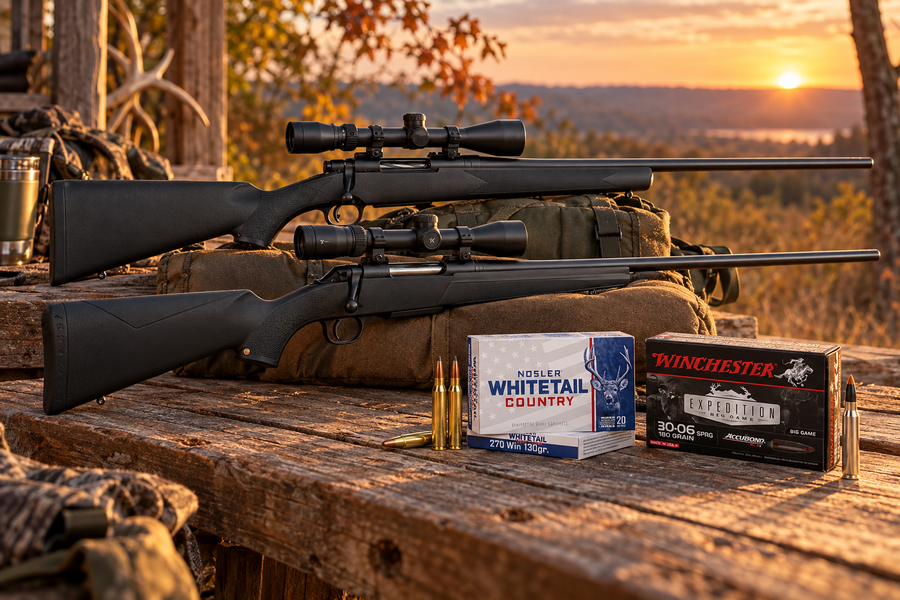
The .270 Winchester is best known for combining relatively high velocity with common 130-, 140-, and 150-grain hunting bullets. That combination has helped build its reputation as a flat-shooting deer and general big-game cartridge while typically producing somewhat less recoil than representative .30-06 hunting loads fired from rifles of similar weight. Modern .270 ammunition also gives hunters a much wider selection of bullet constructions than the cartridge's traditional reputation might suggest, including bonded, monolithic, polymer-tipped, and conventional soft-point designs.
The .30-06 Springfield offers a broader range of commonly available factory bullet weights. Hunters routinely encounter 150-, 165-, and 180-grain loads, while manufacturers also offer heavier options for specialized applications. That flexibility gives the .30-06 an advantage for buyers who want one traditional hunting cartridge with a particularly deep ammunition catalog covering deer-sized game through larger North American big-game applications where the selected load is appropriate and lawful.
For a hunter primarily pursuing whitetail or mule deer and wanting somewhat less recoil in comparable rifles, the .270 Winchester remains an extremely compelling choice. For someone who values heavier factory bullets, a broader selection of ammunition, and maximum versatility from one traditional long-action cartridge, the .30-06 Springfield usually has the stronger argument.
Neither cartridge is automatically more accurate, and neither should be selected by reputation alone. Rifle fit, barrel quality, bullet construction, actual ammunition performance, recoil tolerance, hunting conditions, and applicable regulations all matter more than declaring one cartridge the winner in every situation.
Key Takeaways
- The .270 Winchester uses .277-inch bullets, while the .30-06 Springfield uses .308-inch bullets.
- Both cartridges belong to the same general .30-03/.30-06-length family and are normally chambered in long-action rifles.
- The .270 Winchester commonly uses 130-, 140-, and 150-grain hunting bullets and usually produces somewhat less recoil than representative .30-06 loads in comparable rifles.
- The .30-06 Springfield commonly uses 150-, 165-, and 180-grain bullets and offers an especially broad selection of heavier factory hunting loads.
- The .270 has a strong reputation for relatively flat trajectory, but actual trajectory depends on the specific bullet, ballistic coefficient, muzzle velocity, zero, and environmental conditions.
- The .30-06 generally offers greater factory-load flexibility, but heavier bullets are not automatically better for every animal or hunting situation.
- Neither cartridge has an inherent accuracy advantage. Individual rifles can show strong preferences for particular factory loads.
- Current rifle families from Winchester, Browning, and Tikka continue to support both cartridges, keeping them highly relevant in 2026.
Understanding the .270 Winchester and .30-06 Springfield
The .270 Winchester and .30-06 Springfield are often portrayed as very different hunting cartridges because their most familiar factory loads emphasize different bullet weights. Mechanically and historically, however, they are close relatives. Both use rimless bottleneck cases of similar overall length and are normally housed in the same general class of long-action sporting rifle.
The differences begin with bullet diameter and expand from there. The .270 Winchester uses a .277-inch projectile and is traditionally associated with lighter bullets driven at relatively high velocity. The .30-06 uses a .308-inch projectile and supports a much broader spread of commonly encountered hunting bullet weights, giving ammunition manufacturers more room to tailor loads around different game and performance goals.
Those distinctions influence recoil, trajectory, retained velocity, energy, bullet construction, and rifle behavior, but no single specification settles the comparison. Modern hunting ammunition has narrowed some of the old differences because manufacturers now offer highly aerodynamic, bonded, tipped, and monolithic projectiles in both cartridges.
A Small Historical Detail: The .270's Case Lineage
The .270 Winchester is commonly described as being based on the .30-06 Springfield case, and that shorthand is understandable because the cartridges share the same general family and many important dimensions. Historically, however, the lineage is slightly more nuanced. The .270 retains the longer 2.540-inch case length associated with the earlier .30-03, while the .30-06 case was shortened to approximately 2.494 inches during its 1906 redesign.
For a hunter buying a rifle today, this historical distinction changes very little. Both cartridges occupy the conventional long-action category, both use the same general .473-inch case-head family, and modern sporting rifles are designed around their respective chamber specifications. It is still useful to get the history right because the .270 is not literally just a modern .30-06 case with the neck squeezed down.
What Is the .270 Winchester?
Winchester introduced the .270 Winchester commercially in 1925 with the Model 54 bolt-action rifle. Its .277-inch bullet diameter was unusual for the time, and its combination of velocity and relatively streamlined hunting bullets gave the cartridge an early reputation for flat trajectory. Gun writer Jack O'Connor later became one of its most prominent advocates and helped cement the .270's identity as a classic North American hunting cartridge.
The cartridge became especially associated with deer hunting, mountain hunting, and open-country applications where hunters valued trajectory and manageable recoil. Over the following century, nearly every major hunting-rifle manufacturer offered some form of .270 Winchester, and ammunition companies developed loads ranging from conventional cup-and-core bullets to bonded and monolithic premium designs.
The cartridge is now over a century old, but it has not become obsolete. Modern projectiles have arguably made it more capable because today's bullets can provide aerodynamic performance and terminal characteristics that early .270 hunters could not obtain from 1920s ammunition.
Common .270 Winchester Bullet Weights
The classic .270 Winchester hunting load uses a 130-grain bullet. That weight remains widely available and is still closely associated with deer hunting because it combines relatively high muzzle velocity with useful sectional density and manageable recoil. Many traditional factory loads publish velocities around the 3,000-fps mark or slightly above depending on the ammunition and test barrel.
Modern hunters also have strong 140- and 150-grain options. Those heavier bullets can provide different ballistic coefficients, construction types, penetration characteristics, and downrange behavior. The increased bullet weight does not automatically make them better; the correct choice depends on the projectile design and the game for which the manufacturer recommends it.
Specialized .270 loads outside that traditional range also exist. The important point is that today's .270 ammunition market offers considerably more flexibility than the old stereotype of one 130-grain deer load might suggest.
What Is the .30-06 Springfield?
The .30-06 Springfield traces its military adoption to 1906 and went on to become one of the defining American centerfire cartridges of the twentieth century. After its military career helped establish enormous familiarity with the cartridge, the .30-06 became equally influential in the sporting world. Rifle manufacturers chambered it extensively, ammunition companies developed a huge variety of loads, and generations of hunters used it across a wide range of North American game.
The cartridge uses .308-inch bullets, which gives manufacturers access to one of the deepest projectile catalogs in the entire rifle market. That diversity is one of the .30-06's enduring strengths. A hunter can find relatively light traditional hunting loads, common mid-weight bullets, heavier big-game options, and modern premium projectiles without leaving the cartridge family.
Its age has not made it irrelevant either. Modern bullet design has improved the performance available from the cartridge, allowing current .30-06 ammunition to use aerodynamic tipped bullets, bonded constructions, copper projectiles, and other technologies that did not exist during most of the cartridge's early history.
Common .30-06 Springfield Bullet Weights
Common factory hunting ammunition frequently uses 150-, 165-, or 180-grain bullets. The 150-grain category is especially familiar for deer hunting, while 165-grain loads occupy a useful middle ground and 180-grain bullets remain strongly associated with larger-game applications. Factory offerings above 180 grains are also available from selected manufacturers.
This broad weight range is one of the most practical differences between the cartridges. A hunter who wants to stay with one chambering while choosing among several projectile weights and constructions will usually find a deeper menu in .30-06 than in .270 Winchester.
That advantage should still be interpreted carefully. A 180- or 200-grain bullet is not automatically more effective than a lighter projectile simply because it weighs more. Expansion characteristics, penetration, impact velocity, shot placement, and manufacturer recommendations remain central to hunting performance.
.270 Winchester vs. .30-06 Springfield Specifications
| Specification | .270 Winchester | .30-06 Springfield |
|---|---|---|
| Commercial / Military Introduction | 1925 commercial introduction | 1906 U.S. military adoption |
| Bullet Diameter | .277 inch | .308 inch |
| Case Family | .30-03 / .30-06 family | .30-03-derived .30-06 family |
| Typical Action | Long action | Long action |
| Common Hunting Weights | 130, 140, 150 grains | 150, 165, 180 grains |
| Heavier Factory Options | Available but less common | Broad selection, including 200-grain-class options |
| Traditional Strength | Trajectory and moderate recoil | Versatility and bullet-weight range |
| Factory Ammunition Support | Extensive | Especially extensive |
| Traditional Hunting Role | Deer and general big game | Deer through broad big-game applications |
Representative Factory Hunting Loads
Cartridge comparisons become much more useful when actual ammunition is placed on the table. Comparing the word .270 with the words .30-06 says very little about trajectory or recoil because each cartridge can be loaded with several bullet weights and constructions.
The following examples represent familiar factory hunting categories rather than every product currently available. Manufacturer-published muzzle velocity should always be treated as a reference because an individual hunting rifle can produce a different velocity depending on barrel length, chamber dimensions, ammunition lot, temperature, and other variables.
| Cartridge | Representative Factory Load | Bullet Weight | Advertised Muzzle Velocity |
|---|---|---|---|
| .270 Winchester | Federal Power-Shok Soft Point | 130 grains | Approx. 3,060 fps |
| .270 Winchester | Hornady American Whitetail InterLock | 130 grains | Approx. 3,060 fps |
| .30-06 Springfield | Federal 150-grain hunting-class load | 150 grains | Approx. 2,900 fps class |
| .30-06 Springfield | Hornady American Whitetail InterLock | 165 grains | Approx. 2,800 fps class |
These figures show why the .270 developed its flat-shooting reputation. A conventional 130-grain bullet leaving around 3,060 fps starts quickly and can produce a useful hunting trajectory. The .30-06 trades some of that velocity when firing heavier common bullets but gains additional projectile-mass options and an exceptionally broad factory catalog.
2026 Ammunition Has Made Both Cartridges More Modern

Neither cartridge should be judged only by old soft-point ammunition. Hornady expanded its American Whitetail family for 2026 with American Whitetail Tipped loads using SST projectiles, including a 130-grain .270 Winchester and a 165-grain .30-06 Springfield. That is a useful illustration of how ammunition companies continue applying newer bullet designs to cartridges that are roughly a century old.
Federal, Hornady, Nosler, Barnes, Remington, Winchester, and other manufacturers also offer multiple hunting bullet constructions across these chamberings. Hunters can choose among conventional lead-core soft points, bonded bullets, monolithic copper bullets, polymer-tipped designs, and other purpose-built projectiles depending on the application.
That evolution matters because a modern bullet can change the practical comparison considerably. The old assumption that cartridge choice alone determines penetration, expansion, or effective range is much less useful than comparing the exact loads being considered.
Which Cartridge Shoots Flatter?
The .270 Winchester generally retains the easier claim to a flatter trajectory when comparing traditional mainstream hunting loads. A 130-grain .270 starting around 3,060 fps will commonly require less elevation correction over ordinary hunting distances than a heavier conventional .30-06 load with a lower muzzle velocity and similar aerodynamic efficiency.
That advantage is real, but it is not universal. A projectile's ballistic coefficient affects how quickly it loses velocity, and modern aerodynamic .30-caliber hunting bullets can narrow the gap. Zero distance, sight height, atmospheric conditions, and the specific load also affect the trajectory the hunter actually sees.
The practical conclusion is that .270 Winchester has a strong traditional trajectory advantage, but hunters should use the ballistic table for the exact ammunition in their rifle rather than memorize a generic number from a cartridge comparison.
Why Muzzle Velocity Alone Does Not Set Trajectory
Muzzle velocity describes only what happens at the beginning of the bullet's flight. Once the projectile leaves the barrel, aerodynamic drag determines how quickly it loses velocity, while gravity continually pulls it downward. Two projectiles leaving at different speeds can therefore produce a closer downrange comparison than the muzzle numbers initially suggest if the slower projectile retains velocity more effectively.
Ballistic coefficient is one tool used to describe that aerodynamic efficiency. Higher-BC hunting bullets generally retain velocity better and experience less wind drift than less efficient projectiles under comparable conditions. Bullet shape, mass distribution, nose profile, boat-tail design, and actual velocity all contribute.
This is why a modern tipped .30-06 hunting load can behave very differently from an old round-nose or basic flat-base load even when both boxes carry the same cartridge designation.
Which Cartridge Handles Wind Better?
There is no automatic answer because wind drift depends heavily on the individual projectile. A high-BC .270 bullet can outperform a less aerodynamic .30-caliber projectile, while a modern high-BC .30-06 bullet may compare much more favorably against a traditional .270 soft point.
At ordinary woodland deer distances, the difference may be too small to dominate the hunting decision. At longer distances in exposed terrain, projectile choice, verified muzzle velocity, and an accurate ballistic solution become much more important.
Hunters should resist converting the general statement that the .270 is flat shooting into the much broader claim that every .270 load handles wind better than every .30-06 load. Those are different questions.
Which Cartridge Has More Recoil?
The .30-06 Springfield generally produces more recoil when comparing rifles of similar weight firing representative hunting ammunition. It commonly launches a heavier bullet and often uses a greater total momentum combination of projectile and propellant gases, which increases the rearward momentum that the rifle must manage.
A traditional 130-grain .270 load will normally feel softer than a 180-grain .30-06 load from otherwise comparable rifles. A comparison between a 150-grain .270 and a relatively light .30-06 load may be closer, which is another reason cartridge names alone do not provide a complete recoil comparison.
For hunters who are sensitive to recoil or who want to practice extensively from field positions, the .270's somewhat milder behavior can be a meaningful advantage. Reduced recoil can make it easier to maintain good shooting habits, especially in lightweight rifles.
Rifle Weight Can Change the Recoil Comparison
The cartridge is only half of the recoil equation. A lightweight mountain rifle chambered in .270 Winchester can feel surprisingly lively, while a heavier .30-06 with a well-designed stock and recoil pad may be more comfortable than expected. Rifle mass, stock geometry, recoil-pad design, shooting position, and the shooter's build all influence felt recoil.
This becomes especially relevant because both cartridges are offered in very light hunting rifles. Saving a pound during a long day in the mountains is valuable, but that lost weight becomes noticeable every time the rifle is fired from a bench during sight-in or practice.
Hunters should therefore compare the complete rifle rather than assuming the .270 will always be soft or the .30-06 will always be punishing.
Recoil Tolerance Matters More Than Pride
A hunter who shoots a .270 confidently and practices regularly is better equipped than someone who buys a harder-recoiling rifle for theoretical capability and then avoids practicing with it. Recoil-induced anticipation can degrade trigger control and field accuracy, which can erase any ballistic advantage the larger cartridge supposedly provides.
This is especially important for newer hunters and lighter-framed shooters. Cartridge selection should support good marksmanship rather than becoming a test of how much recoil someone is willing to tolerate.
Which Cartridge Produces More Muzzle Energy?
The .30-06 often produces greater muzzle-energy figures when common heavier hunting bullets are compared with typical .270 loads. That is unsurprising because kinetic-energy calculations strongly reflect both projectile mass and velocity. A 180-grain .30-caliber projectile launched at a useful hunting velocity carries substantial energy at the muzzle.
Energy alone should not be treated as a terminal-performance score. A bullet needs to behave appropriately when it reaches the animal. Expansion, penetration, retained weight, impact velocity, projectile construction, and shot placement all matter, and two bullets with similar energy figures can perform very differently.
Muzzle energy is therefore useful as one piece of the comparison, but hunters should place far more emphasis on using a projectile designed for the intended game and impact conditions.
Sectional Density and Bullet Construction
Bullet diameter and weight also influence sectional density, which describes projectile weight relative to diameter. Historically, hunters have used sectional density as one tool for discussing penetration potential, but modern bullet construction complicates simple comparisons because bonded cores and monolithic copper bullets can behave differently from traditional cup-and-core bullets of similar weight.
A lighter premium bullet can sometimes retain more weight and penetrate more predictably than a heavier conventional projectile that loses a substantial portion of its mass. That does not mean lighter is always better either. It means projectile design needs to be considered alongside weight.
This is particularly relevant when comparing .270 and .30-06 for larger game. The heavier bullet selection of the .30-06 is an advantage, but the exact bullet construction still determines whether a particular factory load is appropriate.
Do Both Cartridges Use Long Actions?
Yes. In conventional modern bolt-action rifles, both .270 Winchester and .30-06 Springfield are generally treated as long-action cartridges. Their overall cartridge lengths are similar enough that choosing one over the other normally does not provide a meaningful receiver-length advantage.
This distinguishes both cartridges from .308 Winchester, 6.5 Creedmoor, and other familiar cartridges commonly housed in shorter action families. However, action category still does not tell the hunter how heavy or compact the complete rifle will be.
A lightweight long-action rifle can easily weigh less than a heavy short-action precision rifle. Barrel contour, stock material, bottom metal, magazine design, and optics frequently have more influence on final carry weight than a small difference in receiver length.
Are .270 Winchester and .30-06 Interchangeable?
No. The cartridges are not interchangeable and must never be treated as though their shared family history makes them compatible. They use different bullet diameters, different chamber dimensions, and different cartridge specifications.
A firearm should only be fired with the exact ammunition designated by its manufacturer. Hunters who own rifles chambered for both cartridges should check the barrel marking and ammunition box carefully, especially when loading equipment in low light or preparing multiple rifles for the same trip.
Which Cartridge Has Better Ammunition Availability?
Both cartridges benefit from excellent commercial support, but the .30-06 Springfield generally has the broader overall catalog. Its enormous historical user base and .308-inch projectile diameter give ammunition companies a large range of traditional and modern hunting configurations to work with.
The .270 Winchester is hardly difficult to feed. Common 130-, 140-, and 150-grain hunting loads remain widely produced, and major ammunition manufacturers continue introducing updated products in the chambering. A hunter using mainstream ammunition is unlikely to view either cartridge as niche.
Local availability still matters. A cartridge with a huge national catalog may not help much if the stores near a particular hunting area stock only one load. Hunters who rely heavily on local retailers should check what is actually available before buying a rifle.
Which Cartridge Is Cheaper to Shoot?
There is no permanent price winner. Ammunition cost changes with manufacturer, bullet construction, packaging, retailer, seasonal demand, and promotional pricing. Both cartridges are sold in relatively affordable traditional hunting lines as well as expensive premium ammunition.
The .30-06's larger product catalog may create more opportunities to find several price tiers, but that does not guarantee that a comparable .30-06 load will always cost less than .270 Winchester. The only useful price comparison is between current products of similar quality and intended use.
Hunters should also include practice in the equation. If one cartridge encourages substantially more range time because recoil is more comfortable or ammunition is easier to find locally, that can matter more than a small difference in per-box price.
.270 Winchester vs. .30-06 for Whitetail Deer

Both cartridges are more than capable of serving as whitetail hunting cartridges when loaded with appropriate ammunition. The .270 Winchester has a particularly strong reputation in this role because traditional 130- and 150-grain hunting bullets provide a useful balance of trajectory, recoil, and terminal performance.
The .30-06 is equally established in deer camps. Common 150- and 165-grain loads give hunters a deep selection of conventional and premium projectile designs, while the broad ammunition market makes it relatively easy to test several factory loads in one rifle.
For whitetail hunting alone, the decision rarely needs to be made on raw cartridge capability. The .270 may be more appealing to a hunter who prefers lighter recoil, while the .30-06 may appeal to someone who wants the same rifle to cover additional larger-game applications with heavier factory ammunition.
Woodland Deer Hunting
In thick woods where shots are relatively close, the famous trajectory difference matters less than it does in open country. At those distances, reliable bullet performance, rifle handling, sight picture, and the shooter's ability to place the shot become more important than a few inches of theoretical trajectory difference hundreds of yards away.
A short, well-balanced hunting rifle chambered in either cartridge can therefore make excellent sense in woodland conditions. The rifle may influence the experience more than the chambering.
Open-Country Whitetail Hunting
In agricultural country or other more open terrain, the .270's traditional trajectory advantage becomes easier to appreciate. A hunter using a properly zeroed 130-grain load may have a relatively forgiving trajectory across common field distances, reducing the amount of elevation correction required compared with some heavier conventional .30-06 loads.
That should not encourage hunters to extend beyond distances at which they can reliably place shots. Flat trajectory simplifies part of the ballistic problem; it does not remove wind, range estimation, target movement, field-position stability, or the shooter's limitations.
.270 Winchester vs. .30-06 for Mule Deer

Both cartridges are established mule deer choices. The .270's combination of moderate recoil and relatively flat trajectory fits naturally with the longer sight lines encountered in some western terrain, which helps explain its historical popularity among mountain and open-country hunters.
The .30-06 remains equally capable when paired with an appropriate modern hunting load. High-BC .30-caliber projectiles can provide excellent retained velocity and wind performance, and a hunter who already shoots a .30-06 confidently gains little by changing cartridges solely because mule deer are involved.
Terrain should influence equipment selection, but it should not become a substitute for comparing real ammunition. Hunters should look at the actual ballistic performance of the factory load they intend to carry.
.270 Winchester vs. .30-06 for Elk

Both cartridges have long histories of elk hunting where their use is lawful. The .30-06 often receives the advantage in this comparison because its factory ammunition catalog contains a particularly strong selection of 180-grain and other heavier hunting bullets. Those loads give hunters more choices when they want a projectile designed around penetration and larger-game performance.
The .270 Winchester is also supported by factory ammunition intended for elk and other big-game applications. Modern bonded and monolithic projectiles have expanded what hunters can expect from .277-inch bullets compared with early twentieth-century ammunition.
The deciding factor should be the complete load, not the name on the case head. Hunters should use ammunition the manufacturer recommends for the intended game, confirm their rifle's performance with that load, and follow local hunting regulations.
Does the .30-06 Automatically Win for Larger Game?
The broader heavy-bullet selection gives the .30-06 a legitimate practical advantage when larger game is the priority, but automatically declaring it superior ignores projectile technology. A premium .270 bullet engineered for controlled expansion and deep penetration may be a much better choice than a poorly matched .30-06 projectile selected only because it is heavier.
The .30-06's advantage is therefore best described as flexibility rather than guaranteed effectiveness. It gives the buyer more factory choices at the heavier end of the spectrum, which can make it easier to tailor one rifle to several hunting applications.
Which Is Better for One-Rifle Hunting?
If the goal is one conventional bolt-action hunting rifle for a broad range of North American big-game applications, the .30-06 Springfield remains exceptionally difficult to dismiss. Its ammunition catalog spans several common bullet weights and nearly every major hunting-bullet construction, making it easy to tailor the rifle to different needs without changing chamberings.
The .270 Winchester can also function extremely well as a one-rifle choice for many hunters, especially when deer-sized game makes up most of the season. It generally asks the shooter to accept a somewhat narrower bullet-weight range in exchange for milder recoil and the classic .270 trajectory profile.
The right answer depends heavily on what one-rifle actually means. A whitetail hunter who occasionally travels west has a different requirement from someone who routinely hunts several larger species.
Which Is Better for a First Hunting Rifle?
Both are legitimate first centerfire hunting cartridges, but the .270 Winchester may have a slight advantage for a recoil-conscious new hunter. Lower recoil can make practice more comfortable and reduce the chance that the shooter begins anticipating the shot.
The .30-06 has the advantage for someone specifically seeking one cartridge with maximum factory-load variety. Its large ammunition ecosystem can make it easier to experiment with different bullet weights as the hunter gains experience and expands into other game.
Rifle fit remains more important than the cartridge label. A poorly fitting lightweight .270 can be harder to shoot well than a heavier, well-fitted .30-06 with a quality recoil pad.
Which Is Better for a Youth or Recoil-Sensitive Hunter?
Neither cartridge would automatically be the first recommendation for every new or smaller-framed hunter because several lower-recoiling centerfire options exist. If the decision is specifically between these two, the .270 Winchester normally receives the advantage.
That advantage becomes more meaningful when the rifle fits properly and the ammunition uses a conventional hunting weight rather than an unusually heavy load. Recoil management should be considered before the hunt, not discovered after developing a flinch during sight-in.
Does One Cartridge Have Better Accuracy?
No inherent accuracy advantage belongs to either cartridge. A well-manufactured .30-06 can produce excellent groups, and a well-manufactured .270 can do the same. Barrel quality, chamber geometry, ammunition consistency, bedding or stock design, optic mounting, and shooter technique all matter more than the difference in bullet diameter.
Individual rifles also display ammunition preferences. One .270 may group extremely well with a conventional 130-grain soft point and dislike a premium load. Another rifle from the same manufacturer may behave differently.
The correct approach is to test several suitable hunting loads and select one that combines reliable function, good groups, appropriate terminal design, and acceptable recoil.
Why Ammunition Testing Matters Before Hunting
A hunter should never assume that a highly regarded factory load will automatically shoot to the same point of impact as another load. Changing bullet weight or construction can shift zero, and switching manufacturers can produce another change even when the bullet weights match.
The hunting load should therefore be tested from the actual rifle before the season. The shooter should confirm zero, verify consistent groups from realistic positions, and understand the trajectory well enough to use the rifle responsibly within their personal distance limit.
Modern Factory Rifle Options
One reason this cartridge comparison remains relevant is that major manufacturers still chamber current hunting rifles in both .270 Winchester and .30-06 Springfield. These are not legacy cartridges surviving only in used gun racks.
Winchester's Model 70 family, Browning's X-Bolt 2 lineup, and Tikka's T3x hunting rifles all continue to support the two chamberings in current or recent production configurations. That allows a hunter to compare similar rifle families without changing the basic style of rifle simply because of cartridge selection.
Winchester Model 70

The Model 70 has one of the strongest historical connections to both cartridges. Current Model 70 production continues the familiar controlled-round-feed action, three-position safety, and M.O.A. Trigger system, while individual configurations range from traditional walnut rifles to specialized hunting versions.
For 2026, the Model 70 family continues to include .270 Winchester and .30-06 Springfield chamberings, including current hunting-oriented configurations. This makes the Model 70 a particularly clean platform for comparing the cartridges because the shooter can evaluate them within essentially the same rifle architecture.
The exact specifications still need to be checked by model. Barrel length, stock material, weight, capacity, and finish differ across the Model 70 catalog.
Browning X-Bolt 2

Browning's X-Bolt 2 family provides another modern comparison. The current X-Bolt 2 Speed is offered in both .270 Winchester and .30-06 Springfield, allowing hunters to choose between the cartridges while keeping the same basic receiver family, Vari-Tech stock system, redesigned bolt, and DLX trigger architecture.
This is useful because it isolates the cartridge decision more effectively than comparing two completely different rifles. A hunter who likes the X-Bolt 2 can focus on recoil, bullet selection, ammunition availability, and intended game rather than letting unrelated stock and trigger differences dominate the choice.
Tikka T3x Lite and Lite Roughtech

Tikka's current T3x Lite family also supports both cartridges. The current T3x Lite Roughtech lists .270 Winchester and .30-06 Springfield among its chambering options, while the broader T3x Lite family has long supported both.
Tikka emphasizes lightweight hunting construction, making these rifles an interesting recoil comparison. Reducing carry weight is valuable on long hunts, but the same light rifle can make a .30-06 feel more energetic during practice than a heavier sporting rifle.
That tradeoff illustrates why a cartridge comparison should always be attached to a real rifle. Recoil, balance, and portability do not exist independently from firearm weight.
Current Rifle Comparison
| Rifle Family | .270 Winchester | .30-06 Springfield | Primary Buying Consideration |
|---|---|---|---|
| Winchester Model 70 | Available in selected current configurations | Available in selected current configurations | Traditional controlled-round-feed hunting platform |
| Browning X-Bolt 2 | Available | Available | Modern adjustable hunting-rifle platform |
| Tikka T3x Lite / Roughtech | Available | Available | Lightweight hunting emphasis |
Exact SKU availability can change by year, region, and distributor. Hunters should verify the specific configuration before choosing a rifle based on one chambering listed elsewhere in the same product family.
What About Barrel Length?
Both cartridges are commonly encountered with hunting barrels around 22 to 24 inches, although shorter and longer configurations exist. A shorter barrel can reduce overall rifle length and weight but may also produce less muzzle velocity than the manufacturer's published test-barrel figure.
That matters when comparing ammunition. A velocity printed on the box may have been obtained from a 24-inch SAAMI-specification test barrel, while a lightweight hunting rifle with a shorter barrel can chronograph lower.
This does not make the shorter rifle ineffective. It simply means the hunter should verify actual velocity if precise long-range ballistic data matters.
Suppressor-Ready Hunting Rifles Change the Barrel-Length Equation
Modern hunting rifles increasingly use shorter threaded barrels intended to remain manageable after a suppressor is installed. This trend can affect both cartridges because a compact .270 or .30-06 may trade some velocity for a shorter complete suppressed package.
Hunters considering that configuration should evaluate the actual rifle and ammunition combination rather than importing trajectory numbers from a conventional 24-inch test barrel. Suppressor compatibility, hunting regulations, and applicable federal and state law should also be verified independently.
.270 Winchester Strengths
The .270 Winchester's primary strengths are its manageable balance of recoil, velocity, trajectory, and established hunting performance. For deer-focused hunters, it provides more capability than many will ever need while remaining comfortable enough for substantial practice in a properly fitted rifle.
Its long market history also means rifle and ammunition support are excellent. The cartridge is old enough to be proven yet popular enough that manufacturers continue developing new loads for it instead of treating it as a historical curiosity.
.270 Winchester Tradeoffs
The main limitation compared with .30-06 is the narrower range of commonly stocked heavy hunting bullets. The cartridge can certainly be used beyond deer-sized game with appropriately designed ammunition, but the .30-06 gives hunters more factory choices when they specifically want heavier projectiles.
Its flat-shooting reputation can also create unrealistic expectations. The .270 is not immune to wind or gravity, and modern rangefinders and ballistic calculators do not eliminate the need to know actual rifle performance.
.30-06 Springfield Strengths
The .30-06's greatest strength is versatility. Few traditional hunting cartridges offer a factory ammunition catalog spanning such a broad range of bullet weights and constructions while remaining available from so many rifle manufacturers.
That flexibility makes the cartridge particularly attractive to hunters who want one rifle chambering for several types of big-game hunting. The .30-06 may not be the newest or fastest solution in any one category, but it remains remarkably difficult to make irrelevant.
.30-06 Springfield Tradeoffs
The principal tradeoff is recoil. When representative loads are compared in similarly weighted rifles, the .30-06 generally asks the shooter to manage more rearward energy than the .270, especially with heavier 180- or 200-grain ammunition.
The cartridge's huge ammunition catalog can also encourage buyers to overthink bullet weight. Heavier is not automatically better, and selecting a 180-grain bullet for ordinary deer hunting simply because the cartridge can fire it may not provide any meaningful advantage over a suitable 150- or 165-grain design.
Which Is Better for a Lightweight Mountain Rifle?
The .270 Winchester generally makes a particularly strong case in a lightweight rifle because its somewhat milder recoil helps offset the increased felt recoil associated with reducing firearm mass. Its traditional trajectory characteristics also fit naturally with open-country and mountain hunting where longer sight lines can occur.
A lightweight .30-06 can still make excellent sense for someone who already shoots the cartridge well and values heavier bullet options. The hunter should simply be realistic about how the rifle feels during sight-in and practice rather than choosing the lightest catalog weight automatically.
Which Is Better for Hunters Who Practice a Lot?
The answer often favors whichever cartridge the hunter finds more comfortable and affordable. High practice volume builds familiarity with the rifle, improves field-position shooting, and gives the hunter more opportunities to verify ammunition performance.
If the .270's lower recoil encourages twice as much practice, that can be a much larger practical advantage than the .30-06's heavier projectile selection. If .30-06 ammunition is substantially easier to obtain locally and the shooter handles the recoil comfortably, the equation can reverse.
Which Is Better for Handloading?
Both cartridges have deep handloading histories and extensive component support, but handloading introduces additional technical and safety requirements beyond the scope of a basic factory-ammunition comparison. The .30-06 benefits from the enormous .308-inch projectile market, while the .270 has a mature selection of .277-inch hunting bullets.
Anyone who handloads should use current published data from reputable component manufacturers and follow established reloading safety practices. Historical loads, internet recipes, and assumptions about case similarity should never replace current published data.
Which Cartridge Is Better in 2026?
The answer has not changed as dramatically as the age of these cartridges might suggest. Modern rifles and bullets have improved around them, but the underlying personalities remain recognizable. The .270 still emphasizes manageable recoil and a flat traditional hunting trajectory, while the .30-06 still emphasizes flexibility and a broad weight range.
The difference is that today's hunter can access better projectiles, better optics, more accurate rangefinders, improved factory rifles, and much more detailed ballistic information than hunters of previous generations had. Those technologies reduce the need to make the decision according to old campfire stereotypes.
Quick Hunting Decision Guide
| Buyer Priority | Cartridge Worth Considering | Why |
|---|---|---|
| Whitetail deer | Either | Both have deep factory ammunition support and long hunting histories |
| Mule deer | Either | Both are capable with appropriate modern hunting loads |
| Somewhat milder recoil | .270 Winchester | Generally less recoil with representative loads in comparable rifles |
| Traditional flat trajectory | .270 Winchester | Common 130-grain loads combine high velocity with useful hunting ballistics |
| Broadest common bullet-weight selection | .30-06 Springfield | Strong factory support from 150 grains through heavier hunting options |
| Elk-oriented factory flexibility | .30-06 Springfield | Especially broad selection of 180-grain and other heavier loads |
| Lightweight mountain rifle | .270 Winchester | Lower recoil can pair well with reduced rifle weight |
| One traditional rifle for varied big game | .30-06 Springfield | Exceptionally broad factory ammunition catalog |
| Widely supported classic hunting cartridge | Either | Both remain mainstream rifle and ammunition chamberings |
Which Should You Buy?
Choose the .270 Winchester if most of your hunting centers on deer-sized game, you appreciate its traditional flat-shooting characteristics, and you would benefit from somewhat less recoil in a comparable rifle. It is especially attractive for hunters who practice regularly and want a cartridge that remains comfortable in lighter sporting rifles without giving up serious hunting capability.
Choose the .30-06 Springfield if you value maximum flexibility in factory ammunition and want easy access to a broad range of common bullet weights. It is particularly attractive to hunters who expect one rifle to cover deer hunting along with larger-game applications where heavier purpose-built factory loads may be desirable.
If both rifles fit equally well and both cartridges are readily available locally, there is no bad choice. The decision becomes one of preference and intended use rather than basic adequacy.
Final Thoughts
The .270 Winchester and .30-06 Springfield have survived roughly a century of cartridge development because they still solve real hunting problems well. Newer cartridges can outperform them in individual measurements, but neither classic has become difficult to feed, difficult to chamber in a modern rifle, or incapable of benefiting from current projectile technology.
The .270 Winchester remains particularly compelling for hunters who want a traditional long-action cartridge with relatively mild recoil and useful trajectory. Common 130-, 140-, and 150-grain hunting loads cover a broad range of deer and general big-game applications, while modern bonded, monolithic, and tipped bullets expand the options far beyond the ammunition available during the cartridge's early decades.
The .30-06 Springfield remains one of the most flexible hunting cartridges ever commercialized. Its unusually broad factory ammunition selection gives hunters access to familiar 150-, 165-, and 180-grain loads plus additional heavier choices, allowing one chambering to serve several sporting roles without requiring unusual ammunition or a niche rifle platform.
That does not mean the .30-06 automatically wins because it can fire heavier bullets. A hunter who primarily pursues whitetail and mule deer may gain very little from additional projectile weight while accepting more recoil during every practice session. Likewise, a hunter who routinely values heavier big-game loads may find the .270's trajectory advantage less important than the .30-06's ammunition flexibility.
The rifle itself should remain part of the decision. A well-fitting .270 that a hunter practices with regularly is more useful than a poorly fitting .30-06 selected because of reputation. A balanced, comfortable .30-06 that the owner shoots confidently can likewise be a better hunting tool than a lighter-recoiling cartridge in a rifle that simply does not fit.
Current factory support also makes the choice easier than it might appear. Winchester continues to build Model 70 configurations around both cartridges, Browning offers both in the X-Bolt 2 family, and Tikka continues chambering T3x hunting rifles for each. Ammunition manufacturers are still developing new hunting loads as well, including updated 2026 products rather than allowing these cartridges to survive only on legacy ammunition.
For a deer-focused hunter who values manageable recoil and a straightforward trajectory, the .270 Winchester remains difficult to improve upon.
For a hunter who wants one classic long-action cartridge with the broadest practical selection of common hunting bullet weights, the .30-06 Springfield still earns its reputation.
The better choice is ultimately the one that fits the hunter, the rifle, the ammunition, and the game rather than the one that wins the argument around the campfire.
Choosing between the .270 Winchester and .30-06 Springfield ultimately comes down to personal preference, hunting conditions, and the characteristics a hunter values most. The .270 remains an excellent choice for hunters who appreciate its trajectory and recoil characteristics, while the .30-06 offers exceptional versatility for those who hunt multiple species or prefer a broader selection of bullet weights. For whitetail hunting, both cartridges are proven performers. Readers still evaluating the complete firearm can explore our comparison of whitetail hunting rifle options for a broader perspective on rifle selection.

Norma Whitetail 270 Winchester 130 Grain Jacketed Soft Point
$32.80
at Pro Armory
Prices accurate at time of writing
Frequently Asked Questions
Is .270 Winchester or .30-06 Springfield better for deer hunting?
Both are excellent deer cartridges with extensive factory ammunition support. The .270 Winchester generally produces somewhat less recoil and is strongly associated with flat-shooting 130- and 150-grain deer loads. The .30-06 provides a broader range of common bullet weights and can be especially attractive for a hunter who wants the same rifle chambering to serve additional big-game roles.
Does .30-06 Springfield recoil more than .270 Winchester?
Generally, yes. When rifles of similar weight are compared using representative hunting loads, the .30-06 typically produces more recoil because it commonly launches heavier bullets. Actual felt recoil also depends on rifle weight, stock geometry, recoil pad, shooting position, and the specific ammunition.
Is .270 Winchester flatter shooting than .30-06 Springfield?
The .270 Winchester generally has the flatter traditional trajectory when comparing common 130-grain .270 loads against heavier conventional .30-06 hunting loads. The exact difference depends on muzzle velocity, ballistic coefficient, zero distance, sight height, and environmental conditions, so the ballistic tables for the specific factory loads should be compared.
Which cartridge has more power?
The .30-06 often produces greater muzzle-energy figures with its heavier common hunting bullets, but energy alone does not determine hunting effectiveness. Projectile construction, penetration, expansion, retained weight, impact velocity, and shot placement are all critical parts of terminal performance.
Can you hunt elk with a .270 Winchester?
The .270 Winchester has an established elk-hunting history where its use is lawful. Hunters should select factory ammunition specifically appropriate for the intended game, verify the manufacturer's recommendations, understand the impact-velocity limitations of the bullet, and comply with local regulations.
Is .30-06 better for elk?
The .30-06 has a practical advantage in factory ammunition selection because hunters can choose among numerous 180-grain and other heavier big-game loads. That does not mean every .30-06 load is automatically better than every .270 load. Bullet construction and actual performance remain essential.
Which is better for whitetail deer?
Either cartridge provides more than enough capability when paired with appropriate hunting ammunition. The .270 may appeal to someone who values somewhat less recoil, while the .30-06 may appeal to someone wanting broader factory bullet-weight options.
Which is better for mule deer?
Both are established mule-deer cartridges. The .270's traditional high-velocity loads are well suited to open-country hunting, while modern .30-06 loads can also provide excellent external ballistics. Rifle fit, ammunition performance, and shooter familiarity matter more than the cartridge name alone.
Which cartridge has better ammunition availability?
Both are widely supported. The .30-06 Springfield generally offers the larger total selection of factory bullet weights and product lines, but common .270 Winchester hunting ammunition remains easy to find in many markets.
Which cartridge is cheaper to shoot?
There is no permanent winner because prices vary by retailer, manufacturer, bullet construction, and hunting season. Compare current ammunition of similar quality and intended use rather than assuming one cartridge is always cheaper.
Is .270 Winchester more accurate than .30-06?
No inherent accuracy advantage belongs to either cartridge. Barrel quality, chamber dimensions, rifle construction, ammunition consistency, optic setup, and shooter performance all influence accuracy.
Is .30-06 more accurate than .270 Winchester?
No. A particular .30-06 rifle may shoot better than a particular .270 rifle, but the cartridge designation itself does not establish greater mechanical accuracy.
Do .270 and .30-06 use the same action length?
They are normally chambered in conventional long-action rifles and occupy a similar overall cartridge-length category. Individual manufacturers can still use different receiver architectures, so action specifications should be verified by rifle model.
Can .270 Winchester ammunition be fired in a .30-06 rifle?
No. The cartridges are not interchangeable. Only ammunition specifically designated for the firearm's chambering should be used.
Can .30-06 ammunition be fired in a .270 rifle?
No. The cartridges use different bullet diameters and chamber specifications. Always verify both the rifle's chamber marking and the ammunition packaging before loading.
Is the .270 Winchester based on the .30-06?
The cartridges belong to the same general case family, but the history is slightly more nuanced than that shorthand suggests. The .270 retains the longer case length associated with the earlier .30-03 lineage, while the .30-06 case was shortened during its 1906 redesign. For modern hunting-rifle purposes, both are conventional long-action cartridges.
What bullet weight is best for .270 Winchester deer hunting?
Common factory deer loads use 130-, 140-, and 150-grain bullets. The best choice depends on projectile construction, rifle accuracy, impact conditions, and manufacturer recommendations rather than bullet weight alone.
What bullet weight is best for .30-06 deer hunting?
150- and 165-grain factory loads are especially common for deer, although other suitable options exist. Hunters should prioritize a projectile designed for deer hunting that performs accurately and reliably from their rifle.
Is a 180-grain .30-06 bullet too heavy for deer?
Not necessarily, but a 180-grain bullet is not automatically more effective simply because it is heavier. Many 150- and 165-grain hunting bullets are specifically designed for deer and may provide a different combination of trajectory, recoil, and terminal behavior.
Which cartridge is better in a lightweight rifle?
The .270 Winchester often has the advantage because its generally lower recoil can pair well with reduced rifle weight. A lightweight .30-06 can still be an excellent hunting rifle for shooters who are comfortable with the additional recoil.
Which is better as a first hunting cartridge?
Either can work well. The .270 Winchester may be easier for a recoil-sensitive beginner, while the .30-06 gives a new hunter a broader factory bullet-weight range for future applications. Rifle fit and the shooter's willingness to practice should be major parts of the choice.
Are .270 Winchester and .30-06 still worth buying in 2026?
Yes. Both continue to receive strong support from major rifle and ammunition manufacturers. Current hunting-rifle families such as the Winchester Model 70, Browning X-Bolt 2, and Tikka T3x remain available in these traditional chamberings, while ammunition manufacturers continue introducing updated bullet designs for them.
Which should I choose if I only want one hunting rifle?
The .30-06 Springfield has the stronger case for maximum factory-load versatility because of its unusually broad common bullet-weight selection. The .270 Winchester remains an excellent one-rifle choice for hunters whose primary focus is deer and similar game and who place a higher value on somewhat lighter recoil.
About the Author
The ProArmory editorial team includes experienced hunters, competitive shooters, military veterans, firearms instructors, and firearms industry professionals committed to producing accurate, practical, and research-based content. Our articles draw on manufacturer specifications, current industry information, and real-world shooting experience to help readers make informed decisions about firearms, ammunition, optics, and related equipment.
Disclaimer
This article is intended for educational and informational purposes only. Firearm specifications, ammunition ballistics, bullet construction, pricing, chambering availability, and product offerings can change over time. Manufacturer-published velocities are normally produced under controlled test conditions and may differ from results obtained from an individual sporting rifle.
Hunting suitability depends on projectile construction, game species, shot conditions, firearm performance, and applicable hunting regulations. Always verify that the selected ammunition is recommended for the intended application, confirm zero and function with the actual rifle before hunting, and follow established firearm-safety practices.
Only use ammunition specifically designated for the firearm's chambering. Hunters are responsible for complying with applicable federal, state, and local firearm and hunting regulations.


