


Quick Answer
The .243 Winchester and .25-06 Remington are both established centerfire hunting cartridges with long histories in American sporting rifles, but they solve the hunting-rifle problem in different ways. The .243 Winchester uses a shorter .308 Winchester-based case and .243-inch bullets, while the .25-06 Remington uses a necked-down .30-06 Springfield-length case and .257-inch bullets. Those dimensional differences influence common bullet weights, recoil, rifle action length, ammunition availability, and the types of factory rifles buyers are likely to encounter.
For most modern buyers, the .243 Winchester is the easier cartridge to own. It generally produces less recoil, is offered in a broader selection of current factory rifles, and benefits from a deeper ammunition market that includes lightweight varmint loads and heavier hunting ammunition. That combination makes it particularly attractive for new hunters, recoil-sensitive shooters, and anyone who wants one rifle capable of filling several sporting roles without depending on a narrow ammunition supply.
The .25-06 Remington takes a different approach. Its larger case commonly drives 100- to 120-grain hunting bullets at substantial velocities, giving it more muzzle energy than many comparable .243 hunting loads while retaining the relatively flat trajectory for which the cartridge has been known for decades. It remains an appealing deer and pronghorn cartridge for hunters who appreciate traditional long-action rifles and can reliably obtain suitable ammunition.
Neither cartridge is universally better. A .243 Winchester firing a properly constructed hunting bullet can be an excellent deer rifle where lawful, while a .25-06 Remington may provide a more appealing combination of bullet weight, velocity, and retained energy for a hunter who accepts somewhat greater recoil and a smaller modern rifle-and-ammunition market. The better choice depends on the complete rifle, intended game, typical shooting distance, ammunition availability, and the shooter's recoil tolerance.
Key Takeaways
- The .243 Winchester uses .243-inch bullets and a .308 Winchester-family case, while the .25-06 Remington uses .257-inch bullets and a .30-06 Springfield-length case.
- The .243 Winchester is generally associated with short-action rifles, while .25-06 Remington commonly uses long-action designs, although individual manufacturers sometimes use shared receiver architectures.
- Representative .243 hunting loads commonly use 90- to 100-grain bullets, while .25-06 hunting ammunition frequently uses bullets between roughly 100 and 120 grains.
- The .243 Winchester generally produces less recoil from rifles of comparable weight, making it easier for many shooters to practice with extensively.
- The .25-06 Remington typically produces more muzzle energy with common deer-oriented factory loads because it combines heavier bullets with substantial velocity.
- Trajectory cannot be ranked by cartridge name alone. Bullet ballistic coefficient and exact factory-load velocity determine which load is flatter at a particular distance.
- The .243 Winchester has the stronger contemporary factory-rifle and ammunition ecosystem, including new hunting ammunition introduced for 2026.
- The .25-06 remains a capable hunting cartridge, but buyers should confirm local ammunition availability and current rifle chamberings before committing to the platform.
Understanding the .243 Winchester and .25-06 Remington
The .243 Winchester and .25-06 Remington overlap enough in hunting applications that they are frequently compared, yet their design histories are quite different. Both are bottleneck centerfire rifle cartridges capable of producing relatively flat trajectories with appropriate ammunition, and both have been used extensively for deer, varmints, predators, and other sporting applications. The similarities become much less important once the case dimensions, projectile diameters, and common bullet weights are examined closely.
The .243 Winchester is fundamentally a short-action cartridge created from the .308 Winchester case family. The .25-06 Remington is based on the substantially longer .30-06 Springfield case and belongs to the traditional long-action family. Those different parent cases help explain why rifles chambered in the two cartridges can differ in receiver length, bolt travel, magazine dimensions, barrel specifications, and overall handling.
Neither architecture automatically produces a better hunting rifle. A lightweight long-action .25-06 can weigh less than a heavy short-action .243, and a compact .243 can carry a longer barrel than another manufacturer's .25-06. Cartridge design establishes certain mechanical requirements, but the complete rifle determines what the hunter actually carries into the field.
What Is the .243 Winchester?

Winchester introduced the .243 Winchester commercially in 1955. The cartridge was created by necking the .308 Winchester case down to accept .243-inch, or 6mm, bullets. That relatively compact case allowed manufacturers to chamber the cartridge in short-action rifles while giving hunters access to substantially lighter bullets and less recoil than the .308 Winchester parent cartridge.
The .243 quickly developed a reputation as a versatile sporting cartridge because its bullet selection could span lightweight varmint-oriented projectiles and considerably heavier hunting bullets. Modern factory ammunition continues that pattern, with loads ranging from fast, lightweight predator and varmint bullets to approximately 90- to 100-grain deer-oriented projectiles. Specialized bullet offerings can fall outside those ranges, so bullet construction and manufacturer application remain more important than weight alone.
Its continued popularity is also tied to rifle availability. The .243 Winchester has appeared in youth rifles, lightweight hunting rifles, traditional wood-stocked sporting rifles, inexpensive package rifles, and more specialized precision platforms. That broad representation gives buyers considerable freedom to choose a rifle around their physical size, budget, hunting style, and preferred optic rather than having to select from only a few chambering-specific models.
What Is the .25-06 Remington?

The .25-06 has roots stretching back to the early twentieth century, when experimenters began necking the .30-06 Springfield case down to accept .257-inch bullets. The concept remained a popular wildcat for decades before Remington standardized the cartridge commercially in 1969 as the .25-06 Remington. Its long case and relatively small bore allowed it to produce substantial velocity with bullets commonly used for hunting.
Factory ammunition has traditionally included bullet weights from roughly the mid-80-grain range through approximately 120 grains, although the modern hunting market is especially associated with 100- to 120-grain loads. These heavier common bullets distinguish the .25-06 from the .243 Winchester and contribute to the cartridge's higher muzzle-energy figures in many representative hunting comparisons. Projectile construction still matters more than weight by itself, particularly when evaluating terminal performance on game.
The .25-06 remains commercially supported, but its modern market is narrower. It is not difficult to recognize among experienced hunters, yet fewer new rifle models and fewer factory ammunition choices are typically available than with .243 Winchester, .308 Winchester, or 6.5 Creedmoor. For the hunter who already has reliable ammunition access, that limitation may matter very little; for a first-time rifle buyer who depends heavily on local retail availability, it deserves serious consideration.
.243 Winchester vs. .25-06 Remington: Core Specifications
| Specification | .243 Winchester | .25-06 Remington |
|---|---|---|
| Commercial Introduction | 1955 | 1969 |
| Parent Case | .308 Winchester | .30-06 Springfield |
| Bullet Diameter | .243 inch | .257 inch |
| Common Factory Bullet Range | Approx. 55–105 grains | Approx. 85–120 grains |
| Typical Action Category | Short action | Long action |
| Typical Sporting Role | Varmint, predator, deer and general hunting | Predator, deer, pronghorn and general hunting |
| Recoil Tendency | Generally milder | Generally greater |
| Modern Factory Ammo Selection | Broad | More limited |
| Modern Factory Rifle Selection | Broad | More selective |
This table describes broad market characteristics rather than universal engineering rules. Individual rifle manufacturers can use receiver architectures that do not fit neatly into the traditional short-action and long-action labels, and ammunition makers can introduce loads outside the most familiar bullet-weight ranges. Buyers should always evaluate the specific rifle and ammunition rather than using the cartridge category as a substitute for actual specifications.
Short Action vs. Long Action
The .243 Winchester is generally considered a short-action cartridge because it belongs to the .308 Winchester-length cartridge family. The .25-06 Remington normally requires a longer magazine and bolt travel because it is based on the .30-06 Springfield case. On manufacturers that build separate short- and long-action receivers, this can translate into a physically shorter receiver and bolt system for the .243.
Savage provides an excellent example of why the rule still needs qualification. Savage identifies post-2018 Model 110 rifles in cartridges such as .243 Winchester as short actions and .25-06 Remington as long actions, with different receiver lengths. The company's Axis family, however, uses the same receiver length across cartridge families and changes the magazine well and related stock geometry instead.
The practical lesson is that cartridge length and receiver length are related but not always identical concepts. Buyers comparing replacement stocks, scope bases, magazines, or chassis systems should verify the exact rifle model rather than simply ordering a part marked short action or long action. This becomes even more important when products from different manufacturers are being compared.
Does the Shorter .243 Action Make a Better Hunting Rifle?
Not automatically. A shorter receiver can save some weight and reduce bolt travel, but those differences are only part of the complete rifle. Barrel contour, barrel length, stock construction, scope, mount, magazine system, and recoil pad can outweigh the relatively small weight difference between receiver lengths.
A hunter carrying a seven-pound .25-06 may have an easier rifle to live with than someone carrying a nine-pound .243 precision rifle. Likewise, a short action does not automatically cycle more smoothly or shoot more accurately than a well-designed long action. The value of the shorter receiver is best viewed as a potential packaging advantage rather than a universal performance advantage.
Factory Bullet Weights: Where the Cartridges Separate
Bullet weight is one of the clearest differences between the cartridges. The .243 Winchester supports very light 6mm projectiles that can be driven at substantial velocities for varmint and predator applications, while still offering heavier hunting bullets around 90 to 100 grains. That broad range contributes heavily to the cartridge's reputation for versatility.
The .25-06 starts with a larger .257-inch bore and is commonly paired with heavier hunting bullets. Factory offerings around 100, 115, 117, and 120 grains have historically been especially relevant to deer and pronghorn hunters. The cartridge can also use lighter varmint-oriented bullets, but today's factory ammunition shelves generally emphasize its hunting role more strongly than the .243 market does.
Weight alone does not determine which cartridge is better for game. A properly designed 95-grain .243 hunting bullet can be more appropriate for a particular deer application than a heavier .25-caliber projectile designed primarily for another purpose. Construction, impact velocity, penetration, expansion, shot placement, and manufacturer recommendations remain part of the decision.
Representative Factory Ballistics

A useful comparison requires loads intended for broadly similar applications. Comparing an ultra-light .243 varmint bullet against a heavy .25-06 deer load will exaggerate some differences while hiding others. The table below uses representative Federal soft-point hunting data to show what happens when each cartridge is loaded with a traditional heavier hunting bullet.
| Cartridge | Representative Load | Bullet Weight | Published Muzzle Velocity | Published Muzzle Energy |
|---|---|---|---|---|
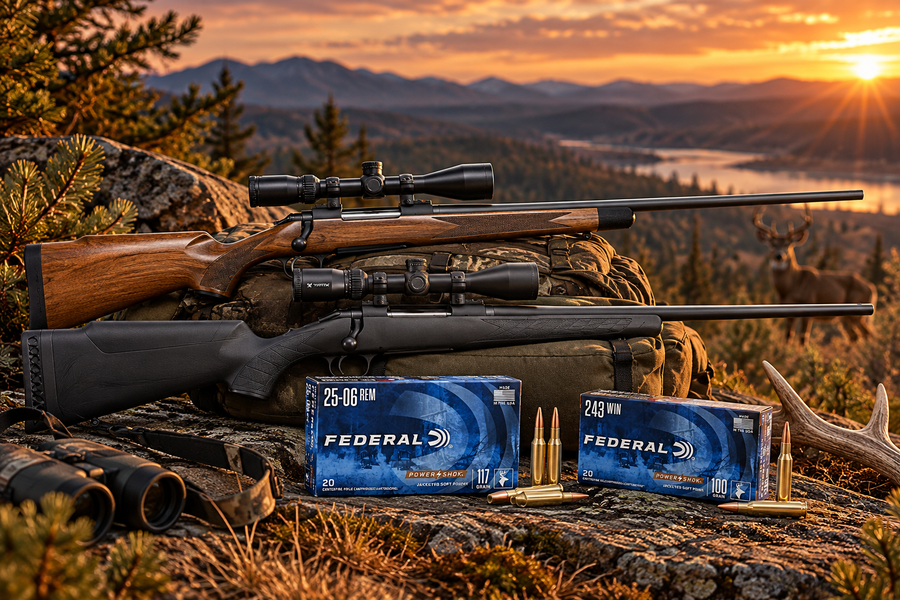
| .243 Winchester | Federal 100-grain soft point | 100 grains | 2,960 fps | Approx. 1,945 ft-lb |
| .25-06 Remington | Federal 117-grain soft point | 117 grains | 3,030 fps | Approx. 2,385 ft-lb |
The .25-06 produces the larger energy figure in this comparison because it launches a heavier bullet slightly faster. That difference is real, but it should not be turned into a universal statement that every .25-06 load is more effective than every .243 load. Hunters need to compare the exact projectile, impact conditions, intended game, and rifle rather than treating muzzle energy as a complete terminal-performance score.
Which Cartridge Is Faster?
There is no meaningful cartridge-wide answer because both are offered with substantially different bullet weights. A light .243 varmint bullet can reach velocities far beyond those of a heavy .25-06 deer load, while a .25-06 firing a 100-grain bullet can substantially outrun a .243 firing a conventional 100-grain hunting projectile. The comparison changes as soon as bullet weight and construction change.
This is why manufacturer ballistic tables are more useful than cartridge reputations. A hunter deciding between two actual rifles should compare the ammunition they genuinely intend to use. Muzzle velocity is only the starting point, because retained velocity, ballistic coefficient, wind drift, and terminal performance become more important as range increases.
Which Cartridge Shoots Flatter?
Both cartridges earned flat-shooting reputations long before modern rangefinding optics and ballistic applications became common. The .25-06 is particularly associated with high velocity from a traditional hunting case, while lightweight .243 ammunition can also produce exceptionally flat short- and medium-range trajectories. Neither cartridge, however, owns a universal trajectory advantage across every factory load.
Using Federal's representative 100-grain .243 and 117-grain .25-06 soft-point data, the .25-06 maintains a modest trajectory advantage at extended range because the heavier bullet begins slightly faster and retains velocity effectively. Change the .243 to a high-BC modern projectile and the comparison can move closer or change entirely. A trajectory claim therefore needs the exact load attached to it.
For hunters, this matters because most field shots do not involve comparing abstract cartridges. The actual decision is whether a specific rifle, zero distance, projectile, and verified ballistic solution give the shooter enough confidence to make an ethical shot at the intended distance. Flat trajectory can reduce range-estimation sensitivity, but it does not replace accurate range confirmation or knowledge of the rifle.
Wind Drift May Matter More Than Drop
Gravity acts predictably, which means bullet drop can be calculated and corrected when the distance is known. Wind is more difficult because its speed and direction may vary across the bullet's flight path. This makes ballistic coefficient and retained velocity particularly important when hunting in open country.
The .25-06 has access to heavier .257-caliber bullets capable of good retained velocity, while modern .243 ammunition can use streamlined 6mm bullets with excellent ballistic coefficients. The cartridge name again does not determine the winner by itself. A high-BC .243 hunting load can outperform an older, less aerodynamic .25-06 soft point in some conditions, while a modern .25-caliber projectile can reverse that relationship.
Which Cartridge Has More Recoil?
The .243 Winchester generally produces less recoil when compared with .25-06 rifles of similar weight firing representative hunting ammunition. The .25-06 burns more propellant and commonly launches a heavier bullet, so the rifle normally transfers more rearward momentum to the shooter. This difference can become especially noticeable when both cartridges are fired from lightweight hunting rifles.
Felt recoil is not determined by the cartridge alone. Stock geometry, recoil pad design, rifle weight, shooting position, muzzle devices, and the shooter's body shape all influence how recoil is perceived. A well-fitted eight-pound .25-06 can feel more comfortable than an extremely light .243 with poor stock fit.
For new hunters, recoil-sensitive shooters, or someone planning high-volume practice, the .243 has a meaningful advantage. Lower recoil can make it easier to maintain position, observe impacts, and avoid developing poor habits caused by anticipating the shot. That can matter more in practical shooting than a modest ballistic advantage on paper.
Why Recoil Matters for New Hunters
A first hunting rifle needs to be shot enough for the owner to become comfortable with it. A cartridge that creates unnecessary discomfort can reduce practice volume and make consistent marksmanship more difficult. This is one reason .243 Winchester has remained a popular starting cartridge for decades.
The appropriate lesson is not that every young or new hunter automatically needs a .243. Rifle fit, body size, hunting regulations, game species, and the shooter's ability all matter. It does mean that recoil should be treated as a practical training variable instead of a measure of how serious a hunting rifle is.
Muzzle Energy: Where the .25-06 Pulls Ahead

The .25-06 commonly produces greater muzzle energy with deer-oriented factory loads because it combines heavier bullets with substantial velocity. The representative Federal 117-grain load produces roughly 2,385 foot-pounds at the muzzle, while the representative .243 100-grain soft point is around 1,945 foot-pounds. That difference illustrates the broader character of the two cartridges.
Muzzle energy is still an incomplete hunting metric. A bullet does not transfer its performance to game according to one number printed on the box, and an unsuitable projectile does not become appropriate simply because it carries more energy. Expansion, penetration, retained weight, impact velocity, shot angle, and placement remain essential.
Sectional Density and Bullet Construction
Sectional density relates bullet weight to diameter and is sometimes used when discussing penetration potential. It can provide useful context, but it does not account for differences in jacket design, core bonding, monolithic construction, expansion characteristics, or impact velocity. Two bullets with similar sectional density can behave very differently in tissue.
Modern hunting ammunition makes simple diameter comparisons even less useful. A smaller-diameter controlled-expansion bullet can penetrate very effectively, while a larger but lightly constructed projectile may expand rapidly and penetrate less. Hunters should evaluate the complete projectile rather than assuming .257 inch automatically provides superior terminal performance to .243 inch.
Barrel Length: Does the .25-06 Need More?
The .25-06 is commonly associated with 24-inch hunting barrels because its relatively large powder capacity can benefit from additional bore length. Shorter barrels can certainly be used, but actual velocity may fall farther below published test-barrel figures depending on the load. The cartridge does not suddenly stop working from a shorter barrel, although buyers should expect the rifle's measured velocity to differ from catalog values.
The .243 Winchester is commonly encountered with barrel lengths from roughly 20 to 24 inches in hunting rifles, with compact and youth models sometimes using shorter configurations. This gives manufacturers more freedom to build relatively compact rifles without the same concern for maximizing the velocity potential of a longer .30-06-derived case. Exact performance still depends on the individual rifle and ammunition.
Hornady notes that published rifle-ammunition velocities are commonly developed using SAAMI-specification test barrels, often around 24 inches for many rifle cartridges. A hunter using a significantly shorter production barrel should therefore chronograph the actual rifle when precise ballistic data matters rather than assuming the box velocity is exact.
Modern .243 Winchester Ammunition Support
The .243 Winchester remains deeply established in the current ammunition market. Traditional 100-grain soft points coexist with premium controlled-expansion loads, lightweight varmint bullets, monolithic copper projectiles, and newer tipped hunting ammunition. That variety gives owners the ability to tailor one rifle toward very different field applications without changing cartridges.
Hornady's 2026 expansion of the American Whitetail TIPPED line includes a 95-grain .243 Winchester SST load, showing that manufacturers are still investing in new factory options for the cartridge. Winchester has also continued modern .243 varmint offerings such as its 65-grain Varmint X Extreme Point load. The cartridge is not surviving merely because old rifles exist; it remains part of active product development.
Modern .25-06 Remington Ammunition Support
The .25-06 remains supported by major ammunition manufacturers, including conventional soft points and premium hunting bullets. Federal has cataloged .25-06 offerings using 100-grain copper bullets, 115-grain Nosler Partition projectiles, and traditional 117-grain soft points, among other configurations. Component support also remains available for hunters and handloaders who are invested in the cartridge.
The difference is breadth. A local retailer that carries ten or more .243 products may stock only a few .25-06 options, and some stores may not keep the cartridge on the shelf continuously. Online availability reduces that disadvantage for many buyers, but it still makes advance planning more important for someone relying on factory ammunition.
Ammunition Availability Can Matter More Than Ballistics
A cartridge is not particularly useful if the hunter cannot obtain the load their rifle shoots well. This issue becomes more noticeable when traveling, replacing ammunition shortly before a hunt, or trying to practice regularly throughout the year. The .243's broad market presence gives it a meaningful logistical advantage.
A dedicated .25-06 owner can easily work around the smaller market by maintaining an adequate supply of a proven load. For a first-time buyer who does not want to plan ammunition purchases far in advance, however, the deeper .243 market is easier to live with. Convenience is not glamorous, but it becomes very valuable once the rifle is actually being used season after season.
What About Ammunition Cost?
Prices vary enough that neither cartridge has one permanent cost per round. Bullet construction, manufacturer, retailer, packaging, and seasonal demand can create larger differences than the cartridge designation itself. The .243 Winchester's advantage is that more product lines generally means more opportunities to choose between basic and premium hunting ammunition.
The .25-06 may have fewer budget-oriented options at a given retailer, particularly when shelves are thin. Hunters who shoot only a few boxes per year may consider that irrelevant, while someone who practices frequently should account for it. The true ownership cost includes the amount of ammunition the shooter intends to fire, not simply the price of one box purchased before deer season.
.243 Winchester for Deer Hunting

The .243 Winchester has a long history as a deer cartridge where its use is lawful. Modern hunting ammunition provides several projectiles specifically designed around deer-sized game, including controlled-expansion lead-core, tipped, bonded, and monolithic designs. Its relatively mild recoil makes accurate shot placement easier for many shooters, which is one reason the cartridge remains so widely recommended.
The cartridge still has limitations. Hunters need to select ammunition designed for the intended game and remain within distances where they can place the shot reliably and the projectile retains appropriate performance. Local regulations also vary, so a cartridge that is lawful for deer in one state may not satisfy another jurisdiction's requirements.
.25-06 Remington for Deer Hunting

The .25-06 has an equally established deer-hunting reputation. Its common 100- to 120-grain hunting bullets provide more projectile mass than typical .243 deer loads while still allowing substantial muzzle velocity. That combination has made the cartridge particularly popular among hunters working in open country where moderate recoil and flat trajectory are valued together.
The cartridge's extra power should not encourage unreasonable shot selection. Ethical range is determined by the hunter's ability, rifle precision, verified ballistic data, environmental conditions, and the projectile's impact behavior. The .25-06 can extend practical capability for an experienced shooter without making distance irrelevant.
What About Pronghorn?
Both cartridges have characteristics well suited to open-country hunting, but the .25-06 has a particularly strong historical association with pronghorn. Its combination of velocity, heavier common bullets, and relatively manageable recoil creates a useful field balance where shots may occur across exposed terrain. Modern .243 hunting bullets can also be effective where legal and appropriate, especially when the shooter values lower recoil.
The better cartridge depends on the rifle and load rather than tradition alone. A hunter who has practiced extensively with a .243 and verified its trajectory may be far better equipped than someone carrying a more powerful .25-06 they rarely shoot. Familiarity remains part of field performance.
Varmint and Predator Use
The .243 Winchester has a clear contemporary market advantage for varmint-oriented factory ammunition. Lightweight bullets around the 55- to 75-grain range can produce high muzzle velocities, and several manufacturers continue to market dedicated varmint loads. This allows a .243 hunting rifle to shift roles simply by changing to appropriately designed ammunition and reconfirming zero.
The .25-06 can also be used for varmint and predator hunting, and historically it has done so very effectively. Its larger case can produce substantial velocity with lighter .257-caliber bullets, but modern factory shelves are more heavily oriented toward deer and general hunting loads. A handloader may see that distinction very differently because component selection opens the cartridge considerably.
Which Cartridge Is Better for a First Hunting Rifle?
For most first-time hunting-rifle buyers, the .243 Winchester has the practical edge. Recoil is generally milder, factory rifles are widely available, ammunition selection is broader, and the cartridge can cover several sporting roles. Those advantages make it easier for the new owner to practice regularly and learn the rifle before hunting season.
The .25-06 can still be an excellent first rifle for the right person, particularly if a family already uses the cartridge or has a reliable supply of ammunition. A hunter who expects primarily deer or pronghorn hunting and prefers a traditional long-action rifle may find the .25-06's performance exactly what they want. The deciding factor should be the complete ownership situation rather than the idea that a beginner cartridge must be the smallest possible option.
Which Is Better for a Recoil-Sensitive Shooter?
The .243 Winchester is normally the stronger recommendation. In otherwise similar rifles, its lighter common bullets and smaller powder charge generally produce less recoil than the .25-06. This can be especially helpful for young hunters, smaller-framed adults, or anyone who has difficulty maintaining good shooting form with harder-recoiling rifles.
Rifle weight and fit still matter. A poorly fitting ultralight .243 can be less pleasant than expected, while a well-stocked, slightly heavier .25-06 can distribute recoil comfortably. Buyers should handle the actual rifle rather than choosing the chambering in isolation.
Which Is Better for an Experienced Hunter?
Experience does not automatically point toward the more powerful cartridge. An experienced hunter may choose the .243 because it is light recoiling, easy to source, and completely adequate for the intended game with a suitable projectile. Another may choose the .25-06 because its traditional hunting loads and retained energy better match open-country deer or pronghorn hunting.
The advantage of experience is knowing which characteristics matter in the field. A hunter who understands their typical shot distance, preferred rifle weight, recoil tolerance, and ammunition needs can make the decision without relying on broad internet rankings.
Current Factory Rifle Availability
The .243 Winchester remains common across modern bolt-action rifle families. Ruger's American Rifle history includes the chambering extensively, Savage continues to support .243 across several product families, and numerous other manufacturers have maintained current or recent .243 hunting configurations. This broad availability allows buyers to choose among lightweight rifles, adjustable-stock platforms, package rifles, left-handed models, and higher-end sporting guns.
The .25-06 market is narrower but not extinct. Savage has continued to identify it as a long-action Model 110 chambering, and the cartridge remains familiar across traditional sporting-rifle families. Buyers should pay closer attention to current SKU availability because individual .25-06 models tend to appear in fewer stock, barrel, and price configurations than equivalent .243 rifles.
Savage Model 110 Classic

The Savage 110 is particularly useful for this comparison because Savage builds true short- and long-action versions of the modern platform according to cartridge family. A .243 Winchester Model 110 uses the short-action architecture, while a .25-06 version uses the long-action receiver. Savage's 2026 overhaul of the Model 110 family added a new generation of stocks, action refinements, and an extremely broad SKU structure.
Exact chambering availability varies by specific Trophy, Core, Ultralite, Pro, left-hand, and other configurations. Buyers should therefore confirm the precise model rather than assuming every member of the Model 110 family comes in both cartridges. The platform remains a strong example of how one rifle family can accommodate each cartridge while changing receiver length underneath the shared model name.
The Savage Axis Is an Important Exception

The Savage Axis helps explain why action terminology should never be applied too casually. Savage states that Axis receivers use the same receiver length regardless of cartridge. The magazine well and stock or chassis configuration change to accommodate shorter or longer cartridges instead.
This means a .243 Axis and a rifle chambered for a longer cartridge can share the same receiver length even though shooters may casually describe them as short- and long-action versions. For buyers interested in replacement stocks, scope bases, or other accessories, the exact manufacturer architecture matters more than the general cartridge category.
Ruger American Rifle

The Ruger American family has long demonstrated the .243 Winchester's advantage in contemporary rifle availability. Ruger has offered .243 across the American line while supporting a broad mix of short-action and hunting-oriented cartridges. The .25-06 has not maintained equivalent representation across the current American lineup.
That distinction can matter for a buyer shopping within a specific budget. If the hunter strongly prefers a Ruger American, .243 may be readily obtainable while .25-06 effectively removes that platform from the current comparison. Cartridge choice and rifle preference therefore influence each other.
Remington Model 700

The Remington Model 700 has a long historical relationship with both cartridges. The .243 Winchester appeared early in the Model 700's history, and .25-06 Remington became a natural pairing after Remington standardized the cartridge commercially. Used Model 700 rifles in both chamberings remain relevant to hunters evaluating traditional sporting rifles.
The current 2026 Remington firearm operation is actively relaunching and promoting the Model 700 family, but its new website does not yet provide a complete chambering-by-model catalog equivalent to older Remington catalogs. Buyers looking for a brand-new .243 or .25-06 Model 700 should therefore verify current dealer allocation and exact SKU rather than assuming every historical chambering is already part of the new-production rollout.
Used Rifle Availability Changes the Picture
The .25-06 becomes much easier to shop when used rifles are included. Decades of production from Remington, Savage, Browning, Winchester, Ruger, Weatherby, and other manufacturers created a substantial population of hunting rifles already in circulation. A buyer willing to purchase used may have access to configurations no longer offered in a current catalog.
Condition becomes more important with older rifles. Bore condition, crown damage, stock integrity, prior modifications, scope-base holes, trigger work, and maintenance history should all be evaluated. A desirable chambering does not make an abused rifle a good purchase.
Does .243 Winchester Wear Barrels Faster?
Neither cartridge has a single universal barrel-life number. Throat erosion depends on firing schedule, powder charge, pressure, barrel material, cleaning, and the shooter's accuracy expectations. A hunting rifle fired only a few dozen rounds per year can remain useful for an extremely long time regardless of which cartridge is selected.
High-volume varmint shooting changes the equation because barrels can become hot quickly. The .243 Winchester can be fired in long strings when used as a varmint cartridge, while the relatively large case capacity of the .25-06 can also create considerable heat. Allowing the barrel to cool and avoiding unnecessary sustained overheating may matter more than arguing about theoretical round counts.
Does the .25-06 Need a Long Barrel?
It does not require a 24-inch barrel to function, but the cartridge's case capacity makes longer hunting barrels especially common. Manufacturers often pair .25-06 rifles with approximately 24-inch barrels to make good use of the available powder capacity and velocity potential. A shorter barrel can still be completely functional while producing somewhat less velocity depending on the ammunition.
The buyer should decide whether the additional barrel length fits the hunting environment. A 24-inch .25-06 can be easy to manage in open terrain but less convenient in dense timber or inside a compact blind. A shorter .243 may be easier to maneuver while sacrificing little for the type of hunting being done.
Suppressors and Modern Hunting Rifles
Threaded hunting barrels have become considerably more common, which creates another practical difference in rifle configuration. A suppressor adds length and weight to the muzzle, so a 24-inch .25-06 with a suppressor can become a notably long package. A shorter .243 barrel may create a more manageable overall system depending on the rifle and suppressor.
This is a rifle-selection consideration rather than an inherent cartridge advantage. Manufacturers now offer different barrel lengths and threaded configurations, and the ideal setup depends on the user's equipment. Any suppressor should be compatible with the cartridge, barrel threading, and manufacturer's requirements.
Accuracy Potential
Neither cartridge is inherently more accurate. Both can be chambered in extremely precise rifles, and both have decades of sporting use behind them. Mechanical accuracy depends on barrel quality, chamber geometry, crown, action consistency, stock or bedding system, ammunition, optic, and shooter technique.
The .243 Winchester benefits from a large selection of modern bullets originally developed around precision-oriented 6mm shooting, but a high-ballistic-coefficient projectile does not automatically make a hunting rifle more accurate. The .25-06 likewise has access to excellent .257-caliber bullets. The specific rifle and ammunition combination determines the result.
Which Cartridge Is Easier to Shoot Well?
For many shooters, the .243's lower recoil gives it an advantage in practical accuracy. Less movement makes it easier to maintain a consistent shooting position, follow through, and observe the target through the scope. These benefits are especially noticeable from field positions where the rifle is not locked into a heavy benchrest.
The .25-06 still falls well below hard-recoiling magnum territory and is comfortable for many experienced hunters. A well-fitted rifle can make the additional recoil modest in practical terms. The difference becomes more meaningful when a shooter is very recoil sensitive or expects to fire large numbers of rounds during practice.
Which Cartridge Is Better for a Lightweight Hunting Rifle?
The .243 Winchester is generally easier to pair with a very light rifle because its recoil remains manageable as firearm weight drops. Manufacturers can combine a short receiver, lighter stock, and moderate barrel contour without creating an especially punishing package. This makes the cartridge attractive for mountain, youth, and lightweight general-purpose rifles.
A lightweight .25-06 can also be excellent, but the shooter will feel the cartridge more as rifle weight decreases. Some hunters willingly accept that tradeoff because the rifle spends far more time being carried than fired. Others prefer a slightly heavier long-action rifle that moderates recoil and remains steadier from field positions.
Which Cartridge Is Better for Long-Range Hunting?
Neither cartridge should be selected solely because it has a flat-shooting reputation. Long-range hunting places increasing importance on wind reading, range estimation, bullet construction, retained velocity, rifle stability, and the shooter's ability to place a first shot accurately. The projectile has to arrive with appropriate terminal performance, not merely a calculated trajectory.
The .25-06 offers more energy with many common hunting loads and can perform very well across open terrain. The .243 can use modern streamlined bullets with excellent external ballistics and lower recoil. The better setup is the one the hunter has verified under realistic field conditions and can use within an ethical distance.
Which Cartridge Is Better for a One-Rifle Hunter?
The .243 Winchester is probably the more flexible modern choice for someone buying one rifle to cover recreational shooting, varmints, predators, and deer where lawful. Its ammunition selection lets the owner move from lightweight fast-expanding bullets to heavier hunting projectiles without changing rifles. Broad factory support also makes replacement ammunition easier to obtain.
The .25-06 makes a different kind of one-rifle argument. For a hunter primarily focused on deer, pronghorn, and similar hunting applications, the heavier common bullets and additional energy can be appealing. It is simply less convenient for someone who also wants inexpensive practice ammunition or broad local availability.
.243 Winchester vs. .25-06 Remington by Buyer Priority
| Buyer Priority | Cartridge With the Advantage | Why |
|---|---|---|
| Lower recoil | .243 Winchester | Lighter common bullets and smaller powder charge generally reduce recoil |
| First hunting rifle | .243 Winchester | Broad rifle availability, mild recoil, deep ammunition selection |
| Factory rifle selection | .243 Winchester | More widely represented in current rifle families |
| Factory ammunition variety | .243 Winchester | Large selection of varmint and hunting loads |
| Heavier common hunting bullets | .25-06 Remington | Common hunting loads extend through 115–120 grains |
| Higher representative muzzle energy | .25-06 Remington | Heavier bullets launched at substantial velocity |
| Traditional open-country hunting rifle | .25-06 Remington | Longstanding role in deer and pronghorn hunting |
| Varmint factory-ammo variety | .243 Winchester | Broader modern lightweight factory-load selection |
| Easy local ammunition sourcing | .243 Winchester | Generally more common in contemporary retail channels |
| Hunter already invested in .25-06 | .25-06 Remington | Existing rifle, brass or ammunition supply may outweigh market differences |
Reasons to Choose the .243 Winchester
The .243 Winchester makes the strongest case for a hunter who values flexibility and convenience. It is relatively mild to shoot, available in a large number of factory rifles, and supported by ammunition covering a broad range of sporting uses. Its short-action dimensions can also contribute to compact rifle designs, although actual overall weight and length remain model dependent.
The cartridge is particularly attractive for someone who expects to practice frequently. Lower recoil encourages longer range sessions, and broad factory support makes it easier to compare loads without committing to a rare product. A shooter who becomes familiar with one rifle through regular practice gains an advantage far more important than a few hundred foot-pounds on a specification chart.
Reasons to Choose the .25-06 Remington
The .25-06 appeals to a hunter who appreciates classic high-velocity sporting cartridges and does not need the deepest possible factory-rifle catalog. Its common hunting bullets are heavier than typical .243 offerings, and representative loads produce substantially more energy while retaining manageable recoil compared with much larger cartridges. That balance has kept it relevant despite the arrival of numerous newer hunting rounds.
Its ownership demands slightly more planning. Ammunition can be less common, new factory rifles may be available in fewer configurations, and long-action rifles are generally required on platforms that use cartridge-specific receiver lengths. For someone comfortable with those tradeoffs, the cartridge remains extremely capable rather than obsolete.
Common Mistake: Comparing Only Muzzle Velocity
One cartridge being 100 or 200 feet per second faster with a particular bullet does not establish overall superiority. A lighter bullet can start faster and then lose velocity more rapidly, while a heavier, more aerodynamic projectile may retain speed better downrange. Velocity must be evaluated together with ballistic coefficient and projectile purpose.
This is especially important when comparing varmint and hunting ammunition. A 65-grain .243 varmint bullet and a 117-grain .25-06 deer bullet are designed for completely different jobs. Ranking the cartridges from those two muzzle velocities would tell the hunter very little.
Common Mistake: Comparing Only Muzzle Energy
Muzzle energy rewards projectile mass and velocity mathematically, which makes it useful as one comparison tool. It does not describe how a bullet expands, how deeply it penetrates, or whether it is appropriate for the intended animal. A poorly chosen bullet carrying more energy can still be a worse hunting choice than a properly constructed lower-energy projectile.
The cartridge comparison should therefore begin with suitable hunting ammunition rather than raw energy. Once the bullet is appropriate for the game, energy and retained velocity provide more useful context.
Common Mistake: Assuming .25-06 Is Obsolete
The .25-06 occupies a smaller market than .243 Winchester, but smaller is not the same as obsolete. Major ammunition companies continue to support it, components remain available, and a large population of existing sporting rifles keeps the cartridge relevant. Its ballistic characteristics remain useful regardless of whether it is currently fashionable.
The question is ownership convenience. Someone buying a first rifle today may find more .243 rifles and ammunition on the shelf, while a hunter who already owns a quality .25-06 has little reason to abandon it solely because newer cartridges receive more advertising.
Common Mistake: Assuming .243 Is Only for Beginners
The cartridge's mild recoil and youth-rifle popularity sometimes cause experienced shooters to dismiss it as an introductory round. That ignores its long history as a serious hunting and varmint cartridge. Modern bullet construction has expanded what competent hunters can do with the cartridge while preserving the low-recoil characteristics that made it popular in the first place.
Choosing a mild-recoiling rifle is not a step backward. If the cartridge is suitable for the game and the shooter places the bullet accurately, reduced recoil can improve practical performance.
Common Mistake: Choosing the Cartridge Before the Rifle
Cartridge preference matters, but the rifle still needs to fit the hunter. Stock dimensions, trigger reach, safety placement, barrel length, optic mounting, weight, and balance can make one rifle much easier to use than another. A hunter who loves the idea of .25-06 but dislikes every current rifle available locally may be better served by a .243 platform that fits perfectly.
The opposite can also be true. A well-priced used .25-06 in excellent condition may offer more practical value than a new .243 that requires immediate stock or optic changes. The cartridge is one part of the complete hunting system.
Common Mistake: Ignoring Local Hunting Regulations
Minimum caliber, cartridge, projectile, and hunting-zone rules vary by jurisdiction. Some states or seasons also impose specific equipment restrictions that have nothing to do with whether a cartridge is ballistically capable. Hunters should verify the current regulations for the species and location before choosing ammunition or buying a rifle.
This is especially important for first-time hunters who may assume that a cartridge widely used elsewhere is automatically lawful in their state. Ethical suitability and legal suitability need to be satisfied independently.
How to Decide Between Them
Begin with the game and hunting environment. If recoil sensitivity, rifle availability, local ammunition supply, or youth-sized rifle options are major concerns, the .243 Winchester has a clear practical advantage. If the hunter values heavier common bullets, greater representative energy, and a traditional open-country long-action rifle, the .25-06 deserves serious consideration.
Next, compare the actual rifles available rather than theoretical cartridges. Handle the stocks, compare published weights and barrel lengths, examine whether the barrels are threaded if that matters, and verify magazine and optic compatibility. Finally, check the ammunition shelves or online supply and confirm that suitable hunting loads can be obtained consistently.
That process usually produces a better answer than arguing about which cartridge is superior in isolation. Both have enough performance for legitimate hunting applications when paired with appropriate bullets and used within sensible limits.
Final Thoughts
The .243 Winchester and .25-06 Remington have remained relevant for decades because both offer useful hunting performance without moving into the recoil levels associated with much larger centerfire cartridges. The .243 approaches the problem with a compact .308 Winchester-based case and a broad range of 6mm bullets. The .25-06 uses the longer .30-06 case to drive heavier .257-inch hunting bullets at substantial velocities.
For the modern buyer, the .243 Winchester is easier to recommend broadly. Factory rifle selection is deeper, ammunition availability is stronger, recoil is generally lower, and manufacturers continue introducing new factory loads. That combination makes it especially appealing for first-time hunters, recoil-sensitive shooters, families sharing a rifle, and owners who want one platform capable of moving between varmint and deer-oriented ammunition.
The .25-06 Remington remains compelling for a different buyer. Its common hunting loads provide more bullet weight and greater representative muzzle energy while maintaining the flat-shooting character that made the cartridge famous. Hunters who spend time in open country and already have access to a good .25-06 rifle and dependable ammunition supply have very little reason to view the cartridge as outdated.
The largest practical disadvantage is not ballistic. It is market size. The .25-06 simply gives the buyer fewer new-rifle and ammunition choices than .243 Winchester, so ownership benefits from planning ahead. For hunters who fire relatively little ammunition and buy several boxes of a proven load at a time, that may never become a serious problem.
The action-length difference is also worth understanding without exaggerating it. The .243 generally belongs in the short-action category while the .25-06 is traditionally a long-action cartridge, but manufacturers do not all build rifles the same way. Savage's Model 110 uses separate action lengths, while its Axis family demonstrates that a manufacturer can use one receiver length across cartridge families and change other components instead.
Neither cartridge has a universal accuracy advantage. Neither owns every trajectory comparison. Neither can be judged correctly from muzzle energy alone. The better rifle is the one that fits the shooter, uses ammunition appropriate for the intended game, can be practiced with regularly, and performs predictably under the conditions in which it will actually be hunted.
If convenience, low recoil, and broad modern support are the priorities, choose the .243 Winchester.
If heavier common hunting bullets, additional energy, and the character of a traditional long-action hunting rifle are more important, the .25-06 Remington remains an excellent option.
The .243 Winchester and .25-06 Remington demonstrate why choosing a deer cartridge involves balancing several characteristics rather than focusing on a single ballistic advantage. The .243 offers lighter recoil and a wide selection of short-action hunting rifles, while the .25-06 provides greater powder capacity and strong performance with heavier .25-caliber hunting bullets.
Both can be effective whitetail cartridges when paired with suitable ammunition and used within appropriate limits. However, the cartridge is only one part of the equation. Our guide to choosing the right whitetail hunting rifle explores how rifle fit, weight, optics, terrain, and overall configuration can be just as important as the caliber stamped on the barrel.
Frequently Asked Questions
Is .25-06 Remington more powerful than .243 Winchester?
With representative deer-oriented factory ammunition, the .25-06 generally produces more muzzle energy because it commonly launches heavier bullets at similar or greater velocities. For example, published Federal data places a traditional 117-grain .25-06 soft point at about 3,030 fps compared with approximately 2,960 fps for a 100-grain .243 soft point. Terminal performance still depends on projectile construction and impact conditions rather than muzzle energy alone.
Does .243 Winchester have less recoil?
Generally, yes. In rifles of comparable weight, the .243 typically produces less recoil because it uses lighter common bullets and less propellant than the .25-06. Stock design, recoil pad, rifle weight, and shooting position can change how that difference feels to an individual shooter.
Which cartridge shoots flatter?
It depends on the exact load. Both cartridges can produce relatively flat trajectories, and the result depends on muzzle velocity, ballistic coefficient, projectile weight, and atmospheric conditions. Specific manufacturer ballistic tables are more useful than assuming either cartridge is always flatter.
Is .243 Winchester a short-action cartridge?
Yes, it is generally classified as a short-action cartridge because it is based on the .308 Winchester family. Individual rifle manufacturers may still use a shared receiver length across multiple cartridge families, so the cartridge classification does not guarantee one exact receiver dimension.
Is .25-06 Remington a long-action cartridge?
Yes. The .25-06 uses the .30-06 Springfield-length case and is normally chambered in long-action rifles when the manufacturer produces different action lengths. Exact receiver architecture remains manufacturer dependent.
Is the .243 Winchester better for a first deer rifle?
For many new hunters it is one of the easier choices because recoil is generally mild, rifles are widely available, and factory ammunition is plentiful. A properly constructed hunting bullet and compliance with local regulations remain essential.
Is the .25-06 Remington good for deer?
Yes. The .25-06 has a long history as a deer-hunting cartridge and is available with numerous hunting-oriented projectiles. Hunters should choose ammunition designed for the intended game and remain within their own verified shooting capabilities.
Which is better for pronghorn?
Both can be suitable with appropriate ammunition, but the .25-06 has a particularly strong historical reputation for open-country deer and pronghorn hunting because of its combination of velocity, bullet weight, and manageable recoil. The .243 remains a viable option where legal when the shooter uses an appropriate hunting load.
Which cartridge is better for varmints?
The .243 Winchester has the stronger current factory-ammunition market for varmint use. Numerous lightweight, high-velocity .243 loads are available, while modern .25-06 factory offerings tend to emphasize traditional hunting bullets more heavily.
Which has better ammunition availability?
The .243 Winchester generally has the advantage. It appears in more contemporary product lines and is usually easier to find across different bullet weights, price categories, and projectile designs. .25-06 remains commercially supported but can require more planning depending on local inventory.
Is .25-06 ammunition difficult to find?
It is not a discontinued cartridge, but selection is typically narrower than .243 Winchester. Hunters who depend heavily on local stores should check availability before buying a rifle, while owners who purchase online or maintain an ammunition reserve may find the difference relatively minor.
Which cartridge has more factory rifle choices?
The .243 Winchester generally has broader current representation. It is offered across numerous hunting-rifle categories, including budget, youth, lightweight, and premium models. .25-06 tends to appear in a more selective group of traditional hunting rifles.
Does .25-06 need a 24-inch barrel?
No, but 24-inch barrels are common because the cartridge's relatively large powder capacity can benefit from additional barrel length. Shorter barrels can function normally but may produce lower actual velocity than longer test-barrel specifications depending on the ammunition.
Is .243 Winchester accurate at long range?
The cartridge is capable of excellent accuracy when chambered in a quality rifle and paired with appropriate ammunition. Modern 6mm bullets can also provide strong external ballistics. Long-range hunting suitability depends on much more than the cartridge's mechanical accuracy, including wind, impact velocity, projectile design, and shooter skill.
Is .25-06 Remington obsolete?
No. The cartridge still receives factory ammunition support and remains useful in existing and selected new hunting rifles. Its market is simply smaller than that of .243 Winchester and several newer mainstream cartridges.
Can .243 Winchester and .25-06 Remington ammunition be interchanged?
No. They use different case dimensions, bullet diameters, and chamber specifications. A firearm should only be used with the exact ammunition designation approved and marked for that firearm.
Which one should I buy?
Choose the .243 Winchester if lower recoil, broad ammunition availability, and a wide selection of current rifles are your priorities. Choose the .25-06 Remington if you prefer heavier common hunting bullets, more energy from representative deer loads, and a traditional long-action hunting platform. In either case, prioritize rifle fit, appropriate ammunition, and realistic hunting conditions over cartridge reputation alone.
About the Author
The ProArmory editorial team includes experienced hunters, competitive shooters, military veterans, firearms instructors, and firearms industry professionals committed to producing accurate, practical, and research-based content. Our articles draw on manufacturer specifications, current industry information, and real-world shooting experience to help readers make informed decisions about firearms, ammunition, optics, and related equipment.
Disclaimer
This article is intended for educational and informational purposes only. Firearm specifications, chambering availability, ammunition performance, pricing, product availability, and manufacturer offerings may change over time. Published velocity and energy figures are manufacturer reference values and can vary in individual rifles because of barrel length, chamber dimensions, environmental conditions, and ammunition lot variation.
Hunting regulations differ by jurisdiction and species. Always verify current state and local requirements before selecting a cartridge or ammunition for hunting, use projectiles appropriate for the intended game, follow firearm and ammunition manufacturer instructions, and observe established firearm-safety practices.


