



Quick Answer
The compact handgun sweet spot is the balance between portability, grip comfort, weight, capacity, and ergonomics. The Smith & Wesson M&P9 Shield Plus represents the micro-compact category, emphasizing reduced dimensions and relatively low weight. The Glock 19 Gen 5 represents the traditional compact category, offering a larger frame and grip, while the Springfield Armory Hellcat Pro represents the compact/slimline category by combining a narrow profile with dimensions that fall between those of the other two examples.
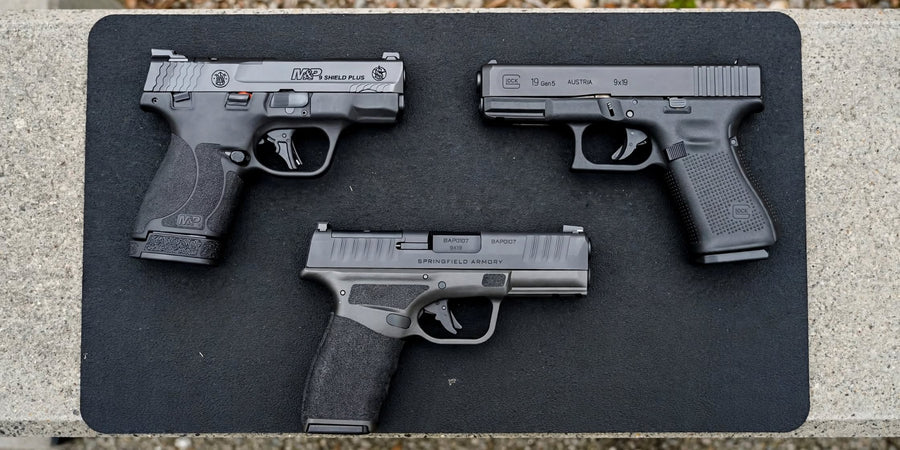
For buyers who find micro-compact grips too small but traditional compact frames too bulky, the slimline category is worth considering. However, individual fit matters more than the category label.
Key Takeaways
- The smallest handgun is not automatically the most comfortable or practical.
- Micro-compacts prioritize reduced dimensions, while traditional compacts generally offer more gripping surface.
- Slimline compact pistols attempt to combine a narrow profile with a more substantial grip.
- The Shield Plus, Glock 19 Gen 5, and Hellcat Pro illustrate three different approaches to handgun sizing.
- Grip height, grip width, and control placement often matter more than barrel length alone.
- Lighter firearms can produce a different perceived recoil experience than heavier models.
- Manufacturer weight specifications are not always measured under identical conditions.
- Buyers should compare actual specifications, evaluate ergonomics in person, and consider training and secure storage.
The concealed carry handgun market offers more choices than ever, with manufacturers producing micro-compacts, traditional compacts, and slimline pistols that blur the boundaries between categories. Smaller designs have gained magazine capacity and features once associated primarily with larger handguns, but that progress has not eliminated the compromises that come with reduced dimensions.
A handgun that looks ideal on a specification sheet may feel very different in the hand. Grip length, frame width, weight, and control placement can influence comfort and handling just as much as overall size, which is why the smallest available option is not automatically the best match for every owner.
To examine those differences, we'll compare three familiar 9mm pistols: the Smith & Wesson M&P9 Shield Plus, Glock 19 Gen 5, and Springfield Armory Hellcat Pro. Each represents a different approach to balancing size, capacity, and ergonomics, helping illustrate where the compact handgun sweet spot may fall for different buyers.
Understanding the Three Handgun Size Categories
Handgun manufacturers commonly use labels such as micro-compact, subcompact, compact, and full-size. These descriptions are useful for narrowing a search, but they are not governed by one universal set of measurements.
A manufacturer may classify a particular model as compact even though its dimensions overlap with another company's subcompact or slimline offering. That makes comparing specific firearms more informative than relying on marketing categories alone.
For this article, we'll use three established 9mm pistols to demonstrate the differences.
Micro-Compact: Smith & Wesson M&P9 Shield Plus

The Smith & Wesson M&P9 Shield Plus represents the micro-compact category. Its design emphasizes a relatively short overall length, narrow frame, and manageable weight. The standard 3.1-inch model has an overall length of approximately 6.1 inches, a height of 4.6 inches, and a listed frame width of 1.1 inches. Smith & Wesson identifies it as a micro-compact handgun.
One of the Shield Plus's defining characteristics is its compact grip combined with a double-stack-style magazine arrangement. Standard configurations commonly include 10-round flush-fit and 13-round extended magazines, although exact packages and capacities vary.
The Shield Plus demonstrates how manufacturers have increased capacity without requiring the dimensions of a traditional compact handgun. However, its shorter grip and smaller overall frame may feel less comfortable to some owners, particularly those with larger hands. For buyers who prioritize minimal dimensions, it is a useful example of what the micro-compact category offers.
Traditional Compact: Glock 19 Gen 5

The Glock 19 Gen 5 represents the traditional compact handgun category. It is larger than the Shield Plus in overall length, height, and width, giving it a different feel and ownership profile.
The Glock 19 Gen 5 has a 4.02-inch barrel, an overall length of 7.28 inches, a height of 5.04 inches, and an overall width of 1.34 inches. Its standard magazine capacity is 15 rounds.
Unlike the smallest micro-compacts, the Glock 19 uses a more substantial frame and grip. The Gen 5 design also incorporates interchangeable backstraps, allowing some adjustment to grip dimensions. The larger frame may feel more comfortable to buyers who find micro-compact pistols cramped, and its controls may feel less crowded depending on individual hand size.
The tradeoff is additional bulk and weight. The Glock 19 Gen 5 illustrates why a traditional compact handgun may appeal to someone who prioritizes a fuller grip over minimum overall dimensions.
Compact/Slimline: Springfield Armory Hellcat Pro

The Springfield Armory Hellcat Pro occupies an interesting middle ground. It offers a narrow grip and frame while retaining dimensions that are larger than many micro-compact pistols.
The original Hellcat Pro has a 3.7-inch barrel, an overall length of approximately 6.6 inches, a height of 4.8 inches, and a grip width of approximately 1 inch. Its standard flush-fit magazine capacity is 15 rounds.
These specifications place it between the Shield Plus and Glock 19 in several important measurements. It is longer than the Shield Plus but shorter than the Glock 19, while its narrow grip distinguishes it from a traditional compact frame.
The Hellcat Pro is a useful example of the slimline compact approach: maintaining a relatively narrow profile while offering more grip length than the smallest micro-compact designs. That combination may appeal to buyers who find a micro-compact too small but do not want the width of a traditional compact handgun.
The evolution of concealed carry handguns has gradually changed what shooters expect from a compact pistol. Modern micro-compacts have demonstrated that impressive magazine capacity and practical features no longer require a traditionally sized handgun, but the pursuit of smaller dimensions has also highlighted the importance of grip length, weight, and overall shooting comfort.
Models that fall between traditional micro-compacts and larger compact pistols have become increasingly appealing because they offer a different balance of concealability and control. Our examination of how concealed carry handguns have changed explores the developments that brought the market to this point and why manufacturers continue refining the balance between smaller dimensions and practical usability.
Shield Plus vs. Glock 19 Gen 5 vs. Hellcat Pro: Specifications
The following table compares representative factory configurations of the three pistols.
| Specification | S&W M&P9 Shield Plus | Glock 19 Gen 5 | Springfield Hellcat Pro |
|---|---|---|---|
| Category | Micro-compact | Traditional compact | Compact/slimline |
| Operating system | Striker-fired semiautomatic | Striker-fired semiautomatic | Striker-fired semiautomatic |
| Caliber | 9mm | 9mm | 9mm |
| Barrel length | 3.1 in. | 4.02 in. | 3.7 in. |
| Overall length | 6.1 in. | 7.28 in. | 6.6 in. |
| Overall height | 4.6 in. | 5.04 in. | 4.8 in. |
| Width | 1.1 in. frame width | 1.34 in. overall width | 1 in. grip width |
| Listed weight | 17.9 oz. | 21.52 oz. without magazine | 21 oz. |
| Standard capacity | 10 or 13 rounds | 15 rounds | 15 rounds |
| Grip design | Short, narrow profile | Fuller compact grip | Extended slimline grip |
Specifications reflect representative standard models, not every variant. Width measurements refer to different manufacturer-defined dimensions and should not be treated as perfectly equivalent. Published weights also use different measurement conventions.
This comparison reveals the main differences among the three categories. The Shield Plus is the shortest and lightest example in the group, the Glock 19 Gen 5 has the largest overall dimensions and offers a fuller traditional compact frame, and the Hellcat Pro falls between them in length and height while retaining a notably narrow grip.
These differences are not enormous on paper, but small dimensional changes can influence how a firearm feels to an individual owner.
Why Grip Size Is Often More Important Than Barrel Length

When buyers compare compact handguns, barrel length tends to receive considerable attention. However, grip dimensions can have an equally important influence on comfort and ergonomics because the grip is the primary interface between the owner and the firearm.
The Shield Plus uses a relatively short grip to keep overall height down. That approach reduces dimensions but may feel cramped to buyers with larger hands. The Glock 19 Gen 5 offers a taller, fuller grip, which may give some owners more usable surface area during extended supervised range sessions.
The Hellcat Pro provides another approach by combining a relatively long grip with a narrow profile. This may appeal to buyers who prefer a slimmer handgun but want more room for the hand than the smallest micro-compacts provide.
None of these designs is universally superior. Grip comfort depends on hand size, finger length, physical strength, and personal preference.
Grip Width and Hand Size
Width is another important factor. A narrow handgun can feel comfortable to someone with smaller hands, but the same design may feel less substantial to someone who prefers a fuller grip. The Shield Plus and Hellcat Pro emphasize relatively narrow profiles, while the Glock 19 uses a wider traditional compact frame.
Published width measurements can also be misleading because manufacturers may report slide width, frame width, grip width, or maximum overall width. Buyers should check exactly what is being measured rather than assuming every published number is directly comparable.
The most reliable comparison is an in-person ergonomic evaluation conducted safely with assistance from a reputable dealer or qualified instructor.
How Weight Changes the Experience
Handgun weight influences portability, balance, and perceived recoil. It also affects how substantial a firearm feels during handling. The Shield Plus is relatively lightweight, reflecting its micro-compact design, while the Glock 19 Gen 5 has more overall mass and the Hellcat Pro occupies an intermediate position in the comparison.
A lighter firearm can be convenient, but reduced mass may make recoil feel more noticeable when comparing firearms using similar ammunition. That does not mean a lightweight handgun is inherently difficult to use or that a heavier handgun is automatically easier, since grip geometry, operating characteristics, ammunition, and individual experience all affect perceived recoil.
Buyers should also pay attention to how manufacturers report weight. Some specifications exclude the magazine, while others include an empty magazine. Comparing those numbers without understanding the difference can create a misleading impression.
For example, Glock lists the Glock 19 Gen 5 at 21.52 ounces without a magazine and 23.63 ounces with an empty magazine. Other manufacturers may use a different convention for the headline weight, which is why the practical lesson is to evaluate the complete firearm rather than relying on a single weight figure.
Magazine Capacity: Why the Numbers Don't Tell the Whole Story
Magazine capacity has become a major selling point in the compact handgun market. Manufacturers have developed magazine designs that provide substantial capacity in relatively small frames, and the Shield Plus demonstrates this trend with commonly available 10- and 13-round factory magazine configurations.
The Glock 19 Gen 5 offers a standard 15-round magazine, while the original Hellcat Pro also uses a 15-round flush-fit magazine. At first glance, the Glock 19 and Hellcat Pro appear similar in capacity, but their overall dimensions and grip profiles are noticeably different.
The Shield Plus uses a smaller overall package, but its capacity varies depending on the magazine configuration. This illustrates why capacity should be considered alongside ergonomics, dimensions, and intended ownership requirements rather than treated as the only meaningful specification.
Buyers should also verify current magazine restrictions in their jurisdiction. Factory configurations and legally available capacities may differ by location.
Does a Longer Barrel Make a Compact Handgun Better?
The three comparison models also illustrate differences in barrel length. The Shield Plus uses a 3.1-inch barrel, the Hellcat Pro uses a 3.7-inch barrel, and the Glock 19 Gen 5 uses a 4.02-inch barrel.
Barrel length can affect overall dimensions, balance, sight radius, and ammunition velocity. However, the relationship is not always straightforward. A longer barrel may produce different velocities with particular ammunition, but the results depend on the cartridge, load, and individual firearm.
It would therefore be inaccurate to assume that every longer-barreled handgun is more accurate or reliable than a shorter model. For buyers, barrel length is best evaluated as part of the complete firearm design rather than as an isolated measure of quality.
Where the Slimline Compact Category Fits
Slimline compact pistols occupy the space between traditional compact handguns and the smallest micro-compact designs. Their defining characteristic is typically a relatively narrow frame combined with enough overall size to offer a more substantial grip than many smaller pistols.
The Springfield Armory Hellcat Pro illustrates this approach. It retains a narrow profile while offering a longer grip and greater overall dimensions than the standard Shield Plus. Compared with the Glock 19 Gen 5, it represents a different balance between frame width and grip size.
The advantage is not that slimline compacts are universally better. Instead, they give buyers another option when a micro-compact feels too small or a traditional compact feels unnecessarily bulky. Individual ergonomics remain the deciding factor.
Why Specifications Cannot Replace an In-Person Evaluation

Specification tables are useful for narrowing down choices, but they cannot fully describe how a handgun feels. Two firearms with similar dimensions may differ in grip angle, trigger reach, frame contour, control placement, and weight distribution, all of which influence comfort in ways that are difficult to capture with numbers alone.
This is especially important when comparing the Shield Plus, Glock 19 Gen 5, and Hellcat Pro. Each uses a different approach to frame shape and grip dimensions. One buyer may discover that the smallest model feels most natural, another may prefer the larger compact frame, while a third may find the slimline configuration more comfortable.
When possible, buyers should evaluate prospective firearms through a reputable dealer or supervised rental range. Qualified instruction can help identify ergonomic concerns and reinforce safe handling practices.
How to Find Your Compact Handgun Sweet Spot
Finding the right compact handgun begins with identifying which characteristics matter most. Some buyers prioritize reduced overall dimensions, while others prefer a fuller grip, different weight distribution, or controls that feel more accessible. Comparing those preferences against actual firearm specifications is more useful than relying on broad category labels.
The Shield Plus, Glock 19 Gen 5, and Hellcat Pro provide three distinct starting points. Their differences in length, height, width, weight, and magazine configuration demonstrate how manufacturers approach compact handgun design, but those numbers cannot fully describe how a particular model will feel to an individual owner.
Whenever possible, evaluate prospective firearms in person through a reputable dealer or supervised rental range. Consider grip comfort, control accessibility, safe handling, training requirements, and secure storage. The goal is not to select the smallest handgun or the model with the highest capacity, but one whose overall design and ownership requirements fit the individual.
Final Thoughts
The compact handgun sweet spot is not defined by a particular barrel length, grip width, or magazine capacity. It is the balance between portability, ergonomics, and practical ownership requirements that makes a firearm suitable for an individual. Smaller handguns offer advantages in reduced dimensions, but those benefits can come with compromises in grip comfort and handling.
The Smith & Wesson M&P9 Shield Plus illustrates the micro-compact approach, while the Glock 19 Gen 5 represents the fuller traditional compact category. The Springfield Armory Hellcat Pro occupies a slimline middle ground, combining a narrow profile with dimensions that fall between the other two examples in several respects. None is automatically superior because each addresses a different set of preferences.
For buyers who find micro-compacts too small and traditional compacts too bulky, slimline designs deserve consideration. Ultimately, the best choice is the firearm that fits the owner comfortably, supports safe handling, and aligns with the intended lawful use rather than simply being the smallest available option.
Magtech 9mm 115gr FMJ
$20.00
at Pro Armory
Prices accurate at time of writing
Frequently Asked Questions
What Is the Compact Handgun Sweet Spot?
The compact handgun sweet spot is the balance between size, weight, grip comfort, capacity, and ergonomics. It varies by individual rather than being defined by one specific model.
Is the Smith & Wesson Shield Plus a Micro-Compact?
Yes. Smith & Wesson classifies the M&P9 Shield Plus as a micro-compact handgun. Its relatively short barrel, narrow frame, and compact grip are consistent with that category.
Is the Glock 19 Gen 5 Considered a Compact Handgun?
Yes. Glock classifies the Glock 19 Gen 5 as a compact pistol. Its dimensions are larger than those of many micro-compact and slimline handguns.
Is the Springfield Hellcat Pro a Compact or Micro-Compact?
The Hellcat Pro is commonly described as a compact or slimline compact pistol. Its dimensions are larger than those of the original Hellcat and many micro-compacts, while its grip remains relatively narrow.
Which Is Smaller: Shield Plus or Hellcat Pro?
The standard 3.1-inch Shield Plus is shorter and lower in overall height than the original Hellcat Pro. Exact dimensions depend on the particular variant and magazine configuration.
Does the Hellcat Pro Have the Same Capacity as the Glock 19?
The original Hellcat Pro and standard Glock 19 Gen 5 both offer 15-round factory magazine configurations. Other magazine options and jurisdiction-specific configurations may differ.
Is a Slimline Compact Better Than a Traditional Compact?
Not universally. Slimline compacts emphasize reduced width, while traditional compact designs may provide a fuller grip. Buyers should evaluate both categories rather than assuming one is better.
Should First-Time Buyers Choose a Micro-Compact?
Not automatically. First-time buyers should prioritize safe handling, comfortable ergonomics, qualified instruction, and appropriate ownership requirements rather than selecting a firearm solely because it is small.
About the Author
The ProArmory Editorial Team creates practical, research-informed content for firearm owners, ammunition shoppers, hunters, and shooting enthusiasts. Our articles focus on product education, firearm specifications, buying considerations, safety, and responsible ownership.
Our goal is to help readers understand their equipment options and make informed purchasing decisions without exaggerated performance claims or unnecessary hype.
Disclaimer
This article is intended for general educational and informational purposes only. Firearm specifications, dimensions, magazine capacities, and manufacturer configurations may change or vary by model and jurisdiction. The comparisons presented are based on manufacturer documentation and general design characteristics, not independent hands-on testing conducted by ProArmory.
Always follow manufacturer instructions, practice established firearm safety procedures, seek qualified training, and maintain appropriate secure storage. Firearm ownership, transportation, and carrying are subject to applicable federal, state, and local laws.
ProArmory does not guarantee the performance, reliability, or suitability of any firearm or accessory discussed in this article.


