


Quick Answer
For most shooters entering centerfire precision rifle competition, a quality factory bolt-action rifle chambered in 6.5 Creedmoor remains one of the easiest and most practical starting points. The cartridge offers broad factory-ammunition support, established long-range performance, widespread rifle availability, and enough ballistic capability to learn the sport without immediately committing to a specialized handloading program.
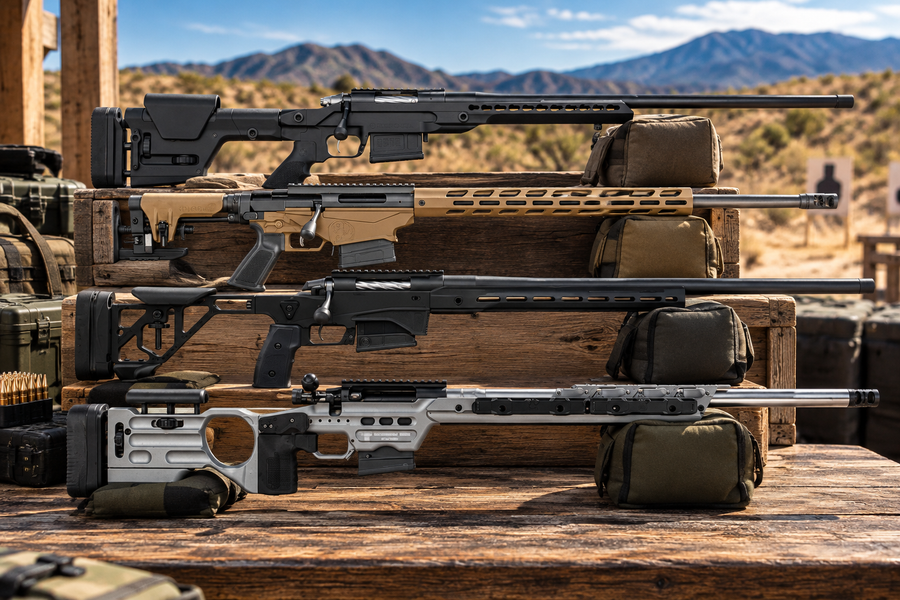
Experienced PRS competitors often move toward cartridges such as 6mm Dasher, 6mm GT, and 6mm Creedmoor because those rounds can provide a useful combination of manageable recoil, long-range performance, and competition-oriented rifle support. Current top-level equipment trends also show rapidly growing interest in .25-caliber cartridges, particularly 25×47 Lapua among elite shooters and the now-SAAMI-standardized 25 Creedmoor as commercial support expands.
The current factory-rifle market is stronger than it has ever been. The Bergara Premier Competition Elite, updated Ruger Precision Rifle, Tikka T3x Ace Target, and competition-focused MasterPiece Arms platforms give shooters access to equipment that would once have required a custom build.
That does not mean the rifle or cartridge used by the top PRS competitors is automatically the best choice for a new shooter. Specialized cartridges can introduce ammunition-supply, reloading, feeding, barrel-life, and component-cost considerations that are less important to an experienced competitor with several barrels, established load data, and a season's worth of ammunition already prepared.
The best first precision-rifle setup is usually the one that lets the owner shoot more matches and practice more frequently with fewer logistical problems. For many people, that still means 6.5 Creedmoor.
For someone committed specifically to PRS Open competition and willing to accept a more specialized ammunition ecosystem, 6mm Dasher and 6mm GT deserve much closer consideration.
Key Takeaways
- 6.5 Creedmoor remains one of the strongest starting cartridges for new precision-rifle competitors because rifles and factory match ammunition are widely available.
- The latest survey of the top 200 PRS shooters found 6mm Dasher used by 46 percent of competitors, making it by far the most common individual cartridge in that group.
- 6mm GT ranked second at 9 percent and offers a more magazine-friendly case design along with growing factory-ammunition support.
- .25-caliber cartridges are gaining significant ground at the highest level, especially 25×47 Lapua, while 25 Creedmoor now offers a SAAMI-standardized commercial alternative.
- PRS currently includes Open, Production, Tactical, Gas Gun, and Sportsman divisions, each with different equipment considerations.
- Production currently limits the rifle to $3,000 MSRP and the optic to $2,500 MSRP.
- Sportsman is limited to 6.5 Creedmoor and a configured rifle weight of 13 pounds under standard match conditions.
- Current factory options include dedicated competition platforms such as the Bergara Premier Competition Elite, Ruger Precision Rifle and Custom Shop RPR, Tikka T3x Ace Target, and MasterPiece Arms competition rifles.
- Barrel life, ammunition cost, magazines, optics, match fees, travel, and eventual replacement components can matter more financially than the original rifle purchase.
What Is Precision Rifle Competition?
Precision rifle competition is a broad category rather than one single shooting discipline. PRS-style competition, F-Class, NRL-style matches, rimfire precision events, and other long-range sports can all involve accurate rifles and distant targets while placing very different demands on the equipment.
This article focuses primarily on centerfire Precision Rifle Series competition because that is where modern heavy chassis rifles and specialized cartridges such as 6mm Dasher and 6mm GT are especially prominent.
PRS stages commonly require shooters to engage steel targets at different distances from barricades, tank traps, rooftops, prone positions, natural terrain, and other supports under time limits. Success depends on far more than raw benchrest accuracy.
The rifle needs to feed reliably, balance predictably on props, allow the shooter to manage recoil well enough to see impacts, and remain comfortable through numerous positional transitions.
The result is a rifle design philosophy very different from a lightweight hunting rifle intended to be carried for miles before firing one or two shots.
PRS Is About Managing the Entire Shooting System
A precision rifle competitor is managing a system that includes the rifle, ammunition, optic, support bag, bipod, magazines, ballistic data, and environmental information.
A rifle capable of tiny groups from a bench may still be frustrating in competition if it feeds inconsistently, balances poorly on barricades, has awkward controls, or recoils enough that the shooter cannot see where the shot went.
Likewise, a cartridge with outstanding theoretical ballistics can become a poor competition choice if ammunition is difficult to source or the owner cannot produce enough consistent rounds to practice.
This is why experienced competitors frequently talk about consistency and logistics almost as much as they talk about ballistic coefficient.
Current PRS Centerfire Divisions
Before buying a competition rifle, determine which division the rifle is expected to enter. The 2026 Precision Rifle Series rules currently define five centerfire divisions: Open, Production, Tactical, Gas Gun, and Sportsman.
| PRS Division | Current General Structure | Main Buying Consideration |
|---|---|---|
| Open | Bolt guns up to .30 caliber and below the 3,200 fps velocity limit | Maximum equipment and cartridge flexibility |
| Production | Factory rifles within current MSRP and manufacturer requirements | Factory configuration, rifle MSRP, optic MSRP |
| Tactical | .223 Remington / 5.56 NATO or .308 Winchester only | Bullet-weight and velocity restrictions |
| Gas Gun | Semi-automatic precision rifles | Platform type and .30-caliber / velocity limitations |
| Sportsman | 6.5 Creedmoor only, 13-pound configured rifle limit | Complete match weight and hunting-oriented configuration |
The exact rulebook should always be checked before a purchase or match. PRS rules can change between seasons, and a rifle being advertised as competition ready does not automatically make it legal for every division.
Open Division: Where Specialized Equipment Lives
Open is the least restrictive bolt-gun division and is where many of the highly specialized rifles and cartridges associated with modern PRS competition appear.
Current rules limit Open rifles to .30 caliber or smaller and establish a 3,200 fps velocity ceiling. Within those boundaries, competitors have broad freedom to select actions, barrels, triggers, chassis systems, weights, optics, cartridges, and other equipment.
This freedom is why equipment surveys of top PRS competitors often look dramatically different from the rifles encountered at an ordinary sporting-goods counter.
Heavy custom rifles, specialized 6mm cartridges, large balance weights, premium optics, and highly adjustable chassis systems are common because competitors are optimizing around the scoring environment rather than general-purpose use.
Production Division: Factory Equipment With Price Limits
PRS Production is intended to give shooters access to factory-built competition equipment without requiring a full custom rifle.
Under the current 2026 rules, the rifle may not exceed a $3,000 manufacturer-listed MSRP and the optic may not exceed $2,500 MSRP.
The rifle must also meet PRS requirements defining a genuine manufacturer-produced firearm rather than a collection of individually sourced parts assembled to fit under a price ceiling.
This distinction has helped encourage manufacturers to develop true factory competition rifles instead of leaving new shooters to enter the custom-build market immediately.
Production Does Not Mean Bare Bones
The modern Production rifle can be remarkably sophisticated.
Factory chassis systems, heavy barrels, premium triggers, AICS-pattern magazines, full-length ARCA rails, adjustable stocks, barricade stops, and competition-oriented chamberings can all appear on production-eligible rifles.
The category therefore should not be confused with a beginner class built around inexpensive hunting rifles.
Its purpose is closer to controlling the rifle and optic marketplace while keeping competitors within a genuine factory-product structure.
Tactical Division: .223 and .308 Still Matter
PRS Tactical restricts competitors to .223 Remington / 5.56 NATO or .308 Winchester.
The current rules also limit projectile weight and velocity. The .223/5.56 side has a 77-grain bullet-weight cap and a 3,000 fps velocity ceiling, while .308 is limited to 178 grains and 2,800 fps.
Modified wildcat cartridges are not permitted.
This gives .223 and .308 a competitive role that cannot be judged simply by looking at what dominates Open Division.
Sportsman Makes 6.5 Creedmoor Even More Relevant
The newer Sportsman division creates a particularly interesting role for 6.5 Creedmoor.
Current rules limit the rifle to 13 pounds configured and restrict the division to 6.5 Creedmoor.
The configured-weight requirement includes the rifle, optic, muzzle device, bipod, empty magazine, and several detachable accessories. The rifle therefore needs to be planned as a complete package rather than selected according to its bare catalog weight.
This makes Sportsman a useful bridge between hunting-style precision rifles and the extremely heavy rifles common in Open competition.
Why Caliber Choice Matters So Much
Competition cartridge selection influences far more than trajectory.
Recoil affects whether the shooter can stay behind the optic and observe the impact or miss. Ammunition cost determines how much practice is financially realistic. Factory-ammunition availability affects whether a non-reloader can maintain a season's supply.
Barrel life influences long-term cost, while cartridge geometry can affect magazine feeding and rifle setup.
A cartridge can therefore be ballistically excellent and still be a poor ownership choice for one particular competitor.
What the Top PRS Shooters Are Actually Using
The most useful current dataset comes from Precision Rifle Blog's survey of the top 200 PRS competitors.
In the 2025 survey, 6mm cartridges remained dominant overall, representing 70 percent of the top 200 shooters.
6mm Dasher alone accounted for 46 percent, making it the most popular individual cartridge by an enormous margin.
6mm GT ranked second at 9 percent.
The larger trend to watch, however, is the rise of .25 caliber.
The .25-Caliber Shift Is Real
.25-caliber cartridges represented 16 percent of the top 200 shooters in the latest survey.
Among the top 25 competitors, that figure reached 40 percent.
25×47 Lapua accounted for 7 percent of the entire top 200 and came very close to the Dasher among the highest-ranked shooters.
That does not mean every new competitor should abandon 6mm cartridges and immediately build a .25-caliber rifle.
It does mean the competitive cartridge landscape is evolving faster than a simple 6mm-versus-6.5mm comparison suggests.
Popular Precision Rifle Competition Cartridges
| Cartridge | Typical Role | Factory Ammo Situation | Main Tradeoff |
|---|---|---|---|
| 6.5 Creedmoor | Entry-level, Sportsman, general long-range use | Excellent | More recoil than specialized 6mm PRS cartridges |
| 6mm Creedmoor | Factory-supported competition | Good | Barrel wear and higher velocity |
| 6mm GT | Dedicated PRS competition | Growing, including major factory support | Smaller market than Creedmoor chamberings |
| 6mm Dasher | Highly optimized PRS Open competition | Available but comparatively specialized | Ammo logistics and magazine setup |
| 25×47 Lapua | Emerging elite-level PRS cartridge | Highly specialized | Primarily enthusiast / handloader ecosystem |
| 25 Creedmoor | Emerging commercial .25-caliber precision option | Growing factory support | Newer ecosystem than established Creedmoor cartridges |
| .308 Winchester | Tactical and traditional precision disciplines | Excellent | More recoil and different external ballistics |
| .223 Remington | Tactical division and lower-cost precision practice | Excellent | Energy and wind limitations at extended range |
6.5 Creedmoor: Still the Practical Starting Point

6.5 Creedmoor is no longer the dominant cartridge among elite PRS Open shooters, but that is not the same as saying it has become a poor competition cartridge.
For a new shooter, its enormous commercial ecosystem remains difficult to beat.
Factory rifles are available from numerous manufacturers. Match ammunition is produced by major ammunition companies. Brass, dies, load data, magazines, barrels, and replacement components are widely supported.
That matters when someone is learning an entirely new sport.
The Beginner Needs Trigger Time More Than a Trend
A new PRS competitor needs to learn how to build stable positions, manage a bag, find targets quickly, operate the bolt without losing the sight picture, read wind, build accurate ballistic data, and manage a stage under time pressure.
None of those skills requires the most popular cartridge among the top 25 shooters.
Choosing a mainstream cartridge can allow the beginner to spend more time practicing and less time solving ammunition problems.
That is one of 6.5 Creedmoor's greatest competitive strengths even if it appears infrequently in the top Open leaderboard.
Sportsman Gives 6.5 Creedmoor Another Advantage
A shooter interested in the PRS Sportsman division does not have to debate the cartridge at all.
The current division requires 6.5 Creedmoor.
That makes the cartridge particularly attractive to someone who wants a rifle capable of hunting, recreational long-range shooting, and a rules-defined competitive role.
6mm Creedmoor: The Easy Step Into 6mm

6mm Creedmoor offers one of the easiest ways to move into a competition-oriented 6mm cartridge without abandoning mainstream factory support.
Several rifle manufacturers chamber factory precision rifles in 6mm Creedmoor, and factory match ammunition is readily available compared with more specialized BR-derived cartridges.
It also provides higher velocity than smaller-capacity rounds such as the Dasher.
The tradeoff is that additional velocity generally comes with more powder consumption and potentially more aggressive barrel wear.
6mm Creedmoor Is Not Automatically Faster in Competition
A flatter trajectory looks excellent on a ballistic chart, but PRS performance is not decided solely by drop.
Recoil management, wind calling, feeding reliability, ammunition consistency, and the ability to observe a miss can matter just as much.
This is one reason many top competitors choose smaller and more efficient 6mm cartridges even when a larger-capacity case can produce more velocity.
6mm Dasher: The Current PRS Benchmark

No modern PRS cartridge discussion can ignore the 6mm Dasher.
The latest top-200 survey found 46 percent of shooters using it, a remarkable level of concentration in a sport whose competitors are usually eager to experiment with new cartridges.
Its appeal comes from an efficient case, manageable recoil, strong precision reputation, and a long track record in the sport.
For experienced competitors who reload and already understand PRS equipment, the Dasher remains one of the most obvious cartridges to evaluate.
Why Doesn't Everyone Start With Dasher?
Commercial convenience is the main reason.
Factory-loaded 6mm Dasher ammunition exists, but the ecosystem remains far narrower than 6.5 Creedmoor, .308 Winchester, or even 6mm Creedmoor.
Many serious Dasher shooters are handloaders who buy brass and components in season-sized quantities and develop ammunition around their exact barrel.
Magazine feeding may also require appropriate magazines or internal spacer arrangements because the short BR-derived case does not occupy a conventional AICS magazine in the same way as longer cartridges.
Dasher Is an Excellent Cartridge, Not a Requirement
The fact that nearly half of the top 200 shooters use one demonstrates its competitive effectiveness.
It does not establish that an inexperienced shooter will improve faster by starting with the same equipment.
A shooter who fires fewer rounds because ammunition becomes a logistical project may gain less from the cartridge than a 6.5 Creedmoor owner who trains every week.
6mm GT: The Purpose-Built Middle Ground

The 6mm GT was designed specifically with practical precision-rifle competition in mind.
Its case is longer than the 6mm Dasher and was developed in part to feed cleanly from standard AICS-pattern magazines without the magazine modifications commonly associated with shorter BR-family cartridges.
That makes it especially interesting for competitors who like the low-recoil 6mm concept but want simpler magazine behavior.
Factory Support Has Changed the 6 GT Equation
The 6mm GT was once a cartridge closely associated with enthusiasts and reloaders.
That situation has changed significantly.
Hornady now produces factory 6mm GT Match ammunition and brass, and current factory rifle options include the cartridge.
Ruger's current Custom Shop Precision Rifle lineup, for example, includes a 6mm GT model.
That does not make 6 GT as easy to find as 6.5 Creedmoor everywhere in the country, but it substantially lowers the barrier to entry.
6mm GT vs. 6mm Dasher
The Dasher remains far more common among the current top 200 PRS competitors, while 6mm GT ranked second at 9 percent.
The GT's strongest argument is not that it has displaced the Dasher. It has not.
Its appeal is the combination of competition-oriented ballistics, standard-magazine feeding, and growing commercial support.
For a shooter who does not want to build the entire ammunition and magazine system around a BR-derived case, that can be meaningful.
The Rise of 25×47 Lapua

One of the most interesting developments in elite PRS equipment is the growth of 25×47 Lapua.
In the latest survey, it became the third most popular individual cartridge among the top 200 shooters at 7 percent.
Among the top 25, its presence was much more dramatic, nearly matching the number of competitors using 6mm Dasher.
The concept is straightforward: modern high-ballistic-coefficient .25-caliber bullets can provide improved wind performance compared with smaller projectiles while keeping recoil below traditional 6.5mm configurations.
25×47 Is Still a Specialized Competitor's Cartridge
The caveat is accessibility.
25×47 Lapua remains much more specialized than mainstream factory chamberings and makes the most sense for experienced shooters already comfortable with handloading, component selection, and custom or semi-custom rifle configurations.
A first-time competitor should not interpret leaderboard popularity as a reason to begin with the most specialized ammunition system available.
25 Creedmoor Changes the Commercial .25-Caliber Picture

25 Creedmoor is a different story.
SAAMI accepted the cartridge in 2025, and Hornady now offers factory Match and hunting ammunition.
The cartridge was specifically designed around modern low-drag .25-caliber bullets and a standard short-action overall length compatible with AICS-style magazines.
That makes it a potentially important bridge between the elite .25-caliber competition trend and shooters who prefer standardized commercial ammunition.
Do Not Confuse 25 Creedmoor With 25×47 Lapua
The growth of .25 caliber does not mean one cartridge has already become the universal replacement for 6mm Dasher.
The strongest current top-competitor data involves 25×47 Lapua.
25 Creedmoor offers broader commercial standardization and factory-ammunition potential, but its long-term share of the PRS field is still developing.
They should therefore be discussed as two different approaches to the same broader .25-caliber movement.
.308 Winchester: Still Relevant

.308 Winchester is no longer the cartridge most people associate with maximizing PRS Open performance, but it remains deeply relevant to precision rifle competition.
PRS Tactical specifically supports .308 within defined projectile and velocity restrictions.
The cartridge also benefits from enormous factory-ammunition support and a vast selection of rifles, barrels, magazines, and components.
For someone interested in Tactical division or traditional precision-rifle training, it remains a meaningful option.
.223 Remington: An Underrated Precision Training Cartridge

.223 Remington has similarly broad commercial support and can provide low recoil and relatively affordable practice compared with larger centerfire cartridges.
PRS Tactical gives it a formal competition role, although the current division rules restrict projectile weight and velocity.
At longer distances, wind and retained energy become greater challenges than with larger competition cartridges.
That limitation can also make .223 extremely educational because poor wind calls become visible very quickly.
Popular Factory Precision Rifle Platforms
The modern precision-rifle market now gives buyers several ways to enter competition without commissioning a complete custom build.
| Platform | General Position | Notable Current Competition Options |
|---|---|---|
| Bergara Premier Competition Elite | Purpose-built factory PRS platform | Competition chamberings and MDT ACC Elite chassis |
| Ruger Precision Rifle | Established factory precision platform | 6.5 Creedmoor, .308, 6mm Creedmoor and Custom Shop options |
| Ruger Custom Shop Precision Rifle | Higher-spec competition configuration | 6mm GT, 6mm Creedmoor, 6.5 Creedmoor |
| Tikka T3x Ace Target | Current Tikka PRS-focused chassis rifle | Heavy barrel, modular chassis, two-stage trigger |
| Tikka T3x TACT A1 | Long-range tactical / precision platform | Folding aluminum chassis and established T3x action |
| MasterPiece Arms PMR / competition rifles | Premium factory competition platforms | Multiple specialized PRS chamberings |
Bergara Premier Competition Elite

Bergara's current Premier Competition Elite represents exactly how far factory competition rifles have progressed.
The concept pairs Bergara's Premier action with a competition-oriented barrel, TriggerTech trigger, and MDT ACC Elite chassis rather than placing a precision barreled action into a general-purpose stock.
The ACC Elite chassis is built around positional competition with a long accessory interface, adjustable ergonomics, and the ability to tune rifle balance.
That matters because balance on a barricade can be just as important as total rifle weight.
The Bergara Chambering List Reflects the Modern PRS Market
Current Competition Elite launch configurations include a broad range of chamberings aimed directly at the precision-rifle community, including 6mm Dasher, 6mm GT, 6mm Creedmoor, 6.5 Creedmoor, .25 Creedmoor, and additional specialized options.
This is notable because cartridges that once implied a custom barrel and gunsmith can now appear in a complete factory rifle.
That gives Production-oriented buyers and non-builders access to far more specialized equipment than was available only a few years ago.
Ruger Precision Rifle: Still One of the Most Important Factory Platforms

The Ruger Precision Rifle helped change expectations for factory long-range rifles when it arrived in 2015.
Its significance was not simply accuracy. Ruger delivered an adjustable chassis-style platform, detachable magazines, threaded muzzle, compatible grip architecture, and competition-friendly ergonomics in a factory rifle at a price far below many custom systems of the period.
That basic formula remains relevant, but the current rifle has evolved considerably.
The Current RPR Is More Competition Focused
Ruger's latest Precision Rifle generation incorporates years of feedback from competitive shooters.
Current standard configurations include 6.5 Creedmoor and .308 Winchester along with other precision chamberings, while more competition-focused models expand the lineup further.
This makes the RPR less of a single rifle and more of a family spanning general long-range shooting and specialized competition.
The Ruger Custom Shop Now Includes 6mm GT
One of the most significant current developments is Ruger's Custom Shop offering.
Current configurations include 6mm GT, 6mm Creedmoor, and 6.5 Creedmoor with features such as a heavy stainless barrel, TriggerTech two-stage trigger, muzzle brake, and competition-oriented barricade equipment.
That is another example of a cartridge once associated with dedicated competition builds moving into mainstream factory production.
Is the RPR Still a Good First Competition Rifle?
Yes, depending on configuration and price.
The RPR remains a complete factory system with broad manufacturer support and a large amount of community knowledge surrounding the platform.
Its biggest competition is no longer basic hunting rifles. It now competes against newer factory chassis guns that have learned from the market Ruger helped create.
That makes comparison shopping more important than simply buying the rifle because the RPR name is familiar.
Tikka T3x Ace Target: The More Current PRS Choice

The T3x TACT A1 remains a capable long-range rifle, but Tikka's current competition positioning has shifted toward the T3x Ace Target.
Tikka now features the Ace Target directly within its Precision Rifle Series lineup.
The rifle uses a heavy barrel, highly adjustable chassis, modular accessory architecture, and a two-stage trigger intended specifically for precision competition.
That makes it a more natural current comparison against purpose-built PRS rifles than the older TACT A1 alone.
The Tikka Action Remains Part of the Appeal
Tikka's reputation in long-range circles is strongly connected to its smooth bolt operation and consistent factory manufacturing.
Those characteristics can matter significantly in timed stages where the shooter wants to cycle the action while remaining behind the optic.
A smooth bolt cannot replace stable positional technique, but it can reduce unnecessary disruption during rapid follow-up shots.
T3x Ace Target vs. TACT A1
The TACT A1 remains a current product and uses a folding aluminum chassis with adjustable comb and length of pull.
Its design also reflects tactical and professional long-range requirements beyond pure sporting competition.
The Ace Target, by comparison, is the more explicitly competition-oriented branch of the current Tikka catalog.
Someone shopping specifically for PRS should therefore compare the Ace Target first rather than assuming the familiar TACT A1 is still Tikka's most focused match option.
MasterPiece Arms: Factory Rifles That Border on Custom Builds

MasterPiece Arms occupies an interesting position in the precision-rifle market because the company is closely associated with both chassis development and high-level competition rifles.
Its PMR and related competition platforms offer specialized chamberings, heavy barrels, adjustable chassis systems, and competition-specific components in complete factory configurations.
Current PMR-family rifles have been offered in cartridges including 6mm Dasher, 6mm GT, 6mm Creedmoor, 6.5 Creedmoor, and other precision chamberings.
These rifles make the most sense for someone already committed to the sport and able to identify which premium features they actually want.
A Premium Rifle Is Not Necessarily a Better First Rifle
New competitors often discover that their priorities change dramatically after shooting several matches.
The stock geometry they thought looked perfect may not balance well on a barricade. A particular grip may feel wrong from awkward positions. A cartridge may require more reloading effort than expected.
Starting with a competent factory platform can allow the shooter to develop informed preferences before spending custom-rifle money.
Chassis vs. Traditional Stock
A chassis system is one of the most recognizable features of modern PRS rifles, but aluminum construction alone does not make a rifle more accurate.
The advantage is primarily one of adjustability, repeatability, mounting capability, and balance management.
Competition chassis systems can provide adjustable cheek height and length of pull, vertical grips, ARCA rails, weight systems, bag riders, barricade interfaces, and attachment points for other equipment.
These features are valuable because the rifle needs to adapt to the shooter and stage rather than simply sit comfortably in a traditional standing field position.
Why ARCA Rails Matter
Full-length ARCA-style accessory rails have become common on dedicated competition chassis systems.
They allow bipods, tripods, and other compatible equipment to move along the bottom of the rifle without occupying fixed short rail sections.
This creates another way for competitors to adjust balance and support position.
An ARCA rail does not make a rifle intrinsically more precise. It makes the support system more adaptable.
Rifle Weight in Open Competition
Modern Open rifles are often surprisingly heavy.
The latest top-shooter data shows many elite rifles falling roughly in the high-teens through mid-20-pound range.
That weight is intentional.
Additional mass can reduce rifle movement during recoil and help the shooter maintain the sight picture long enough to see impacts and corrections.
Heavier Is Not Automatically Better
A heavy rifle is also more difficult to move rapidly between props and positions.
The important concept is balance rather than simply adding weight everywhere.
A competition rifle that balances predictably near the front of the magazine well or barricade contact point can feel much easier to manage than another rifle of similar total weight with poor weight distribution.
Sportsman Completely Changes the Weight Conversation
The Sportsman division's 13-pound limit means the equipment strategy is fundamentally different from Open.
Competitors need to account for the optic, bipod, empty magazine, muzzle device, and specified detachable accessories within the configured weight.
A rifle advertised at 10.5 pounds can therefore become too heavy once a large precision optic, mount, bipod, suppressor, and accessories are installed.
Buying for Sportsman should begin with a complete weight budget.
Optics Can Cost as Much as the Rifle
A precision rifle scope is not an accessory that should be treated as an afterthought.
Reliable turret tracking, repeatable adjustments, useful parallax control, a readable reticle, appropriate magnification, durable construction, and manufacturer support can all affect match performance.
The current Production division's separate $2,500 optic limit illustrates how central optics have become to the equipment equation.
First Focal Plane Is Common for a Reason
First focal plane reticles remain popular in PRS because the reticle's angular measurements remain consistent as magnification changes.
This allows the shooter to use the same MRAD or MOA hold references across the magnification range.
That can be particularly helpful when a stage forces magnification changes between targets or positions.
Second focal plane optics are not inherently inaccurate, but they require the user to understand at which magnification the reticle subtensions are correct.
MRAD vs. MOA
MRAD and MOA are both angular measurement systems.
Neither is mechanically more accurate simply because one uses different units.
MRAD has become extremely common in PRS because many competitors, scopes, reticles, ballistic tools, and spotter calls use the same decimal-based system.
The most important requirement is that the reticle and turret adjustments match and that the shooter understands the system instinctively.
Factory Rifle vs. Custom Build
The gap between factory and custom precision rifles has narrowed dramatically.
A modern factory competition rifle can arrive with a premium chassis, competition trigger, heavy barrel, AICS magazine system, ARCA interface, and a chambering such as 6mm GT or Dasher.
Those features once required several separate purchases and a gunsmith.
Why Buy Factory?
A factory rifle offers one manufacturer responsible for the complete configuration.
Warranty coverage is easier to understand, factory specifications are documented, and Production-division eligibility can be evaluated more clearly.
The buyer also avoids selecting an action, barrel blank, chamber reamer, gunsmith, trigger, chassis, bottom metal, and magazine system before having enough competition experience to know what they prefer.
Why Build Custom?
Custom rifles provide far greater freedom.
An experienced competitor can select a specific action footprint, bolt throw, barrel contour, chamber, twist, freebore, trigger, chassis, magazine system, and weight distribution.
The result can be tailored closely to one shooter's preferences.
That customization has the most value when those preferences are already informed by substantial competition experience.
Ammunition Logistics May Decide the Cartridge Before Ballistics Do
Competition consumes ammunition quickly.
A shooter needs match ammunition, practice ammunition, zero confirmation rounds, chronograph data, and extra ammunition for travel or equipment problems.
A cartridge that performs brilliantly but cannot be supplied consistently becomes a serious problem over a full season.
Factory Ammo Shooters Have More Options Than Before
Factory precision ammunition has improved considerably.
6.5 Creedmoor, 6mm Creedmoor, .308 Winchester, and .223 Remington all have deep commercial support.
6mm GT now has major factory Match ammunition available, while 25 Creedmoor also has current Match support.
Even 6mm Dasher can be sourced as factory ammunition from specialized suppliers, although it remains a much smaller commercial ecosystem.
Reloading Still Dominates at the Highest Level
Many top competitors handload because it gives them control over velocity, projectile selection, brass preparation, seating depth, and lot consistency.
The goal is not merely producing ammunition cheaper.
It is creating a large quantity of ammunition that behaves predictably through one specific rifle.
For a beginner, that can become an entirely separate hobby layered on top of learning precision rifle competition.
Barrel Life Is Part of the Competition Budget
Precision barrels are consumable components.
They normally do not fail suddenly. Instead, throat erosion and other wear gradually change velocity and accuracy until the barrel no longer meets the shooter's requirements.
The exact useful round count varies enormously with cartridge, firing schedule, barrel material, load intensity, cleaning, and the shooter's accuracy standard.
This is why universal claims that one cartridge always provides a fixed number of rounds should be treated cautiously.
Why Competition Shooters Replace Barrels Earlier
A hunting rifle may remain completely useful after its groups have opened slightly.
A competition shooter trying to hit small targets at long distance needs a much narrower performance window.
The same physical barrel could therefore be considered worn out by one competitor while remaining perfectly usable for recreational shooting.
6mm Creedmoor and Barrel Wear
6mm Creedmoor can produce excellent velocity, but the larger powder charge pushing a relatively small-bore projectile creates substantial thermal and erosive stress near the throat.
Competitive shooters who use it heavily should plan for barrel replacement as part of the ownership cost.
This does not make the cartridge fragile or unsuitable. It simply means its performance comes with a different maintenance budget than a lower-intensity cartridge.
Dasher's Efficiency Is Part of Its Appeal
6mm Dasher achieves competitive velocity with less powder than larger-capacity 6mm cartridges.
That efficiency is one reason the cartridge has developed such a strong reputation among PRS shooters.
It combines low recoil, competitive external ballistics, and generally manageable barrel wear in a cartridge proven across years of high-level competition.
How Much Should a Beginner Spend?
The rifle should not consume the entire equipment budget.
A new competitor also needs a suitable optic, mount, magazines, bipod, support bag, ammunition, ballistic data solution, hearing protection, and travel money.
Match fees and practice ammunition continue after the rifle purchase is forgotten.
A $5,000 rifle with no ammunition budget is less useful than a competent $2,000 platform the owner can afford to shoot regularly.
Your First Match Does Not Require a Professional-Level Rifle
PRS itself encourages new competitors to begin with safe, reliable equipment they understand rather than believing they need a complete professional setup before attending a match.
A first competition teaches more about equipment needs than hours of studying specification tables.
Shooters frequently discover which accessories matter only after watching other competitors solve the same stage in several different ways.
A Practical First Competition Setup
For someone entering centerfire precision competition with no established preferences, a quality factory rifle in 6.5 Creedmoor remains an exceptionally sensible starting point.
Pair it with a reliable first focal plane optic using matching reticle and turret units, several magazines, a good bipod, and a simple support bag.
Spend the remaining money on ammunition and match experience.
That setup may not resemble the rifle of the PRS season champion, but it provides almost everything necessary to learn why the champion's rifle looks the way it does.
When Does It Make Sense to Start With 6mm GT?
6mm GT makes more sense for a new competitor who already knows they are committed specifically to practical precision competition and is comfortable with a smaller ammunition ecosystem.
Factory ammunition support makes that choice much easier today than it was when the cartridge first appeared.
The magazine-friendly design is another advantage for someone who wants a specialized PRS cartridge without immediately dealing with BR-case magazine tuning.
When Does It Make Sense to Start With Dasher?
A beginner can absolutely start with 6mm Dasher, but the decision should be deliberate.
The shooter should understand ammunition sourcing, magazine configuration, barrel replacement, and the possibility that handloading will become part of the program.
If those requirements are acceptable, the cartridge has arguably the strongest current competitive pedigree in PRS.
When Does .25 Caliber Make Sense?
The .25-caliber trend is most relevant to experienced competitors chasing additional wind performance without moving all the way to heavier-recoiling 6.5mm configurations.
25×47 Lapua currently has the stronger elite-competitor representation.
25 Creedmoor offers the cleaner commercial path because it is standardized and supported by factory ammunition.
Both deserve attention, but neither needs to be the first cartridge a new competitor buys simply because the trend line is rising.
Best Rifle and Cartridge Combinations by Buyer Type
| Buyer Priority | Platforms to Compare | Cartridges to Consider |
|---|---|---|
| First centerfire precision match rifle | Ruger Precision Rifle, Tikka T3x Ace Target or TACT A1 | 6.5 Creedmoor |
| PRS Sportsman | Eligible rifles that remain under configured weight | 6.5 Creedmoor |
| Factory Production competition | Bergara Competition Elite, Ruger competition configurations, eligible Tikka or MPA rifles | 6.5 Creedmoor, 6mm Creedmoor, 6mm GT, model-dependent options |
| Dedicated Open competitor | Competition factory rifle or custom build | 6mm Dasher, 6mm GT, 6mm Creedmoor |
| Experienced shooter following current elite trends | Custom or high-end competition platform | 25×47 Lapua, 25 Creedmoor, 6mm Dasher |
| Tactical division | Eligible precision bolt rifle | .223 Remington / 5.56 NATO or .308 Winchester |
| Long-range rifle that also sees general sporting use | Tikka T3x, Ruger Precision Rifle or similar versatile factory platform | 6.5 Creedmoor, .308 Winchester |
What Matters More Than the Brand Name?
Action smoothness matters.
Magazine reliability matters.
Trigger consistency matters.
Chassis fit, balance, optic height, barrel availability, and manufacturer support matter.
The logo on the side of the receiver matters far less if the rifle constantly fights the shooter's position or becomes difficult to service between matches.
Replacement Barrels Deserve Attention Before Purchase
Competition shooters eventually need another barrel.
Before selecting a rifle, investigate how that manufacturer handles barrel replacement.
Some actions support relatively easy pre-fit barrel options. Others require traditional gunsmith fitting or factory service.
A rifle that is convenient during its first barrel but difficult to maintain over several seasons may have a different long-term value than the initial price suggests.
Magazine Compatibility Matters Too
AICS-pattern magazines dominate much of the precision-rifle market, but that does not mean every cartridge feeds equally well from every AICS-pattern magazine.
Feed-lip geometry, internal spacers, cartridge overall length, follower design, and action dimensions can all matter.
Competition reliability should be tested with the exact magazines and ammunition intended for matches.
Do Not Ignore Left-Handed Availability
Left-handed shooters should evaluate bolt position, ejection, chassis compatibility, and actual factory availability early in the purchasing process.
Some product families provide strong left-hand support while others offer very limited options.
A theoretically perfect rifle loses much of its value if obtaining the correct handed configuration requires rebuilding most of the platform.
Accuracy Guarantees Are Not the Whole Story
Sub-MOA or half-MOA guarantees can be useful manufacturer commitments, but PRS rifles are not fired exclusively from concrete benches with unlimited time.
A rifle that produces a spectacular five-shot group but feeds poorly or balances badly can still cost points.
Competition accuracy needs to exist alongside repeatable operation under time pressure.
Recoil Management May Be More Important Than Tiny Group Differences
PRS targets are generally large enough that a quality competition rifle already has sufficient mechanical precision.
The ability to remain behind the optic and identify where the bullet went can be more important than reducing a bench group from 0.6 MOA to 0.4 MOA.
This is a major reason low-recoil cartridges and heavy rifles remain so popular.
Spotting Your Own Impact Is a Competitive Skill
When the shooter sees the hit, they receive confirmation that the wind call and elevation were correct.
When they see the miss, they can correct the next shot.
When recoil moves the optic completely off target, that information may disappear.
Cartridge recoil, muzzle device, rifle mass, balance, body position, and shooting technique all affect this ability.
The Best Caliber Is the One You Can Master
Precision Rifle Blog's equipment data contains one lesson that can disappear beneath the percentages.
Top shooters repeatedly emphasize becoming intimately familiar with one cartridge rather than constantly switching equipment.
A competitor who burns through several barrels of the same chambering learns its wind behavior, velocity tendencies, brass life, magazine behavior, and barrel-to-barrel differences.
That familiarity can become a larger competitive advantage than moving constantly toward the newest cartridge trend.
Common Mistake: Copying the Top 10
The rifle of an elite PRS competitor reflects years of experience and a very specific competitive objective.
The owner may handload thousands of rounds, change barrels during a season, travel extensively, and have manufacturer support unavailable to the average shooter.
Copying the hardware without copying the logistics can create an expensive rifle that is difficult to maintain.
Common Mistake: Overspending on the Rifle and Underspending on the Scope
The optic is the interface through which the shooter sees targets, measures holds, dials corrections, and observes impacts.
A mediocre scope with inconsistent tracking can undermine an excellent rifle.
The budget should therefore be built around the complete sighting system rather than whatever money remains after purchasing the barreled action.
Common Mistake: Ignoring Ammunition Before Choosing the Chambering
Before ordering a rifle, verify that the intended ammunition can actually be obtained in the necessary quantity.
This is especially important with specialized cartridges.
One box of premium ammunition being available online does not establish that a shooter can obtain several hundred identical rounds before the next major match.
Common Mistake: Assuming More Velocity Always Wins
Velocity can reduce drop and wind drift, but additional powder can also increase recoil and barrel wear.
PRS competitors often deliberately choose efficient cartridges rather than simply selecting the fastest option available.
The correct balance depends on how easily the shooter can observe impacts and how much ballistic performance is actually required for the match distances.
Common Mistake: Ignoring Total Configured Weight
This matters especially in Sportsman and any other weight-restricted competition.
The catalog weight of the rifle is only the starting point.
A large optic, steel mount, bipod, brake, suppressor, level, data board, and magazine can add several pounds to the finished system.
Common Mistake: Treating Factory and Custom as Quality Levels
Factory and custom describe different purchasing approaches, not automatic levels of accuracy.
A sophisticated factory competition rifle can outperform a poorly specified custom build.
A professionally designed custom rifle can provide exactly the balance and ergonomics an experienced competitor wants.
The value depends on execution.
Which Platform Should a New Shooter Choose?
A new competitor should prioritize a reliable rifle with a good trigger, stable stock or chassis, usable detachable-magazine system, and enough adjustability to establish a consistent position behind the optic.
Ruger, Tikka, Bergara, and several other major manufacturers now offer capable platforms meeting those requirements.
The exact brand matters less than selecting a rifle that can be supported financially and mechanically over several seasons.
Which Cartridge Should a New Shooter Choose?
6.5 Creedmoor remains the safest broad recommendation.
It is not the dominant elite Open cartridge, but it makes the entry process easier and is explicitly required for the current Sportsman division.
A shooter who knows from the beginning that they are entering dedicated Open competition and has reliable access to 6mm GT ammunition may reasonably start there instead.
Which Cartridge Makes the Most Sense for an Experienced PRS Shooter?
6mm Dasher remains the obvious benchmark because its current adoption among the top 200 is extraordinary.
6mm GT offers another proven competition path with easier standard-magazine behavior and stronger factory-ammunition support than it had several years ago.
Competitors chasing the newest elite trends should also be watching 25×47 Lapua and 25 Creedmoor carefully.
Final Thoughts
The best precision-rifle competition platform is not simply the rifle with the highest price or the most elaborate chassis, and the best cartridge is not automatically the one currently used by the largest number of professional competitors.
The correct setup depends on the division, the shooter's experience, ammunition supply, training volume, and long-term budget.
For a first centerfire precision rifle, 6.5 Creedmoor remains difficult to argue against. The ammunition ecosystem is mature, rifle availability is enormous, match-grade factory loads are easy to understand, and the cartridge is capable of serious long-range performance.
The current PRS Sportsman division gives it another clear competitive role by making 6.5 Creedmoor the required chambering within the 13-pound configured rifle limit.
For a shooter moving toward dedicated Open competition, 6mm Dasher remains the current benchmark. Its 46-percent share among the latest surveyed top 200 competitors shows an extraordinary level of confidence among experienced PRS shooters.
6mm GT provides a compelling alternative. It combines low-recoil competition characteristics with a case designed around reliable standard-magazine feeding, and commercial support has improved substantially now that major manufacturers offer rifles and factory ammunition.
The next major trend may be .25 caliber.
25×47 Lapua has already become a significant presence among elite shooters, while standardized 25 Creedmoor brings factory ammunition and broader commercial accessibility into the conversation.
That development is worth watching, but a rising equipment trend should not automatically dictate a beginner's first rifle.
The factory-rifle market is equally dynamic.
Bergara now offers a highly specialized Competition Elite configuration with current PRS chamberings and an MDT ACC Elite chassis. Ruger's Precision Rifle has evolved into a broader family that now includes competition-oriented 6mm GT and 6mm Creedmoor configurations. Tikka's T3x Ace Target has moved to the front of the company's PRS lineup, while MasterPiece Arms continues to offer factory rifles that approach custom-build territory.
Those choices make it easier than ever to enter the sport without commissioning a complete custom rifle.
That may be the most important development for new shooters.
You no longer need the same equipment as the top competitor in the country simply to own a rifle capable of competing.
Start with a reliable platform, a cartridge you can afford to shoot, an optic you understand, and enough ammunition to practice consistently.
After several matches, the sport will tell you what needs to change.
That experience is more valuable than any specification table.
Choosing a precision rifle competition setup involves more than selecting a well-regarded action or a cartridge with favorable ballistic characteristics. The complete system must account for rifle weight, ergonomics, ammunition consistency, component quality, and the demands of the intended competition format.
Modern chassis systems provide additional opportunities to tailor rifle fit and configuration, although their benefits come with potential tradeoffs in cost, weight, and complexity. Readers interested in that aspect of rifle design can explore our guide to modern rifle chassis systems for a deeper look at the engineering and design decisions behind today's precision-oriented platforms.
Frequently Asked Questions
What is the best caliber for a beginner in PRS?
6.5 Creedmoor remains one of the strongest beginner choices because factory rifles, factory match ammunition, brass, load data, and replacement barrels are widely available. It also qualifies for the current PRS Sportsman division when the complete rifle meets the weight requirements.
What is the most popular cartridge among top PRS shooters?
The latest Precision Rifle Blog survey of the top 200 PRS competitors found 6mm Dasher used by 46 percent of shooters, making it by far the most common individual cartridge in that group.
What is the second most popular PRS cartridge?
6mm GT ranked second in the latest top-200 survey at approximately 9 percent.
Why is 6mm Dasher so popular?
The Dasher combines low recoil, efficient powder use, strong precision performance, and years of proven PRS results. Its biggest disadvantages are a comparatively specialized ammunition ecosystem and additional magazine or feeding considerations compared with longer cartridges.
Is 6mm GT good for a beginner?
It can be, especially for someone committed specifically to PRS competition. Factory ammunition availability has improved substantially, and its case was designed to feed well from conventional AICS-pattern magazines. The commercial ecosystem remains smaller than 6.5 Creedmoor.
Is 6mm Creedmoor better than 6.5 Creedmoor for PRS?
Not universally. 6mm Creedmoor offers lower projectile mass and competition-oriented ballistic characteristics, but 6.5 Creedmoor has broader ammunition support and is easier to use across competition, hunting, and recreational long-range shooting. The best choice depends on the shooter's role and priorities.
Is 25 Creedmoor becoming a PRS cartridge?
Yes. 25 Creedmoor is now SAAMI standardized and has factory ammunition support. The broader .25-caliber trend is already significant at the top of PRS, although 25×47 Lapua currently has stronger representation among elite competitors than 25 Creedmoor specifically.
What is PRS Sportsman division?
Sportsman is a current PRS centerfire division built around more hunting-oriented rifles. Standard rules limit the configured rifle to 13 pounds and require 6.5 Creedmoor. The current rulebook should be checked for complete weighing procedures and any match-specific allowances.
What is the Production division rifle price limit?
Under the current 2026 PRS rules, the Production rifle may not exceed a $3,000 manufacturer-listed MSRP, while the optic may not exceed $2,500 MSRP. Additional manufacturer and configuration requirements also apply.
Can you shoot .308 in PRS?
Yes. .308 Winchester is specifically allowed in Tactical division within current projectile-weight and velocity limits and may also appear in other eligible configurations depending on division rules.
Can you shoot .223 in PRS?
Yes. .223 Remington / 5.56 NATO is permitted in Tactical division within the current 77-grain projectile-weight cap and velocity restriction. Exact rules should be verified before a match.
Is the Ruger Precision Rifle still good for competition?
Yes. The RPR remains an established factory precision platform, and current Ruger configurations include more competition-focused options than earlier generations. Ruger's Custom Shop now offers chamberings including 6mm GT and 6mm Creedmoor.
Is the Tikka T3x TACT A1 still a good precision rifle?
Yes. The TACT A1 remains a current long-range precision platform with a folding aluminum chassis and adjustable ergonomics. However, Tikka now positions the T3x Ace Target more directly toward PRS-style competition.
What is the Tikka T3x Ace Target?
The Ace Target is Tikka's current competition-focused precision rifle built around the T3x action. It uses a heavy barrel, modular chassis, adjustable ergonomics, and a two-stage trigger and is prominently featured in Tikka's current PRS lineup.
Are factory rifles competitive in PRS?
Yes. Modern factory competition rifles can include premium chassis systems, heavy barrels, competition triggers, specialized chamberings, and other features once associated mainly with custom builds. Production division exists specifically around manufacturer-produced rifles meeting current rules.
Are custom precision rifles better?
Not automatically. A custom rifle gives an experienced competitor more control over every component, while a high-quality factory rifle can provide excellent performance and simpler warranty support. Customization becomes more valuable after the shooter understands their preferences.
How heavy should a PRS rifle be?
There is no universal ideal. Open rifles are often very heavy because competitors use mass to manage recoil and tune balance. Sportsman imposes a 13-pound configured limit, so the appropriate weight depends heavily on division.
Why are PRS rifles so heavy?
Additional mass can reduce rifle movement under recoil and help competitors keep the target in the optic so they can observe impacts and misses. Weight is also used strategically to balance the rifle on barricades and other support surfaces.
How important is barrel life in PRS?
Very important. Competition shooters can fire enough practice and match ammunition to wear barrels much faster than casual rifle owners. The cost and availability of replacement barrels should therefore be considered before selecting a chambering.
Do you need to reload for PRS?
No. Several competitive cartridges now have high-quality factory ammunition available. Handloading remains popular among serious competitors because it gives them greater control over consistency, components, and ammunition supply.
What optic should a PRS shooter use?
A suitable precision optic should have reliable tracking, usable exposed turrets, an appropriate reticle, parallax adjustment, sufficient elevation travel, and durable construction. First focal plane MRAD systems are especially common, but the best optic is one the shooter understands completely and that complies with any applicable division rules.
How much should a beginner budget for PRS?
The complete budget should include the rifle, optic, mount, magazines, bipod, support bag, ammunition, maintenance supplies, match fees, travel, and eventual barrel replacement. Spending the entire budget on the rifle usually leaves too little money for the practice that actually builds competitive skill.
About the Author
The ProArmory editorial team includes experienced hunters, competitive shooters, military veterans, firearms instructors, and firearms industry professionals committed to producing accurate, practical, and research-based content. Our articles draw on manufacturer specifications, current competition rules, industry data, and real-world shooting experience to help readers make informed decisions about firearms, ammunition, optics, and related equipment.
Disclaimer
This article is intended for educational and informational purposes only. Rifle specifications, chambering availability, ammunition availability, MSRP, competition divisions, weight limits, and equipment eligibility may change.
Precision Rifle Series and other competition organizations control their own rules and equipment requirements. Always review the current official rulebook before purchasing or modifying equipment specifically for competition.
Cartridge performance, accuracy, barrel life, recoil, and ammunition availability vary by rifle, barrel, load, environmental conditions, and shooting schedule. Manufacturer or competitor performance data should not be interpreted as a guarantee that every rifle or shooter will produce identical results.
Always follow manufacturer instructions, use established firearm-safety practices, and comply with applicable federal, state, and local laws.


