RANGE DAY, BABY! Load up the blasters, bullets, eyes, and ears and let the sweet, sweet sounds of freedom ring forth!
But what should you shoot? What’s your goal? High-volume lead slinging, precision plinking — why not both? When it comes to 5.56 NATO ammo for the range, distinctions exist for whatever you’re trying to do.
In general, all 5.56 ammo is pretty good, and some products are great. It’s hard to find straight-up trash ammo in 5.56 because of the theoretical specs of this round (more on that later).
For instance, you’ll never find steel-cased 5.56. Steel simply doesn’t cut the mustard for a NATO-spec round. Real NATO-spec ammo is brass cased FMJ, most often with nicely annealed necks, sealed (and sometimes crimped) primers, and a pretty uniform performance.
But just because something is “mil spec” or “NATO spec” doesn’t mean it’s the best of the best. To be adopted by the military, a round needs to hit several criteria, including the big one: cost. That alone eliminates anything uber-premium.
What you do get with 5.56 ammo is predictable, reliable performance. Once you’ve got your expectations set to mil spec and NATO spec performance, you’ll find very little not to love about most all flavors of 5.56.
That said, we’re ammo nerds at Pro Armory — and we have our favorites. Let’s take a look at what we consider to be the best 5.56 ammo for the range.
Why Choose 5.56 for Range Ammo?
The 5.56x45mm NATO is a great choice for range work for several reasons.
-
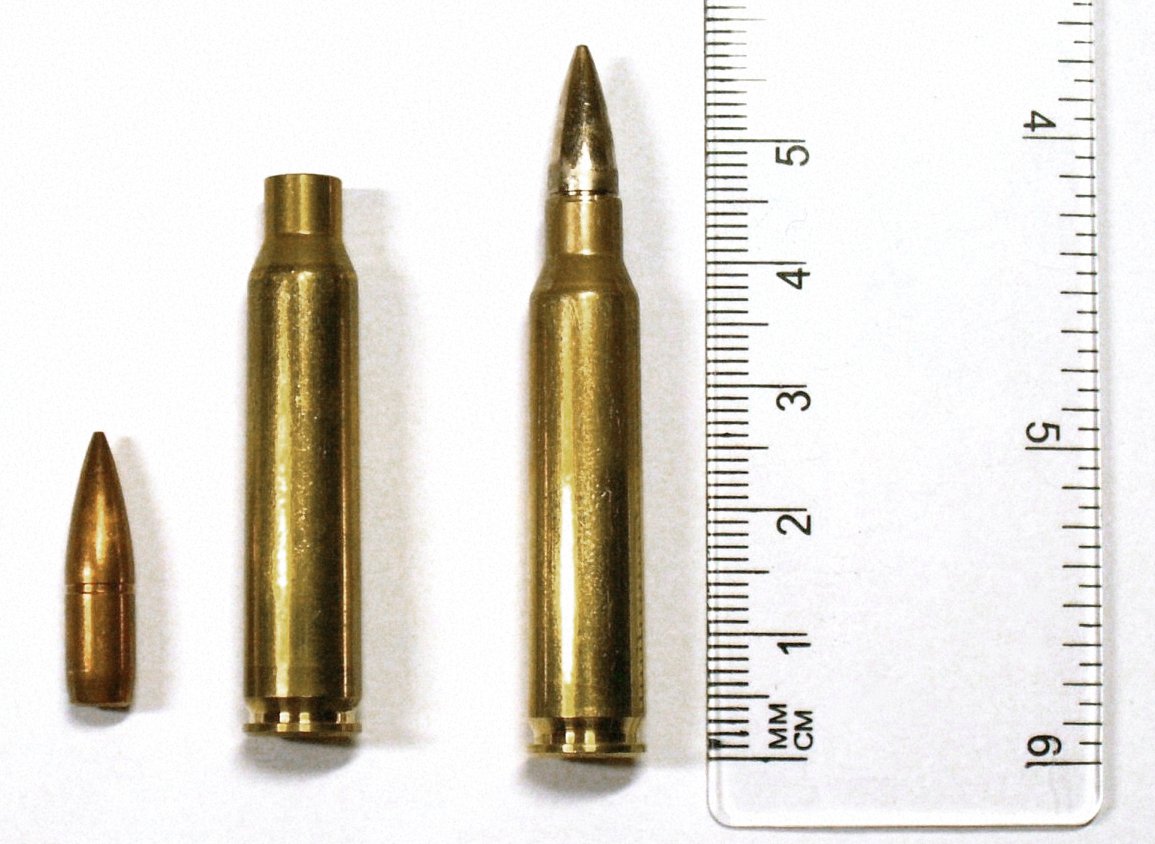
Cost: 5.56 NATO and its cousin the .223 Remington are the main chamberings of the most popular rifle in America, the AR-15. The 5.56 operates at slightly higher pressures than the .223, so most rifles are chambered for the 5.56 to handle both properly*. Every manufacturer of ammo, large and small, makes some flavor of 5.56, usually loading a 55- or 62-grain FMJ bullet. The sheer volume of 5.56 out there makes it some of the cheapest centerfire rifle ammo around.
-
Versatility: The 5.56 serves admirably in a variety of roles from plinking to target shooting. Its FMJ nature sort of precludes it from hunting use and its “more or less” precision means it’s not the best for ultimate accuracy work. But for training and all-out volume of fire, 5.56 is your go-to.
-
Size: Its relatively small size means the 5.56 is a great choice for young shooters and those who are recoil shy. You can bang away at steel all afternoon with 5.56 and not have a bruised shoulder or cheek to show for it.
*NOTE: Word to the wise, do NOT shoot 5.56 in a .223-chambered rifle, but blast away with .223 in any 5.56 rifle.

(Source: en.wikipedia.org)
What Kinds of 5.56 Are There?
We’ve already talked about 5.56 vs. .223, so what kinds of 5.56 ammo are available?
Basically, the offerings are an inch wide and a mile deep. In other words, you’ll find a whole lot of the same thing regarding 5.56 ammo. Most of it is either 55- or 62-grains with the occasional 68- and 77-grain loading.
Why So Few Flavors?
Again, the 5.56 is a NATO loading, and they're pretty strict on what they’ll adopt to call 5.56. Ammo has to hit a certain set of criteria to be used by NATO and other militaries, but that doesn’t mean that everything with 5.56 stamped on it meets them. In fact, most don't meet the most critical parameter — velocity.
For instance, to be true M193 5.56, the bullet needs to leave a 20” barrel at or above 3,250 fps. Most is north of 3,000, but falls short of that 3,250 mark. The reason is cost. Shaving a few grains of powder from each bullet millions of times over really adds up. So, don’t trust what’s printed on the box and do your own homework with a chrono if you want to invest in true M193 performance.

(Source: upload.wikimedia.org)
5.56 Performance
What do we mean by performance? A 55-grain slug traveling at greater than roughly 3,200 fps enables the round to take advantage of the terminal effects it was designed for: When encountering flesh, it yaws and splits into a bajillion pieces, completely ruining someone’s day. Speed kills.
All that said, most 5.56 is going to be eminently reliable thanks to its simple, proven design. FMJ bullets are inherently the most reliable bullet style because they lack the gaping maw of a hollow point and the soft tip of a soft point. They’re made to feed and extract reliably under the most adverse conditions, so your range day won’t be an issue.

Key Considerations for 5.56 Ammo
As with any ammo offering, it needs to be (first and foremost) reliable as the sunrise. Otherwise your range or training day will suck.
Besides that, there are oodles of tradeoffs with ammo, namely price vs. performance. Quality ammo ain’t cheap.
5.56 actually splits the difference very well with its super reliable performance, respectable accuracy, and palatable cost.
Cost is consideration number 2. Be sure to look for quality, but also take some time and determine which bullet weight your gun shoots best. ARs in particular are best with 55-, 62-, or 77-grain bullets. There are others out there, but these three will shoot well enough out of your gun, no matter the twist rate.
Twist Rate
Twist rate measures how far it takes the rifling to make one full 360-degree rotation in a barrel. For instance, 1:7 twist means that a bullet, when traveling down the barrel, will make a full 360-degree rotation in 7 inches. 1:9 twist means the bullet does a full turn in 9 inches. Most ARs are either 1:7 or 1:9. 1:9 is better for lighter bullets while 1:7 is better for 62 grains and above. Some rifles have 1:8 to split the difference.
Quality
Concerning 5.56, quality is a question of factory new vs reloads.
We’re not talking about your grandpappy’s faithful .30-30 reloads, but rather factory ammo vs. commercial reloads. They're out there, and for the most part, they’re okay. But spend a few minutes Googling “reloaded 5.56 kaboom”. Then, decide whether it’s worth it to save a penny or two per shot and risk becoming one of those guys.
Get factory new. You won’t regret it.
The Best 5.56 for the Range
Now, on to the goods! We stock different flavors of 5.56, and all will meet your needs. Here’s a look at a few of our personal favorites.
1. Winchester M193
| Weight | Velocity @ Muzzle | Velocity @ 100 Yards | Energy |
|---|---|---|---|
| 55 grains | 3,180 fps | 2,786 fps | 1,235 ft. lbs. |
Winchester M193 is pretty close to real-deal M193-spec ammo. It’s decently hot, consistent, as accurate as you might hope any M193 to be, and if you’d like it to be really super-duper milspec, get this pack, which comes on stripper clips like military M193!
All M193 clones, whether they hit the velocity threshold or not, have a lead core bullet, so they won’t attract a magnet.
Why does that matter? If you shoot at an indoor range, chances are they have a magnet on the counter when you walk in. This is to test your ammo. If it attracts a magnet, they’ll probably tell you that you can’t shoot it because it has a steel core that will tear up their backstops.
2. Winchester M855/SS109
| Weight | Velocity @ muzzle | Velocity @ 100 yards | Energy |
|---|---|---|---|
| 62 grains | 3,000 fps | 2,704 fps | 1,288 ft. lbs. |
Winchester M855 is steel core, commonly referred to as penetrator ammo. Most have a green tip (M855), some do not (SS109). Neither will give the terminal performance of M193 or soft point/hollow point in flesh, but we aren’t talking about shooting 2- or 4-legged critters at the moment.
It’s made as a “barrier blind” round for machine guns and infantry rifles that won’t deflect when encountering glass or thin steel. Because it's produced in eye-popping numbers, it’s still plenty affordable and accurate for range use and for saturating an area with fire. Remember, it won’t make you any friends at an indoor range because as a rule, it’s probably prohibited.
3. Hornady American Gunner
| Weight | Velocity @ muzzle | Velocity @ 100 yards | Energy |
|---|---|---|---|
| 55 grains | 3,246 fps | 2,901 fps | 1,282 ft. lbs. |
Hornady’s American Gunner line provides most of the performance of high-end ammo with a lower price tag. Hornady makes premium ammo, and this is their nod to those of us who count our shekels but still want good stuff.
The boxes aren’t as fancy, and it might not be as accurately charged with powder for ultimate consistency (which is the root of all accuracy), but it’s way better than Combloc steel-cased ammo and way cheaper than precision ammo.
4. PMC X-Tac
| Weight | Velocity @ muzzle | Velocity @ 100 yards | Energy |
|---|---|---|---|
| 55 grains | 3,120 fps | 2,898 fps | 1,316 ft. lbs. |
You won’t find many who badmouth PMC. It’s one of the most solid manufacturers for accuracy, consistency, quality, and reliability. The stuff just works. Plus, it’s pretty dang hot for a 62-grain M855 clone.
There are two flavors of X-Tac, a 55-grain and 62-grain mimicking M193 and M855, respectively.
5. Winchester USA Valor 5.56
| Weight | Velocity @ Muzzle | Velocity @ 100 Yards | Energy |
|---|---|---|---|
| 55 grains | 3,180 fps | 2,804 fps | 1,235 ft. lbs. |
Okay, it says M193 on the front of the box, but the printed velocity spec on the back (3,180 fps) doesn’t meet M193 spec (3,250 fps) . Either way, Winchester USA Valor 5.56 is still good, reliable blasting ammo. Plus, it’s a shade more affordable than other M193s out there.
6. Prvi Partisan M193
| Weight | Velocity @ Muzzle | Velocity @ 100 Yards | Energy |
|---|---|---|---|
| 55 grains | 3,248 fps | 2,900 fps | 1,283 ft. lbs. |
Prvi is another rock-solid manufacturer. Sure, they might be European (manufacturing in Serbia), but no one will have a problem with this ammo unless they're a huge snob.
Plus, Prvi Partisan M193 ammo is hot at nearly 3,250 fps. This is actually really good stuff, which is why it's quite often sold out.
Bonus Filthy Blasting Ammo: Wolf!
| Weight | Velocity @ Muzzle | Velocity @ 100 Yards | Energy |
|---|---|---|---|
| 55 grains (more or less) | 3,241 fps (sus...) | 2,846 fps (also sus...) | 1,283 ft. lbs. (Unadulterated Commie propaganda) |
Perhaps the most infamous and schizophrenic ammo manufacturer comes out of Russia and is known among ammo fanatics and budget minded shooters by one syllable: Wolf.
Some Russian stuff is amazing and nearly without comparison (the Match .22 loads) while the vast majority of the centerfire is garbage.
This ammo is filthy for a few reasons. It uses cheap, dirty powder that gums up your gun faster than M193 or M855, the actual cases themselves are dirty, and it has a weird smell. You should feel filthy just shooting it!
The bimetal bullets (copper and random pot metal from junked cars) are “rougher” on your barrel, but that’s really a non-issue for 99% of shooters, unless you put more than 5,000 rounds downrange a year. Plus, steel cases don’t expand the way brass does, which is partly to blame for the doodoo they leave in your gun’s chamber.
All that said, don’t be afraid to buy some steel case for mag dumps and the pure fun of shooting. In reality, steel cases are totally fine for the vast majority of shooters who aren’t looking to shoot tiny groups or single-handedly take out a terrorist cell embedded in the city park. Plus, you’ll save a lot of loot!

(Source: Thomas Ashlock on Unsplash)
Final Thoughts
Simply put, there’s nothing finer than spending an afternoon belching freedom pills downrange from your favorite blaster, be it an AR-15, bolt-action rifle, or “pistol.” You want to blend value with performance, so being mindful of your purchase is the best way to maximize your range-day pleasure.
There are LOTS AND LOTS of options out there, some good, some great, some piss poor. At times, you want a little of each. Keep an eye peeled for deals and do not hesitate if one pops up — cause if you do, someone else won’t.
Stocking up for your next range trip? Pro Armory has you covered. Check out our selection of 5.56 ammo for the range, hunting, self-defense, and more — in small boxes or bulk cases. Get fast, affordable shipping on your favorite ammo and accessories to improve your shooting experience in every way.